Author: Trish

  • DM’s Pocket Guide Ep 3: Mounted Combat

    DM’s Pocket Guide Ep 3: Mounted Combat

    Mounted Combat DM’s Pocket Guide

    Okay, so you found a steed (check out last week’s episode about the spell “Find Steed”), but how do you ride it into glorious battle?  For that, you’re going to need to know the 5e rules about Mounted Combat! We’re Tricia and Rachel from Roar Cat Reads.  If you would like to learn about a specific D&D rule or spell, send us a request at roarcatreads@gmail.com.  Please like, review, and share to support DM’s Pocket Guide! If you want more rules, buy a copy of the Player’s Handbook! Follow us on Twitter and Instagram  Artwork by Haley Boros DM’s Pocket Guide is unofficial Fan Content permitted under the Fan Content Policy. Not approved/endorsed by Wizards. Portions of the materials used are property of Wizards of the Coast. ©Wizards of the Coast LLC.

    Transcription

    Welcome to DM’s Pocket Guide, where we discuss the rules, spells, and monsters of Dungeons and Dragons, 5th edition.

    Tricia:  Okay, today we are going to talk about Mounted Combat!
    Rachel:  This is something that has come up in games more and more, especially as people get to higher levels and want to pick up an extra creature, a collection of pets.

    T:  This information is found on page 198 of the Player’s Handbook, and yeah, I think you’re right.  People will always want to have pets.  At a certain level, paladins will have the “Find Steed” spell, which references mounted combat, so this is good information to have.  Different kinds of mounts could be warhorses, griffons, pegasuses…

    R:  Pegasi.

    T:  Or dragons.  All those kinds of things.  A mount has to be one size larger than you, which would be important but also super fun if you’re a gnome, because then just like everything is bigger than you.

    R:  Oh yeah.

    T:  When you’re mounting and dismounting, you do have to take a few technical things into consideration.  Your mount has to be within five feet of you.  You cannot mount something that is across the room from you.

    R:  That makes sense.

    T:  Yes!  You also have to use up to half of your speed in order to mount this creature.

    R:  Oh, that makes sense.  Like standing up from being prone takes half your movement as well.  Moving through difficult terrain.  Okay.

    T:  So that comes into play if your mount is 30 feet away from you and your speed is 30 feet, you cannot run to it and climb on it in the same turn.  You would have to be within 15 feet to run there and jump on.

    R:  You’d still have your action.  So you could take the Dash action and then it would just be movement to get on the horse.  You’re not taking an action to get on the mount.

    T:  Other things to take into consideration, this is kinda cool.  If there’s an effect that moves your mount against its will, so a gust of wind pushes it, you have to succeed on a DC10 Dexterity saving throw or fall off the mount.  So this is, you’ve lost control of your mount, can you stay on the horse?  If you do fall off, you land prone, and if you’re knocked prone, you have to make a saving throw.  Saving throws all around!  If your mount itself is knocked prone, you have to use your reaction to dismount as it falls if you want to land on your feet and look like a badass.

    R:  Okay, so.  Controlling a mount, there’s a couple of rules around this too.  When you’re mounted you have two options.  You can either control the mount or allow it to act independently.  So this is, both times you’re still on the mount, but you can let it wander off on its own and do its own thing, or you can choose to control it.

    T:  Like that time we went horseback riding, and you were on a horse, but it was acting independently and going up the hill instead of down.

    R:  That’s true.  And there is a little sentence in here that says, “Intelligent creatures such as dragons can act independently.”  

    T:  Ah, okay, so this is much different than like, you have your find steed spell as a paladin, and those steeds have an intelligence of 6.  I’ve looked up dragons, and black dragons have an intelligence of 14.  So that’s very different.

    R:  Yeah, no, for sure.  Huge difference there, of like, yup, your intelligent dragon can totally act independently and will make smart choices.  Your intelligence of 6 steed warhorse probably isn’t going to make the best choices.  It’s still trained, it knows what it’s doing, but you know – 

    T:  It probably could stand still and not flinch in the face of battle, but it’s not going to be like, “I’m going to go to the left and then fight that guy!”

    R:  “This looks like the strongest person in the battle so I’m going to make sure I target that person.”  A horse is not thinking that.  You can control a mount only if it’s been trained to accept a rider.  Domesticated horses, donkeys, and similar creatures are assumed to have such training.

    T:  Okay, so if you find a horse at the inn, it probably is trained.  If your group wants to role play, you can find a horse and spend time training it.

    R:  For sure.  The initiative of a controlled mount changes to yours when you mount it.  So it’s going to share your initiative order.  It doesn’t mean it shares your turn, though.  It’s going to act either before or after the player that is mounted on it.  It moves as you direct it, and has only three options:  Dash, Disengage, or Dodge.

    T:  Wait, wait, wait.  Only – so it’s NOT going to attack.

    R:  No.  Not on it’s – when it’s the mount’s turn, it doesn’t have the option to attack.  The player still has the option to attack from the back of the mount.  But this is, uh – 

    T:  The mount itself is just going to move; it’s not going to take its turn to attack with hooves!  And then you attack.

    R:  Yeah, exactly.

    T:  We’ve done this wrong, I’ve done this wrong.

    R:  Yeah, for sure.  So the options that are available – Dash, Disengage, and Dodge – are all either movement or defense based, essentially.  Because you wouldn’t necessarily be able to take those options, or the player wouldn’t necessarily be able to take those options from the back of a mount.  They wouldn’t be able to Dash without dismounting.

    T:  Yeah, that makes sense.

    R:  And a controlled mount can move even on the turn that you mount it.  So in that example that we gave before, where you rushed the 30 feet, hop on the horse – it’s now the horse’s turn, and it can move it’s movement speed.

    T:  Yeah, so mounts are pretty awesome!  Cause even with those like, movement based skills, that’s pretty rad that you could ride up, and with your player’s turn, attack attack attack, and then use your mount’s turn to Disengage and run away.  That’s pretty awesome, because as a player yourself, you cannot both attack and Disengage.

    R:  Yeah, it makes sense as a cavalry charge.  I like that.  Okay, so moving on to the other category: the independent mounts.

    T:  So this is still, you’re on it but it’s independent.

    R:  It’s doing its own thing.

    T:  Okay.

    R:  These are our intelligent creatures.  So, an independent mount retains its place in the initiative order.  It’s got its own initiative.  Bearing a rider puts no restrictions on the actions a mount can take.

    T:  Wow.

    R:  It can do literally anything.  It doesn’t have to listen to you.  It moves and acts as it wishes.  It might flee from combat, rush to attack and devour a badly injured foe, or otherwise act against your wishes.

    T:  I love that!  So that implies to me that the DM is controlling it, but it doesn’t explicitly say that.

    R:  Yeah, this is where it might get a little bit tricky.  It leaves room for interpretation, for sure, about who gets to say what it does.  Because it’s called an independent mount, I would say it’s probably the DM is most likely controlling it.  But the players are certainly going to want to have some input into what this creature does.

    T:  That’s one of those trust things, like can your player role play the mount separated from their player’s desires?

    R:  Yeah, for sure.  Judgment call on that one.  In either case, if the mount provokes an opportunity attack while you’re on it, the attacker can target either you or the mount.

    T:  That makes sense.

    R:  So if you try to move away from a combat without taking the Disengage action – 

    T:  The monster can get you!

    R:  Indeed.  Excellent.

    T:  Well, that sounds awesome.

    R:  And that’s all on page 198 of the Player’s Handbook.

    Thanks for listening!  If you have something you’d like us to cover, email it to roarcatreads@gmail.com or find us on Twitter and Instagram @roarcatreads.  

  • DM’s Pocket Guide Ep 2: Find Steed

    DM’s Pocket Guide Ep 2: Find Steed

    What’s a paladin without a celestial elk?  Don’t sleep on this spell like Tricia did when she played Akta, Paladin of Torm.  Take 10 minutes to say a prayer and bam!  All your animal handling dreams can come true. We’re Tricia and Rachel from Roar Cat Reads.  If you would like to learn about a specific D&D rule or spell, send us a request at roarcatreads@gmail.com.  Please like, review, and share to support DM’s Pocket Guide! If you want more rules, buy a copy of the Player’s Handbook! Follow us on Twitter and Instagram  Artwork by Haley Boros DM’s Pocket Guide is unofficial Fan Content permitted under the Fan Content Policy. Not approved/endorsed by Wizards. Portions of the materials used are property of Wizards of the Coast. ©Wizards of the Coast LLC.

    Transcription

    Welcome to DM’s Pocket Guide, where we discuss the rules, spells, and monsters of Dungeons and Dragons, 5th edition.

    Tricia:  Alright, today we are going to talk about the spell “Find Steed” on page 240 of the Player’s Handbook.

    Rachel:  Do do dooo!  That’s me finding a steed.

    T:  Your little steed horn.  This was a spell that, when I played my first paladin, I didn’t realize how awesome it was for a long time!  Then I was like, “I could have been riding a horse this whole time?”

    R:  Yeah, once your paladin remembers that they can use “Find Steed,” it’s very hard to get them off the horse, or whatever creature it is they choose to summon.

    T:  Yes, exactly.  This is a second level conjuration spell, and it takes ten minutes to cast.

    R:  Oh, right.  So it’s not like, *snap* “Ah, there’s my steed!”

    T:  No, you’ve got to prepare this.  You’ve got to be in a space where you can prepare it, so it’s unlikely that in the midst of battle you will be finding a steed.

    R:  Mmhm, it’s something you have to prepare before.

    T:  Yeah.  The range is 30 feet, so the steed will appear near you.  You can’t summon it away from you – makes sense.  It’s both verbal and somatic components.

    R:  So you can only do it if you are able to speak and move.  You couldn’t be bound and gagged in a castle somewhere and be like, “Well, I’ll summon my steed to help me out of this.”

    T:  No, that won’t work.  This part is a bit confusing.  In the book it says that the duration is instantaneous.  So as a DM you need to be looking out for that.  If a player is like, “Well, I instantaneously cast this!”  No, it takes 10 minutes to cast.  Instantaneous means, this is going to last for as long as it lasts.  It’s weirdly phrased.

    R:  Yeah, that’s not really the right word for it.  This lasts until it’s either dismissed or is reduced to zero hit points, and apparently that is covered by the word “instantaneous.”

    T:  Yeah, it’s not great.  So!  The way that this works is you summon a spirit that assumes the form of an unusually intelligent, strong and loyal steed, creating a long lasting bond with it.  So all you horse girls out there are going to be real excited about this!  Uh, I’m not even a horse girl, and I’m really excited about this!  It appears in an unoccupied space within range.  The steed can take on these forms:  it could be a warhorse, a pony, a camel, an elk, or a mastiff.  And the book helpfully says that your DM can allow other things if they want to.

    R:  Yeah, players will usually want whatever critter that they want to ride into battle.

    T:  Yup.  So this is a spirit, so that means that these steeds are either celestial, fey or fiend.  The player gets to choose.  And they have the statistics of the creature.

    R:  Okay, so thinking about that celestial, fey or fiend – you might think, “Oh, well why would this matter?”  If the regular form of that creature, let’s say a warhorse, for example, that would be a beast.  It no longer counts as a beast, so spells that affects beasts or – they wouldn’t work on this.  Whatever form it’s taking, like celestial.  I know paladins have that – 

    T:  Detect good and evil?

    R:  Something like that – divine sense!  This horse will now show up if the paladin detects…uses their divine sense.

    T:  Yeah, so it’s just a little thing, but it’s good flavour.  And I think as a DM, you could take that choice and run with it.  Additionally, even though it does have its traditional stat block, the steed’s intelligence cannot be lower than 6, so it will be bumped up if it was lower.

    R:  Ah, so it’s a super smart horse.

    T:  No.

    R:  I’m going to be holding conversations with this guy.  It’s gonna be, like, playing chess in a tavern!

    T:  Yeah, it’s the Mr. Ed of steeds.  Um, no, unfortunately even though it does gain the ability to understand one language of your choice that you speak, an intelligence of 6 is still lower than the lowest option of the standard array.  

    R:  Oh, that’s true.  It’s like a minus 2 modifier?

    T:  Yes.  I did find online someone had written examples of what this would look like, and with an intelligence of 6, it’s still – you might understand the language, but you misunderstand words, and you misremember words often.  So this would be a steed that gets words mixed up sometimes.  You tell it to do something – “Go right!” – he goes left.

    R:  So it’s like taking three classes of French or Spanish?  It’s really good at nouns but doesn’t have any idea how to make a sentence?
    T:  Yes!  That’s a great way to look at it.  So your steed serves you as a mount, both in combat and out, and we’re going to have a separate episode on mounted combat, so we’ll deal with that there.  When your steed drops to zero hit points, it disappears, leaving behind no physical form because it is a spirit.

    R:  Poof!

    T:  You can also dismiss your steed as an action at any time, which will also make it disappear.

    R:  That will probably never happen.  They will never want to get rid of their steed.

    T:  You can cast this spell again to summon the same steed, restoring its hit points to its maximum.  So the other big thing is that while your steed is within one mile of you, you can communicate with each other telepathically.  Once again – with limited language!  I have had a player who wanted to send their warhorse on a reconnaissance mission, telepathically communicating with each other and feedback and information to the player, and I hadn’t read this spell carefully, so I was like, “Yeah, I guess!  But this feels like a very easy way to break the world.”  So lean hard into that language is still very difficult.

    R:  For sure.

    T:  Also, you cannot have more than one steed bonded by this spell at a time.

    R:  Not multiple steeds?  I can’t have a team of carriage horses?

    T:  That would be amazing, but no.  You have to have a team of paladins, all with their own steeds!

    R:  Oh, right, yeah.  I just need to be friends with a bunch of paladins.

    T:  That is “Find Steed” on page 240 of the Player’s Handbook.

    Thanks for listening!  If you have something you’d like us to cover, email it to roarcatreads@gmail.com or find us on Twitter and Instagram @roarcatreads.  
  • DM’s Pocket Guide Ep 1: Inspiration

    DM’s Pocket Guide Ep 1: Inspiration

    Inspiration! DM’s Pocket Guide

    Thanks for checking out our podcast – gain one inspiration!  Just don’t forget to use it… We’re Tricia and Rachel from Roar Cat Reads.  If you would like to learn about a specific D&D rule or spell, send us a request at roarcatreads@gmail.com.  Please like, review, and share to support DM’s Pocket Guide! If you want more rules, buy a copy of the Player’s Handbook!. Follow us on Twitter and Instagram  Artwork by Haley Boros DM’s Pocket Guide is unofficial Fan Content permitted under the Fan Content Policy. Not approved/endorsed by Wizards. Portions of the materials used are property of Wizards of the Coast. ©Wizards of the Coast LLC.

    Transcription

    Welcome to DM’s Pocket Guide, where we discuss the rules, spells, and monsters of Dungeons and Dragons, 5th edition.

    Tricia:  Today we’re going to talk about Inspiration.

    Rachel:  Inspiration!!

    T:  This is something that we did not use, well actually, I still don’t think we use it most of the time – 

    R: No.  If I have inspiration, I usually forget that I have it.

    T:  And if I’m a DM, I usually forget to give it.  But I have seen it used really, really well, and it’s something I want to get better at as a DM.

    R:  For sure.  So the rules for inspiration are on page 125 of the Player’s Handbook.  It’s three different paragraphs – there’s not a huge amount to it.  So what it is is, when you have inspiration, you can spend that inspiration to gain advantage on an attack roll, ability check, or saving throw.  You can only have one inspiration point at a time, so you can’t hoard up a bunch of inspiration.  It’s usually given out by the DM.

    T:  Yes, typically the DM would give it because the player has done something that is very based in their character flaws, bonds, personality.

    R:  It’s really encouraging role play.

    T:  Yeah.  And I particularly like that piece because if the player acts on their flaws, you can reward them with inspiration.  Because I find that a lot of people who are playing characters in D&D – they want to be perfect and never make a mistake and always be the hero.  But interesting characters have flaws, and this is a way to encourage players to lean into that a little bit.

    R:  Yeah.  If you’re playing with characters over a period of time, you get to know them.  You know what you would expect them to do and what – are they playing their character particularly true?  That’s the sort of thing that you want to reward with inspiration.

    T:  Yeah, a DM’s not the only person that can reward players with inspiration.  The Player’s Handbook also mentions that inspired characters can give that inspiration to someone else if they see them playing their character well, which was something I did not know!

    R:  Which is also a really cool thing, like, one of your characters has this resource and they’re willing to give it up to someone else to reward their role play?  That’s really nice.  That’s something that I would love to see my players do.

    T:  Yeah, it really involves team bonding.  Another piece that is not an official rule but is something that I have heard done and seems intriguing to me is that players just in general can reward each other inspiration.  So it is that team bonding element again of like, “Wow, that was such a good role playing moment, you should have inspiration!”  Probably the DM needs a final say on whether that’s true or not, but I like that sense of giving players themselves that responsibility to, yeah, encourage each other and say, “Good job!”

    R:  [sarcastic] But my players are going to abuse that!  They’re just going to be giving each other inspiration for no reason at all.

    T:  Well you know what?  Like, is that the worst thing in the world?

    R:  It’s not the worst thing in the world, and also, that’s the thing of building the trust in your group.  Whichever one of these rules works for you and your group…

    T:  That’s true.  I think what I was saying about ‘Is that the worst thing in the world?’ is that I do tend to think of inspiration as – well, when I think of it at all – it does feel like you’ve got to really earn it.  But I have seen The GM Tim in particular, when he plays games, he gives out inspiration all the time.  If you do something interesting or character-driven, he will just be like, “That’s awesome!  Take inspiration.”  It encourages players to use it quickly, because that’s a problem that you forget you have inspiration.  And it encourages this sense of like, everyone’s mood goes up.  “I did do good!  I want to do more of that!”  And keeping it frequent – have advantage on a roll is good, but it is not the most powerful thing in the world.  It’s not going to break your game.

    R:  Absolutely not.  So it sounds like The GM Tim uses the “rule of cool” to award this.  If a player does something that is, “Yeah, that’s awesome!”  Give them inspiration.  You don’t have to be an inspiration dragon creating a giant hoard of inspiration points that you very rarely give out.  Reward your players for doing that stuff.

    T:  Yeah, definitely.  You have also said that what you’ll do to remember you have inspiration is you’ll set aside dice that is your inspiration dice.

    R:  Yeah, so because I have a big hoard of dice, I can do that.  I’ll usually use a bright-coloured one or something like that to have it in front of me just so I remember that I’ve got it.  I recently took the Lucky feat with one of my characters where I get three of those, so I really have to remember that I have this thing, or I’ve wasted that particular use.  It’s definitely made me a lot more aware of that.  Having a physical representation of my inspiration can be useful.  There are also some variant rules for inspiration as well.  Granting advantage is one way to use inspiration but there is one in particular that I’m thinking of that involves the Tarroka deck.  This is based in the Curse of Strahd campaign where if you gain inspiration, you pull a card from a deck and it gives you access to like, single uses of magic spells that you wouldn’t have access to otherwise and maybe other abilities.  I haven’t gone through the whole stack, but that was a nice little variation.  I think it does make inspiration powerful, but – 

    T:  But also more random.  It’s a little like the Wild Magic Surge table.  Sometimes it’s like, “Oh, this is exactly what I need.”  It’s very powerful.  Other times it’s useless to me, so I’ll find a funny way to use it or just get rid of it for the next thing.  But it does make it fun to play around with different kinds of – inspiration doesn’t have to mean just advantage rolls, it can be something else!

    R:  Yeah, so the takeaway is – Inspiration, all the time.  All the time, inspiration!

    T:  So that is the Inspiration rule which is on page 125 of the Player’s Handbook.

    Thanks for listening!  If you have something you’d like us to cover, email it to roarcatreads@gmail.com or find us on Twitter and Instagram @roarcatreads.  

  • Queer Books, Queer Readers:  Kelly Slaven Recommends John Irving

    Queer Books, Queer Readers: Kelly Slaven Recommends John Irving

    Hi there, my name is Kelly Slaven and my pronouns are she/her/hers.

    What queer book have you chosen to share with our readers today?

    OK, I know that I am beginning the interview by breaking the rules. I LOVE John Irving. I love him so very much that I will always read anything he writes and I love the detail and mundane that he provides in his writing. So, here’s the deal, I suggest ALL of his books. In In One Person, Billy is the bisexual narrator and the heroines of the novel are two transgender women, in The Cider House Rules, Dr. Larch is reported to only have had sex one time, and Johnny Wheelwright, who is the “nonpracticing homosexual” narrator of A Prayer for Owen Meany, never has sex. There are transgender characters in The World According to Garp and A Son of the Circus, and gay characters in The Hotel New Hampshire and Son of the Circus.

    Why is this book one of your favorites?

    I trust John Irving to show me every detail of the story, especially the day to day ones, so that I believe him. Life is not always exciting so his mundane details are what make his writing real to me.

    How would you describe yourself as a reader?

    The opposite of who I am in life. In life, I don’t want all of the details, just the big picture and tell me in one sentence, not 20. But, in a book, when I slow down, I want to know it all! The more words the better.

    As a queer person, have books helped you explore or express your queer identity?

    I think that any representation helps me in this way. The author, Glennon Doyle, has helped me realize myself and all of my details (being queer, being female, etc) more than anyone else because she says what everyone is thinking and allows space to explore it without shame.

    Other than reading, are there any queer nerdy recommendations that you would like to leave with our readers?

    I love the podcast We Can Do Hard Things with Glennon Doyle and Abby Wambach.

    Thank you, Kelly!

    Check out our Queer Lil Library for more book recommendations and reviews!

    Processing…
    Success! You're on the list.
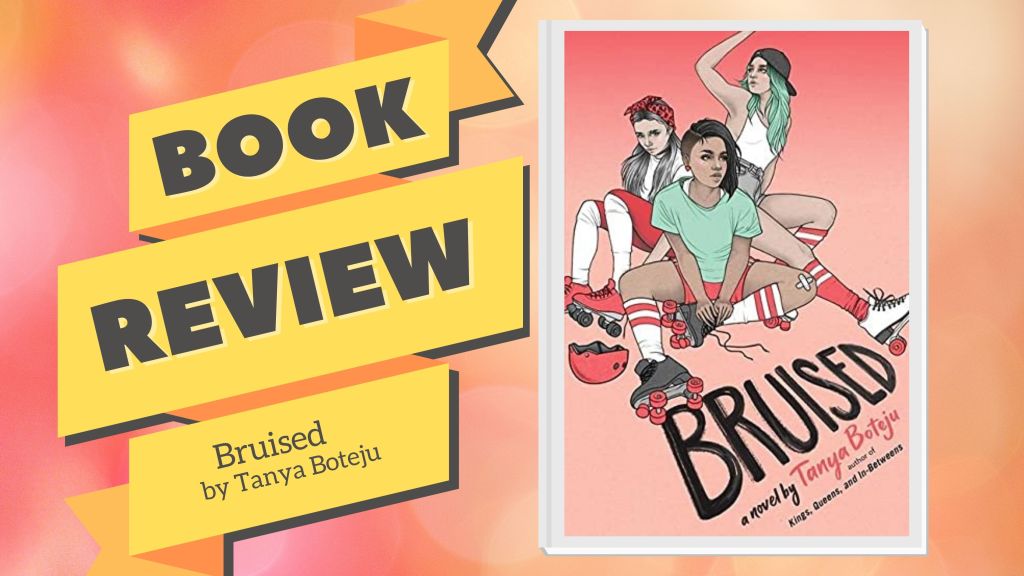
  • Bruised by Tanya Boteju

    Bruised by Tanya Boteju

    Genre | YA Contemporary Fiction
    Page #s | 336
    Publishing Date | March 2021

    To Daya Wijesinghe, a bruise is a mixture of comfort and control. Since her parents died in an accident she survived, bruises have become a way to keep her pain on the surface of her skin so she doesn’t need to deal with the ache deep in her heart.

    So when chance and circumstances bring her to a roller derby bout, Daya is hooked. Yes, the rules are confusing and the sport seems to require the kind of teamwork and human interaction Daya generally avoids. But the opportunities to bruise are countless, and Daya realizes that if she’s going to keep her emotional pain at bay, she’ll need all the opportunities she can get.

    The deeper Daya immerses herself into the world of roller derby, though, the more she realizes it’s not the simple physical pain-fest she was hoping for. Her rough-and-tumble teammates and their fans push her limits in ways she never imagined, bringing Daya to big truths about love, loss, strength, and healing.

    Goodreads

    A story of loss, trauma, and identity that centers on roller derby and found family (both queer and otherwise), Bruised was a sure-fire win in my books. I loved Daya’s fierce exterior, her self-awareness that she protects herself by keeping other out, and her slow acceptance that perhaps it is worth risking potential hurt for the sake of connection and joy.

    The foundation of Daya’s story is made of some pretty heavy content (death, self-harm), but the book captures the seriousness of her situation without reveling in the trauma-porn aspect. I was also very impressed by Boteju’s skill at depicting self-harm (intentional bruising, in Daya’s case) with realism and understanding, but without ever glorifying the practice.

    This isn’t a book about trauma, though; it’s about learning to live again after experiencing trauma. Daya’s friend introduces her to roller derby, and although she is initially attracted to its violent aspects, she quickly learns that she has to be strong not just for herself, but for her team. Add in a love interest who is a sweet soft nerd, and Daya doesn’t stand a chance. Despite her fear, she starts to open herself up to vulnerability and connection.

    My favorite thing about the book is undoubtedly the found families that welcome Daya in the wake of her loss. Her roller derby family expands to include a beautifully intergenerational queer family, and her initial resistance to her aunt and uncle (who have taken her in) warms in the face of their overwhelming love, joy, and acceptance. I have never read a coming out scene that is more hilarious and lovely than this book.

    Who Do I Recommend This Book To?

    Bruised will especially appeal to those who already love roller derby, but if you’re like me and know very little about the sport, it’s still an excellent book about accepting the start a new phase of life after a previous phase ends abruptly.

    Check out our Queer Lil Library for more book recommendations and reviews!

  • Queer Books, Queer Readers:  Lauren Recommends It Goes Like This

    Queer Books, Queer Readers: Lauren Recommends It Goes Like This

    Hi, I’m Lauren! Or Lo. I use she/her or they/them pronouns. I’m queer and neurodivergent and a little witchy and book obsessed. You can find me occasionally posting about books at @readingwithfeelings on Instagram.

    What queer book have you chosen to share with our readers today?

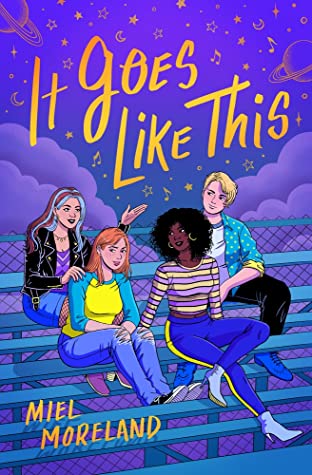
    Okay, after many false starts and much deliberation, I have chosen to tell you about IT GOES LIKE THIS. An absolutely beautiful debut from Miel Moreland, it is a YA book about a queer pop group who have broken up but come back together for a benefit concert after a storm ravaged their hometown. 

    Why is this book one of your favorites?

    It made me feel so many feelings. If a book makes me both laugh and cry, I am basically forever obsessed with it. Steph’s exploration of gender identity and their feelings around Moonlight Overflow constantly being referred to as a girl group. Their love of family and trying to balance that with living their own life. Celeste and Eva and their relationship and the ways we can hurt those we love, and hopefully the ways we heal from that hurt. The song lyrics! The fact that everyone was allowed to be young and make mistakes and figure out what they wanted! Ugh, so, so good and I wish it got more hype 💜

    How would you describe yourself as a reader?

    Voracious? I read a lot. Definitely every single day. It is a form of escapism and learning both. I definitely read more fiction than nonfiction but I try to get in a few nonfiction books per month. I also read more queer than not, and I love the over abundance of queer books now! I have so many I want to read!

    As a queer person, have books helped you explore or express your queer identity?

    I feel like I read a lot of YA that teenage Lo would have benefitted from greatly. I feel like my main responsibility as a queer person is to constantly question my own beliefs and make sure I am interrogating my own internalized homophobia, racism, sexism, ableism, xenophobia, etc. Reading keeps me intersectional. I am loving Andy’s intentional reading challenge for this year! (You can check it out at Andy’s Insta @foreverinastory)

    Other than reading, are there any queer nerdy recommendations that you would like to leave with our readers?

    This is also book related, but: I love the Bookstagays podcast! Alex and Sam are amazing.

    Thank you, Lauren!

    Check out our Queer Lil Library for more book recommendations and reviews!

    Processing…
    Success! You're on the list.
  • The Roar Cat Reads Discord Community is Saving My Life Right Now

    The Roar Cat Reads Discord Community is Saving My Life Right Now

    In Modern Mrs. Darcy, Anne Bogel (yes, that’s the woman behind the excellent podcast What Should I Read Next) recently posted a challenge to write a list of the things that are saving our lives right now, especially as we approach February 2nd, the midpoint of winter.

    As I thought about the good things that are happening in my life right now, I realized that a lot of them were based in the Roar Cat Reads Discord community. Through interviews and charity events, I have gotten to know many queer nerdy people who are truly awesome. Here are some of the reasons our community is saving my life right now:

    1. The support. Rachel and I recently launched a new D&D podcast, DM’s Pocket Guide, and it made my heart happy to see our new friends reacting with joy and support. This was not a one-off event! My absolute favorite part of the community is seeing someone share something they’re working on and be greeted with praise, questions, and support.
    2. The creativity. This is tied into the first point. There are so many people in our community who working on awesome, creative projects! Whether it’s Halli’s fandom surveys, Jessy’s DMs of Vancouver podcast or Tory’s Boardgame B*tch podcast, Haley’s artwork, or the random crafts that are shown off, I am so often inspired and impressed by the cool stuff being made.
    3. The inclusive cat pictures. When I started the Discord community, I knew I wanted a channel for cat pictures. Since some people (weirdly) choose to have pets other than cats, we quickly allowed dog-cats and bird-cats. There is nothing better than a cute animal picture that is shared in the middle of a long Wednesday afternoon at the office!
    4. The queer nerdiness. This is why people join, but I never stop being delighted by the opportunities to play Wanderhome, try out regency-era eldritch horror TTRPGs, and launch charity events. These are my people, and I’m so glad to have found them.

    A year ago, I didn’t know any of these people! Roar Cat Reads wasn’t even an idea in my brain at that point! I’ll be doing some year-in-review posts as we near our anniversary on March 2nd, but I couldn’t pass up this opportunity to revel in the gratitude I feel for our community.

    What about you? What are one or two things that are saving your life right now?

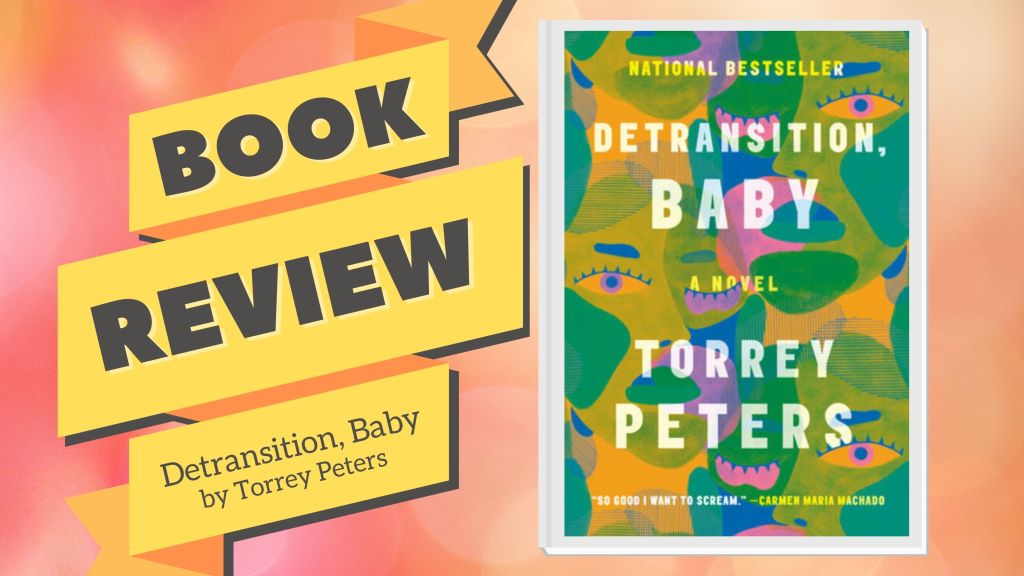
  • Detransition, Baby by Torrey Peters

    Detransition, Baby by Torrey Peters

    Genre | Contemporary Fiction
    Page #s | 337
    Publishing Date | January 2021

    A whipsmart debut about three women—transgender and cisgender—whose lives collide after an unexpected pregnancy forces them to confront their deepest desires around gender, motherhood, and sex.

    Reese almost had it all: a loving relationship with Amy, an apartment in New York City, a job she didn’t hate. She had scraped together what previous generations of trans women could only dream of: a life of mundane, bourgeois comforts. The only thing missing was a child. But then her girlfriend, Amy, detransitioned and became Ames, and everything fell apart. Now Reese is caught in a self-destructive pattern: avoiding her loneliness by sleeping with married men.

    Ames isn’t happy either. He thought detransitioning to live as a man would make life easier, but that decision cost him his relationship with Reese—and losing her meant losing his only family. Even though their romance is over, he longs to find a way back to her. When Ames’s boss and lover, Katrina, reveals that she’s pregnant with his baby—and that she’s not sure whether she wants to keep it—Ames wonders if this is the chance he’s been waiting for. Could the three of them form some kind of unconventional family—and raise the baby together?

    This provocative debut is about what happens at the emotional, messy, vulnerable corners of womanhood that platitudes and good intentions can’t reach. Torrey Peters brilliantly and fearlessly navigates the most dangerous taboos around gender, sex, and relationships, gifting us a thrillingly original, witty, and deeply moving novel.

    Goodreads

    I feel like I’ve been reading a lot of idealistic queer stories lately, and while I do truly love a book that celebrates queerness and avoids discussing the pitfalls of such an identity, I found Detransition, Baby to be a breath of fresh air. This is a book that wades confidently into the messiness of queer and trans identities, that holds up the trauma, unhealthy coping strategies, and internalized prejudices and says, “This is part of the experience, too.”

    The plot revolves around the idea that three women – one trans woman, one cis woman, and one detransitioned woman presenting as a man – try to see if they can work together to form a parenting unit. I have to admit that the way in which this got started felt wildly impossible to me, and while some characters did react with shock, everyone got on board with the idea very quickly. The unique struggles of this decision are a part of the story right up to the end, though, so I suppose their initial acceptance is balanced by the tricky dynamics of claiming equal motherhood for three people.

    But the plot is honestly not the most important thing here. Diving back and forth between the present situation and past flashbacks for both Reese and Ames/Amy are where the heart of this story lies. I particularly loved Ames’s story as we watch her wrestle with dissociation as a young boy, explore and accept her female identity, find power and emotional distance in reclaiming her male identity, before finally claiming a middle space with the knowledge that his identity is not immoveable, and might never be.

    Reese is a mess, and one of those characters that I found myself wanted to reach through the pages and say, “OH MY GOSH JUST TAKE CARE OF YOURSELF!” But her self-destructive sex life and emotional connections are rooted in so much honesty. It’s heartbreaking and illuminating all at once.

    Katrina doesn’t have much of a voice in this book, but I did appreciate the moments when she, a biracial Asian woman, interjects racial awareness into the trans stories of trauma and oppression. It very intentionally avoids a competitive vibe, but instead serves to remind the characters (and readers) that no one has the final say on all things oppressive.

    I read Detransition, Baby in two days, eagerly turning page after page. It is so compelling and readable, and I can’t wait to read more by Peters.

    Who Do I Recommend This Book To?

    You should read Detransition, Baby if you want your queer found family narrative matched by messy, unhealthy dynamics and some of the most realistic character work you’ve ever read.

    Check out our Queer Lil Library for more book recommendations and reviews!

  • Take Two: A D&D Proposal

    Take Two: A D&D Proposal

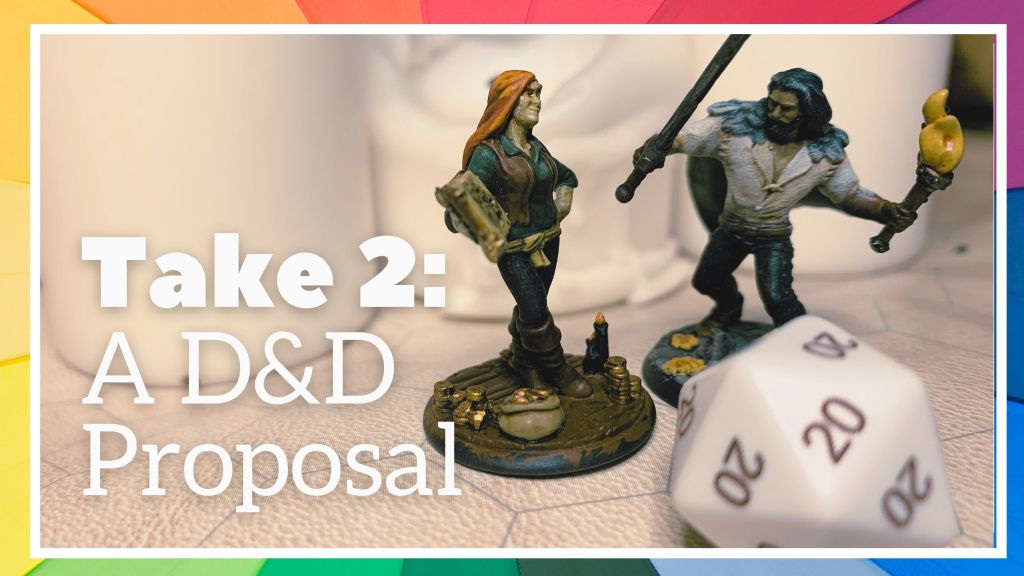
    After Rachel proposed on Christmas Eve, she told me that one of her plans had been to pop the question during D&D, but she chose not to when I said I preferred a private proposal.  Three weeks later, she casually asked if she could run a one-shot for our Curse of Strahd campaign, and I said yes, not thinking anything of it.  Turns out, D&D Proposal was a go!

    Things you need to know for this to make sense:

    • I have been DMing a Curse of Strahd campaign for Rachel and our friends for 15 months.
    • Rachel plays a character named Ireena, who has been doggedly pursued by the evil vampire bad guy (Strahd).
    • While evading Strahd, Ireena fell in love with Szoldar, a beefy sweetheart NPC that I thought would be a throwaway character and instead became integral to the party.
    • Ireena and Szoldar’s romance has grown over the past year.  At one point Ireena tried to break up with him in order to protect him from Strahd’s jealous rage, but Szoldar insisted that she wasn’t allowed to make that decision for him.
    • As played by Rachel and myself, they have a very cute bickering, goofy dynamic that may or may not be very similar to our relationship dynamic *cough*.

    Rachel asked if she could run a session as Ireena, and recommended that I play as Szoldar.  She said her character wanted to pull a gigantic prank, as Ireena is a trickster cleric who earns favors from her deity by being tricksy.  “Sure, just don’t do anything that will upset the overarching plot!” I said, and settled in for a night of chaotic fun.

    Ireena, Szoldar, Beldhur, and Seraphina enter Blinsky’s toy shop.  Magic!  Handwave!  That’s not Blinsky, it’s Strahd!  And he’s kidnapped Ireena and shrunk the rest of us to the size of toys!  Overcome with emotion, Szoldar tears across the now-huge room, heedless of the mutant toys wreaking havoc around him.  It is chaos, with toy dragons attacking each other midair while miniatures hurl weapons from one table to another.  The other party members are left to pick up the pieces (sometimes literally) as six-inch-tall Szoldar hurls himself at the door and screams, “Ireena!!”  I pause from my roleplaying to point at Rachel’s DM glee and tell Frank and Nick, “This is exactly why I fell in love with her.”

    Once everyone gathers together and uses their combined tiny strength, they push open the toy shop door into…a stone corridor?  Ominous music plays from our television and Nick incorrectly says it is an organ remix of Eminem.  Our characters creep forward and realize they are full size again just in time to open the door to a wedding chapel!

    This is not the moment you think it is, based on the blog’s title.  Strahd stands at the front, holding puppet Ireena in his hand and beginning to say the vows that will wed him to her for eternity.  Not on Szoldar’s watch!  My beefy NPC cut his way through the baddies, heedless of all the damage he was taking.  Seraphina drew the majority of the ghosties and ghoulies her way, so Szoldar drew the sunsword and hacked off Strahd’s hand…only to send Puppet Ireena flying through the air!  Beldhur the Druid Dragon batted her back to the ground, inches from Szoldar’s hand.

    Cradling his puppet girlfriend in his hands, Szoldar et al wer surprised when the world faded around them.  Ireena’s illusion was dispelled!  All this time, the group had been at their home.  She explained that she had pulled the biggest prank she could think of in exchange for a gift from her deity.  She asked for ten minutes of privacy away from Strahd’s scrying eyes.  With this completed, she turned and asked Szoldar to marry her.

    Guys, I KNOW that Ireena and Szoldar are fictional characters.  But I teared up!  It was for Ireena and Szoldar, but also it was for us.  Then Rachel said, “May I roll for Proposal?” and ROLLED A NAT 20!!

    Of course, Ireena is a trickster cleric, and after we exploded into shocked delight, Rachel admitted that she had specially bought a rigged dice that was all 20s!  “I wasn’t leaving that to chance,” she said, which is just the sort of intentionality and planning that I look for in a fiancée.  

    We popped a bottle of champagne to celebrate our fictional characters’ engagement.  It was fun, silly, and nerdily romantic. Rachel is the sweetest, most thoughtful and creative person I know.  I’m so glad I get to marry her!

    Sign up to our newsletter for wedding updates!

    Processing…
    Success! You're on the list.
  • Adventure Queers: Meet Jade!

    Adventure Queers: Meet Jade!

    My name is Jade, I go by She/Her Pronouns as a Transwoman Of Color. I am a part of my LGBTQ Metal Band “Fallen Stars“.


    Jade, when did you first start playing D&D?  What do you enjoy the most about the game?

    I only started a few years ago. A friend invited me to a session, and it was a homebrew campaign that has spanned over 4 years and multiple parties. I found it the most boring thing ever. All my friends spoke to old NPC’s who I had no clue who they were, and was very confused as we spent over an hour of playtime in the starting town. I didn’t even roll dice until 3 hours later. But months later there was a dropin DnD at Metrotown, and it was a life-changing experience. It was all oneshots that existed within this small world. The DM was amazing and went with anything, no matter how crazy. We had pie eating contests, talent shows, epic dungeon quests, and so much more. I learned how much fun it was playing with people who just played for fun. I later explored Adventure League and other drop ins, but the Metrotown drop in will always have a special place in my heart.
    The game, to me, is pure imagination. I used to read all these build your own adventure books, and I loved novels and films that sucked you into their world. And here you have a chance to create your own. 

    As a queer person, have roleplaying games helped you explore or express your queer identity?

    When playing games in the past, I was always nervous about playing a female character even though that’s what I wanted to be. But upon moving to Vancouver, I was able to just be myself and enjoy it with like minded people. Even in non-queer Roleplaying groups I have been able to express myself and my characters however I wish. My characters are often Bi-sexual, but I just let it happen naturally and want to have depth as a character, just as they would as a real person.

    More broadly, how have your nerdy and geeky interests helped you discover and understand yourself in different or deeper ways?

    In highschool, the “geeks and nerds” always looked like they were having the most fun. Playing Magic, dressing up as wizards at lunch, or just generally being silly. I quickly was drawn to them and immersed myself in the culture and found things that resonated with me such as anime, sci-fi and so much more. Surprisingly, there was a connection between the metal heads of my school that were just huge nerds so we would often play games and listen to symphonic metal or power metal. Those were the days.

    If you had to choose, what would you say are your top three science fiction movies and why?

    Aliens, StarShip Troopers, and SpaceBalls. Sigourney Weaver was such a powerful role model to me without me even knowing it. The story telling and message behind StarShip Troopers was always so amazing, and the giant war scenes made my imagination explode. SpaceBalls because it takes everything I love about the genre and has so much fun with it. I would watch it on repeat and always wished I found someone who appreciated it as much as I.

    What nerdy hobby are you most into at the moment?

    DnD is my main at this moment. I’m tempted to start DMing as I keep having all these fun ideas. I listen to Dungeons and Daddies which I highly recommend to ANYONE, as it combines improv, story telling, DnD and amazing character development all in one podcast. I long for the days where I can have friends over again and turn down the lights, crank up the creepy dungeon music and dive into our imagination.

    Jade, you started the LGBTQ metal band “Fallen Stars.” What can you tell readers about it?

    I started Fallen Stars by writing a bunch of songs near and dear to me. Originally wanting to collaborate with many accomplished musicians in Vancouver, it didn’t work out that way. Rose (my partner at the time) suggested that I sing overtop of the instrumentals I created. After doing so and putting it online on my Youtube channel, it quickly had over 1,000 views and tons of comments saying that they loved the sound. I wanted to then make this an actual band and there was only one person I trusted to bring the fire and energy to these songs… Rose (my then Ex-Wife). We set upon re-recording the songs with Rose at the helm. Our first single got radio play in the UK, Australia, Austria, Germany, and the USA. We quickly gathered more members and it’s been a journey ever since. 

    We just celebrated our 4 year anniversary of the formation of the band. We’ve played most venues around town that allow bands, as well as many local festivals and even being the first heavy metal band to perform at East Side Pride. 

    To me, the band is a place where I can create musical magic with friends who are much better musicians than myself. They take all my ideas, bring them to life and make them 100 times better than my original idea. Ive been able to write about Trans Issues, Love, Loss, Joy, everything that makes me… me. 

    I could not be prouder of what we do. We are playing the Rio Theatre on Feb 5th with a night of Burlesque, Drag, and Circus Performances.

    Do you have any recommendations of queer nerdy content that you would like people to know about?

    Please listen to Dungeons and Daddies if you haven’t already. And so many local groups doing all this amazing stuff, such as yourself (Roar Cat Reads), Geekenders, and a huge shoutout to everyone who hosts a game night at their store, so that those kids who were like me, longing to find a group to be accepted, will finally find a home.


    Sign up for Roar Cat Reads’ Monthly Newsletter

    Every month one subscriber wins a prize!

    Processing…
    Success! You're on the list.

    By clicking submit, you agree to share your email address with the site owner and Mailchimp to receive marketing, updates, and other emails from the site owner. Use the unsubscribe link in those emails to opt out at any time.

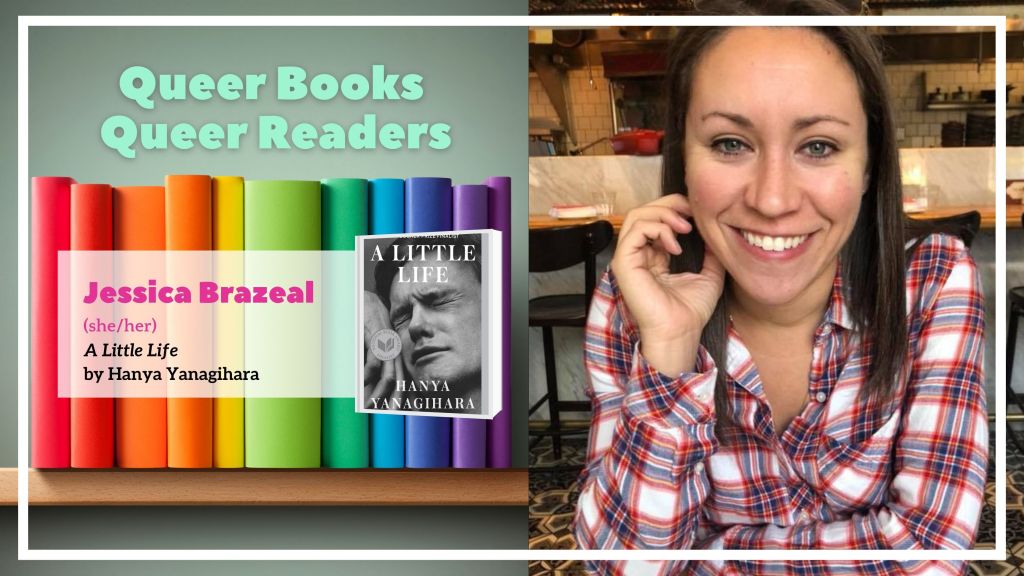
  • Queer Books, Queer Readers:  Jessica Brazeal Recommends A Little Life

    Queer Books, Queer Readers: Jessica Brazeal Recommends A Little Life

    Hello! My name is Jessica Brazeal (she/her) and I am a therapist by day, reader by night hailing from Dallas, Texas. I work with sex trafficking survivors at an organization called New Friends New Life where I oversee all of our program services. I have been married to my wife, the love of my life, Kelly, for almost 4 years. I love to read, always have, and also love so many bookish things as a part of the hobby of reading: reading challenge spreadsheets, my Goodreads account, organizing and reorganizing my library shelves, I could go on. You can find me on Goodreads for sure as well as on Instagram.

    What queer book have you chosen to share with our readers today?

    The book I’ve chosen to share is “A Little Life” by Hanya Yanagihara. It is a fictional story about four friends beginning when they are in college and as they progress to adulthood. As the story progresses, it also narrows in its focus to become about one of the friends, Jude St. Francis. It was also nominated for some awards…Booker Prize Nominee (2015), Dayton Literary Peace Prize Nominee, Fiction (2016), Women’s Prize for Fiction Nominee (2016), Andrew Carnegie Medal Nominee, Fiction (Shortlist) (2016), National Book Award Finalist, Fiction (2015), Kirkus Prize, Fiction (2015), Goodreads Choice Award Nominee, Fiction (2015), Waterstones Book of the Year Nominee (2015), Jarl Hellemann -palkinto (2017), International Dublin Literary Award Nominee, Shortlist (2017), Blogistanian Globalia (2017).

    Why is this book one of your favorites?

     This is actually my very favorite book of all time. Jude breaks my heart into a million tiny little pieces. I love him so much that one of our dogs is named after him. I attached a picture of our pup too. For me, this book spoke to me at the very correct time and place. I was falling in love with my best friend at the time that I read this in much the same way that happens for two of the characters and it gave me an externalized example of just how beautiful our love was and also how deeply my love for her went. There were areas of my life where I was not experiencing a great deal of support for our relationship, so this book was a healing and validating experience for me. It is 750 pages and I read it in 5 days. Just couldn’t put it down. 

    Jude, named after one of the main characters of A Little Life.

    How would you describe yourself as a reader?

    I would describe myself as a voracious and varied reader. I read a LOT and I read lots of different kinds of things. I usually always have a novel, non-fiction audiobook and a book for work going all at the same time. I am also a reader that is highly driven by reading challenges, so this keeps the momentum moving forward. I am currently doing the 52 Books in 52 Weeks Challenge and the PopSugar Reading Challenge. 

    As a queer person, have books helped you explore or express your queer identity?

    Absolutely. I think as a queer person living in a largely conservative place and having a background in a conservative faith, reading and books have been such sources of comfort, support, validation, escape and celebration. I really love seeing more and more queer characters gracing the page, especially in YA literature. Let’s just create visibility and validation right from the start!

    Other than reading, are there any queer nerdy recommendations that you would like to leave with our readers?

    Well, if you haven’t watched the new season of Queer Eye, they came to Austin and it is fantastic. 

    Thank you, Jessica!

    Check out our Queer Lil Library for more book recommendations and reviews!

    Processing…
    Success! You're on the list.
  • To Be Taught, If Fortunate by Becky Chambers

    To Be Taught, If Fortunate by Becky Chambers

    Genre | Science Fiction Novella
    Page #s | 153
    Publishing Date | September 2019

    In her new novella, Sunday Times best-selling author Becky Chambers imagines a future in which, instead of terraforming planets to sustain human life, explorers of the solar system instead transform themselves.

    Ariadne is one such explorer. As an astronaut on an extrasolar research vessel, she and her fellow crewmates sleep between worlds and wake up each time with different features. Her experience is one of fluid body and stable mind and of a unique perspective on the passage of time. Back on Earth, society changes dramatically from decade to decade, as it always does.

    Ariadne may awaken to find that support for space exploration back home has waned, or that her country of birth no longer exists, or that a cult has arisen around their cosmic findings, only to dissolve once more by the next waking. But the moods of Earth have little bearing on their mission: to explore, to study, and to send their learnings home.

    Carrying all the trademarks of her other beloved works, including brilliant writing, fantastic world-building and exceptional, diverse characters, Becky’s first audiobook outside of the Wayfarers series is sure to capture the imagination of listeners all over the world.

    Goodreads

    To Be Taught, If Fortunate is a love letter to science. In this sci-fi novella, Chambers steps away from alien societies and focuses on human astronauts traveling the galaxy to study, learn, and appreciate.

    As is common in her books, this story is more about ideas and characters than plot. In fact, the dramatic events happening on Earth that lead to discontinued communications are quickly ignored by the astronauts as outside of their control and therefore not worth dwelling on. Instead, we travel with the small group of four to worlds diverse in life, from the subtle to the beautiful to the horrifying.

    In contrast to a conquering mentality, our intrepid space scientists have the explicit goal of not influencing the worlds in which they live for years at a time. They are meticulous about this, and the few instances in which they fail to separate their space from the alien planet’s inhabitants are harrowing, both for the characters and for the readers. I loved seeing the joy that can be found in exploration simply for the sake of observation and appreciation rather than claiming or subjugating.

    What Makes This Book Queer?

    This is a subtly queer book, as three of the four astronauts are quietly polyamorous, one is trans, and one is asexual. The queerness is secondary to everything else that is going on and offers a representation of a future where queer relationships are so normalized as to be background information.

    Who Do I Recommend This Book To?

    Like most of Becky Chambers’ books, I think literally everyone would enjoy this! But if I have to be specific, this is for your friend who listens to science podcasts and loves learning for the sake of learning.

    Check out our Queer Lil Library for more book recommendations and reviews!

  • Reviewing Wanderhome, a cozy TTRPG by Jay Dragon

    Reviewing Wanderhome, a cozy TTRPG by Jay Dragon

    History

    Wanderhome is a pastoral fantasy role-playing game about traveling animal-folk, the world they inhabit, and the way the seasons change. It is a game filled with grassy fields, mossy shrines, herds of chubby bumblebees, opossums in sundresses, salamanders with suspenders, starry night skies, and the most beautiful sunsets you can imagine. (Possum Creek Games)

    Created by Jay Dragon, Wanderhome was a hugely successful Kickstarter campaign, raising over $300,000. It has since won Polygon’s Best Indie Tabletop Games of 2021 and is available for digital or physical purchase here.

    Rating: 5 out of 5.

    The Set Up

    Wanderhome is the TTRPG for anyone who wishes D&D had less combat and more animal handling checks. In our Roar Cat Reads’ Discord, those people were easy to find! We each prepared by reading through the book, which is full of gorgeous artwork, and then six of us met online to try the game for the first time.

    It was, dare I say, magical. I have never played a game that included so many people saying, “Awww!” on repeat, and meaning it sincerely every time. For two and half hours, we created characters, settings, and storylines as a group. As an overworked DM, I found this collaborative element hugely enjoyable. The system provides just enough structure to guide creation and keep things moving while allowing an enormous amount of creativity. We spent nearly an hour creating our characters, choosing from 15 different playbooks that are full of delightful flavor that creates a much more nuanced character than traditional systems like D&D. When we had finished, we unanimously agreed that we could happily sit around creating characters for hours, and that this would be entirely satisfying.

    We did move on, however, to creating our first destination. Wanderhome‘s conceit is that your group of travelers arrives at a new destination every session. When played as a GM-less game, this means you can use roll tables and prompts to create the next location as a group. We wound up creating a monastery that overlooked a lake of spirit koi where big cats wove tapestries from whiskers. I never would have created a setting that fun on my own!

    I was most nervous about actually playing the game. After all, how does anything happen if there is no established plot? What do we do if there isn’t someone pulling the strings? I was delightfully surprised to find that we created a fun little scene together that had actual emotional impact. Granted, there were a couple little-too-long moments when we described how we entered the monastery and didn’t quite know what was happening. But those small, purposeless moments feel different in Wanderhome. This is a game that comes to life in the pauses, when you can develop your character by putting your bumblebees to bed or build relationships by asking the squirrel to haul the aged owl onto the roof. It was on that roof that we noticed a spirit ship approaching, and after fifteen minutes of creative role play that culminated with a beach party, we took a contented sigh and realized we had reached the end of our day’s journey.

    Highlights

    • My absolute favorite part was the end of character creation when you ask a pre-written relational question of the characters on your right and left. They were surprisingly deep and truly effective at establishing quick bonds among the party.
    • When everyone is the GM, everyone gets to play the NPCs (“kith” in Wanderhome), which allows for even more diversity and creativity.
    • The vibes! This is a game feels slow, purposeful, and cozy. You could probably include drama and intense action, but I think you would lose some of the magic. Wanderhome is a celebration of the mundane in the absolute best possible way.

    Challenges

    • You need the right group for this with at least a couple very creative people, as the story will only be as good as you make it.
    • Conversely, you also need to make sure your group’s more vocal participants don’t take up the spotlight and prevent the quieter, slower creatives from contributing.
    • Most importantly, make sure your group enters this game with a yes/and mentality! Anything is possible, so say yes to the idea you don’t particularly like, see where it goes, and build on it!

    Other Players’ Reviews!

    Chad (he/him)

    Wanderhome harkens back to the days of my childhood when roleplaying was just some friends sitting in a circle or going over MSN Messenger and making stuff up, but with just enough of a world and guidelines to keep anyone from being put on the spot or having to spend hours planning. It’s almost more of a collaborative story-building event than it is a roleplaying game, though I mean that as the highest of compliments and not to diminish it’s place as a roleplaying game.

    We played roles. We played multiple roles. I was the Owl Teacher I came with, the Hillock we came to along the way, and the misunderstood Warthog Captain of a lake-faring vessel that formed the ‘conflict’ of the session. I say conflict in that the stakes were never much higher than ‘how fun and interesting can we make this’ as opposed to life or death. Wanderhome is painting pictures with words, creating personalities for everything, and being inventive with friends – both old and new. A welcome departure from the typical and a leap into the fantastical.

    Jessy (he/him)

    Playing Wanderhome for the first time was a thoroughly enjoyable experience. It’s very fun! And that fun doesn’t come just from going on adventures as woodland creatures, though that certainly is a lot of fun. For me a big part of the fun was making our characters and location together. This was the only time I’ve played a game where I would have been excited to just keep making characters with everyone.

    The mechanics elegantly facilitate bouncing ideas off of your fellow players while still moving at a brisk pace for those who may want to rush into adventure. Cooperatively creating a location like it is a character of its own was exciting and getting to use the locations’ actions to form a narrative works smoothly once you get the hang of it. After all that creation, playing the characters and locations we built was an absolute blast. I would recommend it to anyone.


    Have you played Wanderhome? Tell us what you thought!

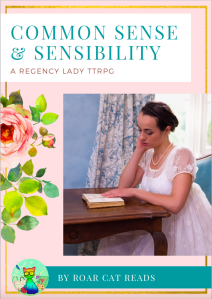
    Common Sense and Sensibility: A Regency Lady TTRPG

    “It is exceedingly well known that the life of a lady is far from easy. Death raises its grisly visage at every turn: whether from shawl insufficiency or too many novels, a Regency-era lady can never be too cautious.”

    In Roar Cat Reads’ original TTRPG character funnel, Regency ladies will test their delicate mettle and try to stay alive. This handbook lays out the game’s core rules, character creation instructions, and a list of the surprisingly mundane events that can test a lady’s constitution.

    Download your FREE copy at our Ko-Fi shop.

  • Adventure Queers: Meet Tarren!

    Adventure Queers: Meet Tarren!

    I’m Tarren (they/them), and I’m an agender singer/songwriter and voice actor who’s been an avid gamer in various ways for more years than I can remember. I am working on developing my Soundcloud page which at this point has the “pocket songs” I’ve written so far. You can find the games I’ve played in here, and for info on things coming up that I can’t talk about yet, follow me on Twitter as @LandrasGembar


    Tarren, what were your first experiences playing D&D like?  What has kept you interested in the game?

    My experience with D&D goes back far before I ever played the game. I grew up in a D&D-playing household, and on occasion would sit listening to my brothers and their friends playing at the dining room table. I was intrigued, but I was also way younger than anyone in the group, and accessible materials for D&D didn’t exist. That was in the 80’s.

    Fast forward to the early 2000s, when an intrepid blind GM got his hands on the *ONE* Braille copy of the original D&D rulebook and some way he could read his dice rolls and started a game on one of the various audio chat services that existed way before Discord or Zoom were even envisioned. I was hooked in…until that group ended up disbanding for whatever reason. I’d be without a D&D outlet until the late ’00s, when a job teaching assistive technology landed me right across the street from Bosco’s, a gaming store that turned out to be running D&D encounters. In those days, ebook versions of the rules were just starting to be a thing, and I would use magnification, as taxing as it was, to read the tables and get the information I needed to build my character.

    I knew, once I had that character built, I had the chance to be more than I ever could be normally. I could face down any foe, I could conquer any obstacle, and it didn’t matter that in reality pretty much any physical stat was a dump stat for me. And I’ve kept on playing for those reasons, along with the excitement of visiting fascinating places not possible in reality.

    As a queer person, have roleplaying games helped you explore or express your queer identity?

    Definitely! D&D was a safe space where I could leave my assigned gender at the door. The fact that most of the characters I played were men aided my decision to transition from female to male, opening the door for me to eventually embrace my genderlessness.

    You have participated in charity events for Everyone Games, an organization that promotes accessibility in nerdy spaces.  What do you think are the biggest obstacles that disabled people experience in traditionally nerdy spaces?

    As to the biggest obstacle we face, I think there’s a bit of an assumption out there that a disabled person coming to a nerdy space probably has all their accomodations figured out, that their tools/adaptations/etc. will take care of everything, or the opposite end, trying to compensate for disabilities without conferring with the person in question. It’s a good idea, even if you think you know what a person might or might not need, to check in with them on what accommodations might or might not be needed.

    What are some examples of issues that disabled people find themselves working around that other people take for granted?

    I’ve read, over the years, of people in wheelchairs having trouble in public gaming events because things were spaced too close together. An average person may well be able to slip into narrower spaces, but a person using a wheelchair or other mobility aid might not be able to. Another thing we sometimes struggle with is not knowing when our energy might suddenly deplete, and we have to discard plans at the last second.

    What is one thing that you wish sighted players would do when playing with partially sighted or blind gamers?

    If you’re going to use an image, map, or other visual aid, describe it. This will keep us on the same page as the rest of the table. For those who do audio podcasting, if your podcast listeners would be left out, so would we. In chat spaces, if you share a GIF or meme, please add a description so that those who can’t see it well, if at all, know what people are talking about. Also know that not all text can be read by screen readers, and when it can, it’s sometimes skewed because of OCR flukes and/or typographical quirks. So if you’re sharing text, please share it outside of images where screen readers can find it accurately.

    Do you have any examples of people or organizations that are doing accessibility well in nerdy circles?  What are they doing right?

    Knights of the Braille is one of the hosting organizations of the Everyone Games event mentioned above, and they are actively working to promote accessible gaming opportunities and adapting gaming materials as needed. Possum Creek Games, creators of Wanderhome have done an amazing job making sure that their PDF is easy to read and has excellent descriptions for the various illustrations throughout the book.

    Do you have any recommendations of queer nerdy content that you would like people to know about?

    Multiclass Theater is an amazing actual play podcast with a stellar GM and a talented cast of characters. Diana and her crew weave a gripping tale of magical adventure and companionship, with a good measure of humor in the mix. And along the way they nerd out about everything from Tolkien to music, oh yeah and lots of science. They can be found at @mctpod on Twitter.

    Tracy Barnett is an awesome author and game designer who developed the Iron Eda setting and has their games over at itch.io/theothertracy.


    Sign up for Roar Cat Reads’ Monthly Newsletter

    Every month one subscriber wins a prize!

    Processing…
    Success! You're on the list.

    By clicking submit, you agree to share your email address with the site owner and Mailchimp to receive marketing, updates, and other emails from the site owner. Use the unsubscribe link in those emails to opt out at any time.

  • Queer Books, Queer Readers: Kyle Huntley

    Queer Books, Queer Readers: Kyle Huntley

    Kyle Huntley (he/him, they/them) can be found on Instagram @subtlegazephotography

    What queer book have you chosen to share with our readers today?

    Sunstone by Stjepan Sejic. Mature slice of life, graphic novel.  Sunstone is a powerful and realistic depiction of queer and kink life seen through the lens of the two fem main characters. The story explores the discovery process and gritty real failures that many of us experienced as we explored our identities and communities. We follow the characters through their meeting and relationship, queer, and kinky journey.

    Why is this book one of your favorites?

    This book is one of my favorites because it feels very real. Too often queer media or kink media is hyper sexualized or romanticized in many unrealistic and unhealthy ways. Sunstone addressed many of the common pitfalls and struggles that folks face as they explore, fail, learn, and grow. These characters struggle to communicate and overcome in modern healthy depictions. This combination of exciting and realistic depictions of the mundane and sexy make it one of my favs.

    How would you describe yourself as a reader?

    I consider myself a chaotic reader. I am usually reading two or three books at one time. Switching between a high fantasy novel, an academic style journal or book, and stylized graphic novels. I love satire and works that poke holes in our society or draw humor out of the absurd. Terry Pratchet’s Discworld series is a prime example.

    As a queer person, have books helped you explore or express your queer identity?

    I struggled a lot to find books that spoke to my queer identity. I come with many hyper masc aspects to my life (military service, tradesman, Gold medal athlete) which often came into conflict with my love of romantic poetry, and deep love of expressive painting and photography. I always felt split, as though I couldn’t be both of these things (of course I could but try explaining 24 year old me that). I remember reading the Malus Darkblade series from the black library (very edgelordy I know) and there were multiple characters who were the mercenary and fantasy fighter types. But in the side chapters of the books were artists, and poets, and expressed their love for other characters of various gender expressions as well as their devotion to the main character Malus. Looking back I don’t think these expressions of love were romantic, but to young me they were. It made me think of how a person is not limited by the expectations of others and is free to craft their own forms of self. I have always appreciated strong soft characters. Not the gentle giants, but the big strong characters who choose love and peace in life.

    Other than reading, are there any queer nerdy recommendations that you would like to leave with our readers?

    D&D is one of the single best ways to explore self expression and test out aspects of the self. If you can find a safe queer friendly community you will soar through the act of communal improve.

    Check out our Queer Lil Library for more book recommendations and reviews!

    Processing…
    Success! You're on the list.