Tag: 5e

  • DM’s Pocket Guide Ep 5: Character Creation – Ability Scores

    DM’s Pocket Guide Ep 5: Character Creation – Ability Scores

    Character Creation: Ability Scores DM’s Pocket Guide

    True story, we didn’t know there were multiple ways to roll character stats until our first charity event when someone specified, “Standard array.”  Yikes, was there another option??  Turns out yes!  Embarrassingly, the rules we discuss are right at the beginning of the Player’s Handbook.  You probably don’t need this, but if you do…there’s no shame.  Listen now to your official character creation ability scores options! We’re Tricia and Rachel from Roar Cat Reads.  If you would like to learn about a specific D&D rule or spell, send us a request at roarcatreads@gmail.com.  Please like, review, and share to support DM’s Pocket Guide! Transcripts of every episode are available! If you want more rules, buy a copy of the Player’s Handbook! Follow us on Twitter and Instagram  Artwork by Haley Boros DM’s Pocket Guide is unofficial Fan Content permitted under the Fan Content Policy. Not approved/endorsed by Wizards. Portions of the materials used are property of Wizards of the Coast. ©Wizards of the Coast LLC.

    Transcription

    Welcome to DM’s Pocket Guide, where we discuss the rules, spells, and monsters of Dungeons and Dragons, 5th edition.

    Rachel:  Okay, so today we’re talking about determining character ability scores as part of character creation.

    Tricia:  Yes, this was something that I didn’t actually realize there multiple ways of doing it, because I just used D&D Beyond stuff where it’s like, “Here’s your standard array, put them accordingly.”  I think that’s what you taught me, because that’s what you knew.  So I didn’t know there were other options until we started playing with different people and they were like, “Do you want to do standard array or this or this?” and I was like, “Wha-ha-ha-ut?”

    R:  Yeah, so there’s three different ways to go about doing this.  The first way that’s in the book is the chaos way.  It says you generate your character’s six ability scores randomly by rolling four 6-sided dice and recording the total of the highest three.  So roll four, discard the lowest one.

    T:  That prevents you from getting truly abysmal characters?

    R:  Uhhhh, yeah, well, no, actually.  This is the most chaotic method of doing it, because there is the possibility of you rolling four 1s and having a character with an ability score of 3.

    T:  That’s true.  But by having the fourth dice, it is trying to prevent that as much as possible.

    R:  Yeah.  The law of averages should even you out to something nice and rounded.  It’s true the other way as well, that you could end up with – the highest score possible with this is 18, which is way way up there.  So yeah, if you enjoy chaos, I know this is a good method for, maybe if you don’t know what kind of character you want to make, you can roll the dice and have them decide.  So if you ended up with a really high strength score and a really high charisma score, well that’s leaning toward a paladin.  So yeah, that’s one way to do it.

    T:  I like this.  I haven’t done this way yet, and I now want to, cuz it appeals to me in that – biological determination, that this way is, well you’re just given these sets of skills.  What do you make with them?  Versus what we will talk about next.

    R:  Okay, well maybe there’s a game in our future with that.  The next one is the standard array.  There is a set of six figures that you will apply to your ability scores – 15, 14, 13, 12, 10 and 8.  So that way you’re guaranteed to get a couple of good scores, a couple of bad scores, and a couple of mediocre kinds of things.  It’s the most even way of distributing your ability score points.

    T:  Yeah.

    R:  Yeah.

    T:  I’m trying to think if there’s much to say about it other than that is very even and controlled.  It’s the easiest way to make sure you have a balanced party.

    R:  Or a balanced character, at least.

    T:  Well, but party too!  Cuz then you’re guaranteed that there isn’t going to be that one character that’s so powerful or so tragic.

    R:  That’s true, but I mean, this is before we apply any sort of racial bonuses to it, so you could still end up with a character that piles everything into a single – 

    T:  Yes, but then they’re still only guaranteed a single really good thing.  The foundation is the most even.  

    R:  No, I agree with that, for sure.  And then the last one is a variant way of addressing ability scores.  This is the point-buy system.  I think this is the one that D&D Beyond steers you towards straight away, is the point-buy.  The way it’s described in the book is a little counterintuitive in the age of technology when you can literally just click up and down on a thing.  You have 27 points to distribute.  Everything starts with, I believe an 8, and then you buy up with the different scores.

    T:  You’re looking at me like I should know, but I literally always just choose standard array when I make a character on D&D Beyond.  

    R:  Oh, interesting.  I’ve always been funneled into point-buy.

    T:  Well, keep telling me about it.

    R:  So with point-buy, in the book it’s limited to the highest score you can get is 15, so similar to standard array.  It puts that limitation on there.  You can’t get above that, above that number.  It allows for a bit more customization, so if you wanted to be really good in two skills, you could buy them both up to a 15, and then have like, two really bad ones.  So yeah, if you want to create a character that is all about something and has nothing to do with something else, then this is the way to do it.  

    T:  So it’s still even in that you can’t just be like, “I’m perfect at everything!”  But you can be much better at more skills, so long as you’re willing to compromise by being much worse at more skills.

    R:  Yeah, exactly that, yeah.

    T:  Okay, and where is all of this information?

    R:  This is all very early on the Player’s Handbook.  Page 13 in the Player’s Handbook. 

    T:  Page 13.  So with this one in particular, I do want to just end by summarizing:  On page 13, there’s three different ways to determine your ability scores when you’re character creating.  There’s the chaos method where you use four d6s and use the highest of three, and that’s the most chaotic.  There’s the standard array, which those numbers are in the book.  You have to choose those and allot them to different abilities.  And then there’s the point-buy system where you have 27 points and you can determine how you want to allot those points to different skills.

    R:  Yeah.

    T:  Alright!  Well, let’s make some characters!

    R:  Okay!
    Thanks for listening!  If you have something you’d like us to cover, email it to roarcatreads@gmail.com or find us on Twitter and Instagram @roarcatreads. 

  • DM’s Pocket Guide Ep 4: Owlbears

    DM’s Pocket Guide Ep 4: Owlbears

    We are extremely fond of owlbears over here at Roar Cat Reads, and learning that they are stinky beasts whose habitats are littered with the decaying bodies of their prey only made us fonder. We’re Tricia and Rachel from Roar Cat Reads.  If you would like to learn about a specific D&D rule or spell, send us a request at roarcatreads@gmail.com.  Please like, review, and share to support DM’s Pocket Guide! Transcripts of every episode are available! If you want more rules, buy a copy of the Player’s Handbook! Follow us on Twitter and Instagram  Artwork by Haley Boros DM’s Pocket Guide is unofficial Fan Content permitted under the Fan Content Policy. Not approved/endorsed by Wizards. Portions of the materials used are property of Wizards of the Coast. ©Wizards of the Coast LLC.

    Transcription

    Welcome to DM’s Pocket Guide, where we discuss the rules, spells, and monsters of Dungeons and Dragons, 5th edition.

    Rachel:  Okay, so now we’re gonna talk about Owlbears on page 249 of the Monster Manual. 

    Tricia: I love owlbears. 

    R:  Yeah, they are pretty good. Fun fact about owlbears is they are a large monstrosity.

    T:  Oh, a monstrosity. 

    R:  Not a beast. 

    T:  Interesting. Yeah I definitely would have assumed that they were a beast.

    R:  Yeah. So this is important for druids who wish to Wild Shape into creatures.  They can only Wild Shape into beasts, not into monstrosities. 

    T:  Okay, so no druid is turning into an owlbear. 

    R:  Yeah. And they are unaligned. They aren’t neutral, they aren’t even anything. They’re not evil, not good; they’re not chaotic. They are just unaligned. Owlbears have an armor class of 13, so pretty low.  And they have 59 hit points. So kind of up there – pretty tough. You take a lot of damage. And they can move 40 feet – 

    T:  So faster than the average character. 

    R:  Yeah, definitely faster than level one characters, they can be outrun by an owlbear.  For their individual characteristics, strength is up there with a nice +5. These things are immense hulky things.   I’ll probably point out at this point that it is an owl head on a bear body, not a bear head on an owl body. 

    T:  Yeah, they got those powerful bear limbs – so strong!

    R:  Yeah, and a big fierce beak. So yeah, big strength makes sense. Big body of a bear.  They aren’t very smart; they’ve got a -4 for their intelligence. Not charismatic either, unsurprisingly.  And just like reasonably dextrous. They get a +3 to Perception. You can imagine, like keen eyesight, keen senses. 

    T:  They’re probably gonna see you coming.

    R:  Yeah, they’re gonna know you’re there. 

    T:  Okay. 

    R:  They’ve dark vision up to 60 feet. So, even if it’s dark and you’re in their lair, they’re gonna know you’re there with a Passive Perception 13, which is pretty reasonable. They don’t speak any languages. 

    T:  Sure. 

    R:  And they have a challenge rating of 3.

    T:  Okay, pretty good for early days

    R: Reasonable challenge, yeah. Yeah. And the feature that they’ve got on this sheet is keen sight and smell. They owlbear has advantage on Wisdom Perception checks.  They rely on sight or smell, so when they are trying to find prey – find characters – yeah, they’re gonna have an advantage on those rolls. This thing is ready to hunt things.

    T:  Yeah, it’s a hunter.

    R:  It gets a multi attack when it’s in combat.  They can make two attacks, one with its beak and one with its claws. 

    T:  Oh man, I remember this, the first time fighting an owlbear was the first time that I think a multi-attack ever happened, and it, like, blew my terrified little D&D mind, like, “It can hit twice!?” 

    R:  Yep, it’s just weapons all over this thing. So the beak is going to do 1d10 +5 piercing damage. So this is the big chomper.  They get a +7 to hit as well. So these things are pretty, pretty brutal in battle.  And then its claws do 2d8, so higher average damage but probably more.  Yeah, claws are what you want to be using to deal out your damage.  Again +5  for the damage and then +7 to hit as well. So it does only have a melee attacks, it’s got nothing ranged.

    T:  Right.  It’s got to get up close. 

    R:  Totally.

    T:  To bite your face off.  

    R:  Indeed, yeah. So that’s what the stat block has to say. You’ve got kind of a picture of what this thing is like.  The flavor text in the Monster Manual sort of goes on to describe these creatures as rushing into attack whatever has come into their territory. They don’t care if it’s bigger than them. If you are in its space, it is going to attack you and you will know it’s coming. 

    T:  Yeah. They’re the barbarians of villains, of monsters. They’ll just rush right in. 

    R:  Mmhm. Yeah. So they like hooting and screeching as they’re charging in. They’re probably thick and bulky, and they… it says they prefer, like, denser forests so that their prey doesn’t have room to escape. So you can imagine them, like, crashing through the undergrowth, like you’re gonna know when an owlbear is coming at you.   

    T:  Yeah, I think that is important.  This is not the stealthy monster. This is the, “Oh, my goodness. What is coming at us?”

     R:  Equally with an owlbear den, you’re also gonna know that by the smell.  Apparently, these creatures drag their prey back to their den so there’s a lot of rotting carcasses around and other creatures that – the scavengers, they come in and pick through these things.  So if you’re gonna have your players come across an owlbear den, there’s definitely some great flavor text in the – 

    T:  Yeah, this is definitely the, like, intimidation creature. 

    R:  Yeah, for sure. They typically are solitary creatures, but they do mention hunting in mated pairs.

    T:  Oh!

    R:  But they typically only stay together as long as it takes their young to be able to hunt for themselves essentially.  And we should probably talk about what happens when your party encounters and owlbear – 

    T:  And they want to adopt them!  

    R:  Yes. So their intelligence is pretty low.  It’s a 3, which is required for any kind of, like, training or use as a mount.  It is possible to do it, but it takes a lot of good rolls and probably a bunch of time to, to train your owlbear.  

    T:  Okay. Yeah. This is not just one good Animal Handling. 

    R:  Oh, no, no, many, many good animal handlings. And probably even after that, like, there’s always a chance that your owlbear will become unruly, and –

    T:  Yes, it could bite the hand that feeds it. 

    R:  Yeah, for sure. So that goes on to sort of describe some different ways that owlbears have been used in different cultures, which is kind of cool.  Like a good way to get an idea about how these creatures interact with the world, have been interacted with by the world, and then their origins are very mysterious.

    T:  Ooo!

    R:  Yeah, scholars have long debated the origins of the owlbear, and some people say that it was like a demented wizard that made this first hybrid.

    T:  Of course. 

    R:  Yeah. And then some, there’s some things about a fey ancestry, or like they’ve been around for a lot longer than – 

    T:  So you can kind of make up whatever background you want for these creatures because canonically, it is ambiguous. 

    R:  In fact, there is a really good book that has this as a feature:  Kings of the Wyld by Nicholas Eames has a whole like hunt for owlbears, and that’s definitely – I’ve heard that wizard thing from that book.  Yeah, excellent.  Well, that’s owlbears on page 249 of the Monster Manual.

    Thanks for listening!  If you have something you’d like us to cover, email it to roarcatreads@gmail.com or find us on Twitter and Instagram @roarcatreads.  
  • DM’s Pocket Guide Ep 3: Mounted Combat

    DM’s Pocket Guide Ep 3: Mounted Combat

    Mounted Combat DM’s Pocket Guide

    Okay, so you found a steed (check out last week’s episode about the spell “Find Steed”), but how do you ride it into glorious battle?  For that, you’re going to need to know the 5e rules about Mounted Combat! We’re Tricia and Rachel from Roar Cat Reads.  If you would like to learn about a specific D&D rule or spell, send us a request at roarcatreads@gmail.com.  Please like, review, and share to support DM’s Pocket Guide! If you want more rules, buy a copy of the Player’s Handbook! Follow us on Twitter and Instagram  Artwork by Haley Boros DM’s Pocket Guide is unofficial Fan Content permitted under the Fan Content Policy. Not approved/endorsed by Wizards. Portions of the materials used are property of Wizards of the Coast. ©Wizards of the Coast LLC.

    Transcription

    Welcome to DM’s Pocket Guide, where we discuss the rules, spells, and monsters of Dungeons and Dragons, 5th edition.

    Tricia:  Okay, today we are going to talk about Mounted Combat!
    Rachel:  This is something that has come up in games more and more, especially as people get to higher levels and want to pick up an extra creature, a collection of pets.

    T:  This information is found on page 198 of the Player’s Handbook, and yeah, I think you’re right.  People will always want to have pets.  At a certain level, paladins will have the “Find Steed” spell, which references mounted combat, so this is good information to have.  Different kinds of mounts could be warhorses, griffons, pegasuses…

    R:  Pegasi.

    T:  Or dragons.  All those kinds of things.  A mount has to be one size larger than you, which would be important but also super fun if you’re a gnome, because then just like everything is bigger than you.

    R:  Oh yeah.

    T:  When you’re mounting and dismounting, you do have to take a few technical things into consideration.  Your mount has to be within five feet of you.  You cannot mount something that is across the room from you.

    R:  That makes sense.

    T:  Yes!  You also have to use up to half of your speed in order to mount this creature.

    R:  Oh, that makes sense.  Like standing up from being prone takes half your movement as well.  Moving through difficult terrain.  Okay.

    T:  So that comes into play if your mount is 30 feet away from you and your speed is 30 feet, you cannot run to it and climb on it in the same turn.  You would have to be within 15 feet to run there and jump on.

    R:  You’d still have your action.  So you could take the Dash action and then it would just be movement to get on the horse.  You’re not taking an action to get on the mount.

    T:  Other things to take into consideration, this is kinda cool.  If there’s an effect that moves your mount against its will, so a gust of wind pushes it, you have to succeed on a DC10 Dexterity saving throw or fall off the mount.  So this is, you’ve lost control of your mount, can you stay on the horse?  If you do fall off, you land prone, and if you’re knocked prone, you have to make a saving throw.  Saving throws all around!  If your mount itself is knocked prone, you have to use your reaction to dismount as it falls if you want to land on your feet and look like a badass.

    R:  Okay, so.  Controlling a mount, there’s a couple of rules around this too.  When you’re mounted you have two options.  You can either control the mount or allow it to act independently.  So this is, both times you’re still on the mount, but you can let it wander off on its own and do its own thing, or you can choose to control it.

    T:  Like that time we went horseback riding, and you were on a horse, but it was acting independently and going up the hill instead of down.

    R:  That’s true.  And there is a little sentence in here that says, “Intelligent creatures such as dragons can act independently.”  

    T:  Ah, okay, so this is much different than like, you have your find steed spell as a paladin, and those steeds have an intelligence of 6.  I’ve looked up dragons, and black dragons have an intelligence of 14.  So that’s very different.

    R:  Yeah, no, for sure.  Huge difference there, of like, yup, your intelligent dragon can totally act independently and will make smart choices.  Your intelligence of 6 steed warhorse probably isn’t going to make the best choices.  It’s still trained, it knows what it’s doing, but you know – 

    T:  It probably could stand still and not flinch in the face of battle, but it’s not going to be like, “I’m going to go to the left and then fight that guy!”

    R:  “This looks like the strongest person in the battle so I’m going to make sure I target that person.”  A horse is not thinking that.  You can control a mount only if it’s been trained to accept a rider.  Domesticated horses, donkeys, and similar creatures are assumed to have such training.

    T:  Okay, so if you find a horse at the inn, it probably is trained.  If your group wants to role play, you can find a horse and spend time training it.

    R:  For sure.  The initiative of a controlled mount changes to yours when you mount it.  So it’s going to share your initiative order.  It doesn’t mean it shares your turn, though.  It’s going to act either before or after the player that is mounted on it.  It moves as you direct it, and has only three options:  Dash, Disengage, or Dodge.

    T:  Wait, wait, wait.  Only – so it’s NOT going to attack.

    R:  No.  Not on it’s – when it’s the mount’s turn, it doesn’t have the option to attack.  The player still has the option to attack from the back of the mount.  But this is, uh – 

    T:  The mount itself is just going to move; it’s not going to take its turn to attack with hooves!  And then you attack.

    R:  Yeah, exactly.

    T:  We’ve done this wrong, I’ve done this wrong.

    R:  Yeah, for sure.  So the options that are available – Dash, Disengage, and Dodge – are all either movement or defense based, essentially.  Because you wouldn’t necessarily be able to take those options, or the player wouldn’t necessarily be able to take those options from the back of a mount.  They wouldn’t be able to Dash without dismounting.

    T:  Yeah, that makes sense.

    R:  And a controlled mount can move even on the turn that you mount it.  So in that example that we gave before, where you rushed the 30 feet, hop on the horse – it’s now the horse’s turn, and it can move it’s movement speed.

    T:  Yeah, so mounts are pretty awesome!  Cause even with those like, movement based skills, that’s pretty rad that you could ride up, and with your player’s turn, attack attack attack, and then use your mount’s turn to Disengage and run away.  That’s pretty awesome, because as a player yourself, you cannot both attack and Disengage.

    R:  Yeah, it makes sense as a cavalry charge.  I like that.  Okay, so moving on to the other category: the independent mounts.

    T:  So this is still, you’re on it but it’s independent.

    R:  It’s doing its own thing.

    T:  Okay.

    R:  These are our intelligent creatures.  So, an independent mount retains its place in the initiative order.  It’s got its own initiative.  Bearing a rider puts no restrictions on the actions a mount can take.

    T:  Wow.

    R:  It can do literally anything.  It doesn’t have to listen to you.  It moves and acts as it wishes.  It might flee from combat, rush to attack and devour a badly injured foe, or otherwise act against your wishes.

    T:  I love that!  So that implies to me that the DM is controlling it, but it doesn’t explicitly say that.

    R:  Yeah, this is where it might get a little bit tricky.  It leaves room for interpretation, for sure, about who gets to say what it does.  Because it’s called an independent mount, I would say it’s probably the DM is most likely controlling it.  But the players are certainly going to want to have some input into what this creature does.

    T:  That’s one of those trust things, like can your player role play the mount separated from their player’s desires?

    R:  Yeah, for sure.  Judgment call on that one.  In either case, if the mount provokes an opportunity attack while you’re on it, the attacker can target either you or the mount.

    T:  That makes sense.

    R:  So if you try to move away from a combat without taking the Disengage action – 

    T:  The monster can get you!

    R:  Indeed.  Excellent.

    T:  Well, that sounds awesome.

    R:  And that’s all on page 198 of the Player’s Handbook.

    Thanks for listening!  If you have something you’d like us to cover, email it to roarcatreads@gmail.com or find us on Twitter and Instagram @roarcatreads.  

  • DM’s Pocket Guide Ep 2: Find Steed

    DM’s Pocket Guide Ep 2: Find Steed

    What’s a paladin without a celestial elk?  Don’t sleep on this spell like Tricia did when she played Akta, Paladin of Torm.  Take 10 minutes to say a prayer and bam!  All your animal handling dreams can come true. We’re Tricia and Rachel from Roar Cat Reads.  If you would like to learn about a specific D&D rule or spell, send us a request at roarcatreads@gmail.com.  Please like, review, and share to support DM’s Pocket Guide! If you want more rules, buy a copy of the Player’s Handbook! Follow us on Twitter and Instagram  Artwork by Haley Boros DM’s Pocket Guide is unofficial Fan Content permitted under the Fan Content Policy. Not approved/endorsed by Wizards. Portions of the materials used are property of Wizards of the Coast. ©Wizards of the Coast LLC.

    Transcription

    Welcome to DM’s Pocket Guide, where we discuss the rules, spells, and monsters of Dungeons and Dragons, 5th edition.

    Tricia:  Alright, today we are going to talk about the spell “Find Steed” on page 240 of the Player’s Handbook.

    Rachel:  Do do dooo!  That’s me finding a steed.

    T:  Your little steed horn.  This was a spell that, when I played my first paladin, I didn’t realize how awesome it was for a long time!  Then I was like, “I could have been riding a horse this whole time?”

    R:  Yeah, once your paladin remembers that they can use “Find Steed,” it’s very hard to get them off the horse, or whatever creature it is they choose to summon.

    T:  Yes, exactly.  This is a second level conjuration spell, and it takes ten minutes to cast.

    R:  Oh, right.  So it’s not like, *snap* “Ah, there’s my steed!”

    T:  No, you’ve got to prepare this.  You’ve got to be in a space where you can prepare it, so it’s unlikely that in the midst of battle you will be finding a steed.

    R:  Mmhm, it’s something you have to prepare before.

    T:  Yeah.  The range is 30 feet, so the steed will appear near you.  You can’t summon it away from you – makes sense.  It’s both verbal and somatic components.

    R:  So you can only do it if you are able to speak and move.  You couldn’t be bound and gagged in a castle somewhere and be like, “Well, I’ll summon my steed to help me out of this.”

    T:  No, that won’t work.  This part is a bit confusing.  In the book it says that the duration is instantaneous.  So as a DM you need to be looking out for that.  If a player is like, “Well, I instantaneously cast this!”  No, it takes 10 minutes to cast.  Instantaneous means, this is going to last for as long as it lasts.  It’s weirdly phrased.

    R:  Yeah, that’s not really the right word for it.  This lasts until it’s either dismissed or is reduced to zero hit points, and apparently that is covered by the word “instantaneous.”

    T:  Yeah, it’s not great.  So!  The way that this works is you summon a spirit that assumes the form of an unusually intelligent, strong and loyal steed, creating a long lasting bond with it.  So all you horse girls out there are going to be real excited about this!  Uh, I’m not even a horse girl, and I’m really excited about this!  It appears in an unoccupied space within range.  The steed can take on these forms:  it could be a warhorse, a pony, a camel, an elk, or a mastiff.  And the book helpfully says that your DM can allow other things if they want to.

    R:  Yeah, players will usually want whatever critter that they want to ride into battle.

    T:  Yup.  So this is a spirit, so that means that these steeds are either celestial, fey or fiend.  The player gets to choose.  And they have the statistics of the creature.

    R:  Okay, so thinking about that celestial, fey or fiend – you might think, “Oh, well why would this matter?”  If the regular form of that creature, let’s say a warhorse, for example, that would be a beast.  It no longer counts as a beast, so spells that affects beasts or – they wouldn’t work on this.  Whatever form it’s taking, like celestial.  I know paladins have that – 

    T:  Detect good and evil?

    R:  Something like that – divine sense!  This horse will now show up if the paladin detects…uses their divine sense.

    T:  Yeah, so it’s just a little thing, but it’s good flavour.  And I think as a DM, you could take that choice and run with it.  Additionally, even though it does have its traditional stat block, the steed’s intelligence cannot be lower than 6, so it will be bumped up if it was lower.

    R:  Ah, so it’s a super smart horse.

    T:  No.

    R:  I’m going to be holding conversations with this guy.  It’s gonna be, like, playing chess in a tavern!

    T:  Yeah, it’s the Mr. Ed of steeds.  Um, no, unfortunately even though it does gain the ability to understand one language of your choice that you speak, an intelligence of 6 is still lower than the lowest option of the standard array.  

    R:  Oh, that’s true.  It’s like a minus 2 modifier?

    T:  Yes.  I did find online someone had written examples of what this would look like, and with an intelligence of 6, it’s still – you might understand the language, but you misunderstand words, and you misremember words often.  So this would be a steed that gets words mixed up sometimes.  You tell it to do something – “Go right!” – he goes left.

    R:  So it’s like taking three classes of French or Spanish?  It’s really good at nouns but doesn’t have any idea how to make a sentence?
    T:  Yes!  That’s a great way to look at it.  So your steed serves you as a mount, both in combat and out, and we’re going to have a separate episode on mounted combat, so we’ll deal with that there.  When your steed drops to zero hit points, it disappears, leaving behind no physical form because it is a spirit.

    R:  Poof!

    T:  You can also dismiss your steed as an action at any time, which will also make it disappear.

    R:  That will probably never happen.  They will never want to get rid of their steed.

    T:  You can cast this spell again to summon the same steed, restoring its hit points to its maximum.  So the other big thing is that while your steed is within one mile of you, you can communicate with each other telepathically.  Once again – with limited language!  I have had a player who wanted to send their warhorse on a reconnaissance mission, telepathically communicating with each other and feedback and information to the player, and I hadn’t read this spell carefully, so I was like, “Yeah, I guess!  But this feels like a very easy way to break the world.”  So lean hard into that language is still very difficult.

    R:  For sure.

    T:  Also, you cannot have more than one steed bonded by this spell at a time.

    R:  Not multiple steeds?  I can’t have a team of carriage horses?

    T:  That would be amazing, but no.  You have to have a team of paladins, all with their own steeds!

    R:  Oh, right, yeah.  I just need to be friends with a bunch of paladins.

    T:  That is “Find Steed” on page 240 of the Player’s Handbook.

    Thanks for listening!  If you have something you’d like us to cover, email it to roarcatreads@gmail.com or find us on Twitter and Instagram @roarcatreads.  
  • DM’s Pocket Guide Ep 1: Inspiration

    DM’s Pocket Guide Ep 1: Inspiration

    Inspiration! DM’s Pocket Guide

    Thanks for checking out our podcast – gain one inspiration!  Just don’t forget to use it… We’re Tricia and Rachel from Roar Cat Reads.  If you would like to learn about a specific D&D rule or spell, send us a request at roarcatreads@gmail.com.  Please like, review, and share to support DM’s Pocket Guide! If you want more rules, buy a copy of the Player’s Handbook!. Follow us on Twitter and Instagram  Artwork by Haley Boros DM’s Pocket Guide is unofficial Fan Content permitted under the Fan Content Policy. Not approved/endorsed by Wizards. Portions of the materials used are property of Wizards of the Coast. ©Wizards of the Coast LLC.

    Transcription

    Welcome to DM’s Pocket Guide, where we discuss the rules, spells, and monsters of Dungeons and Dragons, 5th edition.

    Tricia:  Today we’re going to talk about Inspiration.

    Rachel:  Inspiration!!

    T:  This is something that we did not use, well actually, I still don’t think we use it most of the time – 

    R: No.  If I have inspiration, I usually forget that I have it.

    T:  And if I’m a DM, I usually forget to give it.  But I have seen it used really, really well, and it’s something I want to get better at as a DM.

    R:  For sure.  So the rules for inspiration are on page 125 of the Player’s Handbook.  It’s three different paragraphs – there’s not a huge amount to it.  So what it is is, when you have inspiration, you can spend that inspiration to gain advantage on an attack roll, ability check, or saving throw.  You can only have one inspiration point at a time, so you can’t hoard up a bunch of inspiration.  It’s usually given out by the DM.

    T:  Yes, typically the DM would give it because the player has done something that is very based in their character flaws, bonds, personality.

    R:  It’s really encouraging role play.

    T:  Yeah.  And I particularly like that piece because if the player acts on their flaws, you can reward them with inspiration.  Because I find that a lot of people who are playing characters in D&D – they want to be perfect and never make a mistake and always be the hero.  But interesting characters have flaws, and this is a way to encourage players to lean into that a little bit.

    R:  Yeah.  If you’re playing with characters over a period of time, you get to know them.  You know what you would expect them to do and what – are they playing their character particularly true?  That’s the sort of thing that you want to reward with inspiration.

    T:  Yeah, a DM’s not the only person that can reward players with inspiration.  The Player’s Handbook also mentions that inspired characters can give that inspiration to someone else if they see them playing their character well, which was something I did not know!

    R:  Which is also a really cool thing, like, one of your characters has this resource and they’re willing to give it up to someone else to reward their role play?  That’s really nice.  That’s something that I would love to see my players do.

    T:  Yeah, it really involves team bonding.  Another piece that is not an official rule but is something that I have heard done and seems intriguing to me is that players just in general can reward each other inspiration.  So it is that team bonding element again of like, “Wow, that was such a good role playing moment, you should have inspiration!”  Probably the DM needs a final say on whether that’s true or not, but I like that sense of giving players themselves that responsibility to, yeah, encourage each other and say, “Good job!”

    R:  [sarcastic] But my players are going to abuse that!  They’re just going to be giving each other inspiration for no reason at all.

    T:  Well you know what?  Like, is that the worst thing in the world?

    R:  It’s not the worst thing in the world, and also, that’s the thing of building the trust in your group.  Whichever one of these rules works for you and your group…

    T:  That’s true.  I think what I was saying about ‘Is that the worst thing in the world?’ is that I do tend to think of inspiration as – well, when I think of it at all – it does feel like you’ve got to really earn it.  But I have seen The GM Tim in particular, when he plays games, he gives out inspiration all the time.  If you do something interesting or character-driven, he will just be like, “That’s awesome!  Take inspiration.”  It encourages players to use it quickly, because that’s a problem that you forget you have inspiration.  And it encourages this sense of like, everyone’s mood goes up.  “I did do good!  I want to do more of that!”  And keeping it frequent – have advantage on a roll is good, but it is not the most powerful thing in the world.  It’s not going to break your game.

    R:  Absolutely not.  So it sounds like The GM Tim uses the “rule of cool” to award this.  If a player does something that is, “Yeah, that’s awesome!”  Give them inspiration.  You don’t have to be an inspiration dragon creating a giant hoard of inspiration points that you very rarely give out.  Reward your players for doing that stuff.

    T:  Yeah, definitely.  You have also said that what you’ll do to remember you have inspiration is you’ll set aside dice that is your inspiration dice.

    R:  Yeah, so because I have a big hoard of dice, I can do that.  I’ll usually use a bright-coloured one or something like that to have it in front of me just so I remember that I’ve got it.  I recently took the Lucky feat with one of my characters where I get three of those, so I really have to remember that I have this thing, or I’ve wasted that particular use.  It’s definitely made me a lot more aware of that.  Having a physical representation of my inspiration can be useful.  There are also some variant rules for inspiration as well.  Granting advantage is one way to use inspiration but there is one in particular that I’m thinking of that involves the Tarroka deck.  This is based in the Curse of Strahd campaign where if you gain inspiration, you pull a card from a deck and it gives you access to like, single uses of magic spells that you wouldn’t have access to otherwise and maybe other abilities.  I haven’t gone through the whole stack, but that was a nice little variation.  I think it does make inspiration powerful, but – 

    T:  But also more random.  It’s a little like the Wild Magic Surge table.  Sometimes it’s like, “Oh, this is exactly what I need.”  It’s very powerful.  Other times it’s useless to me, so I’ll find a funny way to use it or just get rid of it for the next thing.  But it does make it fun to play around with different kinds of – inspiration doesn’t have to mean just advantage rolls, it can be something else!

    R:  Yeah, so the takeaway is – Inspiration, all the time.  All the time, inspiration!

    T:  So that is the Inspiration rule which is on page 125 of the Player’s Handbook.

    Thanks for listening!  If you have something you’d like us to cover, email it to roarcatreads@gmail.com or find us on Twitter and Instagram @roarcatreads.  
  • Reviewing Feudal Attraction, a D&D 5e Dungeon

    Reviewing Feudal Attraction, a D&D 5e Dungeon

    History

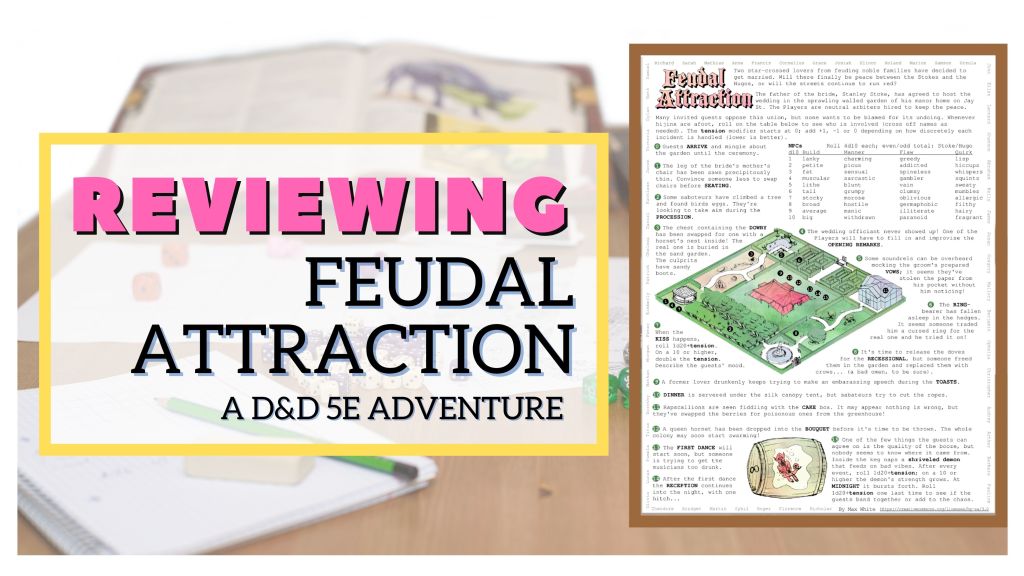
    Feudal Attraction was a winning entry in 2019’s One Page Dungeon Contest by Max White. You can find the single page adventure on RPG Geek.

    “Two star-crossed lovers from feuding noble families have decided to get married. It won’t go smoothly.”

    Rating: 5 out of 5.

    A DM’s Perspective

    Highlight

    This is one of my favorite one-shots to run; it is silly and romantic, which is me in a nutshell. In fact, I have run this adventure four times now! It’s a mark of how good the adventure is that with one page of information, I have had four very different experiences with different groups of people.

    The story is simple: A group of characters has been hired to run interference for a wedding between two feuding families. The wedding takes place in the enclosed grounds of a fancy estate and has a schedule that is recognizable to anyone who has been to a wedding before. As the day (and the adventure) progresses, the players must try and thwart various attempts to keep the happy couple apart.

    My favorite thing about this adventure is that it allows room for a lot of creativity and social interaction. I find this to be a perfect adventure to run for people new to D&D, since weddings are a familiar setting and they only have to worry about creating a character and some basic skill rolls. It’s also a lot of fun with experienced players. I just played through Feudal Attraction with a group (some of whom wrote their thoughts below) who brought a lot of roleplaying and creative character skills to the event. It was an absolute blast as they prevented kids from throwing eggs, found the lost ring and vows, and exchanged a rigged dowry with the correct chest of gems.

    Changes Made

    Other than the first time I ran this campaign, I never include the combat at the end (there is a demon in the wine barrels that can break out and cause a fight). All of the other mishaps are more petty than dangerous, so it feels out of sync with the rest of the experience. More than that, I just really like running an adventure that challenges the assumption that all D&D adventures must have a fight to be fun.

    The other significant change is in how the wedded couple is decided. Sometimes I let the players decide the race/gender/names of the couple (most recently, a female tabaxi named Bella married a nonbinary dwarf named Chives). If I know the group needs something familiar to latch on to, I will run it as the wedding of Legolas and Gimli. This leads to some excellent comedy (Frodo the cursed ring bearer, Gandalf the “a wizard is never late, nor is he early” missing officiant, and Aragorn as the grieving ex) that works if your players are big LotR nerds.

    What I Would Do Differently

    One thing I always forget to mention at the beginning of the session is a warning along the lines of “I don’t know what you might find, so it’s best not to wander alone!” The wedding estate is pretty spacious, and players tend to spread out in 1s and 2s at the beginning. They do inevitably start to work together a bit more as the session goes on, and I’ve gotten better at shifting scenes more smoothly, but setting that expectation early might allow for more player interaction from the beginning.

    Let’s Hear from the Players!

    Izzy AKA Cassian Pwyll (Human Hexblood Shadow Sorcerer and Event Decorator)

    Dungeons and Dragons is not normally a game that is built to reward completely non-combat related conflict. With the level system designed to dole out largely combat related abilities the natural progression is an almost natural shounen anime-like curve… But even in shounen anime sometimes you just need an episode where your characters go to the beach to relax.

    Having a number of challenges social and mental this one shot gave a chance for cantrips, racial abilities and skills to shine. Keeping the players at level one was an incredibly savvy move as most of the flavour of a character is intact at the beginning of their arc and there is no backlog of non-combat skills that never see the light of day. It is also my belief that this particular one shot keeps the DM engaged with a lot of topical variability as at the outset we were given the choice to pick the families of the two persons getting married (We chose a Dwarf and Tabaxi) and their officiant was a party member who chose a cult of the apocalypse which stained upwards to colour the entire tale with the vibrant hues of a calico heat death of the universe which still managed to be endearing and romantic somehow.

    Every character got a chance to shine and teamwork and colorful NPCs tugged at heartstrings and kept us laughing. After a solid three hours of lighthearted comedy, weird facts about doves/bees and bardic inspiration that seemed to affect the players more than the characters themselves I experienced a roleplaying high of the sort that refreshed me like a long rest. Solid 10/10.

    Listen to two players relieve their experiences in character!

    Allonté AKA Maester Diehart (Nihilist Cultist Cleric of Peace, Extoller of the Saint Mediggo’s teaching)

    This the kind of adventure for those who either thirst for roleplay or perhaps may not know how. From the onset, our wonderful DM/GM asked us, the players, to decide whom shall be wed. I am glad our group was on board for the most unlikely of pairings as well as having the ability to remind each other that in a fantasy world, why cling to convention or norms? In that, it is easier to find the heartbeat of this adventure, giving two who love one another the best day possible.

    Now this is an adventure of course, so there will be many obstacles in the way. If you are a completionist like me, you might miss a few things in the pursuit of a mini-quest and that’s….. Great! This is a hallmark of an adventure that you may want to experience again and again to see all the things you missed or to have differing experiences with different characters.

    Be forewarned, this is an adventure made without combat. With that knowledge, if you have some murder hobo tendencies, think of the social interactions or obstacles as a form of combat and choose your spells and abilities somewhat wisely. Or just have fun justifying why or how something should work. If you are a GM/DM looking for something to get your experienced roleplayers on a high or getting those without much experience engaged, I would run this adventure! Moreover, this will test your DM/GM skills in switching between scenes. For once, this is a great time to split the party! 12/10 would play again!

    Chad AKA Albert Corrian (Half-Elf Bard)

    As an experienced and long time player, it was an excellent change of pace to play something that was pure roleplay. There’s more than enough hack and slash to go around so a session with zero combat and all skills and talking was engaging. It’s important to note this was a known element coming in. Had we not been told there would be zero combat, our character choices would likely have been considerably different. I could see a meat-and-potatoes Fighter not having a lot of fun.

    Everyone got to do something, and everyone was involved. Playing a Bard, I focused more on my performing than my bevy of Charisma skills as our Warlock officiant had those in spades. I was ready to back him up but he handled everything well and rolled like a champ (once with a bit of help from Bardic Inspiration). I didn’t even have to sling any of the non-combat spells I selected, like Charm Person or Sleep, as ‘oh hell’ buttons. The atmosphere was calm and enjoyable, and we were able to inject some excellent comedy. Everyone left feeling energized and accomplished.

    10/10 would recommend running this session as a nice break, especially to try and crack some non-roleplayers out of their shells.


  • Reviewing White Plume Mountain, a D&D 5e Dungeon

    Reviewing White Plume Mountain, a D&D 5e Dungeon

    History

    White Plume Mountain is a 13-page dungeon crawl adventure for a group of level 8 characters. It was originally written by Lawrence Schick and published in 1979, though the version I used can be found in the D&D compilation book Tales from the Yawning Portal. Ranked the 9th greatest Dungeons and Dragons adventure of all time by 2004’s Dungeon magazine, it is a game that requires brute force and creative solutions in order to find three very cool sentient weapons.

    Rating: 5 out of 5.

    A DM’s Perspective

    Highlights

    As a DM, I strongly prefer working from pre-existing material, and I was excited to run a tried-and-true dungeon from Tales of the Yawning Portal. This adventure is not a one-shot (it took my group 4 sessions at 3 hours per session), but it is contained enough to be a nice breather in between campaigns or as a single adventure if you don’t want to commit to more, which I didn’t!

    I loved how creative the dungeon is; it is full of riddles, puzzles, and traps to navigate. It really brought out the creativity in my players, and they used their skills and spells in unique ways to survive. Sometimes TOO unique! They refused to enter the Room of Glass Globes (#4) and instead blasted all of the orbs from outside, releasing three shadows, an air elemental, and a gray ooze all at once! Since they had already found Wave, one character created a Cube of Force around the group the size of the corridor, which they used to body slam the monsters into submission. It was not how I expected the encounter to run at all, but it was amazingly creative and fun!

    Changes Made

    The one significant piece that is missing is a final fight with the wizard Keraptis. My players made it clear early on that they were interested in defeating him, so I made some alterations to the campaign to make that happen. I gave Sir Bluto a key that could be used to unlock the way to his santcum from the Pool and Drain (#9). I threw together a random dungeon chamber in which they could fight a lich (though I didn’t use its level 7-9 spells so that they had a hope of defeating him).

    My players were very invested in socializing with any characters they met along the way, so I made all humanoids in the dungeon former treasure seekers who had been forced to guard the weapons they once sought. Some were tricked out of their treasures (they gave the vampire Ctenmiir a footrub so good that he didn’t realize they stole Whelm from him), others were fought, and others were invited to join the cause. In particular, they really latched onto the flesh golem in the Numbered Golems room (#5). They named him Dusty, and a really sweet romance developed between his strong silent arms and one of the players! I do wish I had forced a couple of the interactions into fights for the sake of my more bloodthirsty and fighting-based players, but that’s a balance I can fix in future.

    What I Would Do Differently

    I wish I had done more preparation for the three sentient weapons that characters are meant to find throughout the dungeon. I could have given them much more depth, almost to the point of NPCs, if I had invested more time in preparing them. Because this was a one-shot separate from an overarching campaign, I would have made them more useful for this dungeon in particular so that the party could enjoy the weapons once they had them. One character (Adelin) got Blackrazor just in time to fight the lich…which is undead and therefore doesn’t work! On the fly, I had Blackrazor tell Adelin that it would attack the lich and deal appropriate damage only if he agreed to sacrifice half of his hit points. The player got very into this, stabbing himself with the sword to gain further advantages. It was a fun character moment, and I very much wish I had thought of similar things for Wave and Whelm!

    Let’s Hear from the Players!

    Rachel AKA Kreeth the Aarakocra Fighter

    This was the first time I had played a higher level, purely martial character. I chose this class partially out of curiosity and partly to round out the party; it was possibly not the best choice since I didn’t have a lot of ways to really help out the party. I went with a dex-based fighter, so I wasn’t able to heft things out of the way or force sticky levers, and because we socialed our way out of most combat encounters, I think I only used my +9 attack once or twice. 

    I was able to utilize the features from my race much more effectively than my class. I went with an aarakocra, so being able to fly was great (if a little limited) and getting into the bird mannerisms made it fun to roleplay. I found myself in a support role – when someone would trigger a trap or fail a dex check, I was able to swoop in and save them which was nice.

    I got the magical weapon Wave, but unfortunately, this did not gel well with my dex build (it did not return to your hand if thrown, unlike Whelm). However, its cube of force feature did allow me a brief glimpse into the magic user’s view of the dungeon, but I quickly burned through all the charges and was back to more passive play. 

    Overall I think this is a good dungeon. It was certainly challenging for our group and felt deadly! The only thing I would change is my character choice.

    Anne AKA Cinder the Fire Genasi Artificer (armorer specialty)

    This dungeon has a mix of combat and puzzles. I’d recommend it for people who are less interested in kicking down the door and murder hoboing as much as collaborative, varied paced campaigns. It’s not a hex crawl and there isn’t the frustration of just not being able to figure out which way to go to progress the session. There are enough potentially deadly encounters to keep it interesting.

    The one big flaw with having the goal being to recover magic weapons is that you might have a group that can’t make use of them. I think the DM either needs to communicate this during character creation or be willing to hand wave this aspect of the mechanics. Or enjoy giving your players a bunch of fun loot that they can’t use!

    Allonté AKA The Professor the Human Bard

    I loved my delve into the be-trapped abyss called White Plume Mountain! The beautiful thing about any adventure is that it is not just the setting, mechanics, or build, but it’s the table that makes it wondrous. I feel as if I hit the jackpot in this one-shot!

    DM Tricia, word of the mountain, was everything I wanted in a DM and didn’t know it. There was so much freedom to play in ways that were offbeat, fun, guilt-free, and rewarded us for ingenuity! Going in to this, we were warned this would be a no-holds-barred slog, and the impetus was to explore traps as a DM. I have fun into too many folk who would trigger the trap regardless of the creative ways one could maneuver. Initially I was mildly apprehensive, but that feeling quickly dissolved. This challenge, much to the credit of our DM, became a great experience. My favorite trap-dodging was Mold Earthing monkey bars across the roof while being caressed ‘n’ carried by a flesh golem! Just as importantly, there was also safety to purposefully fail for fun! Adalin, in this same session, explored this trap we were dodging. This resulted in having the entire team enjoy and work together saving them from a very, shall we say, tetanus-y fate. Moreover, I was impressed by how often resolving something in a non-combat way through role-play (not just dice numbers) was encouraged throughout. Let this be a lesson from the Professor to you, foot rubs are the Holy Grail and may one day save your life!

    Hear from Professor Mythalwulf about the adventure:

    I also cannot forget my other delver-in-arms friends, Cinder and Kreeth! All the players at this table made a this a beautiful experience. From the beginning, Cinder brought the realism with the reactions to the environment, really selling me this mini-world, which made me want to role-play more and get more reactions out of them, even if they were love-jabs. I also nominate them for the best Mold-Earth-Bridge Inspector of the Year. Kreeth also gave really great development throughout, whether it be inter party, inner-self, or against opposition; this enthusiastic incorporation made me, as a player, wait on bated breath for what they would do or how I could enhance them or bring more out of them. Kreeth, you will always be the best bird-voicebox-using-in-a-bear-body-sea-worshiping-being in my book. For my last award, I also need to commend Adalin, from one play to another, on playing chaotic in all the right ways: respecting everyone’s autonomy, never inflicting unjust harm in the name of random, and always playing the balance of trying to bring control to the chaos.

    I think the moniker of a good adventure, group, or in this case one-shot, is how it leaves you feeling. This left me wanting more in all the best ways! White Plume Mountain (via our group) left me wanting to explore all the stories that brought us here and all the stories that will take place after! As a fledgling DM, I think this is the perfect adventure both if you are not sure how to make a whole campaign-world OR if you want to add some dungeon-spice to your existing worlds.


    Common Sense and Sensibility: A Regency Lady TTRPG

    “It is exceedingly well known that the life of a lady is far from easy. Death raises its grisly visage at every turn: whether from shawl insufficiency or too many novels, a Regency-era lady can never be too cautious.”

    In Roar Cat Reads’ original TTRPG character funnel, Regency ladies will test their delicate mettle and try to stay alive. This handbook lays out the game’s core rules, character creation instructions, and a list of the surprisingly mundane events that can test a lady’s constitution.

    Download your FREE copy at our Ko-Fi shop.

  • D&D Monster Fight: VROCK vs. DRIDER

    D&D Monster Fight: VROCK vs. DRIDER

    Rachel and I both DM separate Dungeons and Dragons campaigns. In an effort to improve our knowledge of D&D monsters and fight more creatively, we decided to challenge each other to a duel.


    ROUND TWO
    Vrock vs. Drider
    Challenge Rating (CR) 6

    The setting: A 100 ft long section of a shady forest.

    Our battle begins when Razorbeak the Vrock stumbles into a dark patch of forest claimed by Helob the Drider. Helob hides, readying an action until Razorbeak is within range. When the vrock is 30ft away, Helob casts Bane! Razorbeak responds with the single use action Stunning Screech.

    Side note: both of these actions would have been more effective if Helob had companions. Stunning Screech would have affected the whole group and Bane, as we will see, is less effective when you are fighting an enemy alone.

    The screech leaves Helob without movement or any useful actions, so the vrock gets a second turn, swooping in with its beak and claws. When he is able, Helob responds with his sword, clasped in two hands to deal maximum damage. The vrock has greater movement, but with no ranged attack has to keep swooping in. The drider, on the other hand, can switch between sword and bow as needed. 

    On one swoop past Razorbeak releases a cloud of Spores, gross. The spore release becomes a feature of the vrock’s tactic for the next few rounds, and it is quite effective when Helob finally fails his constitution saving throw and takes poison damage. He takes that damage again at the start of each turn until he makes a successful save, a couple of bad saving throws are what turn the tide of this battle.

    Up to this point, the drider had the upper hand with three attacks per turn compared to the vrock’s two. Hello is landing more hits, and thanks to an AC of 19 he is able to dish out more damage than he is taking. This would be especially true if the vrock were not immune to poison since the drider deals additional poison damage on top of the damage done by his weapon.

    Choking on Spores each turn, not even two natural 20s can save the drider. It is a close match! The vrock only has 13 HP when the drider finally falls, its legs curling inward, its face twisted and riddled with spores.

    WINNER: VROCK

    The Takeaway

    Tricia aka Razorbeak the Vrock

    This time, I chose a vrock so that I could have a flying monster after my struggles running a Vampire Spawn against a Cambion.  This made it easy to swoop in on the drider and get away each turn.  However, because the drider had long-range weapons, this wasn’t as big of an advantage as I had hoped.  I liked this fight because it truly felt equally matched – my vrock was easier to hit (AC15) but took less damage (cold, fire, lightning, bludgeoning, slashing, piercing resistant), whereas Rachel’s drider was more difficult to hit (AC19), but if I did, the vrock’s attacks hit hard.  The vrock’s Stunning Screech felt a little bit wasted against a single opponent.  I would love to use it against a party of adventurers and cut through an entire round of attacks.  Perhaps I will…heh heh.

    Rachel aka the Drider

    I chose to use the spellcasting variant from the DM manual, but I found the spells did not really help me in this fight as they seem to be geared towards pre-combat or are only effective against humanoids (hold person is not the same as hold monster). I thought casting Bane early would give me a nice advantage on top of an already beefy AC19 but with no one else around to draw my opponents attention I found that the spell ended quickly when my concentration was broken by taking damage. Essentially I had the choice of foregoing attacking to maybe avoid taking damage for a round or two; the better option seemed to be charging in with the sword. 

    Two of the drider’s attacks deal additional poison damage and with the vrock’s immunity to this extra damage, the edge was taken off my monster. Six of my attacks would have dealt an additional 4 points of damage…with only 13 HP deciding the fight, that was important. Lesson: immunities and resistances matter.

  • D&D Monster Fight: CAMBION vs. VAMPIRE SPAWN

    D&D Monster Fight: CAMBION vs. VAMPIRE SPAWN

    Rachel and I both DM separate Dungeons and Dragons campaigns. In an effort to improve our knowledge of D&D monsters and fight more creatively, we decided to challenge each other to a duel.

    ROUND ONE
    Cambion vs. Vampire Spawn

    Challenge Rating (CR) 5

    The Setting

    A cavern 80 ft long narrows in the middle with a natural pillar in the center.

    The Story

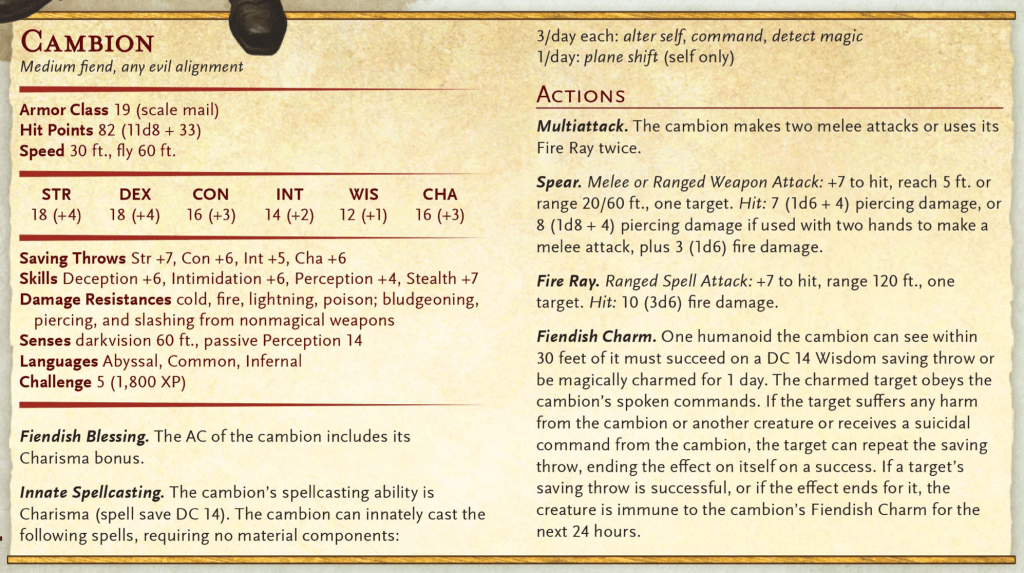
    The cambion, let’s call her Raja, flies forward until she is within range to cast Command on Lucy the vampire spawn. It is successful, and Lucy Halts. Raja swoops forward and finishes her turn. Lucy, held by the Command spell for one round, can take no action. 

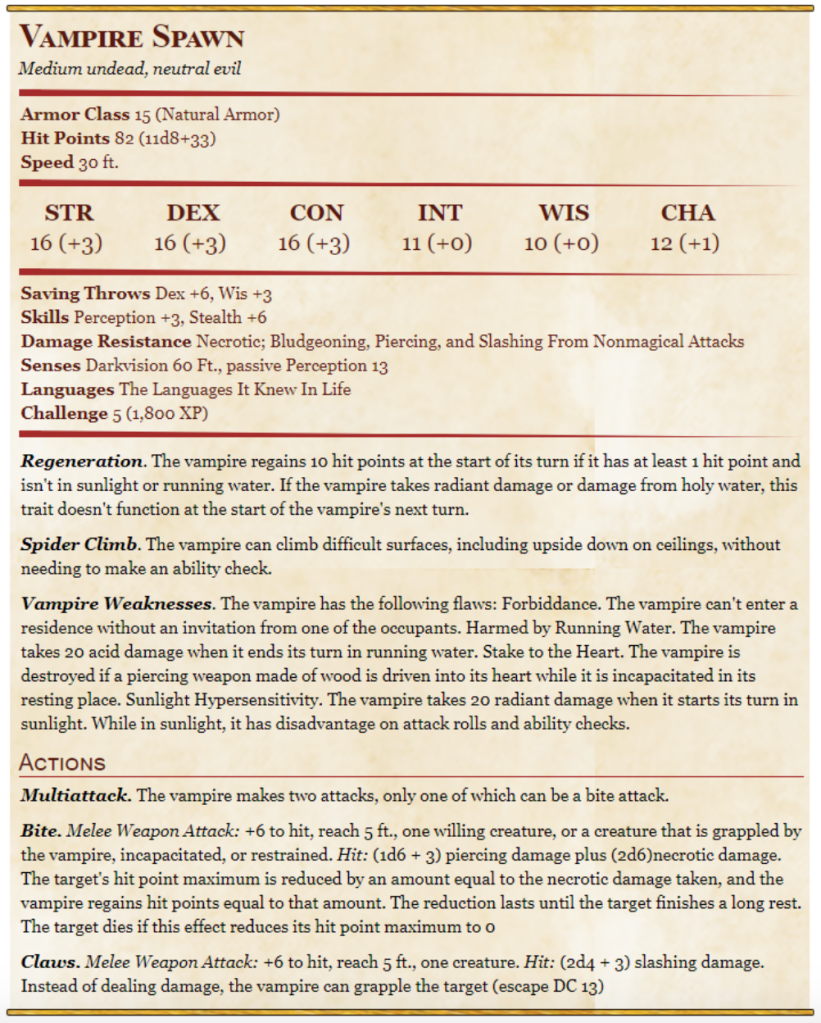
    On the next turn, Raja uses the ranged spell attack Fire Ray twice and deals damage before flying out of range of the vampire spawn. At the start of Lucy’s turn she regenerates 10 HP (something she will do at the start of each of her turns) and scuttles out of sight behind the pillar.

    Raja flies past the pillar to bring the vampire spawn back into view, but she isn’t there. Lucy held her action and used Spider Climb to scale the pillar until she was 20ft above the ground. When the cambion comes into range, she leaps forward and grapples the creature out of the air after succeeding on contesting strength rolls. Raja sustains fall damage and fails to break free of the grapple on her turn. The vampire spawn has now regained full HP thanks to the Regeneration ability and Bites Raja, dealing 19 points of damage. If she hadn’t already been at full HP, the necrotic damage done via Bite would have healed the vampire spawn. Lucy holds on to the Cambion and maintains her grapple.

    On her next turn, Raja breaks free and blasts Lucy with two Fire Rays before retreating to a safe distance. The vampire spawn once again scuttles behind the pillar.

    At this point, we paused to discuss how to resolve the hiding aspect of the vampire spawn's tactics. Because the cambion has 60ft of movement through the air compared to the vampire spawn's 30ft, there is no way for Lucy to close the gap. Hiding and leaping out as the cambion flies past is her best option. We decide to contest Stealth and Perception rolls when Raja and Lucy potentially have line of sight on each other.

    When Raja swoops past, she spots Lucy immediately and blasts her with 2 more Fire Rays. Lucy scuttles away and regenerates.

    On the next pass, Lucy surprises the cambion by falling from the ceiling. Their contested strength rolls match, so Lucy does not grapple Raja and the cambion is free to move. We imagine Lucy is hanging on to Raja’s foot. Raja flies up as high as she can and kicks the vampire spawn off with a contested roll, Lucy takes 40ft of falling damage (4d6).

    The game of cat and mouse around the pillar continues. The vampire spawn’s best tactic is to try and drag the fight out as long as possible. The cambion is below half HP; Raja is doing a lot of damage but has no way to heal, Lucy has taken a total of 140 points of damage, but Regeneration is keeping her in the game. If she can land another couple of surprise attacks, she could win this. 

    On Raja’s next pass Lucy drops on her from above and drives her to the ground dealing 20ft of falling damage, Raja grips Lucy’s wrist and casts Plane Shift. After a successful spell attack and a failed Charisma saving throw from Lucy, the vampire spawn is transported to a plane of Raja’s choosing. “Celestial,” the cambion says with an evil grin. Lucy lasts 12 seconds in the celestial realm, taking 20 points of radiant damage each turn before bursting into flames.

    The Takeaway

    Tricia aka Lucy the Vampire Spawn

    I tend to hack and slash my way through fights, whether as a player or the DM. This fight took that option away from me, since my speed was half that of my opponent, who could also fly! I had to get creative, which meant using Spider Climb to hide and surprise attack the cambion. Having Regeneration was a (literal) lifesaver, and if it weren't for that stupid Plane Shift spell, I maintain that I would have won!

    Rachel aka Raja the Cambion

    Utilizing my movement advantage was key to this fight, so I was constantly flying close and retreating out of reach. It became apparent that I wasn't doing enough damage to the vampire spawn, and I was starting to take significant damage myself without a way to heal. It was nice to have Plane Shift in my back pocket, but because there were two checks, it was not a guaranteed win. This time, it worked in my favor. 

    WINNER: CAMBION