Tag: D&D

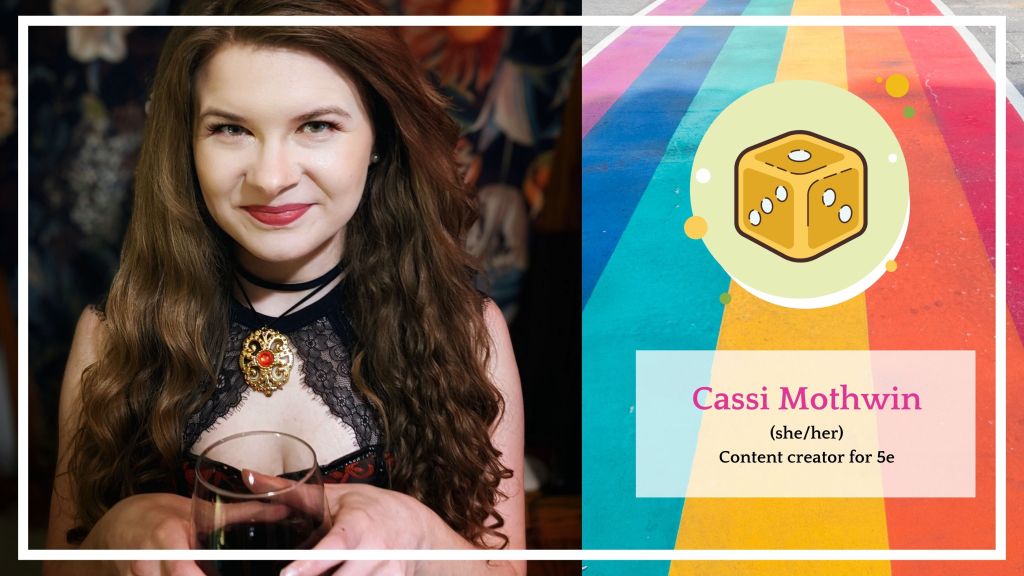
  • Adventure Queers:  Meet Skald of Shenanigans from Awfully Queer Heroes!

    Adventure Queers: Meet Skald of Shenanigans from Awfully Queer Heroes!

    Em (She/Her) goes by Skald or Skald of Shenanigans and is an avid player, content creator and Game Master for TTRPGS. She is co-owner of Awfully Queer Heroes with Kel, which runs a live play podcast in addition to creating Dungeons and Dragons content, all of which promotes LGBTQA+ representation. When she’s not playing games, Skald currently spends time in pursuit of her PhD in mythological studies while balancing work and outdoor hobbies in the mix. She loves a good story, a hike in the woods, or a game session. She currently works on her own small supplemental content in addition to working with Awfully Queer Heroes, and is a player on their latest “Tower of the Soul” podcast.

    @AwfullyQHeroes
    (Awfully Queer Heroes)

    https://www.awfullyqueerheroes.com/


    What were your first experiences playing D&D like?  What has kept you interested in the game?

    My experiences with D&D took some time to build momentum. When I had only just learned to read, one of my school friends had an older brother who had the original Monster Manuals, which I used to spend hours poring over despite barely being able to read a word. The first game I played didn’t come until high school when I joined a mini-campaign with yet another school friend, whose father happened to be a professional DM. Being able to take on a different persona – to build and play a unique character – and to work our way through an adventure of endless possibilities was absolutely captivating in the best way possible. I knew from then that not only did I want to continue to play, but to run campaigns of my own.

    Having some form of creative expression has always been important to me, and D&D is a critical part of that. Beyond just the creative elements, the social connections that can be made and strengthened through a good group can be wonderful. TTRPGs in general have since been a huge part of my life because of this. D&D was the creative outlet through which I was able to pull myself out of some rough spots in my past. Additionally, some of my most important friendships and human connections have been made in, and through, D&D. There is an endless potential for creative expression, collaboration, and human connection.

    You run the liveplay podcast Awfully Queer Heroes, which you’ve described as “pure queer chaos.”  Why do you think our readers should listen?  

    First of all, it’s a ton of fun. The group has excellent chemistry, the Dungeon Master is fantastic, and there is no shortage of laughs and ridiculous shenanigans thrown in with the more dramatic aspects of the adventure. Part of what makes this podcast unique is the emphasis on queer elements, especially inclusion and representation. This is reflected not only in the identity and orientation of the characters but of the players as well. Some of the topics that have also naturally emerged as elements of the campaign include things like found family, chosen names, acceptance, and more.

    This particular campaign uses a module (Tower of the Soul) previously published by Awfully Queer Heroes. It is unique in that the players are aligned with the forces of “chaos”, playing races that are typically vilified in D&D and fighting against those who wish to bring order. It’s a good mix of fun and seriousness in the way it addresses the repeated issues of queer repression and ostracization. It’s a fun mix of advocacy and representation, mixed in with the kind of chaos that can ensue in any D&D session with no limit to crazy ideas, encounters, and unexpected yet hilarious outcomes.

    What episode do you recommend new listeners start with?

    Anyone who wants to dive in can’t go wrong with episode one. It sets the scene for the rest of the campaign, as well as giving listeners an introduction to the players in the podcast. However, for those wanting a bit more action and a straight-shot to the tower itself, episode two has a bit more combat and excitement. There are some small details that might be missed, however, so I would say the best place to begin, is quite simply at the beginning.

    How do you think queer storytelling makes a difference to D&D?

    I think it’s absolutely critical to get more queer representation into D&D. Firstly, because as in many other areas there is a not insignificant lack of it. Not only having content that contains and promotes queer elements but also viewing storylines from that perspective is important not only for combating prejudice but also for increasing the amount of representation that can be found in these games. It’s additionally important for the experience of the players. Increasing the amount of queer storytelling in and behind these games is important when it comes to players being comfortable and able to explore and express their own unique identities. To not only feel like they have the freedom to play in a setting that is welcoming to them, but to also feel comfortable in their own identity in
    the play environment.

    As a queer person, have roleplaying games helped you explore or express your queer identity?

    Absolutely. At the time I started playing, I hadn’t actually identified myself as a sapphic. I frequently played male characters, mostly because I played in games with people who at the time identified as cisgender heterosexual, and I discovered that in playing a male I wasn’t underestimated in the same way I often was if I played a female character. Additionally, I found myself drawn to other female characters and playing a male made that acceptable.

    Exploring different gendered roles and norms, being able to take on a different persona and explore those things in an environment where it was ‘socially acceptable’ for me to do so, were some of the steps on my own journey to coming out as a sapphic. Even presently, playing characters of different identities is a way of exploring my own persona, and expressing different aspects of myself.

    You also make queer content on Kickstarter.  What can you tell us about your creations?

    There are a number of different projects up on Kickstarter, including the “Tower of the Soul” which is a level 1-20 adventure geared towards queer representation. Additionally, there is the “Sun Blades” spells and subclasses. The adventures, spells and subclasses all contain elements of queer representation (spells such as “Rainbow Bridge” and “Summon a Protective Lesbian”) or structure (such as in the “Tower of the Soul”) that is made specifically around increased queer representation and storytelling. Digital copies of previous Kickstarter content is also available on the Awfully Queer Heroes website.

    What are you currently working on/selling?

    We are extremely excited for our next project, which is “Adventures in ADHD”. The Kickstarter went live on Tuesday, March 23, and it is the largest we have done yet. The adventure is designed for levels 5-6, and is set in the Feywild. The party will adventure through a serious of quests to help an overwhelmed member of the Fey who quite literally ‘borrows’ their attention, giving them certain ADHD traits in return. In this adventure the sub-classes, spells, and quests are all designed to help educate players about the wide spectrum of ADHD symptoms while having fun along the way. There has been a lot of input on the project, as it is a topic that we want to do in a way that is respectful and accurate. The response from reviewers and play testers alike has been overwhelmingly positive. It’s been additionally exciting to work on as it has a lot of content, including amazing artwork, STL files, token, maps, and more.

    Do you have any recommendations of queer nerdy content that you would like people to know about?

    The TTRPG sphere on Twitter is a surprisingly (for social media) positive space for creators and players alike. The number of projects people are working on and content that is being created is absolutely mind blowing. I would highly recommend the live play Pathfinder podcast from Bad Heroes (@BadHeroesCast), they are a fantastic crew and really fun to listen to.


    Sign up for Roar Cat Reads’ Monthly Newsletter

    Every month one subscriber wins a prize!

    Processing…
    Success! You're on the list.

    By clicking submit, you agree to share your email address with the site owner and Mailchimp to receive marketing, updates, and other emails from the site owner. Use the unsubscribe link in those emails to opt out at any time.
  • DM’s Pocket Guide Ep 8: Goblins

    DM’s Pocket Guide Ep 8: Goblins

    It's Goblin time!  These classic low-level monsters are just as likely to end up adopted by your party as they are to be killed.  What makes goblins so fun?  We dig into the Monster Manual and discover some fun facts about everyone's favorite mischievous creatures! We’re Tricia and Rachel from Roar Cat Reads.  If you would like to learn about a specific D&D rule or spell, send us a request at roarcatreads@gmail.com.  Please like, review, and share to support DM’s Pocket Guide! Transcripts of every episode are available!   If you want more rules, buy a copy of the Player’s Handbook! Follow us on Twitter and Instagram  Artwork by Haley Boros DM’s Pocket Guide is unofficial Fan Content permitted under the Fan Content Policy. Not approved/endorsed by Wizards. Portions of the materials used are property of Wizards of the Coast. ©Wizards of the Coast LLC.

    Transcription

    Welcome to DM’s Pocket Guide, where we discuss the rules, spells, and monsters of Dungeons and Dragons, 5th edition.

    Tricia: Today we are going to talk about goblins!

    Rachel: Goblins. Gobbos.

    T: Little gobbos! They are on page 165 and 166 of the Monster Manual. They are, you know, stereotypical goblins. It’s usually in the first couple of adventures that happen in a D&D party, you’re gonna run into some goblins. But how well do you actually know them?

    R: I mean, I think pretty well.

    T: Well, let’s see. We’re gonna start with their stat block and then move into the story. So goblins are small humanoids that are neutral evil.

    Rachel: Oh, just straight out evil. But neutral about it.

    T: Yeah, they’re not particularly lawful or chaotic, just out for themselves.

    R: Middle of the road evil.

    T: Yeah. They have an armor class of 15 with only 7 hit points. 

    R: Squishy.

    T: Very squishy, and a speed of 30 feet. So pretty normal. As far as their individual ability stats go, they’re strongest in dexterity, and everything else is pretty average or bad.

    R: Yeah, so if you’re thinking of them as small little nimble creatures.

    T: Yes. And specifically stealthy, because their only skill is that they have a +6 to Stealth.

    R: Oh, wow. That’s pretty good. 

    T: They also have dark vision and a passive perception of 9, which is not good.

    R: No, that’s not. You can definitely sneak up on a goblin.

    T: Yes. But they are going to be able to see in the dark, which you may or may not, especially if you’re playing like level one characters.

    R: Okay. Oh, yeah. Darkvision up to 60 feet.

    T: Yeah. They can speak Common and Goblin. So you can do what you want with that.

    R: Oh, yeah, that’s interesting. I definitely had where I’ve had my players encounter goblins, and then had a language barrier between them. But I guess what this is saying is the goblins can make themselves understood to human or yeah, to speak Common if they want to.

    T: And then they have a challenge rating of 1/4. So as we said before, extremely squishy.

    R: It’s almost as low as it goes.

    T: Yes. Goblins have a feature called Nimble Escape, which fits in with what we know of them, where the goblin can take the Disengage or Hide action as a bonus action on each of its turns.

    R: Oh, that’s cool. I can imagine like a goblin running up and attacking and then like kicking someone in the shin and running away and hiding, right?

    T: Yes, yeah. So that’s going to be I think the thing that often is missed with goblins that we will come back to. These are not creatures that are just going to stand there and fight to the death. They’re going to try to get in, there get out.

    R: Yeah, goblins have high sense of self-preservation. 

    T: Yes. And as far as actions go, they have both a scimitar and a short bow that they can use to attack. They only get +4 to hit and +2 on their damage. So they’re not the strongest, but they do have both melee weapons and long-range weapons.

    R: And they’re rolling a d6 with the damage plus their Dex scores.

    T: So as you’re playing goblins, I think the thing to note is they are not very strong individually. So goblins, if you’re using them in your games, it is going to be about the number – the quantity – of goblins, not the quality. They’re a good one to have waves upon waves if your characters accidentally wipe them out too quickly. You’re like, ah, six more goblins pour out of the tunnels!

    R: Ambushes, I think. That works in the goblin favour. If you think of the sneakiness and their want for self-preservation. They’re always going to make sure that odds are in their favor before they do something.

    T: Yeah, I think self-preservation is a good term to keep in mind with goblins. They are not going to just run out and die in big heaps. They’re going to try to overwhelm players and try to get out of there if they sense that they’re not going to win. So as far as the kind of lore around goblins goes, which is on 165 of the Monster Manual, goblins are described as small, black-hearted, selfish humanoids. They live in caves, abandoned mines and despoiled dungeons. So that makes them ideal D&D characters. This also specifically mentions that they’re individually weak, but they do gather in large groups. So that is where their power comes from. They have related beings like hobgoblins and bugbears that are their stronger cousins. These are the creatures that often end up as like the warlords or the chieftains of goblin tribes.

    R: Yeah, I’ve definitely seen a few adventures with that kind of dynamic setup already.

    T: I do think that’s a good way to go of, oh, it’s five goblins and one hobgoblin or mixing things up a little bit. Goblins are also just super cute, in my book, because the next section is called “Malicious Glee.” They’re motivated by greed and malice, and they can’t help but celebrate the few times they have the upper hand. They dance and caper with sheer joy when victory is theirs. So I think some of these qualities are why I have definitely played in a couple of campaigns where goblins were adopted by the adventuring party.

    R: And once you get past a certain level of like, player character level and goblins just don’t pose any kind of threat, the lean towards adoption is very great.

    T: Yes, yes. Some interesting bits that are also mentioned is the fact that goblins tend to festoon their lairs with alarms designed to signal the arrival of intruders. And they also have narrow tunnels, bolt holes, continuing with that theme of – goblins are always looking for a way out. So I think when designing places and locations where goblins are, it’s good to keep that in mind, that they are going to have some sort of system setup to try to like warn themselves of intruders and they’re going to have a backup plan of how to get away. 

    R: Yeah, for sure. 

    T: And then they also are noted to have an affinity with rats and wolves, which I feel like I have seen goblins and wolves, but not so much rats.

    R: Oh, interesting. I think I’ve seen either, actually.

    T: Like, you know, like goblins on wolves – wolf riders. Lord-of-the-Rings-esque, the wargs!

    R: Oh, right. Yes. Okay. I think of those things as goblins. I suppose I should.

    T: So I like that as just kind of flavor that you can always kind of have some rats and wolves in a goblin lair. That’s nice. And then the most unusual thing that I had never heard about was that goblins worship Maglubiyet.

    R: Mag-what? I’m sorry. 

    T: Maglubiyet.

    R: Maglubiyet.

    T: The mighty one, the lord of depths and darkness.

    R: Oh my goodness.

    T: And so this is the god of goblinoids, which is pictured as an 11-foot tall battle-scarred goblin with black skin and fire erupting from his eyes.

    R: Wow.

    T: Yeah.

    R: Maglubiyet.

    T: He’s worshipped not out of adoration, but fear. And in fact, goblins believe that when they die, their spirits will join in his army. And they don’t want that to happen. They fear this.

    R: Oh, so they want to live as long as possible. Yeah.

    T: Yeah! Which is also really sad. These poor guys are anticipating, like, an eternity of service to this terrifying warlord.

    R: Wow, that is really good motivation to stay alive.

    T: Yes. And I do also like – I don’t ever think of goblins as religious creatures. So I think that is an interesting way to incorporate some of that in there. Like I’m picturing players dressing up as  Maglubiyet and scaring the bejeezus out of them.

    R: Oh, man, if we found your next Halloween costume?

    T: Yes, Maglubiyet! And that is Goblins, on pages 165 and 166 of the Monster Manual.

    Thanks for listening!  If you have something you’d like us to cover, email it to roarcatreads@gmail.com or find us on Twitter and Instagram @roarcatreads. 

  • Adventure Queers: Meet Nicole!

    Adventure Queers: Meet Nicole!

    Hi, my name is Nicole (She/Her). I am a multipotentialite, world-traveler, podcaster, aspiring comedian, and nerd just trying to make the best of life in this mortal realm. One of my favorite pastimes is getting together with friends and playing board games or D&D, it’s a great way to connect with others and disconnect from everything else. You can find me on social media as @itswafflebitz.


    Nicole, you have said that you enjoy playing D&D “with the right crowd.” I can definitely relate!  What does that mean to you?  

    Those rare times I play D&D, I love for the energy in the room to just be sort of… chaotic. I really enjoy being able to just be silly and do absurd things in-game and enjoy it even more when the people playing with me can match that energy. Feeling this “vibe” in the group creates a judgment-free, safe space to just let go and have fun for a few hours.

    As a queer person, have roleplaying games helped you explore or express your queer identity?

    When I first started playing games like D&D, I experimented with my different character’s gender expression & identity. I was still trying to figure myself out in real life, so playing those characters and seeing how supportive the people around me were of that helped me become more comfortable in real life. 

    We love a gamer at Roar Cat Reads, and you are into both board games and video games!  What are some of your favorites, and why?

    I have played 100’s of board games so it’s hard to name just a few, but some of the games I keep coming back to are: Parks, Betrayal at House on the Hill, and Codenames. These have a lot of replayability and are easy to teach. As for video games, I enjoy a game with a well-written story. One of my favorite games is the Walking Dead series from Telltale Games and a great co-op game I played recently is “It Takes Two”. 

    I hear you’ve got a podcast in the works.  What can you tell us about it?  When can we expect it to be released?

    My friend Allonté and I are in the process of creating our podcast, The Imperfect Matters. In our podcast, we talk about societal issues that are far from perfect but really matter. The tone is a healthy balance of informative, comedy, and satire. There is no release date yet, but we have a few episodes already recorded and aiming to release this year (2022).

    In addition to your nerdy interests, you’re a frequent solo traveler.  What are some of your favorite travel destinations?  Do you find that you travel differently when you’re on your own?

    On my first solo trip, I spent 2 months traveling around parts of SE Asia. It was so nerve-wracking leaving the comfort of my country and having to figure things out in a completely new environment. That trip holds a special place in my heart because I literally consider it life-changing. I now love and prefer traveling solo because not only is it easier to meet wonderful people along the way, but also it feels so empowering, especially as a female. Traveling with others can be fun, but there’s always the issue of managing multiple itineraries and schedules, and it’s more difficult to be spontaneous and take as long as you want to do certain activities. Meeting new people can also be difficult when traveling with others because you’re more likely to stick together. I have solo traveled to Mexico, Germany, and Sweden since that trip and have many more to come. 

    Do you have any recommendations of queer nerdy content that you would like people to know about?

    YES. I’m a huge fan of the Avatar the Last Airbender & Legend of Korra universe. There is a TTRPG from Magpie Games coming out very soon that I backed on Kickstarter set in this universe. I’m really looking forward to playing it. 


    Sign up for Roar Cat Reads’ Monthly Newsletter

    Every month one subscriber wins a prize!

    Processing…
    Success! You're on the list.

    By clicking submit, you agree to share your email address with the site owner and Mailchimp to receive marketing, updates, and other emails from the site owner. Use the unsubscribe link in those emails to opt out at any time.

  • DM’s Pocket Guide Ep 7: Schools of Magic

    DM’s Pocket Guide Ep 7: Schools of Magic

    Schools of Magic DM’s Pocket Guide

    We had to learn the Schools of Magic to play the spell “Detect Magic” correctly (see last week’s episode), and we discovered some pretty cool tidbits, like the fact that Resurrection is a necromantic spell! We’re Tricia and Rachel from Roar Cat Reads.  If you would like to learn about a specific D&D rule or spell, send us a request at roarcatreads@gmail.com.  Please like, review, and share to support DM’s Pocket Guide! Transcripts of every episode are available!   If you want more rules, buy a copy of the Player’s Handbook! Follow us on Twitter and Instagram  Artwork by Haley Boros DM’s Pocket Guide is unofficial Fan Content permitted under the Fan Content Policy. Not approved/endorsed by Wizards. Portions of the materials used are property of Wizards of the Coast. ©Wizards of the Coast LLC.

    Transcription

    Welcome to DM’s Pocket Guide, where we discuss the rules, spells, and monsters of Dungeons and Dragons, 5th edition.

    Rachel: Okay, so today we are going to be talking about the Schools of Magic. This is a bit of a follow up to Detect Magic, we had to learn the schools because of that particular spell. So let’s get into it. A nice summary of this appears in a box on page 203 of the Player’s Handbook, and it goes through the Schools of Magic. “Academies of magic group spells into eight categories, called Schools of Magic. Scholars, particularly wizards, apply these categories to all spells, believing that all magic functions in essentially the same way, whether it derives from rigorous study or is bestowed by a deity.”

    Tricia: So this calls into, if you play a wizard, at the second level, you can like choose your particular school of magic, which there are these eight. And then as you’re playing through your wizard character, you like develop skills and stuff based on that. I have never actually played a wizard, so this also contributes to why I’m not very familiar with these different Schools of Magic. But the – I think the idea is that probably in the past, when wizards were like the big D&D thing, they created these, and then they were like, “Oh, also, just like all magic fits into these schools.”

    R: Yeah, I recognize a lot of these categories from like playing Skyrim, or any kind of like, strategy game like that. It goes on to say the Schools of Magic help describe the spells but have no rules of their own, even though there are some rules that refer to the schools of magic.

    T: Yeah, so these are just categorizations. They’re not actually doing anything. It’s just kind of helping you to be like, “Ah, this goes under that category.”

    R: Exactly. Okay. So the first one is Abjuration. “Abjuration spells are protective in nature, though some of them have aggressive uses. They create magical barriers, negate harmful effects, contrast passes, or banish creatures to other planes of existence.”

    T: So some examples of that would be like Remove Curse. Yeah, also Aid, so that’s kind of like a positive way. Aid, you’re doing a protective barrier thing. Remove Curse, you’re removing something harmful. A favorite, Counterspell, is an abjuration spell. So just like, nope! Abjuration are the Nope spells.

    R: Changing something. Okay.

    T: Nope, not changing things, just blocking things.

    R: Blocking things. Okay. Conjuration comes next. “Conjuration spells involve the transportation of objects and creatures from one location to another. So the spells summon creatures or objects to the caster’s side, whereas others allow the caster to teleport to another location. Some conjurations create objects or effects out of nothing.”

    T: So this would be like your Find Familiar.

    R: Okay, yeah.

    T: Bloop! Your familiar pops up into existence. Also, like Conjure Animals, Conjure Celestial. There’s a whole bunch of ‘Conjure.” Surprisingly, it’s a conjuration spell. But this would also include like Mage Hand. Yep, it’s coming out of nothing, conjuring it, and also Entangle. So you’re conjuring the plants out of the ground. This is one that I could actually see it maybe fitting in some others, but it is technically a conjuration spell.

    R: Okay, yeah, it sounds like there might be a few that had a bit of a crossover. Next one is Divination. “Divination spells reveal information, whether in the form of secrets long forgotten, glimpses into the future, the locations of hidden things, and the truth behind illusions or visions of distant people or places.”

    T: So this is Clairvoyance. This is Scrying. Those are kind of classic divination staring into a teacup things.

    R: Detect Magic is a divination spell. 

    T: Uggggh.

    R: Man, the snake eats its tail, I tell you.

    T: Yeah. But it’s also Comprehend Languages, which is sure. And Speak with Animals.

    R: Okay. Yeah, revealing information, being able to understand. Yeah, okay, that’s cool. “Enchantment spells affect the minds of others influencing or controlling their behavior. Such spells can make enemies see the caster as a friend, force creatures to take a course of action, or even control another creature like a puppet.”

    T: Yeah. So some of those would be Calm Emotions, Command – you can just make somebody do something – also Sleep and Animal Friendship.

    R: My cleric from Curse of Strahd is feeling very attacked right now.

    T: Enchantments! Sorry, that was a Dragon Age joke.

    R: Yes, I haven’t played that series, unfortunately. “Evocation spells manipulate magical energy to produce a desired effect. Some call up blasts of fire or lightning and other channel positive energy to heal wounds.”

    T: So yeah, so this is like super most basic magic: Fireball, Burning Hands, Cure Wounds, Eldritch Blast. Anything that’s like Kapow!

    R: Okay, so all of this stuff you would, yeah, use – I see all of these things being used regularly. These are all evocations. Okay, cool. I don’t think I would have known that. “Illusion spells, deceive the senses or the minds of others that cause people to see things that are not there, to miss things that are there, to hear faint noises or to remember things that never happened. Some illusions create phantom images that any creature can see. But the most insidious illusions plant an image directly into the mind of a creature.”

    T: Your Curse of Strahd character might be feeling called out now too. This would be like Disguise Self, Invisibility. But also fun ones like Color Spray.

    R: Huh, fun times.

    T: So anything illusory. That one feels pretty self-explanatory.

    R: Okay, the next one we’ve got is Necromancy. “Necromancy spells manipulate the energies of life and death. Such spells grant an extra reserve of life force, drain the life energy from another creature and create undead, or even bring the dead back to life. Creating the undead through the use of necromancy spells such as Animate Dead is not used by good casters and only evil casters use such those frequently.” This is a bit of a moral…

    T: Yeah, it’s interesting that that’s the only one that has that caveat when you could probably say, if you’re evoking Fireball on innocents, that’s also bad? You know, I don’t know, it’s an interesting thing. But necromancy is divided into these two categories, basically, where it’s either interacting with the dead in a negative way – Animate Dead, Raise Dead – but also, like, Chill Touch does necromantic damage. But it’s also – Resurrection is a necromancy spell because you’re just raising your own party from the dead and it’s therefore okay, versus raising the undead for dealing damage? That’s what your party is gonna do. It’s, uh, it’s kind of weird.

    R: Yeah, that’s interesting that these spells also fall under necromancy.

    T: Yeah. Also Clone. Clone is a necromancy spell.

    R: Oh, yeah. Okay, I mean, I guess under the context, that makes sense. Okay, but the last one we have is Transmutation spells. I believe this used to be called Alteration. I was once corrected on this, that I was quoting 3rd edition even though I’ve never played it. It’s now called Transmutation. And these “change the properties of a creature, object, or environment. They might turn an enemy into a harmless creature, bolster the strength of an ally, or make an object move at the caster’s command, or even enhance the creatures innate healing abilities rapidly recover from an injury.”

    T: Yeah, so that is Barkskin. You’re transmuting your own skin to be protective. This is Control Water. It’s also like Telekinesis.

    R: Okay, yeah, that makes sense.

    T: So those are the Schools of Magic.

    R: Page 203 in the Player’s Handbook.

    Thanks for listening!  If you have something you’d like us to cover, email it to roarcatreads@gmail.com or find us on Twitter and Instagram @roarcatreads. 

  • DM’s Pocket Guide Ep 6: Detect Magic

    DM’s Pocket Guide Ep 6: Detect Magic

    Detect Magic DM’s Pocket Guide

    Today’s episode is about our least favorite spell – Detect Magic!  Find out why it’s the worst by listening today.  Let us know if you agree or not by messaging us @roarcatreads.  I want to know the Detect Magic discourse! We’re Tricia and Rachel from Roar Cat Reads.  If you would like to learn about a specific D&D rule or spell, send us a request at roarcatreads@gmail.com.  Please like, review, and share to support DM’s Pocket Guide! Transcripts of every episode are available!   If you want more rules, buy a copy of the Player’s Handbook! Follow us on Twitter and Instagram  Artwork by Haley Boros DM’s Pocket Guide is unofficial Fan Content permitted under the Fan Content Policy. Not approved/endorsed by Wizards. Portions of the materials used are property of Wizards of the Coast. ©Wizards of the Coast LLC.

    Transcription

    Welcome to DM’s Pocket Guide, where we discuss the rules, spells, and monsters of Dungeons and Dragons, 5th edition.

    Rachel: Okay, so today we’re going to be talking about Detect Magic, which is a spell that can be found on page 231 of the Player’s Handbook.

    Tricia: This is my least favorite spell.

    R: Yeah, one of mine too. It’s definitely one that, as a DM, suddenly comes with a lot of things that you have to know. 

    T: Let’s hear what some of those things are. 

    R: Okay, so read the spell first of all. This is a first-level divination ritual. So it’s first level. So your players might have this very, very early on and sometimes want to spam it.

    T: Yeah. Yeah, I mean, because they can.

    R: Because they can. Absolutely. So the casting time is one action. The range is something that you cast on yourself to try and detect the magic around you. It has a verbal and-

    T: So what is the range? 

    R: The self. 

    T: Oh. Is it of what you can see?

    R: You cast it on yourself to be able to detect the magic around you. And has a verbal and a somatic component, so you have to be able to speak in order to cast this, and you have to be able to make whatever movement it is that allows you to spell it, so if you are restrained in some way, you might not be able to cast Detect Magic. The duration is concentration up to 10 minutes, so this is a spell that can last a bit of time too.

    T: They could like literally walk through an entire building, looking at everything and detecting any magic.

    R: Yeah, an experience that I might have had once was a player that did cast Detect Magic, and then just runs around as much as they can. That really kind of can mess with your plan as a DM, you know, things that you need to reveal. And suddenly, the only thing you can focus on is trying to reveal all of the magical things to this player as they are, you know, running around like a crazy – or like, remember those 90s point-and-click games where you couldn’t find the trigger.

    T: Yes.

    R: And you just clicked literally everywhere on your screen. Yeah, that’s how I think players behave sometimes with this spell.

    T: Yes. Click, click, click, click, click. 

    R: Okay. But let’s get into the description. For the duration, you sense the presence of magic within 30 feet of you. If you sense magic-

    T: Oh within 30 feet. I knew there was something.

    R: Yeah, yeah, it’d be nice to have that somewhere a little bit early on but do you have to get into the description to work out how far they can see the magic. If you sense magic in this way, you can use your action to see a faint aura around any visible creature or object in the area that bears magic. And you can learn its School of Magic if any – so two things there. Faint aura. DMs, get ready to describe what kind of aura it looks like. And you might want it to be thematic for the School of Magic.

    T: It can go really deep, really fast. But I think some of the important things there are it is visible things. So if you want to hide something, like in a drawer, or like in a secret compartment, you wouldn’t be able to see it with Detect Magic.

    R: Ah!

    T: Ohhh.

    R: The spell could penetrate most barriers but is blocked by one foot of stone, one inch of common metal, a thin sheet of lead, or three feet of wood or dirt.

    T: Okay. So it’s literally you’d have to be buried underground, but you could see in like desk drawers and things because it’s not enough wood.

    R: Yeah, unless you had an inch of like a lead-lined drawer or something.

    T: So yeah, so I guess that’s in like world-building as a DM. If you really want to hide something from your players with Detect Magic, you have to prepare for it. I just find this spell so tedious. I hate it so much. Literally, I’ve read it many times, and I’ve already asked questions that are answered in the spell because my brain just refuses to learn it. I hate it. 

    R: Yeah, it is – I’m not gonna say it’s a game-breaking spell, because it’s definitely useful for the players. But I guess the thing I’m thinking about it is: if you have it, it makes any kind of searching the room for the hidden secret magical thing, super easy. But if you don’t have it, then your players might not find it. It’s one of these things that just like, it’s like switching the difficulty mode down when you’re stuck in a part of a video game or something.

    T: Yeah, yeah. And maybe that’s thing. Before I played with people who knew about this spell and used it often, I think we kind of addressed these situations by using perception checks or arcane checks of like, “Oh, I’m looking for magical things. Do I see an arcane energy?” and just as a DM it was like, “Yeah, I’ll help you out. You notice this or that.” But what I hate about this spell too is – the players that I’ve played with who, who knows things, they’re like, “Oh, well, don’t forget that my magical amulet would show up and that person’s magical weapon, and their, like, familiar that, like, all of literally every magical thing!” And it’s just like, ahh!!!

    R: Yeah, it’s so much information to hold in your brain as a DM when that is cast, because yeah, probably the biggest thing that’s gonna show up on Detect Magic are the other members in the party and you know, all of their different things. And if there’s some sort of magical item that somebody is trying to keep secret from the rest of the party, that’s going to show up.

    T: Right! 

    R: So yeah, so let’s add this to the DM’s mental juggling list. You’ve got all of the rooms and the things that are in the dungeon that you’re trying to run, all of your players and their various items and different things and oh, they want to keep this hidden – is this thing going to be a surprise? So congratulations, your player has cast Detect Magic, time to do some mental gymnastics. Or have to retcon like a whole bunch of things.

    T: Yes. So some ways to get around this would be to turn it back on the players. “Okay, you detect magic? Who’s got magical items on them?” Make them do the work for you.

    R: Describe how you show up; what kind of auras your character gives off under Detect Magic. That’s a good way to do it.

    T: Another way to save time and energy is because the aura is just one part. The other is you can determine the School of Magic of each thing.

    R: *Sigh*

    T: We’re gonna do a separate episode on Schools of Magic because that’s a whole thing. But something you can do if you, like us, are not super confident in knowing the Schools of Magic for every magical item in existence – turn it on the players as well. The one who casts Detect Magic say, okay, “So which Schools of Magic are you familiar with?” Because it’s not like it’s going to appear with a sign saying “Boop bo doo! School of Abjuration!”

    R: Here’s something you know nothing about. 

    T: Right. 

    R: So for wizards, this makes sense, because in the wizard section of the Player’s Handbook, it sort of describes that you are a knowledgeable scholar with, you know, knowledge of all of these different Schools of Magic. They are going to be familiar with the different Schools of Magic, but if I’m playing a cleric or a bard- 

    T: Or a fighter! 

    R: Yeah, the fighter class that could get a bit of magic, like, what are they going to know about Schools of Magic? Like, would they care? Or is it just going to show up as magic of some kind?

    T: Yeah. So, this spell sucks. I mean, I think to be fair, there’s probably some cool ways to do it. Like magically revealing something that a character’s wanting to keep secret is kind of cool. You could do some fun stuff with that. But it basically just does require so much mental work for DMs to remember, basically everything. It’s very difficult, and I don’t like it.

    R: Me either, but that’s Detect Magic on page 231 of the Player’s Handbook. May it never appear in your games.

    Thanks for listening!  If you have something you’d like us to cover, email it to roarcatreads@gmail.com or find us on Twitter and Instagram @roarcatreads. 

  • DM’s Pocket Guide Ep 5: Character Creation – Ability Scores

    DM’s Pocket Guide Ep 5: Character Creation – Ability Scores

    Character Creation: Ability Scores DM’s Pocket Guide

    True story, we didn’t know there were multiple ways to roll character stats until our first charity event when someone specified, “Standard array.”  Yikes, was there another option??  Turns out yes!  Embarrassingly, the rules we discuss are right at the beginning of the Player’s Handbook.  You probably don’t need this, but if you do…there’s no shame.  Listen now to your official character creation ability scores options! We’re Tricia and Rachel from Roar Cat Reads.  If you would like to learn about a specific D&D rule or spell, send us a request at roarcatreads@gmail.com.  Please like, review, and share to support DM’s Pocket Guide! Transcripts of every episode are available! If you want more rules, buy a copy of the Player’s Handbook! Follow us on Twitter and Instagram  Artwork by Haley Boros DM’s Pocket Guide is unofficial Fan Content permitted under the Fan Content Policy. Not approved/endorsed by Wizards. Portions of the materials used are property of Wizards of the Coast. ©Wizards of the Coast LLC.

    Transcription

    Welcome to DM’s Pocket Guide, where we discuss the rules, spells, and monsters of Dungeons and Dragons, 5th edition.

    Rachel:  Okay, so today we’re talking about determining character ability scores as part of character creation.

    Tricia:  Yes, this was something that I didn’t actually realize there multiple ways of doing it, because I just used D&D Beyond stuff where it’s like, “Here’s your standard array, put them accordingly.”  I think that’s what you taught me, because that’s what you knew.  So I didn’t know there were other options until we started playing with different people and they were like, “Do you want to do standard array or this or this?” and I was like, “Wha-ha-ha-ut?”

    R:  Yeah, so there’s three different ways to go about doing this.  The first way that’s in the book is the chaos way.  It says you generate your character’s six ability scores randomly by rolling four 6-sided dice and recording the total of the highest three.  So roll four, discard the lowest one.

    T:  That prevents you from getting truly abysmal characters?

    R:  Uhhhh, yeah, well, no, actually.  This is the most chaotic method of doing it, because there is the possibility of you rolling four 1s and having a character with an ability score of 3.

    T:  That’s true.  But by having the fourth dice, it is trying to prevent that as much as possible.

    R:  Yeah.  The law of averages should even you out to something nice and rounded.  It’s true the other way as well, that you could end up with – the highest score possible with this is 18, which is way way up there.  So yeah, if you enjoy chaos, I know this is a good method for, maybe if you don’t know what kind of character you want to make, you can roll the dice and have them decide.  So if you ended up with a really high strength score and a really high charisma score, well that’s leaning toward a paladin.  So yeah, that’s one way to do it.

    T:  I like this.  I haven’t done this way yet, and I now want to, cuz it appeals to me in that – biological determination, that this way is, well you’re just given these sets of skills.  What do you make with them?  Versus what we will talk about next.

    R:  Okay, well maybe there’s a game in our future with that.  The next one is the standard array.  There is a set of six figures that you will apply to your ability scores – 15, 14, 13, 12, 10 and 8.  So that way you’re guaranteed to get a couple of good scores, a couple of bad scores, and a couple of mediocre kinds of things.  It’s the most even way of distributing your ability score points.

    T:  Yeah.

    R:  Yeah.

    T:  I’m trying to think if there’s much to say about it other than that is very even and controlled.  It’s the easiest way to make sure you have a balanced party.

    R:  Or a balanced character, at least.

    T:  Well, but party too!  Cuz then you’re guaranteed that there isn’t going to be that one character that’s so powerful or so tragic.

    R:  That’s true, but I mean, this is before we apply any sort of racial bonuses to it, so you could still end up with a character that piles everything into a single – 

    T:  Yes, but then they’re still only guaranteed a single really good thing.  The foundation is the most even.  

    R:  No, I agree with that, for sure.  And then the last one is a variant way of addressing ability scores.  This is the point-buy system.  I think this is the one that D&D Beyond steers you towards straight away, is the point-buy.  The way it’s described in the book is a little counterintuitive in the age of technology when you can literally just click up and down on a thing.  You have 27 points to distribute.  Everything starts with, I believe an 8, and then you buy up with the different scores.

    T:  You’re looking at me like I should know, but I literally always just choose standard array when I make a character on D&D Beyond.  

    R:  Oh, interesting.  I’ve always been funneled into point-buy.

    T:  Well, keep telling me about it.

    R:  So with point-buy, in the book it’s limited to the highest score you can get is 15, so similar to standard array.  It puts that limitation on there.  You can’t get above that, above that number.  It allows for a bit more customization, so if you wanted to be really good in two skills, you could buy them both up to a 15, and then have like, two really bad ones.  So yeah, if you want to create a character that is all about something and has nothing to do with something else, then this is the way to do it.  

    T:  So it’s still even in that you can’t just be like, “I’m perfect at everything!”  But you can be much better at more skills, so long as you’re willing to compromise by being much worse at more skills.

    R:  Yeah, exactly that, yeah.

    T:  Okay, and where is all of this information?

    R:  This is all very early on the Player’s Handbook.  Page 13 in the Player’s Handbook. 

    T:  Page 13.  So with this one in particular, I do want to just end by summarizing:  On page 13, there’s three different ways to determine your ability scores when you’re character creating.  There’s the chaos method where you use four d6s and use the highest of three, and that’s the most chaotic.  There’s the standard array, which those numbers are in the book.  You have to choose those and allot them to different abilities.  And then there’s the point-buy system where you have 27 points and you can determine how you want to allot those points to different skills.

    R:  Yeah.

    T:  Alright!  Well, let’s make some characters!

    R:  Okay!
    Thanks for listening!  If you have something you’d like us to cover, email it to roarcatreads@gmail.com or find us on Twitter and Instagram @roarcatreads. 

  • DM’s Pocket Guide Ep 4: Owlbears

    DM’s Pocket Guide Ep 4: Owlbears

    We are extremely fond of owlbears over here at Roar Cat Reads, and learning that they are stinky beasts whose habitats are littered with the decaying bodies of their prey only made us fonder. We’re Tricia and Rachel from Roar Cat Reads.  If you would like to learn about a specific D&D rule or spell, send us a request at roarcatreads@gmail.com.  Please like, review, and share to support DM’s Pocket Guide! Transcripts of every episode are available! If you want more rules, buy a copy of the Player’s Handbook! Follow us on Twitter and Instagram  Artwork by Haley Boros DM’s Pocket Guide is unofficial Fan Content permitted under the Fan Content Policy. Not approved/endorsed by Wizards. Portions of the materials used are property of Wizards of the Coast. ©Wizards of the Coast LLC.

    Transcription

    Welcome to DM’s Pocket Guide, where we discuss the rules, spells, and monsters of Dungeons and Dragons, 5th edition.

    Rachel:  Okay, so now we’re gonna talk about Owlbears on page 249 of the Monster Manual. 

    Tricia: I love owlbears. 

    R:  Yeah, they are pretty good. Fun fact about owlbears is they are a large monstrosity.

    T:  Oh, a monstrosity. 

    R:  Not a beast. 

    T:  Interesting. Yeah I definitely would have assumed that they were a beast.

    R:  Yeah. So this is important for druids who wish to Wild Shape into creatures.  They can only Wild Shape into beasts, not into monstrosities. 

    T:  Okay, so no druid is turning into an owlbear. 

    R:  Yeah. And they are unaligned. They aren’t neutral, they aren’t even anything. They’re not evil, not good; they’re not chaotic. They are just unaligned. Owlbears have an armor class of 13, so pretty low.  And they have 59 hit points. So kind of up there – pretty tough. You take a lot of damage. And they can move 40 feet – 

    T:  So faster than the average character. 

    R:  Yeah, definitely faster than level one characters, they can be outrun by an owlbear.  For their individual characteristics, strength is up there with a nice +5. These things are immense hulky things.   I’ll probably point out at this point that it is an owl head on a bear body, not a bear head on an owl body. 

    T:  Yeah, they got those powerful bear limbs – so strong!

    R:  Yeah, and a big fierce beak. So yeah, big strength makes sense. Big body of a bear.  They aren’t very smart; they’ve got a -4 for their intelligence. Not charismatic either, unsurprisingly.  And just like reasonably dextrous. They get a +3 to Perception. You can imagine, like keen eyesight, keen senses. 

    T:  They’re probably gonna see you coming.

    R:  Yeah, they’re gonna know you’re there. 

    T:  Okay. 

    R:  They’ve dark vision up to 60 feet. So, even if it’s dark and you’re in their lair, they’re gonna know you’re there with a Passive Perception 13, which is pretty reasonable. They don’t speak any languages. 

    T:  Sure. 

    R:  And they have a challenge rating of 3.

    T:  Okay, pretty good for early days

    R: Reasonable challenge, yeah. Yeah. And the feature that they’ve got on this sheet is keen sight and smell. They owlbear has advantage on Wisdom Perception checks.  They rely on sight or smell, so when they are trying to find prey – find characters – yeah, they’re gonna have an advantage on those rolls. This thing is ready to hunt things.

    T:  Yeah, it’s a hunter.

    R:  It gets a multi attack when it’s in combat.  They can make two attacks, one with its beak and one with its claws. 

    T:  Oh man, I remember this, the first time fighting an owlbear was the first time that I think a multi-attack ever happened, and it, like, blew my terrified little D&D mind, like, “It can hit twice!?” 

    R:  Yep, it’s just weapons all over this thing. So the beak is going to do 1d10 +5 piercing damage. So this is the big chomper.  They get a +7 to hit as well. So these things are pretty, pretty brutal in battle.  And then its claws do 2d8, so higher average damage but probably more.  Yeah, claws are what you want to be using to deal out your damage.  Again +5  for the damage and then +7 to hit as well. So it does only have a melee attacks, it’s got nothing ranged.

    T:  Right.  It’s got to get up close. 

    R:  Totally.

    T:  To bite your face off.  

    R:  Indeed, yeah. So that’s what the stat block has to say. You’ve got kind of a picture of what this thing is like.  The flavor text in the Monster Manual sort of goes on to describe these creatures as rushing into attack whatever has come into their territory. They don’t care if it’s bigger than them. If you are in its space, it is going to attack you and you will know it’s coming. 

    T:  Yeah. They’re the barbarians of villains, of monsters. They’ll just rush right in. 

    R:  Mmhm. Yeah. So they like hooting and screeching as they’re charging in. They’re probably thick and bulky, and they… it says they prefer, like, denser forests so that their prey doesn’t have room to escape. So you can imagine them, like, crashing through the undergrowth, like you’re gonna know when an owlbear is coming at you.   

    T:  Yeah, I think that is important.  This is not the stealthy monster. This is the, “Oh, my goodness. What is coming at us?”

     R:  Equally with an owlbear den, you’re also gonna know that by the smell.  Apparently, these creatures drag their prey back to their den so there’s a lot of rotting carcasses around and other creatures that – the scavengers, they come in and pick through these things.  So if you’re gonna have your players come across an owlbear den, there’s definitely some great flavor text in the – 

    T:  Yeah, this is definitely the, like, intimidation creature. 

    R:  Yeah, for sure. They typically are solitary creatures, but they do mention hunting in mated pairs.

    T:  Oh!

    R:  But they typically only stay together as long as it takes their young to be able to hunt for themselves essentially.  And we should probably talk about what happens when your party encounters and owlbear – 

    T:  And they want to adopt them!  

    R:  Yes. So their intelligence is pretty low.  It’s a 3, which is required for any kind of, like, training or use as a mount.  It is possible to do it, but it takes a lot of good rolls and probably a bunch of time to, to train your owlbear.  

    T:  Okay. Yeah. This is not just one good Animal Handling. 

    R:  Oh, no, no, many, many good animal handlings. And probably even after that, like, there’s always a chance that your owlbear will become unruly, and –

    T:  Yes, it could bite the hand that feeds it. 

    R:  Yeah, for sure. So that goes on to sort of describe some different ways that owlbears have been used in different cultures, which is kind of cool.  Like a good way to get an idea about how these creatures interact with the world, have been interacted with by the world, and then their origins are very mysterious.

    T:  Ooo!

    R:  Yeah, scholars have long debated the origins of the owlbear, and some people say that it was like a demented wizard that made this first hybrid.

    T:  Of course. 

    R:  Yeah. And then some, there’s some things about a fey ancestry, or like they’ve been around for a lot longer than – 

    T:  So you can kind of make up whatever background you want for these creatures because canonically, it is ambiguous. 

    R:  In fact, there is a really good book that has this as a feature:  Kings of the Wyld by Nicholas Eames has a whole like hunt for owlbears, and that’s definitely – I’ve heard that wizard thing from that book.  Yeah, excellent.  Well, that’s owlbears on page 249 of the Monster Manual.

    Thanks for listening!  If you have something you’d like us to cover, email it to roarcatreads@gmail.com or find us on Twitter and Instagram @roarcatreads.  

  • DM’s Pocket Guide Ep 3: Mounted Combat

    DM’s Pocket Guide Ep 3: Mounted Combat

    Mounted Combat DM’s Pocket Guide

    Okay, so you found a steed (check out last week’s episode about the spell “Find Steed”), but how do you ride it into glorious battle?  For that, you’re going to need to know the 5e rules about Mounted Combat! We’re Tricia and Rachel from Roar Cat Reads.  If you would like to learn about a specific D&D rule or spell, send us a request at roarcatreads@gmail.com.  Please like, review, and share to support DM’s Pocket Guide! If you want more rules, buy a copy of the Player’s Handbook! Follow us on Twitter and Instagram  Artwork by Haley Boros DM’s Pocket Guide is unofficial Fan Content permitted under the Fan Content Policy. Not approved/endorsed by Wizards. Portions of the materials used are property of Wizards of the Coast. ©Wizards of the Coast LLC.

    Transcription

    Welcome to DM’s Pocket Guide, where we discuss the rules, spells, and monsters of Dungeons and Dragons, 5th edition.

    Tricia:  Okay, today we are going to talk about Mounted Combat!
    Rachel:  This is something that has come up in games more and more, especially as people get to higher levels and want to pick up an extra creature, a collection of pets.

    T:  This information is found on page 198 of the Player’s Handbook, and yeah, I think you’re right.  People will always want to have pets.  At a certain level, paladins will have the “Find Steed” spell, which references mounted combat, so this is good information to have.  Different kinds of mounts could be warhorses, griffons, pegasuses…

    R:  Pegasi.

    T:  Or dragons.  All those kinds of things.  A mount has to be one size larger than you, which would be important but also super fun if you’re a gnome, because then just like everything is bigger than you.

    R:  Oh yeah.

    T:  When you’re mounting and dismounting, you do have to take a few technical things into consideration.  Your mount has to be within five feet of you.  You cannot mount something that is across the room from you.

    R:  That makes sense.

    T:  Yes!  You also have to use up to half of your speed in order to mount this creature.

    R:  Oh, that makes sense.  Like standing up from being prone takes half your movement as well.  Moving through difficult terrain.  Okay.

    T:  So that comes into play if your mount is 30 feet away from you and your speed is 30 feet, you cannot run to it and climb on it in the same turn.  You would have to be within 15 feet to run there and jump on.

    R:  You’d still have your action.  So you could take the Dash action and then it would just be movement to get on the horse.  You’re not taking an action to get on the mount.

    T:  Other things to take into consideration, this is kinda cool.  If there’s an effect that moves your mount against its will, so a gust of wind pushes it, you have to succeed on a DC10 Dexterity saving throw or fall off the mount.  So this is, you’ve lost control of your mount, can you stay on the horse?  If you do fall off, you land prone, and if you’re knocked prone, you have to make a saving throw.  Saving throws all around!  If your mount itself is knocked prone, you have to use your reaction to dismount as it falls if you want to land on your feet and look like a badass.

    R:  Okay, so.  Controlling a mount, there’s a couple of rules around this too.  When you’re mounted you have two options.  You can either control the mount or allow it to act independently.  So this is, both times you’re still on the mount, but you can let it wander off on its own and do its own thing, or you can choose to control it.

    T:  Like that time we went horseback riding, and you were on a horse, but it was acting independently and going up the hill instead of down.

    R:  That’s true.  And there is a little sentence in here that says, “Intelligent creatures such as dragons can act independently.”  

    T:  Ah, okay, so this is much different than like, you have your find steed spell as a paladin, and those steeds have an intelligence of 6.  I’ve looked up dragons, and black dragons have an intelligence of 14.  So that’s very different.

    R:  Yeah, no, for sure.  Huge difference there, of like, yup, your intelligent dragon can totally act independently and will make smart choices.  Your intelligence of 6 steed warhorse probably isn’t going to make the best choices.  It’s still trained, it knows what it’s doing, but you know – 

    T:  It probably could stand still and not flinch in the face of battle, but it’s not going to be like, “I’m going to go to the left and then fight that guy!”

    R:  “This looks like the strongest person in the battle so I’m going to make sure I target that person.”  A horse is not thinking that.  You can control a mount only if it’s been trained to accept a rider.  Domesticated horses, donkeys, and similar creatures are assumed to have such training.

    T:  Okay, so if you find a horse at the inn, it probably is trained.  If your group wants to role play, you can find a horse and spend time training it.

    R:  For sure.  The initiative of a controlled mount changes to yours when you mount it.  So it’s going to share your initiative order.  It doesn’t mean it shares your turn, though.  It’s going to act either before or after the player that is mounted on it.  It moves as you direct it, and has only three options:  Dash, Disengage, or Dodge.

    T:  Wait, wait, wait.  Only – so it’s NOT going to attack.

    R:  No.  Not on it’s – when it’s the mount’s turn, it doesn’t have the option to attack.  The player still has the option to attack from the back of the mount.  But this is, uh – 

    T:  The mount itself is just going to move; it’s not going to take its turn to attack with hooves!  And then you attack.

    R:  Yeah, exactly.

    T:  We’ve done this wrong, I’ve done this wrong.

    R:  Yeah, for sure.  So the options that are available – Dash, Disengage, and Dodge – are all either movement or defense based, essentially.  Because you wouldn’t necessarily be able to take those options, or the player wouldn’t necessarily be able to take those options from the back of a mount.  They wouldn’t be able to Dash without dismounting.

    T:  Yeah, that makes sense.

    R:  And a controlled mount can move even on the turn that you mount it.  So in that example that we gave before, where you rushed the 30 feet, hop on the horse – it’s now the horse’s turn, and it can move it’s movement speed.

    T:  Yeah, so mounts are pretty awesome!  Cause even with those like, movement based skills, that’s pretty rad that you could ride up, and with your player’s turn, attack attack attack, and then use your mount’s turn to Disengage and run away.  That’s pretty awesome, because as a player yourself, you cannot both attack and Disengage.

    R:  Yeah, it makes sense as a cavalry charge.  I like that.  Okay, so moving on to the other category: the independent mounts.

    T:  So this is still, you’re on it but it’s independent.

    R:  It’s doing its own thing.

    T:  Okay.

    R:  These are our intelligent creatures.  So, an independent mount retains its place in the initiative order.  It’s got its own initiative.  Bearing a rider puts no restrictions on the actions a mount can take.

    T:  Wow.

    R:  It can do literally anything.  It doesn’t have to listen to you.  It moves and acts as it wishes.  It might flee from combat, rush to attack and devour a badly injured foe, or otherwise act against your wishes.

    T:  I love that!  So that implies to me that the DM is controlling it, but it doesn’t explicitly say that.

    R:  Yeah, this is where it might get a little bit tricky.  It leaves room for interpretation, for sure, about who gets to say what it does.  Because it’s called an independent mount, I would say it’s probably the DM is most likely controlling it.  But the players are certainly going to want to have some input into what this creature does.

    T:  That’s one of those trust things, like can your player role play the mount separated from their player’s desires?

    R:  Yeah, for sure.  Judgment call on that one.  In either case, if the mount provokes an opportunity attack while you’re on it, the attacker can target either you or the mount.

    T:  That makes sense.

    R:  So if you try to move away from a combat without taking the Disengage action – 

    T:  The monster can get you!

    R:  Indeed.  Excellent.

    T:  Well, that sounds awesome.

    R:  And that’s all on page 198 of the Player’s Handbook.

    Thanks for listening!  If you have something you’d like us to cover, email it to roarcatreads@gmail.com or find us on Twitter and Instagram @roarcatreads.  

  • DM’s Pocket Guide Ep 2: Find Steed

    DM’s Pocket Guide Ep 2: Find Steed

    What’s a paladin without a celestial elk?  Don’t sleep on this spell like Tricia did when she played Akta, Paladin of Torm.  Take 10 minutes to say a prayer and bam!  All your animal handling dreams can come true. We’re Tricia and Rachel from Roar Cat Reads.  If you would like to learn about a specific D&D rule or spell, send us a request at roarcatreads@gmail.com.  Please like, review, and share to support DM’s Pocket Guide! If you want more rules, buy a copy of the Player’s Handbook! Follow us on Twitter and Instagram  Artwork by Haley Boros DM’s Pocket Guide is unofficial Fan Content permitted under the Fan Content Policy. Not approved/endorsed by Wizards. Portions of the materials used are property of Wizards of the Coast. ©Wizards of the Coast LLC.

    Transcription

    Welcome to DM’s Pocket Guide, where we discuss the rules, spells, and monsters of Dungeons and Dragons, 5th edition.

    Tricia:  Alright, today we are going to talk about the spell “Find Steed” on page 240 of the Player’s Handbook.

    Rachel:  Do do dooo!  That’s me finding a steed.

    T:  Your little steed horn.  This was a spell that, when I played my first paladin, I didn’t realize how awesome it was for a long time!  Then I was like, “I could have been riding a horse this whole time?”

    R:  Yeah, once your paladin remembers that they can use “Find Steed,” it’s very hard to get them off the horse, or whatever creature it is they choose to summon.

    T:  Yes, exactly.  This is a second level conjuration spell, and it takes ten minutes to cast.

    R:  Oh, right.  So it’s not like, *snap* “Ah, there’s my steed!”

    T:  No, you’ve got to prepare this.  You’ve got to be in a space where you can prepare it, so it’s unlikely that in the midst of battle you will be finding a steed.

    R:  Mmhm, it’s something you have to prepare before.

    T:  Yeah.  The range is 30 feet, so the steed will appear near you.  You can’t summon it away from you – makes sense.  It’s both verbal and somatic components.

    R:  So you can only do it if you are able to speak and move.  You couldn’t be bound and gagged in a castle somewhere and be like, “Well, I’ll summon my steed to help me out of this.”

    T:  No, that won’t work.  This part is a bit confusing.  In the book it says that the duration is instantaneous.  So as a DM you need to be looking out for that.  If a player is like, “Well, I instantaneously cast this!”  No, it takes 10 minutes to cast.  Instantaneous means, this is going to last for as long as it lasts.  It’s weirdly phrased.

    R:  Yeah, that’s not really the right word for it.  This lasts until it’s either dismissed or is reduced to zero hit points, and apparently that is covered by the word “instantaneous.”

    T:  Yeah, it’s not great.  So!  The way that this works is you summon a spirit that assumes the form of an unusually intelligent, strong and loyal steed, creating a long lasting bond with it.  So all you horse girls out there are going to be real excited about this!  Uh, I’m not even a horse girl, and I’m really excited about this!  It appears in an unoccupied space within range.  The steed can take on these forms:  it could be a warhorse, a pony, a camel, an elk, or a mastiff.  And the book helpfully says that your DM can allow other things if they want to.

    R:  Yeah, players will usually want whatever critter that they want to ride into battle.

    T:  Yup.  So this is a spirit, so that means that these steeds are either celestial, fey or fiend.  The player gets to choose.  And they have the statistics of the creature.

    R:  Okay, so thinking about that celestial, fey or fiend – you might think, “Oh, well why would this matter?”  If the regular form of that creature, let’s say a warhorse, for example, that would be a beast.  It no longer counts as a beast, so spells that affects beasts or – they wouldn’t work on this.  Whatever form it’s taking, like celestial.  I know paladins have that – 

    T:  Detect good and evil?

    R:  Something like that – divine sense!  This horse will now show up if the paladin detects…uses their divine sense.

    T:  Yeah, so it’s just a little thing, but it’s good flavour.  And I think as a DM, you could take that choice and run with it.  Additionally, even though it does have its traditional stat block, the steed’s intelligence cannot be lower than 6, so it will be bumped up if it was lower.

    R:  Ah, so it’s a super smart horse.

    T:  No.

    R:  I’m going to be holding conversations with this guy.  It’s gonna be, like, playing chess in a tavern!

    T:  Yeah, it’s the Mr. Ed of steeds.  Um, no, unfortunately even though it does gain the ability to understand one language of your choice that you speak, an intelligence of 6 is still lower than the lowest option of the standard array.  

    R:  Oh, that’s true.  It’s like a minus 2 modifier?

    T:  Yes.  I did find online someone had written examples of what this would look like, and with an intelligence of 6, it’s still – you might understand the language, but you misunderstand words, and you misremember words often.  So this would be a steed that gets words mixed up sometimes.  You tell it to do something – “Go right!” – he goes left.

    R:  So it’s like taking three classes of French or Spanish?  It’s really good at nouns but doesn’t have any idea how to make a sentence?
    T:  Yes!  That’s a great way to look at it.  So your steed serves you as a mount, both in combat and out, and we’re going to have a separate episode on mounted combat, so we’ll deal with that there.  When your steed drops to zero hit points, it disappears, leaving behind no physical form because it is a spirit.

    R:  Poof!

    T:  You can also dismiss your steed as an action at any time, which will also make it disappear.

    R:  That will probably never happen.  They will never want to get rid of their steed.

    T:  You can cast this spell again to summon the same steed, restoring its hit points to its maximum.  So the other big thing is that while your steed is within one mile of you, you can communicate with each other telepathically.  Once again – with limited language!  I have had a player who wanted to send their warhorse on a reconnaissance mission, telepathically communicating with each other and feedback and information to the player, and I hadn’t read this spell carefully, so I was like, “Yeah, I guess!  But this feels like a very easy way to break the world.”  So lean hard into that language is still very difficult.

    R:  For sure.

    T:  Also, you cannot have more than one steed bonded by this spell at a time.

    R:  Not multiple steeds?  I can’t have a team of carriage horses?

    T:  That would be amazing, but no.  You have to have a team of paladins, all with their own steeds!

    R:  Oh, right, yeah.  I just need to be friends with a bunch of paladins.

    T:  That is “Find Steed” on page 240 of the Player’s Handbook.

    Thanks for listening!  If you have something you’d like us to cover, email it to roarcatreads@gmail.com or find us on Twitter and Instagram @roarcatreads.  

  • DM’s Pocket Guide Ep 1: Inspiration

    DM’s Pocket Guide Ep 1: Inspiration

    Inspiration! DM’s Pocket Guide

    Thanks for checking out our podcast – gain one inspiration!  Just don’t forget to use it… We’re Tricia and Rachel from Roar Cat Reads.  If you would like to learn about a specific D&D rule or spell, send us a request at roarcatreads@gmail.com.  Please like, review, and share to support DM’s Pocket Guide! If you want more rules, buy a copy of the Player’s Handbook!. Follow us on Twitter and Instagram  Artwork by Haley Boros DM’s Pocket Guide is unofficial Fan Content permitted under the Fan Content Policy. Not approved/endorsed by Wizards. Portions of the materials used are property of Wizards of the Coast. ©Wizards of the Coast LLC.

    Transcription

    Welcome to DM’s Pocket Guide, where we discuss the rules, spells, and monsters of Dungeons and Dragons, 5th edition.

    Tricia:  Today we’re going to talk about Inspiration.

    Rachel:  Inspiration!!

    T:  This is something that we did not use, well actually, I still don’t think we use it most of the time – 

    R: No.  If I have inspiration, I usually forget that I have it.

    T:  And if I’m a DM, I usually forget to give it.  But I have seen it used really, really well, and it’s something I want to get better at as a DM.

    R:  For sure.  So the rules for inspiration are on page 125 of the Player’s Handbook.  It’s three different paragraphs – there’s not a huge amount to it.  So what it is is, when you have inspiration, you can spend that inspiration to gain advantage on an attack roll, ability check, or saving throw.  You can only have one inspiration point at a time, so you can’t hoard up a bunch of inspiration.  It’s usually given out by the DM.

    T:  Yes, typically the DM would give it because the player has done something that is very based in their character flaws, bonds, personality.

    R:  It’s really encouraging role play.

    T:  Yeah.  And I particularly like that piece because if the player acts on their flaws, you can reward them with inspiration.  Because I find that a lot of people who are playing characters in D&D – they want to be perfect and never make a mistake and always be the hero.  But interesting characters have flaws, and this is a way to encourage players to lean into that a little bit.

    R:  Yeah.  If you’re playing with characters over a period of time, you get to know them.  You know what you would expect them to do and what – are they playing their character particularly true?  That’s the sort of thing that you want to reward with inspiration.

    T:  Yeah, a DM’s not the only person that can reward players with inspiration.  The Player’s Handbook also mentions that inspired characters can give that inspiration to someone else if they see them playing their character well, which was something I did not know!

    R:  Which is also a really cool thing, like, one of your characters has this resource and they’re willing to give it up to someone else to reward their role play?  That’s really nice.  That’s something that I would love to see my players do.

    T:  Yeah, it really involves team bonding.  Another piece that is not an official rule but is something that I have heard done and seems intriguing to me is that players just in general can reward each other inspiration.  So it is that team bonding element again of like, “Wow, that was such a good role playing moment, you should have inspiration!”  Probably the DM needs a final say on whether that’s true or not, but I like that sense of giving players themselves that responsibility to, yeah, encourage each other and say, “Good job!”

    R:  [sarcastic] But my players are going to abuse that!  They’re just going to be giving each other inspiration for no reason at all.

    T:  Well you know what?  Like, is that the worst thing in the world?

    R:  It’s not the worst thing in the world, and also, that’s the thing of building the trust in your group.  Whichever one of these rules works for you and your group…

    T:  That’s true.  I think what I was saying about ‘Is that the worst thing in the world?’ is that I do tend to think of inspiration as – well, when I think of it at all – it does feel like you’ve got to really earn it.  But I have seen The GM Tim in particular, when he plays games, he gives out inspiration all the time.  If you do something interesting or character-driven, he will just be like, “That’s awesome!  Take inspiration.”  It encourages players to use it quickly, because that’s a problem that you forget you have inspiration.  And it encourages this sense of like, everyone’s mood goes up.  “I did do good!  I want to do more of that!”  And keeping it frequent – have advantage on a roll is good, but it is not the most powerful thing in the world.  It’s not going to break your game.

    R:  Absolutely not.  So it sounds like The GM Tim uses the “rule of cool” to award this.  If a player does something that is, “Yeah, that’s awesome!”  Give them inspiration.  You don’t have to be an inspiration dragon creating a giant hoard of inspiration points that you very rarely give out.  Reward your players for doing that stuff.

    T:  Yeah, definitely.  You have also said that what you’ll do to remember you have inspiration is you’ll set aside dice that is your inspiration dice.

    R:  Yeah, so because I have a big hoard of dice, I can do that.  I’ll usually use a bright-coloured one or something like that to have it in front of me just so I remember that I’ve got it.  I recently took the Lucky feat with one of my characters where I get three of those, so I really have to remember that I have this thing, or I’ve wasted that particular use.  It’s definitely made me a lot more aware of that.  Having a physical representation of my inspiration can be useful.  There are also some variant rules for inspiration as well.  Granting advantage is one way to use inspiration but there is one in particular that I’m thinking of that involves the Tarroka deck.  This is based in the Curse of Strahd campaign where if you gain inspiration, you pull a card from a deck and it gives you access to like, single uses of magic spells that you wouldn’t have access to otherwise and maybe other abilities.  I haven’t gone through the whole stack, but that was a nice little variation.  I think it does make inspiration powerful, but – 

    T:  But also more random.  It’s a little like the Wild Magic Surge table.  Sometimes it’s like, “Oh, this is exactly what I need.”  It’s very powerful.  Other times it’s useless to me, so I’ll find a funny way to use it or just get rid of it for the next thing.  But it does make it fun to play around with different kinds of – inspiration doesn’t have to mean just advantage rolls, it can be something else!

    R:  Yeah, so the takeaway is – Inspiration, all the time.  All the time, inspiration!

    T:  So that is the Inspiration rule which is on page 125 of the Player’s Handbook.

    Thanks for listening!  If you have something you’d like us to cover, email it to roarcatreads@gmail.com or find us on Twitter and Instagram @roarcatreads.  

  • Adventure Queers: Meet Jade!

    Adventure Queers: Meet Jade!

    My name is Jade, I go by She/Her Pronouns as a Transwoman Of Color. I am a part of my LGBTQ Metal Band “Fallen Stars“.


    Jade, when did you first start playing D&D?  What do you enjoy the most about the game?

    I only started a few years ago. A friend invited me to a session, and it was a homebrew campaign that has spanned over 4 years and multiple parties. I found it the most boring thing ever. All my friends spoke to old NPC’s who I had no clue who they were, and was very confused as we spent over an hour of playtime in the starting town. I didn’t even roll dice until 3 hours later. But months later there was a dropin DnD at Metrotown, and it was a life-changing experience. It was all oneshots that existed within this small world. The DM was amazing and went with anything, no matter how crazy. We had pie eating contests, talent shows, epic dungeon quests, and so much more. I learned how much fun it was playing with people who just played for fun. I later explored Adventure League and other drop ins, but the Metrotown drop in will always have a special place in my heart.
    The game, to me, is pure imagination. I used to read all these build your own adventure books, and I loved novels and films that sucked you into their world. And here you have a chance to create your own. 

    As a queer person, have roleplaying games helped you explore or express your queer identity?

    When playing games in the past, I was always nervous about playing a female character even though that’s what I wanted to be. But upon moving to Vancouver, I was able to just be myself and enjoy it with like minded people. Even in non-queer Roleplaying groups I have been able to express myself and my characters however I wish. My characters are often Bi-sexual, but I just let it happen naturally and want to have depth as a character, just as they would as a real person.

    More broadly, how have your nerdy and geeky interests helped you discover and understand yourself in different or deeper ways?

    In highschool, the “geeks and nerds” always looked like they were having the most fun. Playing Magic, dressing up as wizards at lunch, or just generally being silly. I quickly was drawn to them and immersed myself in the culture and found things that resonated with me such as anime, sci-fi and so much more. Surprisingly, there was a connection between the metal heads of my school that were just huge nerds so we would often play games and listen to symphonic metal or power metal. Those were the days.

    If you had to choose, what would you say are your top three science fiction movies and why?

    Aliens, StarShip Troopers, and SpaceBalls. Sigourney Weaver was such a powerful role model to me without me even knowing it. The story telling and message behind StarShip Troopers was always so amazing, and the giant war scenes made my imagination explode. SpaceBalls because it takes everything I love about the genre and has so much fun with it. I would watch it on repeat and always wished I found someone who appreciated it as much as I.

    What nerdy hobby are you most into at the moment?

    DnD is my main at this moment. I’m tempted to start DMing as I keep having all these fun ideas. I listen to Dungeons and Daddies which I highly recommend to ANYONE, as it combines improv, story telling, DnD and amazing character development all in one podcast. I long for the days where I can have friends over again and turn down the lights, crank up the creepy dungeon music and dive into our imagination.

    Jade, you started the LGBTQ metal band “Fallen Stars.” What can you tell readers about it?

    I started Fallen Stars by writing a bunch of songs near and dear to me. Originally wanting to collaborate with many accomplished musicians in Vancouver, it didn’t work out that way. Rose (my partner at the time) suggested that I sing overtop of the instrumentals I created. After doing so and putting it online on my Youtube channel, it quickly had over 1,000 views and tons of comments saying that they loved the sound. I wanted to then make this an actual band and there was only one person I trusted to bring the fire and energy to these songs… Rose (my then Ex-Wife). We set upon re-recording the songs with Rose at the helm. Our first single got radio play in the UK, Australia, Austria, Germany, and the USA. We quickly gathered more members and it’s been a journey ever since. 

    We just celebrated our 4 year anniversary of the formation of the band. We’ve played most venues around town that allow bands, as well as many local festivals and even being the first heavy metal band to perform at East Side Pride. 

    To me, the band is a place where I can create musical magic with friends who are much better musicians than myself. They take all my ideas, bring them to life and make them 100 times better than my original idea. Ive been able to write about Trans Issues, Love, Loss, Joy, everything that makes me… me. 

    I could not be prouder of what we do. We are playing the Rio Theatre on Feb 5th with a night of Burlesque, Drag, and Circus Performances.

    Do you have any recommendations of queer nerdy content that you would like people to know about?

    Please listen to Dungeons and Daddies if you haven’t already. And so many local groups doing all this amazing stuff, such as yourself (Roar Cat Reads), Geekenders, and a huge shoutout to everyone who hosts a game night at their store, so that those kids who were like me, longing to find a group to be accepted, will finally find a home.


    Sign up for Roar Cat Reads’ Monthly Newsletter

    Every month one subscriber wins a prize!

    Processing…
    Success! You're on the list.

    By clicking submit, you agree to share your email address with the site owner and Mailchimp to receive marketing, updates, and other emails from the site owner. Use the unsubscribe link in those emails to opt out at any time.

  • Adventure Queers: Meet Tarren!

    Adventure Queers: Meet Tarren!

    I’m Tarren (they/them), and I’m an agender singer/songwriter and voice actor who’s been an avid gamer in various ways for more years than I can remember. I am working on developing my Soundcloud page which at this point has the “pocket songs” I’ve written so far. You can find the games I’ve played in here, and for info on things coming up that I can’t talk about yet, follow me on Twitter as @LandrasGembar


    Tarren, what were your first experiences playing D&D like?  What has kept you interested in the game?

    My experience with D&D goes back far before I ever played the game. I grew up in a D&D-playing household, and on occasion would sit listening to my brothers and their friends playing at the dining room table. I was intrigued, but I was also way younger than anyone in the group, and accessible materials for D&D didn’t exist. That was in the 80’s.

    Fast forward to the early 2000s, when an intrepid blind GM got his hands on the *ONE* Braille copy of the original D&D rulebook and some way he could read his dice rolls and started a game on one of the various audio chat services that existed way before Discord or Zoom were even envisioned. I was hooked in…until that group ended up disbanding for whatever reason. I’d be without a D&D outlet until the late ’00s, when a job teaching assistive technology landed me right across the street from Bosco’s, a gaming store that turned out to be running D&D encounters. In those days, ebook versions of the rules were just starting to be a thing, and I would use magnification, as taxing as it was, to read the tables and get the information I needed to build my character.

    I knew, once I had that character built, I had the chance to be more than I ever could be normally. I could face down any foe, I could conquer any obstacle, and it didn’t matter that in reality pretty much any physical stat was a dump stat for me. And I’ve kept on playing for those reasons, along with the excitement of visiting fascinating places not possible in reality.

    As a queer person, have roleplaying games helped you explore or express your queer identity?

    Definitely! D&D was a safe space where I could leave my assigned gender at the door. The fact that most of the characters I played were men aided my decision to transition from female to male, opening the door for me to eventually embrace my genderlessness.

    You have participated in charity events for Everyone Games, an organization that promotes accessibility in nerdy spaces.  What do you think are the biggest obstacles that disabled people experience in traditionally nerdy spaces?

    As to the biggest obstacle we face, I think there’s a bit of an assumption out there that a disabled person coming to a nerdy space probably has all their accomodations figured out, that their tools/adaptations/etc. will take care of everything, or the opposite end, trying to compensate for disabilities without conferring with the person in question. It’s a good idea, even if you think you know what a person might or might not need, to check in with them on what accommodations might or might not be needed.

    What are some examples of issues that disabled people find themselves working around that other people take for granted?

    I’ve read, over the years, of people in wheelchairs having trouble in public gaming events because things were spaced too close together. An average person may well be able to slip into narrower spaces, but a person using a wheelchair or other mobility aid might not be able to. Another thing we sometimes struggle with is not knowing when our energy might suddenly deplete, and we have to discard plans at the last second.

    What is one thing that you wish sighted players would do when playing with partially sighted or blind gamers?

    If you’re going to use an image, map, or other visual aid, describe it. This will keep us on the same page as the rest of the table. For those who do audio podcasting, if your podcast listeners would be left out, so would we. In chat spaces, if you share a GIF or meme, please add a description so that those who can’t see it well, if at all, know what people are talking about. Also know that not all text can be read by screen readers, and when it can, it’s sometimes skewed because of OCR flukes and/or typographical quirks. So if you’re sharing text, please share it outside of images where screen readers can find it accurately.

    Do you have any examples of people or organizations that are doing accessibility well in nerdy circles?  What are they doing right?

    Knights of the Braille is one of the hosting organizations of the Everyone Games event mentioned above, and they are actively working to promote accessible gaming opportunities and adapting gaming materials as needed. Possum Creek Games, creators of Wanderhome have done an amazing job making sure that their PDF is easy to read and has excellent descriptions for the various illustrations throughout the book.

    Do you have any recommendations of queer nerdy content that you would like people to know about?

    Multiclass Theater is an amazing actual play podcast with a stellar GM and a talented cast of characters. Diana and her crew weave a gripping tale of magical adventure and companionship, with a good measure of humor in the mix. And along the way they nerd out about everything from Tolkien to music, oh yeah and lots of science. They can be found at @mctpod on Twitter.

    Tracy Barnett is an awesome author and game designer who developed the Iron Eda setting and has their games over at itch.io/theothertracy.


    Sign up for Roar Cat Reads’ Monthly Newsletter

    Every month one subscriber wins a prize!

    Processing…
    Success! You're on the list.

    By clicking submit, you agree to share your email address with the site owner and Mailchimp to receive marketing, updates, and other emails from the site owner. Use the unsubscribe link in those emails to opt out at any time.

  • The Adventure Zone: The Crystal Kingdom by the McElroy Family

    The Adventure Zone: The Crystal Kingdom by the McElroy Family

    Genre | Fantasy Graphic Novel
    Page #s | 272
    Publishing Date | July 2021

    Based on the blockbuster podcast where the McElroy brothers and their dad play a tabletop RPG and illustrated by cartooning powerhouse Carey Pietsch, The Adventure Zone: The Crystal Kingdom takes this #1 New York Times bestselling series to haunting new heights.

    A desperate call for help interrupts holiday celebrations at the Bureau of Balance, and sends Taako, Magnus and Merle on a high-stakes mission to find and Reclaim a fourth deadly relic: a powerful transmutation stone, hidden somewhere in the depths of a floating arcane laboratory that’s home to the Doctors Maureen and Lucas Miller. An unknown menace has seized control of the stone, and is using it to transform the lab into a virulent pink crystal that spreads to everything it touches.

    It’s only a matter of time before this sparkling disaster crash-lands, but in order to find the stone and save the whole planet from being King Midased, our heroes will have to fight their way through a gauntlet of rowdy robots and crystal golems, decide whether they can trust the evasive Lucas Miller, and solve the mystery of what—or who—has put them all in peril, before there’s no world left to save.

    Goodreads

    Although this is the fourth installment in the graphic novelization of the McElroy’s D&D actual play podcast The Adventure Zone, the story stands on its own as an entertaining romp with the McElroy’s characteristic charm, side jokes, and zany creativity.

    This time, Magnus, Merle, and Taako are saving a scientific research station that is slowing turning into pink crystal from crashing in the planet and crystallizing / killing everything. It’s a fun arc with beautiful artwork and a mix of fantasy and sci-fi tropes. This is what The Adventure Zone does best – throwing fun things at you, regardless of whether or not it makes complete sense.

    In addition to a great plot and fun worldbuilding, this story has excellent characters. I love an ambiguous villain, and Lucas’s motivations remain clouded for much of the book, which is great! The work that he and his mom did on planar mirrors is super cool, and a focus on familial love rather than romantic love is always welcome in my opinion.

    We get a lot of cameos and recurring characters in this section of the overarching Balance arc, which made Merle’s confused, “Who is that?” very rewarding as I was often wondering the same thing. This tongue in cheek acknowledgment of the sprawling story (as well as Clint McElroy’s hilarious inability to remember details) allows this story to stand alone while also moving the larger story forward.

    Speaking of Merle! I adored his character growth in this book as his faith in Pan is tested pretty significantly. The pay off was epic, and I loved it.

    I can’t wait for the next book to continue enjoying this story and the McElroy’s joyous humor. Until then – Happy Candlenights!

    What Makes This Book Queer?

    Taako flirts with death…literally. When the Grim Reaper appears and turns out to be a handsome man, Taako and death flirt fairly fantastically. I’m not sure if this is the first acknowledgement that Taako is gay, but it’s definitely the first time he openly has a crush (that is reciprocated). I ship them!

    We also get some side queer action in the characters of Killian and Carey, and COME ON. An orc/dragonborn lesbian romance? Yes, please!

    Who Do I Recommend This Book To?

    If your preferred flavour of D&D is silly with a side of dramatic story beats, you probably already know about The Adventure Zone. Do yourself a favour and read the book in addition to listening to the podcast – it’s a great adapation!

    Check out our Queer Lil Library for more book recommendations and reviews!

  • How closely do I need to stick to the rules?

    How closely do I need to stick to the rules?

    This week Roar Cat answers a question by a Dungeons and Dragons player who wants to GM but is intimidated by all the rules. Roar Cat offers advice on how to jump into GMing in the midst of learning the rules.

    Dear Roar Cat,

    I want to GM, but there are SO MANY rules in D&D, and if I’m honest, they really intimidate me. How closely do I need to stick to the rules, or can I just tell a fun story and make things up as I go?

    Sincerely,

    Overwhelmed by Rulebooks


    Dear Overwhelmed by Rulebooks,

    You are not the only person who has looked at the 320-page Player’s Handbook and 320-page Dungeon Master’s Guide with fear and trembling. The rules are there for a reason; after all, without them there would be no game! However, that doesn’t mean they are all equally important. When you are GMing, we recommend that you start with a knowledge of core rules and build from there as you play the game. Get a good sense of the following as a foundation:

    • How to Build a Character
    • Basic Combat Rules
    • Ability Checks

    Here at Roar Cat Reads, we also believe that the rules of D&D are flexible, meant to be read as guidelines to foster ideas and create game cohesion. When you are creating a game, take the rules that work for you and leave others behind. If you later realize that some of those rules that you ignored would have been useful, that’s totally okay! Use them in your next session. Many of us want our D&D sessions to be perfectly smooth from the jump, but the reality is often messy. A key GM trait is the flexibility to react to new information – both from players in-game and from your expanding knowledge.

    While you learn the rules and adapt them to your group’s style, keep the following in mind:

    • Accept corrections with humility and gratitude. You might GM for players who know more of the rules than you do. This can be uncomfortable, but keep in mind that D&D is a collaborative game. Any information shared at the table is useful for everyone, and it doesn’t all have to come from you as the GM.
    • If you’ve homebrewed a rule (accidentally or on purpose) and someone corrects you, make the decision as to whether you’re going to go with the established rulebook or homebrew as a group. While you have the final call as the GM, asking for a vote can keep players feeling like they have a voice at the table.
    • Similarly, if you get into a situation where a rule is not obvious or doesn’t exist, try to avoid breaking out of the story to spend several minutes Googling the scenario. Instead, let your players know that you are making your best call. Then note the question, look it up after the session, and let players know how that scenario will be played out in the future.
    • Explain your thought process as much as possible to your players, balancing the impact upon the session (“If I let this player do this thing, is it going to derail the story so completely that I won’t be able to recover?”) with the rule of cool.
    • Have confidence in your decision!

    D&D is fundamentally a game about creativity, and that includes rules. Do your best to learn, but in the end, all that matters is that you and your players are having fun. I recently ran a game where a player wanted to be a wood elf the size of a sprite. Instead of saying no or checking how this request would affect weapon attacks, I simply agreed and let the chaos roll. Everyone had a good time, which is what ultimately matters.

    Wishing you high intuition,

    Roar Cat Reads


    Send your D&D questions to Dear Roar Cat Reads at roarcatreads@gmail.com.

  • Adventure Queers:  Meet Cassi Mothwin!

    Adventure Queers: Meet Cassi Mothwin!

    Cassi Mothwin (she/her) is content creator for 5e who hopes to branch out into other TTRPGs in the future.

    Twitter


    When did you begin playing D&D?  And what do you love most about the game?

    I started playing D&D after the chaos of planning my wedding in 2018. I always wanted to play, but never really had a chance, time, or energy to learn. Thankfully my brother stepped up and taught me. I just love how D&D has become this incredible excuse to celebrate my friends regularly and cooperatively use our imaginations.

    As a queer person, have roleplaying games helped you explore or express your queer identity?

    I would say so. When I play with people I trust, I know I don’t have to worry about managing (or hiding) my queerness. 

    What drew you to want to play the Curse of Strahd adventure?

    I’ve always been drawn to dark fiction and mystery. When I read the title, I immediately wanted to know what the curse is. Throw in a vampire overlord, and I’m sold! After I played through as a PC, I knew I would love to run it. It was unique in that it’s tightly self-contained compared to other modules — the party can’t just run from the problem forever. That leaves a lot of opportunity for intrigue, red herrings, and drama.

    Do you have any tips or tricks for DMs who want to run the adventure?

    I have so many tips. Two important things to consider for this module are safety tools and how a GM wants to run Strahd. First, figure out what your group is comfortable with in terms of horror. Their answers will dictate how far you can push the module. When it comes to Strahd, there are several different schools of thought. Some like a ruthless general, some like an evil tyrant. I prefer the patient noble archetype. Once you’ve decided how you want to run Strahd, you can shape your NPCs around their experience within Barovia. 

    On November 16th, What Crooked Roots (15 folk-horror themed role-play encounters) was released.  How do you envision DMs incorporating this material into their sessions?

    The encounters within What Crooked Roots are purposely loose. My hope is that GMs can twist them to fit their world quite easily and with a low amount of prep. 

    What inspired you to create within the folk horror genre, and how is that set apart from other kinds of horror stories?

    My current Curse of Strahd party inspired me! At our 6-month anniversary, I sent out a survey to get their feedback on the campaign as a whole. I asked them about several genres and which one they wanted to see more of. Folk horror was the most requested. As I set out for resources, I couldn’t find anything to suit my needs. I originally planned on making a d20 roll table, but my ideas got ahead of me. 

    Folk horror shares a lot of similarities with other genres, and I think the definition is fairly broad. I break it down a bit in What Crooked Roots, but to summarize, it’s a realization of anxieties regarding the unknown within nature and the wild within humans. 

    Do you have any recommendations of queer nerdy content that you would like people to know about?

    • Twice Bitten is an amazing Curse of Strahd actual play with passionate players who do a wonderful job of roleplaying diverse characters.
    • Planet Arcana is a podcast with a delightfully rich world unlike any I’ve seen in the D&D space before. I recommend giving them a listen all the time.

    Sign up for Roar Cat Reads’ Monthly Newsletter

    Every month one subscriber wins a prize!

    Processing…
    Success! You're on the list.

    By clicking submit, you agree to share your email address with the site owner and Mailchimp to receive marketing, updates, and other emails from the site owner. Use the unsubscribe link in those emails to opt out at any time.