Genre | Science Fiction Page #s | 365 Publishing Date | October 2016
Lovelace was once merely a ship’s artificial intelligence. When she wakes up in an new body, following a total system shut-down and reboot, she has no memory of what came before. As Lovelace learns to negotiate the universe and discover who she is, she makes friends with Pepper, an excitable engineer, who’s determined to help her learn and grow.
Together, Pepper and Lovey will discover that no matter how vast space is, two people can fill it together.
A Closed and Common Orbit is the stand-alone sequel to Becky Chambers’ beloved debut novel The Long Way to a Small, Angry Planet and is perfect for fans of Firefly, Joss Whedon, Mass Effect and Star Wars.
Goodreads
After falling completely in love with Chambers’ first book in this series, The Long Way to a Small, Angry Planet, I was disappointed to find that it took me a while to connect with the alternating storylines in A Closed and Common Orbit. I should not have doubted! I wound up absolutely loving the story of two beings learning how to survive and find connection, one a human unwillingly treated as a machine and the other an AI unwillingly treated as human.
Jane/Pepper’s story was fascinating, and arguably the more plot-driven arc as we wait to see how she will survive living in a rundown spaceship after escaping a factory that raises human slaves. I loved watching her grow up with Owl, her AI mother, and scavenge for food and parts. However, it was a very smart move on Chambers’ part to balance the isolation and desperation of Pepper’s past with the Sidra’s (formerly Lovelace) story of struggling to fit in to a happy, healthy society. Together, they make a cohesive story.
As always, Chambers’ books take advantage of a sci fi setting to create uniquely diverse alien races that have a variety of gender and sexuality presentations. In this book, we get a closer look at Auleons, both generally at their cultural festival and specifically in the character of Tak. With the central premise that it is very difficult for their species to breed, an entire culture emerges around the importance of mating and parenting as a respected full-time job for fathers who went to school to prepare. Additionally, we’re introduced to their four genders and how the culture makes space for and celebrates each one.
Finally, I really enjoyed the conversations about what makes someone/something worthy of personhood. There is such a satisfying hook to Pepper being raised by an AI and therefore feeling invested in helping Sidra fit in as an illegal AI with a body. It’s clear to the readers that this crime is absurd and that AI should be granted personhood, but the book pushes this to challenge our assumption about any technology that has been granted even the barest form of personality. Whether coded through genes or software, who are we to determine where personhood begins? So interesting!
Who Would I Recommend This Book To?
A Closed and Common Orbit is perfect for lovers of sci-fi and philosophy.
⭐⭐⭐⭐
Rating: 4 out of 5.
Check out our Queer Lil Library for more book recommendations and reviews!
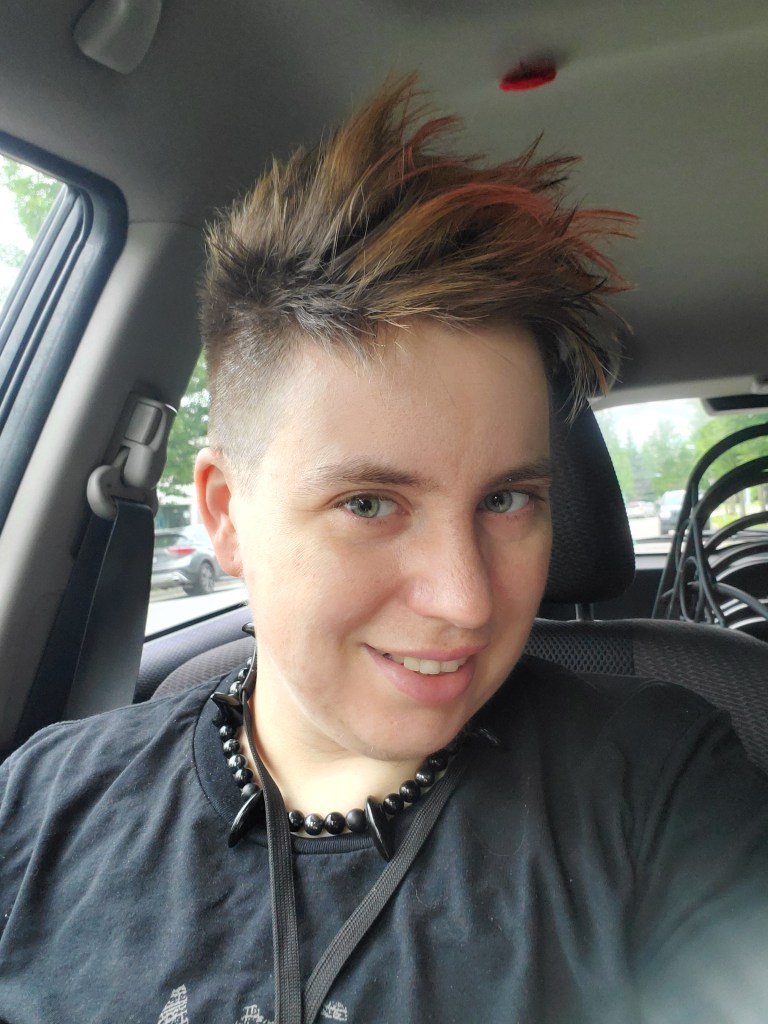
Izzy Braumberger (they/them) is an armchair historian and philosopher as well as an avid player of TTRPG games and a developing system designer.
Izzy, you’ve been playing D&D for over 15 years, and during that time you’ve seen some of its limitations, like the way its mechanics and history create a colonialist focus on combat and looting. What keeps you playing the game despite this, and what kind of changes would you like to see to the system?
D&D is a very popular system with wide-spread appeal. I think that’s mostly because it has the crunchy mechanical stuff that people enjoy while also being loose enough to leave room for people to make it their own.
I find D&D to be very transactional and video game-like. The default is a system model that rewards the story “go out, find a problem, kill the problem, loot the room.” This model makes it easy to track people’s success and determine when and how they level up, but it’s also limiting and celebrates a particular kind of playing. Even in parties that try to value equality, the distribution of wealth and power still tends to be dependent upon who killed the most enemies.
I would like to see the system emphasize rewards based on nonviolent participation. I have seen other systems like Exalted create mechanics to track political and social relationships; it would be as if the bonds and relationships in D&D were put to mechanical use. Instead of always rewarding players with treasure, parties can be rewarded with allies and stronger relationships. This would create room for more kinds of stories and characters.
In a previous conversation, you mentioned that you’re a history nerd. Roleplaying games often take place in a liminal space between history and fantasy that is often defaults Eurocentric. What historical facts would you like to see acknowledged in D&D campaigns? What is your dream setting for a campaign?
When I GM, I like to throw in historical facts that have no societal baggage. I don’t want to bring up real world struggles, consciously or unconsciously, but adding little known details to the adventure can make the world feel richer. For instance, let’s say your party is traveling by wagon pulled by a team of oxen. I would include the fact that the one on the right has a two syllable name and the one on the left has a one syllable name – that way the oxen know which one is being talked to.
My dream campaign would be one that is so grounded in actual history that it seems alien to players. I would like to see a game set in pre-Enclosure England, when the structure of land use was centered on families, and there was no concept of “going to work” because you worked where you lived.
D&D isn’t very accurate, really. The typical tavern/inn that parties go to would have looked very different historically! There weren’t rooms or subdivided spaces, because there was no way to heat everything. There also weren’t roaring fires, because fireplaces didn’t exist until much later than most people think. Privacy was not a thing until very recently. Even royal houses were just a line of rooms that people had to walk through; hallways weren’t common for most of history. Industrialization changed everything worldwide, so setting an adventure before then would be my preference.
Roleplaying in D&D provides the opportunity to explore your identity in myriad ways. For queer people, this can be a really liberating experience. How have you been able to explore your identity through D&D?
I have found that role playing games are a wonderful mirror to hold up so that you can figure out what sort of person you would be if you could be anyone. You get to be any kind of person you want and experience how it feels when people react to you in this different way. Self-exploration is expected in these spaces. You can be the manliest man who plays a 4’2″ elf with a high-pitched voice who flirts with guys. No one automatically assumes that’s what you’re into in real life – it’s play. And play is a valuable teaching space.
For the longest time, I thought it was just play, and I didn’t really take to heart what I was experiencing. I knew I felt free, happy, and more myself, but I didn’t quite get what was going on. It took me time to piece together disparate behaviors and thoughts to figure out what made me feel happy and comfortable. Really, embracing my trans identity was about finding comfort. There were both disphoric and euphoric elements to finding out what I do and don’t like – all together it paints a picture to your route toward happiness. I asked myself a lot of questions: Can I live with this? What do I need to change or give up? What is the fluctuating baseline that I want to rest at?
The valuable thing about role playing games is that you don’t have to wrestle with all of these variable judgments all the time. I don’t actually play non-binary characters very often. I lean into masculine characters because I don’t get to be that in real life. It’s an interplay of wish fulfillment and that mirror to see who you could be. I’ll be honest, I’ve used some DMs as therapists over the years – it’s always a bad idea, but we do it anyway!
Self-exploration is a vulnerable process. In your experience, what makes a D&D group safe to explore or live out your queerness?
When you play a roleplaying game with people, you enter a social contract to be cool with whoever your party members are. A good DM will stop people from imposing their will or view of your character on you. If someone says, “Why are you flirting with that girl? You said your character was gay,” a DM should guard and support nuance. Don’t let people police people’s expressions of sexuality or gender identity.
I think it’s most important to show enthusiasm for people who are exploring new things. Show active positivity, ask questions with the desire to know more rather than judge. Focus on understanding people, not being disappointed or uninterested in what they’re doing.
When DMing a game, it can sometimes be hard to fight the cisheteronormative culture in which we were raised and populate the world with diverse NPCs. How do you prioritize representation of trans people in D&D? What tips do you have to convey the complications of gender identity in role playing games?
Exploring gender identity is an in depth, nuanced process, and this doesn’t translate to D&D very well if NPCs aren’t given the space or time to explore that nuance (and most of the time NPCs are one and done). When introducing characters, it’s easy to rely on shorthand descriptions to indicate trans people, and that usually means perpetuating potentially harmful stereotypes. The easiest thing to do is to make these NPCs central characters that are returned to throughout the campaign. You can have more meaningful representation when players are emotionally invested in characters and want to learn more about them. That’s when you can have those more nuanced conversations and experiences over multiple interactions.
Introducing MtF or FtM characters into your campaign can be tricky. How do you alert characters to the NPC’s trans identity without some kind of gross skill check that amounts to “You can tell this character is trans”? In a campaign that I’m playing in, the DM took us into an NPC’s memories, where we saw her experiencing abuse as a child for being trans. It was such a smart way to reveal this fact about an NPC we all really cared about!
I personally have no problem with straight cis GMs role playing trans characters, so long as they aren’t fetishizing anyone or perpetuating harmful stereotypes. At the stage we’re in culturally, visibility is really important, and it’s a great opportunity to practice they/them pronouns and get in the headspace of people who have had different experiences from you. Having diverse characters can also help communities surrounding property more inclusive.
Are there any resources you recommend for players or GMs who want to work to create a safer, more inclusive gaming table?
In general, I recommend you look into TTRPG horror games. Horror has a unique contract regarding the creation of a safe space at the table. You have to lay everything on the table beforehand – your fears, your expectations, your limits – so that you can create a safety system, and you’re expected to check in after the session to make sure people are okay. There is an overlap with the BDSM community, actually. Playing horror games helped me learn how to engage with other people more sensitively, which I think transfers to all kinds of games.
Specifically, I want to recommend the podcast DMs of Vancouver. They intentionally interview diverse guests and value showcasing a variety of perspectives. [Note: Izzy was a guest on DMs of Vancouver. Check out their episode here!]
Roar Cat Reads is a blog for queer nerdy content. What is something queer and nerdy that you would like readers to know about?
League of Ultimate Questing – an amazing podcast with a pretty diverse cast of characters. They do a great job of normalizing inclusivity.
Chilling Adventures of Sabrina – the mechanics of the world support the gender identity of the character Theo in some really cool ways.
Philosophy Tube – the trans host of this YouTube channel has one of the best coming out videos I’ve seen.
Inn Between – another podcast with great representation AND one of the most interesting handlings of a body swap episode I’ve ever encountered!
Thank you for spending some time with us at Roar Cat Reads, Izzy! If anyone would like engage in more of their content, you can check out their episode on DMs of Vancouver. And stay posted! They’re in the early stages of an actual play project that we can’t wait to learn more about.



 Roar Cat Reads