Tag: Miranda

  • Theology and Black Sails

    Theology and Black Sails

    Little known fact about me: I went to seminary! I love thinking about the theological messages that are implicit and explicit in the media I love, and Black Sails has some VERY interesting things to say about religion in general and Christianity in particular. In the following four discussions, we’ll dig into what the characters of Pastor Lambrick and Thomas Hamilton reveal about the Black Sails theological framework.

    Season 1, Episode 3: Miranda Barlow and Pastor Lambrick

    Pastor Lambrick:  I’m afraid I’ve become a burden.
    Miranda:  Far from it.  I look forward to our conversations. This week’s sermon?
    PL:  Your thoughts are always enlightening.

    From their first lines together, we see that Pastor Lambrick frequently visits Miranda and asks her opinion on his sermon notes.  Taken charitably, this shows his willingness to accept a woman’s spiritual leading.  This is something that is fought about today and perhaps shows the spiritual freedom of 1715 Nassau away from “civilization’s” influence.  Cynically, this is Pastor Lambrick’s excuse for spending time with a beautiful woman or a desire for external validation.  Since one of Black Sails‘ theological themes is the concurrent sinfulness and saintliness of every man and woman, I like to think that his motivations include all three.

    BlackSails-103_2476

    Miranda:  Easter.  Is it Easter already?  ‘It is Christ’s love of sinners that gave him the strength to endure agony.  This, the truest form of love, love through suffering.’  Do you believe this?
    Pastor Lambrick:  It’s not to be believed or disbelieved.  It’s God’s gospel truth, is it not?
    M:  ‘Thy navel is like a round goblet which wanteth not liquor.  Thy belly is like a heap of wheat set about with lilies.  Thy breasts are like two fawns, twins of a gazelle.  Thy stature is like that of a palm tree and thy breasts like clusters of grapes.  I will go up the palm tree and take hold of its fruits.’  God wrote that, too.  True love shouldn’t require suffering.  And you don’t have to take my word for it.

    Over and over again, we will see that Lambrick’s faith is simplistic.  When Miranda asks him if he believes what he has written about Christ’s love and suffering, his reaction is one of confusion.  It is truth, and not to be questioned.  Interestingly, Miranda’s argument is not so much about the statement’s truth, but about its totality.

    In quoting the erotic love poetry of Song of Solomon, she reminds Lambrick that love, as explained by God, has many forms.  Christ’s suffering is one form, but it is not the only way that love exists, and we should not exalt it as such.  In effect, she calls Lambrick out on picking and choosing Scripture to suit his message.  She is here, I believe, a wonderful example of a systematic theologian.

    BlackSails-103_2433

    Pastor Lambrick:  I must confess there is an ulterior motive for my visit today beyond the content of my sermon.
    Miranda:  Is that so?
    PL:  There are whispers among my flock that a ship of the Royal Navy docked in Harbour Island recently.  The Scarborough.  They say the king means to reassert colonial rule here.  Perhaps soon.  Judgment in this world, not the next.  For those who are a part of my flock when that judgment arrives, their righteousness will almost certainly go beyond doubt.
    M:  It’s not quite that simple for me.
    PL:  Is he keeping you here?
    M:  Good day, Pastor.

    In the final part of their exchange, Lambrick further reveals the motivations for his visit. Before I discuss the negative implications of what he says, I do want to give credit for his asking if Captain Flint is keeping Miranda in the house against her will.  More faith leaders would do well to look for and address potential instances of domestic violence among their parishioners.  But let’s delve into his assertion that his church will be spared when the British arrive to reassert their dominance.

    To begin, his words have an air of paternalistic protection that Miranda clearly has no interest in.  It’s telling that she just demonstrated a greater understanding of Scripture than he has, so his sudden switch to “I’ll protect you” contains hints of reasserting power over her.

    Far more damning is the way his words bely an exclusionary view of Nassau, one in which his “righteous” flock will be spared.  The implication, of course, is that the heathen pirates will not.  Although we do not yet know Miranda’s full story, or her opinion of the pirates of Nassau, her disinterest in his proposition is our first hint that she might not see the world so divided.

    Ultimately, Lambrick is pretending to be a leader, though one whose leadership is granted through capitulation to England and “civilization.”  This is a theme that has yet to be fully fleshed out in the show, but it is important to note going forward.

    In our first scene that explicitly discusses theology, we are treated to two drastically different theologians.  One is primarily concerned with upholding the status quo, both spiritually and culturally.  The other questions what is “obvious,” thinks deeply, and refuses to benefit from the advantages of living under the status quo.  It remains to be seen which of these theologians we are meant to admire and imitate.


    Season 1, Episode 7: Pastor Lambrick Preaches to an Empty Field

    The seventh episode begins with Pastor Lambrick practicing his Easter sermon to an empty field before he is interrupted by a messenger on horseback tearing through his oration.

    “Easter is upon us, an opportunity for renewal and rebirth both in spirit and the flesh.  And yet we may also ask ourselves, ‘When the spirit is renewed and the body resurrected, what becomes of the sin?’  Will not a trace of it linger to mock and torment us, to remind us of the roiling pit of despair that awaits the unrepentant beyond this life?  And yet does it not often feel as if life itself is the pit?”

    It’s a short bit of preaching, but it’s fitting in an episode focused on Captain Flint’s plan for Nassau and the partners who fail to support his vision.

    For what is Flint’s plan if not one of renewal and rebirth, one in which a wealthy Nassau can allow pirates to become soldiers and farmers?  But Lambrick’s sermon asks us to consider this rebirth – can pirates-turned-farmers truly leave behind their old ways?  Is a renewed Nassau possible, or will it forever be marred with the sins of corruption, greed, and violence?

    Flint believes that, in the words of Lambrick, Nassau can be reborn without sin.  But he is very much caught in the “roiling pit of despair” that Lambrick worries is a hellish current existence.  Flint tells Miranda that he has made enormous sacrifices for his cause, some of which he is experiencing in this episode as Gates and Miranda abandon his vision. We later learn that James McGraw created the persona of Flint to accomplish Thomas’s plan, and that he hated this persona (aka himself) a little more every day.  For ten years.  In pursuit of the dream of a renewed Nassau, he lost Thomas and then Miranda.  He murdered Gates, his closest friend.  He endured mutinies and sent his crew to their deaths on innumerable occasions.  He partnered with men he despised and attacked innocent men.  His life truly is a hell on earth, but astonishingly, he continues to hope for a hell-free future.


    Season 3, Episode 9: Pastor Lambrick and Charles Vane

    When Lambrick visits Vane before his execution, his attempt to offer peace and repentance is rejected.

    bs309_2958

    Lambrick enters and offers Vane bread, which coming from a clergyman seems pretty obviously to symbolize Communion.  But bread is only one half of the grace of Communion, just as the peace Lambrick is about to offer is not complete.  He wants Vane to feel fear for what is coming so that the mighty pirate will need a pastor’s solace.

    Lambrick:  Men who’ve never experienced fear are said to know it for the first time.  But in this moment, there is quiet.  An opportunity to find some measure of peace.
    Vane:  Get many takers, do you?  For the kind of peace you’re offering?
    Lambrick:  It is a different experience to what you may imagine it being.  Surely a man like you has faced death before, but never so nakedly.

    Lambrick’s pretense is revealed when Vane shows zero interest in accepting what he offers.

    “I can help you do that.  To repent.”
    “I have nothing to repent for with you.”

    Tellingly, Vane does not say he has nothing to repent for.  He just doesn’t want to repent to Lambrick, later insisting that “whatever I have to say to God, I’ll tell him myself or not at all.”  We know that Vane has begun to see the wider ramifications of his kill-or-be-killed worldview.  When fighting the Spaniard in 305, Vane realized that everyone isn’t fighting for the glory of fighting.  Some fight simply so that their dead bodies will be evidence enough to provide their families with food.

    But whatever sins Vane believes he has committed, he has no interest in sharing them with someone like Lambrick, who will use them as evidence to distance himself, a “good” man, from “monsters” like Vane.

    “Don’t you?  I understand you believe your violence is justified in the name of a defiance of tyranny, but there are mothers who buried their sons because of you.  Wives widowed because of you.  Children awoken in their sleep to be told their father was never coming home because of you.  What kind of man can experience no remorse from this?”

    “What kind of man” reveals that Lambrick shares civilization’s instinct to make pirates inhuman.  Vane clearly sees Lambrick as representative of the people he hates, those who would willingly enslave themselves to England, and an English worldview, for a bit of comfort and security.

    Lambrick:  I am a shepherd sent to help you find a path to God’s forgiveness.
    Vane:  A shepherd?  You are the sheep.

    Sheep are consumed by fear, and a shepherd leads them into a new world of freedom and hope.  Vane sees Lambrick’s hypocrisy and therefore wants nothing from this man of God who is blind to his own failings.

    Ironically, although Lambrick did not get what he wanted, Vane does leave their conversation with peace.  He has seen himself as a shepherd capable of leading people into freedom, and as such he delivers one hell of a last speech.  It probably wasn’t quite what Lambrick intended.


    Pastor Lambrick and Thomas Hamilton

    There are two main characters in Black Sails whose actions are explicitly motivated by Christianity:  Pastor Lambrick and Thomas Hamilton.  Together they represent the best and worst of their religion, with one embodying its privilege and the other its sacrifice.  This duality is perfectly expressed in the metaphor of a shepherd and the sheep.  A shepherd leads people and challenges the status quo for the betterment of their flock, even at personal risk.  The sheep follow people and fearfully accept the status quo out of a desire to maintain their privilege.

    bs309_3168

    Pastor Lambrick believes he is a shepherd, but his conversations with Miranda and Vane reveal his inner sheep.  As I mentioned earlier, Lambrick has an exclusionary view of Nassau that separates his “righteous” flock from the heathen pirates.  This becomes even more obvious in his conversation with Vane, which ends with him implying that Vane is inhuman.  He sees his connection with civilization as something that elevates him above others.  We have never seen him try to create a better life for the men and women of Nassau in the present, and when forced to interact with a pirate, the only hope he offers is a fear-based call to repentance in hope of a better life to come.  One imagines Vane might have been more open to repenting to Lambrick if he had seen the man fight against slavery and injustice rather than enjoy a comfortable life in the island’s interior.  Lambrick’s power is entirely based upon capitulation to England.  He believes he is a shepherd when in reality, he is a sheep.

    blacksails-2042525

    Miranda:  In some ways he [Thomas] was like you, a shepherd to his flock.

    -Episode 106

    Unofficially, Thomas Hamilton established himself as a shepherd to men and women in England by hosting salon conversations with the goal of seeing “the yoke of shame lifted from your shoulders,” a habit that seems to be grace incarnate.  Both in word and in deed, Thomas believes that his social and political privilege is something to be sacrificed, not clung to.  In episode 201, he gives money to the poor, which seems to be a regular occurrence.  His plan to offer pardons to the pirates of Nassau is done out of a desire to inspire England to live up to its Christian ideals (204) despite the possibility, and eventual reality, of it costing him everything.  Thomas passionately lives out his ideals, leading others into freedom as their shepherd.

    Lambrick, the sheep, sees monsters where there are men, and he wants people to change in order to better serve England.  Thomas, the shepherd, sees men where others see monsters, and he wants England to change in order to better serve people.  There is no question as to who is more fully living out Christ’s belief in inherent human dignity and His willingness to sacrifice privilege for others’ gain.  The fact that Black Sails chose to show Christ embodied in a rich white queer polyamorous man opens spiritual doors that some churches currently keep closed, and I personally find that incredibly beautiful.


  • Black Sails Season 2 Episode 9 Review – XVII

    Black Sails Season 2 Episode 9 Review – XVII

    Flint and Miranda confront their past.  Bonny declares her intents to Rackham.  Vane takes a massive prize.  Eleanor declares war.

    (Summary provided by starz.com)


    BEST FLINT MOMENT

    This is another excellent Flint episode where literally everything he does is phenomenal, but the scene that always stands out to me is when he agrees to Peter’s plan and consents to being publicly humiliated for the sake of Nassau/Thomas’s dream.

    Peter:  There are men in Whitehall who could potentially find a proposal such as yours to be plausible…but there are other men who will oppose it categorically for the same reason all men refuse to do the things they should.  Pride.
    James:  You think they’re too proud to put pardons on the table?
    Peter:  I think they fear you.  And to capitulate to something one fears is a humiliation that powerful men cannot accept.  If we are to persuade them to ally with you, then we have to completely redefine their understanding of who you are, what you are.
    James:  How do you propose we do that?
    Peter:  With the truth…You will stand up, and you will tell your story…You will reveal everything.  And when you do, Captain Flint will be unmasked, the monster slain.  And in his place will stand before all the world a flawed man, a man that England can relate to and offer its forgiveness.

    We KNOW that Flint cares desperately about how people view him.  And we KNOW that Flint wants England to apologize to him, that he finds the idea of apologizing to England intolerable.  So when Peter suggests that he publicly expose himself, his love for Thomas, his murders and great deeds, that he apologize for everything to men who want to see him look small…it is astounding that he agrees.  It is astounding that as he stands to think, he smiles before agreeing.  What is going on through his mind?  Is it ironic, because he was prepared for a battle, but he got this instead?  Is it relief, because he will finally tell the full truth?  Or is it simply joy, knowing that at the end of a long road, he has finally found a solution that will bring Thomas’s dream into reality?

    WHATEVER IT IS, I LOVE HIM.  He’s so brave in this moment.  Braver even than when he’s fighting.

    TODAY’S RUNNER UP

    Miranda!  Oh, God, Miranda.  She is phenomenal in this episode.  She notices the clock and fears what it means, but she keeps it inside because she doesn’t want to disturb the plan.  When it becomes clear that the man who betrayed them is asking Flint to humiliate himself without the decency of offering the humiliation of his own sins in turn, she is DONE.  Her disgust, her utter contempt for him is astounding.  We’ve seen her become angry with Flint before, but this is her whole inner world being revealed.  All the pain and fury and unfairness that she’s kept locked up…she’s finally letting it out.  And they kill her for it.

    Miranda:  You destroyed our lives!  You caused our exile!  Thomas died in a cold, dark place–
    Peter:  What more do you want from me?
    Miranda:  What do I want?  I want to see this whole goddamn city, this city that you purchased with our misery, burn!  I want to see you hanged on the very gallows you’ve used to hang men for crimes far slighter than this.  I want to see that noose around your neck and I want to pull the fucking lever with my own two hands!

    RIP Miranda.  I loved you!

    WELL-FORMED THOUGHTS

    “When I first met Mr. Gates and he asked me my name, I feared the man I was about to create.  I feared that someone born of such dark things would consume me were I not careful, and I was determined only to wear him for a while and then dispose of him when his purpose was complete.  Am I ready to let him go?  Truth is every day I’ve worn that name I’ve hated him a little more. I’ve been ready to return him to the sea for a long time.”

    The cognitive dissonance that is being James McGraw/James Flint.  This revelation, that he hated being Captain Flint, is a gut-punch, even though we saw the first hints of it in his conversation with Silver about whether he was viewed as a villain.  But this depth of self-hatred?  WOW, it is horrible.

    It must be agonizing to feed the darkest parts of yourself (we know James McGraw had a violence in him that was “darker and wilder” than other men’s), to intentionally develop that darkness when every other part of you wants to stop.  It must be confusing to fear being consumed by that darkness while also loving what that darkness makes you capable of doing, to hate yourself for loving it.

    James McGraw:  the most tragic figure in all existence, about to become even more tragic.

    FRAGMENTED THOUGHTS

    • Poor Eleanor.  It must be awful to grieve a confusing loss AND put up with people who are Performing Grief in order to impress you or size up your strength.  Even more awful when the woman you used to love pretends to understand, but she’s just sizing you up too.
    • How unbelievably sexy is it that Flint became captain of a pirate crew in less than four months?  How perfect it is that he became captain by “being someone worth listening to”?
    • How unbelievably weird is it to see Flint as the calming influence?? His hand on Miranda’s back.  

    “We were angry.  We allowed that anger to drive us to a dark deed.  But I ask you not to judge me by that one deed.  Judge me by the ends that I have come here in service of.”

    • James’s acceptance of his sins but request to be viewed as more than them reminds me of Eleanor’s statement in 208: “I have done what I’ve done and I will live with it.  But do not for a moment believe that that defines me.”  They really are so similar.
    • Billy saying “You’re all good people” to his crew is HILARIOUS (but no LOL section for this episode because NO ONE DESERVES TO LAUGH after Miranda’s murder.
    • The hope that shines in Flint’s eyes when Peter first entertains their plan – OH it’s painful now.
    • RIP Randall.    This is the second time the Ranger crew has boarded a ship by water just this season.  Someone really should be keeping better tabs on them.
    • BILLY VS. VANE, wow!!
    • Silver is so good at producing solutions out of impossible situations.  When Vincent asks if Silver is saving the two of them or the whole crew, Silver doesn’t answer.  He doesn’t know either.
    • Eleanor’s emphatic assertion that she’s not a pirate felt jarring to me at first. But Vane confirmed her worst fears that pirates, no matter how much they say they love you, will murder your father if you take something valuable from them.  BRB CRYING FOREVER.  Of course she wants to eradicate piracy with a vengeance.
    • Anne comes back just in the nick of time, because Jack and Featherstone would literally be dead without her.  Her reunion with Jack is lovely.  She apologizes, and he looks so scared to approach her too quickly, unsure of who she is and where he stands with her.
    • It’s very satisfying that as Max, Jack, and Featherstone hesitate, Anne is the one to set their pursuit of the Urca gold in motion.  She’s found herself, and therefore her confidence.
    • The conversation between Vane and Billy is lovely.  Shockingly sad to hear him call Billy “Mr. Gates’s boy,” and shockingly perfect to hear that Vane recognizes Billy’s “proper pirate”ness and has long wanted him on his own crew.
    • Silver is helping Flint’s crew survive, Billy is convincing Vane to help Flint.  We might as well rename the show Black Sails: the Story of a Bunch of People Who Hate Flint But Find Themselves Helping Him Regardless
    • It’s ironic that the story Peter wants Flint to tell Whitehall, the true story, is one that made us as viewers see him as Bigger and More, but it’s a story that will make Asshole London think of him as small.
    • Am I reading too much into the fact that an angry woman gets killed for speaking her mind in a world that values submissive, supportive women?  Feels a little on the nose to me.  I see what you’re doing, showrunners!
    • I don’t like Peter, but I do think his plan is genuine.  I think he regrets his past actions and has convinced himself that it was his only choice (“a hard choice”).  I think he does still want the redemption of Nassau and will work with James and Miranda to accomplish it, even if his plan keeps himself above questioning while submitting James to humiliation.  The Turning Point when he becomes a villain is when Miranda is murdered and his solution to this is to publicly try and hang Flint.

    “You wish to return to civilization, THAT is what civilization is.”

    • Major props to Vane for seeing the bigger picture so quickly.  He trusted Billy’s experience, and when it was substantiated, he realized that his only option is to do a 180 and rescue Flint.  This Vane is so much more interesting than selfish “show me my future in this room” Vane.

    “Nassau is strongest when she is feared.  And if what promises to happen here tomorrow actually happens, a trophy made of one of her most notorious captains, she may never be feared again.  So I suggest we do something about this.  I suggest we get him the hell out of there.”


    Not done reliving the episode?  Listen to Daphne and Liz’s podcast at Fathoms Deep!

  • Black Sails Season 2 Episode 8 Review – XVI

    Black Sails Season 2 Episode 8 Review – XVI

    Flint and Miranda prepare for the worst.  Silver has his eyes opened.  Eleanor discovers Max’s secret.  Vane makes his move.

    (Summary provided by starz.com)


    BEST FLINT MOMENT

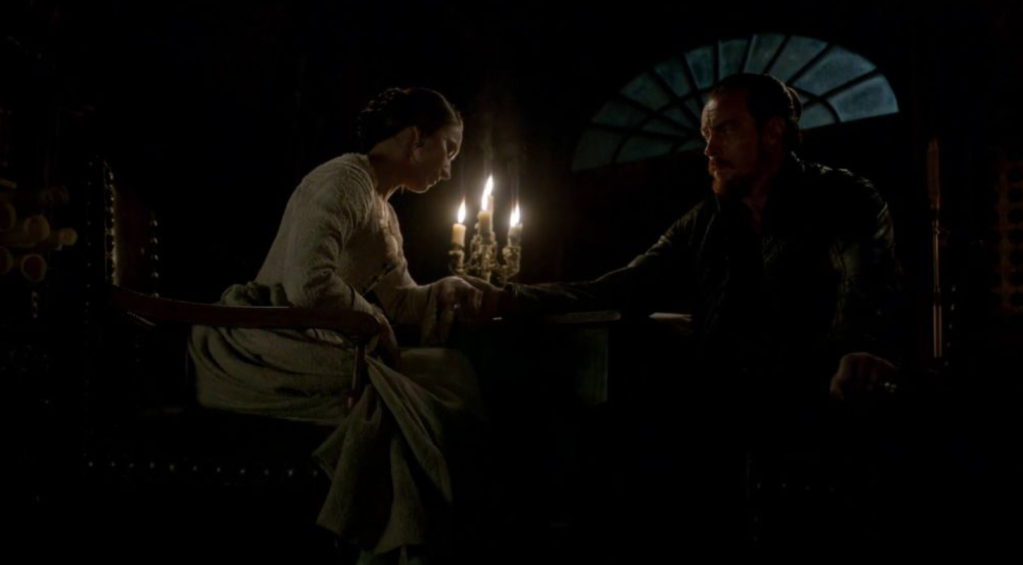
    It is so lovely to see Flint confiding in Miranda, being vulnerable with her and admitting that 1) his decade-long plan might have served to make him into a man that cannot pull off his new plan, and 2) he has done unforgivable things along the way.  Watching them talk about who they were, who they have become, and reassuring each other that they love each other still IS SO GREAT.  They see each other and are seen!!

    Miranda:  It’s like some sort of clock that’s finally struck its chime and woken me from this dream we’ve been living, reminded me how many years separate me from a world I still think of as home.  How unrecognizable the woman I am now would be to the woman I was then.
    Flint:  I recognize you.  Do you recognize me?
    Miranda:  Yes.
    Flint:  So that’s in our favor.

    JAMES AND MIRANDA (WITH THE GHOST OF THOMAS’S DREAM) AGAINST THE WORLD!!

    TODAY’S RUNNER UP

    Silver!  Our boy is getting his first taste of power.  Mr. Scott sees his ability to tell a story as a power that possibly equals Flint’s, but later we see his power goes beyond that.  Vincent kills his partner at a Look from Silver, though he (and other Walrus men) won’t obey Flint until Silver explains why.  When pressed, Vincent says he thinks Silver gives a shit about his interests, which is funny because we know he definitely does not.

    Silver is thrown by this admission, and it’s hard to see what he’s thinking.  Does this realization mean that Silver sees power in pretending to care for a crew (it’s possible to be liked and feared), or does being treated as a caring person inspire him to become caring?

    His character arc is going to be thrown for a major loop in a couple episodes, but it’s fascinating to think where he might have gone had that not happened.  Based on this episode, I think he might have gone quite dark.

    LOL MOMENT

    Featherstone:  We leave the bulk of the coin in the trench, keep the location secret, and rotate men in watches to keep it under guard.
    Max:  Your answer as where to secure five million pieces of eight is to dig a hole?

    That’s a nice little dig at pirate mythology.  

    WELL-FORMED THOUGHTS

    Thanks to Abigail’s voiceovers, we get quite a lot of philosophy to chew on.  I’m especially interested in her view of pirates as performers, especially her initial view of Flint as the puppet master of this theater/illusion.

    “My father told me about these men, about their natures, so I know that any appearance of civility from them is but a glimpse of the men they once were.  A ghost that shows itself only while the darker things that now govern their souls lays dormant.  Though I’m forced to wonder if this illusion is no accident at all, but theater for my benefit, orchestrated by someone so awful, even monsters such as these have no choice but to dance to the tune he plays for them.  Which leads me to the one thought I find most frightening and most difficult to dismiss.  What happens if that man decides the theater no longer serves his purposes and lets the monsters loose?”

    It is ironic that while Abigail fears these are monsters masquerading as good men, Flint is talking with Miranda, worried that him being a good man masquerading as a monster will be his undoing.

    The truth is more complicated than that, which Flint’s conversations with Miranda bear out.  James is a good man, and he has done monstrous things.  Miranda is the woman she always was, and she encouraged the murderous impulses of her friend to arrange the murder of two people.  Billy is cute, sympathetic, and righteous, and we learn that he’s a murderer.  The very thing that convinces Abigail that these are normal men (the death of their brother) was actually murder.

    This is my favorite thing about this show – the unwavering assertion that humans are simultaneously good andmonstrous.  We are all sinners and saints.  We are good and we are ruthless, we create illusions of ourselves, we play up one side of ourself in a certain situation and another side at a different time.  Certain people bring out certain aspects of ourselves that we might never have expected.  We are complex creatures, and like Abigail, Black Sails encourages us to see beyond a black and white view of humanity.

    FRAGMENTED THOUGHTS

    • It’s honestly amazing that Abigail’s opinion of pirates changes at all, considering the stories she was raised on and the fact that her first experience of pirates was of Ned Lowe.  Her willingness to be open-minded and challenge her assumptions is so praiseworthy.
    • I love that Flint is proud of Abigail for enduring what she’s gone through.  One of his best qualities is his ability to see the strength of the women around him.
    • On the other hand, Jack is really rather sexist in this episode.  He’s worried for Vane and blaming it on Eleanor, he’s mad about the situation with Anne, but I don’t care.  I don’t like the two comments he makes.  You’re better than this, Jack!

    “For so many years, I knew her.  Perhaps the only one who truly knew her. But for weeks, with everything we’ve been through, everything she’s done, she’s a fucking mystery to me.  So now I realize two things are possible: one, something has changed within her, something so significant that she’s turned into someone I barely recognize.  Or two, it was a fantasy that I ever knew her at all.”

    • I like the show’s acknowledgment that when one person (Anne) goes through an identity crisis, everyone around them must readjust to the new person before them.
    • Miss Mapleton is spying on Max for Eleanor!  It’s interesting that she supports the plan to make Nassau reputable.  I think of that as the Good Guy plan, and Miss Mapleton as a Bad Guy.  But of course this show is more complicated than that!
    • Silver is making up stories about his past – “five years ago I worked on a merchant ship” – but Billy and Mr. Scott acknowledge that the power lies in the telling of the story, not in the truth of the story.  THAT’S going to continue to be relevant.
    • Silver is pissed to be working with incompetents, and he sounds legitimately scary when confronting Nicholas.  I’m not surprised Vincent thought it within the realm of possibility that Silver would want him to kill his brother.
    • Billy and Abigail make eyes at each other, and I’m pretty sure this is the only time we get any kind of hint as to Billy’s sexuality (though let’s be honest, while her looks were Interested, he mostly seemed confused).
    • It’s heartbreaking to watch Flint realize that he spent the last decade preparing for a battle, not diplomacy.  He’s worried that he became Flint for nothing, that the furious pirate captain he became to save Nassau will now be an impediment to his goals.  The doubt and potential guilt he must feel, retracing every decision he made over the past TEN YEARS is overwhelming.  Especially when on top of his fear of Peter Ashes’s judgment is the fact that he judges himself for some of his actions.

    Flint:  Something else lies at the end of this road: judgment.  Not of Nassau, but of me and the man that I’ve become.  This entire endeavor hangs in the balance of that judgment.
    Miranda:  You can defend that man.  There are good arguments in defense of him.
    Flint:  For some of his deeds, perhaps for most of them.  But there are some things that Captain Flint has done that cannot be defended.

    • Good show writing, that just as Flint is confronting the reality of his persona and the actions he does to protect it, Silver finds himself in a similar position (while wearing black, uh oh).
    • Eleanor is anti-Urca gold if Max is in position of it.  I’m not sure what the difference is between this vs. Flint’s crew bringing it in?  It was already established that forming a Pirate Bank was going to be a tough sell if possible at all.

    “I have done what I’ve done and I will live with it.  But do not for a moment believe that that defines me.”

    • Eleanor’s quote above strikes me as a much more mature variation of Silver’s season 1 advice (to her!) that “Guilt is natural.  It also goes away if you let it.”
    • The Maria Aleyne mystery is solved!  WOW, do I love Miranda insisting that she is just as guilty, if not more, of the murder of Alfred Hamilton and his wife.  “If you’re going to face judgment behind those walls, then so should I.”  They are both so brave, owning up to their past actions and willing to face whatever consequences might result.  And I get that this is, like, catering to the lowest standard, but I really admire Flint for letting Miranda join him and carry her own responsibility alongside him.  None of this “I’ll save you even if you don’t want me to” nonsense.

    “He made these people unafraid.  Everyone realized, the moment you stop fearing it, it loses all it’s power.”

    • Whoops, Colonel Rhett, I think you put an idea in Flint’s mind!
    • When Flint is getting beat, he doesn’t fight back (“what happens if they shoot at us?” “duck”).  Abigail lies, saying she remembers James in order to protect him. That girl!  I like her so much!
    • The fact that Peter admits Flint and Miranda into his house after the shock of realizing that Flint is James shows that someone who knows James’s backstory would go, “Okay, that’s reasonable” about his actions as a pirate captain.
    • Vane killed Daddy Guthrie.  Not just killed, but crucified.  Ugh, Vane, there are better ways to deal with your heartbreak.  And really, Vane’s note about being free and keeping Nassau free?  Why would Eleanor’s betrayal suddenly inspire him to care about the bigger picture?
    • Upon further thought, maybe Vane killed Eleanor’s dad knowing that she would never forgive him for it.  Maybe he knew his weakness for her, and this was the only way he could think to stop their cycle of returning to each other and hurting each other.  But still, CRUCIFIXION IS TOO FAR.
    • But props to him for saying in his note, “I don’t know you too well” about Eleanor.  Fucking finally.
    • Although his ship is in Nassau’s harbor, Vane and his men are hiding in the reeds of Charles Town because…teleportation?  Oh well, let’s find out what they do there in the next episode!

    Not done reliving the episode?  Listen to Daphne and Liz’s podcast at Fathoms Deep!