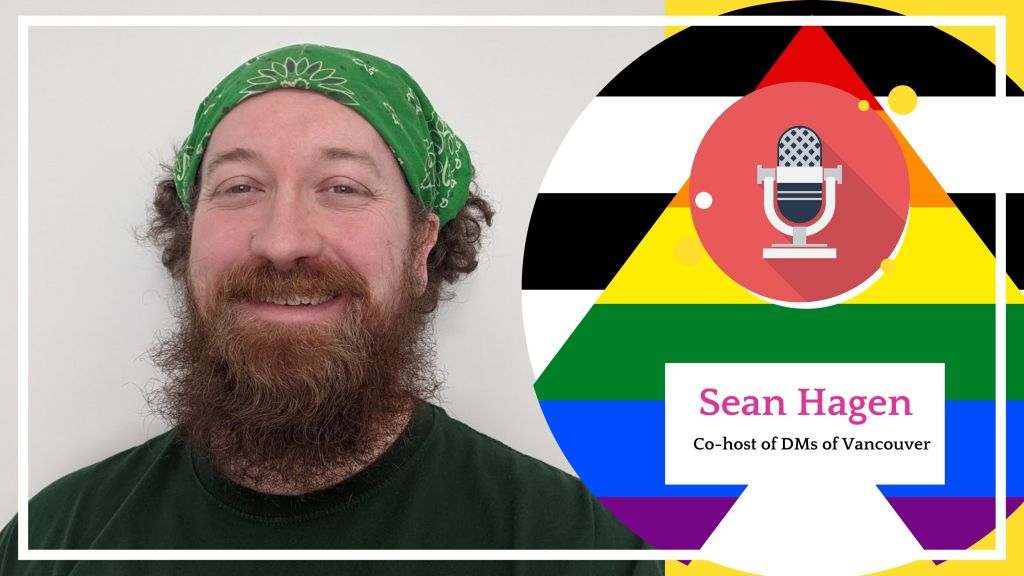

My name is Sean Hagen (he/him), co-host of DMs of Vancouver with Jessy Boros (he/him). I’ve been playing video games almost my entire life, and only somewhat recently got into tabletop RPGs via D&D 5th Edition. Since then I’ve played a whole bunch of games and have plans to play a whole bunch more. You can find me online on Twitter at @seanphagen, Instagram at @seanpatrickhagen, or on my website https://seanhagen.ca !
As one of the hosts of the podcast DMs of Vancouver, you have interviewed a lot of D&D players and DMs. How has your experience of D&D changed as a result of the podcast?
It’s been eye-opening for sure. I think the biggest thing has been realizing that everyone comes to the table for a different reason, and that as a DM you’ve got to be open to that. Some players are there to be social with friends, some are there for story, one of a thousand other reasons, or even a mix of reasons!
I think that’s definitely part of the anxiety new DMs feel, wondering how they could possibly run a game that makes all their players happy. What I’ve learned while doing the podcast is that all you can do is be open and honest with your players about what kind of game you want to run, and to ask for honest feedback that you incorporate into your game. There are things you can do ( like running a session zero and using the safety toolkit ) to ensure that everyone is on the same page and having as much of a good time as possible.
Everyone coming to the table with a different set of purposes and experiences is great, because you can run a really fun game that is utterly unique to your table, and that’s mind blowingly awesome to me. Getting to tell an epic story of a group of adventurers facing down death & danger as they go about saving folks sounds like an awesome way to spend time with friends. The downside is that sometimes trying to relate stories of your awesome game to friends or family feels like trying to explain a dream, but that’s a price worth paying, I think!
Also, as a DM I’ve learned that not only is it okay to have parts of the game that excite you more than others, that’s great! For example, the recommended wisdom for new DMs is to start small, maybe only build a town or small province to run a homebrew game in. When building the world for my first homebrew game I went down a rabbit hole of map making and history building. I surfaced after a week with a binder of maps and tables and a calendar with major celestial events to use when running the game. I put, honestly, probably too much work into that binder.
I felt kind of foolish after putting in all that work into building this world, but soon realized that it had an awesome side benefit: I could ad-lib bits of history and art with total confidence, because I had already sketched out so much that I had a whole world inside my head I could draw upon. I ad-libbed all the descriptions for the statues and mosaics in a dwarven tomb because I knew their history and major events (and how dwarves in that world tended to hugely exaggerate their stories, good and bad parts alike). I was able to foreshadow an upcoming plot point as part of a mosaic because I had all that info in my head, waiting to be put to use. I don’t think I’d go that in-depth again in the future, but if I do I know not to worry about it.
We’ve talked to so many DMs with different jobs and experiences and views on D&D – each of their games is going to be unique to that DM. So for any new DMs (or folks thinking of taking the plunge): don’t worry that your game is going to be different from what you’ve seen online or read about; that difference and uniqueness is why your players are going to love YOUR game!
You are a straight man, but you have included many LGBTQ+ people in your podcast and intentionally create safe and welcoming spaces. How did you cultivate this attitude and awareness?
Honestly it’s been on my mind since we started the podcast. In tabletop games, the voices of straight white dudes are kind of predominant. We’re assumed to be the default consumer for tabletop games in most circles. I’d bet that for the majority of people, if you asked them to picture a D&D player they’d probably imagine someone who looks something like me.
If there’s one thing I know from my day job as a programmer it’s this: having a diverse set of folks contributing to the thing you’re making can only make it better. As a straight white dude, I can do all of the reading, come up with checklists, and do my best to make something inclusive – but I’m going to mess up at some point. I’m going to forget something, or not notice something problematic simply because it’s not something I have to deal with as a straight white dude.
I see it all the time in programming; features that should have either never made it to market or been seriously re-worked got released because there were no women, BIPOC, queer, indigenous, or other marginalized voices on the team. There was nobody to point out that this feature would make it easier for an abuser to track someone down, or that feature would make it easier to out someone before they’re ready, and so on.
And the same thing goes for tabletop games. How long has D&D been able to get by with all of the racism baked in simply because they assumed the audience was straight white dudes who didn’t care?
So since we started the podcast, I’ve been doing what I can to educate myself. I keep an eye out for articles about problems like racial coding in D&D to learn about the problematic bits of the hobby and learn how to do better. I’ve also been looking for non-straight, non-white, non-male folks in the tabletop space on Twitter to follow so I can learn from them. I’m also just taking the time to analyze stuff I’m thinking about putting into a game to try and make sure I’m not leaning on problematic tropes.
It’s an ongoing process that requires ongoing work on my part. But it’s worth it! There are so many experiences and viewpoints out there, making the games we play more inclusive will only make them better. Also, there’s more than enough Western fantasy-inspired stuff out there, so getting more diverse folks creating in the tabletop space means more awesome stuff for me to check out. I’ve had more than enough of that in my life.
Give me more of the Afrofuturism from Black Panther. Show me a fantasy world built on the myths and traditions of an Asian culture, written by someone from that culture and not a white dude. Amaze me with a sci-fi world built by folks from South America. What does an urban fantasy game built by someone from India look like? There are so many rich myths and fantastic folklore traditions in the world — time to give them their chance to shine in the spotlight.
And we’re starting to see some of that stuff coming out, too. I’ve got my eye on Thirsty Sword Lesbians, because that looks like a super fun game.
What advice do you have for other DMs about how to create safe spaces for queer players at their tables?
Whether you’re trying to make a space fun or safe, it all comes back to one thing: communication. Regardless of what system you’re running, the biggest piece of advice I can give is this: RUN A SESSION ZERO. Your first session should always be a Session Zero, no questions asked. Whether it’s your 500th game of D&D or your first game in a new system, running a session zero has so many benefits.
There’s all the basics of a session zero you’re probably aware of: agreeing on what kind of campaign you’re going to run, what kind of tone, how the party all know each other, and stuff the players would like to achieve ( “I want to earn the trust of a gryphon and learn to ride it!” ). It’s also a chance to go over more mundane stuff, like any house rules for critical successes or failures.
But beyond that, session zero is also where you lay the groundwork for creating a safe space for your players, queer or otherwise.
Lay out all the bits of the safety toolkit, and explain how they’ll be used. Go over stuff like the X card, lines & veils, and decide as a group on what kind of film rating you’re aiming for ( it’s a zany PG-13 adventure with swearing” VS “it’s an R rated horror film with vivid descriptions of body horror” ).
Let players know that if there are topics that should absolutely be avoided that they can say so now or send you an email or text. They don’t need to provide any kind of reason – and don’t ask for one, either. Also, their issue doesn’t have to be related to queerness or otherness. It’s a time for anybody to speak up about stuff you can do to make their experience at your table better.
For example, maybe you’ve got an arachnophobe in your group — so replace the giant spiders with giant snakes. Maybe you’ve got a player with auditory processing issues, so they’d prefer no loud music during battles. Another player might have PTSD from being in a war zone, so you know to try not to make any sudden loud noises without warning them. Anybody might have something that if encountered at the table will lead to a bad experience, and the session zero is your chance to become aware of all of those things so you can avoid them.
You shouldn’t be planning to jump into the campaign during session zero, so you’ve got time to make any tweaks or adjustments.
And yeah, it might take some work, especially if you’re running a module; but it’s worth doing because then you know you’re running a game where everybody at your table is having a fun time. I don’t know about you, but it’s hard to feel good about running a game when someone isn’t having any fun.
And when it comes to running games that deal directly with stuff like racism or sexism, or games where those play a major part? My suggestion is that unless a group of players come to you specifically wanting to play in a game that deals with that kind of stuff, maybe just leave that stuff out entirely.
Okay, so you want to know the best part about doing all this stuff, and doing it right? You don’t have to even know that one or more of your players is queer!
It’s kind of like having someone with undisclosed trauma or PTSD – someone can have something that will trigger them and lead to a real bad time, and it’s pretty easy to avoid those things if you put in literally the tiniest amount of effort.
I think that’s what I find so bizzare about the people who complain about safety tools and running a safe table for everyone. It’s not that much effort, and you get to know you’re running a game that everyone actually is enjoying! I don’t know about you, but I want folks to have a good time when they play at my table. It’d absolutely crush me to find out someone has been spending the last few sessions miserable because of something I said or did without thinking. So to know what stuff to avoid ahead of time means I’m more confident that I’m creating an experience everyone can enjoy.
Because I want to have fun when playing tabletop games, and for me to have fun everyone has to have fun.
Lastly: if you’re a straight white dude and this all sounds annoying, or like a lot of work, or wah wah I’m thin skinned and don’t like new things – either do the work or go back to your cave. I’ll be over here running awesome games with fantastic people and having the time of my life.
In general, what are some of your favorite tips and tricks that you use while DMing, either in the creation stage or while playing?
I think I fall more on the “improv” side of the DM spectrum, so my tips and tricks definitely revolve around prep.
Donjon is indispensable, whether you’re running D&D or not. It’s got generators for all sorts of things, including generating world maps.
Another great system-agnostic tool is RPG Cards. I used this to generate cards for any magic items I was planning to give out, as well as generating a bunch of cards for stuff like potions, scrolls, and whatnot. The Gale Force 9 spell & monster cards are great as well — I’ve got a full set of the base spell cards, which I hand out to my players so they’ve got an easier time referencing their spells than flipping through the Player’s Guide. The only downside is that the Gale Force 9 cards are not exactly cheap. Maybe suggest to your players a deck as a thank you gift after you run a great campaign for them?
Another great tool is RPG Tinker. I use it to generate “captain” NPCs – NPCs that have special abilities so that I can mix up combat a bit. Useful for friendly or enemy NPCs, or if you just need something more than a regular human as the boss of a gang or something.
Lastly, I think something that’s more advice than tip or trick: be aware of when you’re getting burnt out! As a DM, you’re going to have a lot on your plate; not to mention all the stuff from your life away from the table. If you find yourself not looking forward to playing, or find it impossible to get psyched about game night: take some time and examine why you’re feeling that way.
I got burnt out after switching to playing online (which happened before the pandemic, funnily enough). The reason was that due to a quirk of my brain, the maps that I would draw on the battle mat when we were all around the table just weren’t good enough and so I ended up spending hours trying to make maps to use in Roll20. All the extra effort ended up burning me out and I ended the campaign early. They beat the big bad, but rather than having to chase down the lich to find and destroy the phylactery, I just ended the campaign after the boss fight.
Now I know that if I’m going to run a game online it has to be entirely theatre of the mind, otherwise I’ll just get burnt out trying to produce assets for virtual tabletops like Roll20.
So keep an eye on how you’re feeling when you sit down to prep (or if you’re unable to even sit down to do prep!). Your players should be okay with you taking a week or two to recharge so that you can come back to the table full of vim and vigour. And to be frank, if you’re not happy running a game your players aren’t going to have fun playing in it.
I care about you, reader, and want you to enjoy running games; so take care of yourself! It’s important.
What can we expect from DMs of Vancouver in the future?
Good question!
I’m hoping to run a contest or two in the future. I’ve got some goodies from backing Kickstarters at a level where I’d get duplicates, specifically with the idea of giving them away to our listeners.
I’m also hoping that we can continue to showcase non-D&D games. At the start of 2021 we started doing reviews of non-D&D games, and it’s been a blast. I love getting to talk about other systems, and not because I’m bored of D&D. There are so many systems out there that are much better suited to different themes and play styles, so getting to explore those and tell our listeners about them has been a blast. I also have a bad habit of buying rule books before I even know if I’m going to run a game in that system, so I’ve now got an excuse to buy a few more rule books!
We’re also going to continue to do our best to lift up and showcase non-white, non-straight, non-male voices. Whenever I think about this topic, I keep coming back to the Issac Newton quote “If I have seen further it is by standing on the shoulders of Giants”. I think it’s time for white folks (especially white dudes) to realize we’re the giants.
We need to lift up and champion the voices of folks not like ourselves – otherwise the hobby will just stagnate or regress. There’s so many folks out there with awesome ideas. Making the hobby more inclusive doesn’t mean less for us, it means more awesome for everyone! And the more diverse voices who engage with the hobby, the better and stronger our hobby will get.
Thanks so much for giving me some space on your site to blather on!
And to you reader, I can’t think of any way to close this out than to do it the same way we close out our episodes of DMs of Vancouver:
Hope to see you out there at the gaming table!
Thank you Sean! Everyone should give DMs of Vancouver a listen today.


 Roar Cat Reads