Tag: The Lord of the Rings

  • All the (Silmarillion) Feels | Chapter 9: Of the Flight of the Noldor

    All the (Silmarillion) Feels | Chapter 9: Of the Flight of the Noldor

    All the (Silmarillion) Feels is an emotion- and story-focused summary of The Silmarillion. You’ll get facts, but that’s not the point here. Let’s talk themes, meaningful quotes, and moments that made us go “WHOA.” I started this project after falling in love with The Rings of Power television show, so expect me to focus on things to do with Galadriel and Sauron.


    Chapter 9: Of the Flight of the Noldor

    We’re diving into morally complex characters, overly-hasty oaths, and a return to Middle-earth!

    Melkor Becomes Morgoth

    After Melkor and Ungoliant team up to take down the Light of the Trees of Valinor, they continue wreaking havoc by killing Finwë, King of the Noldor Elves and stealing Fëanor’s precious Silmarils before escaping across the northern ice wastes back to his old fortress of Angband.

    Ungoliant is hunger personified, and the Light of the Trees is not enough to satiate her. She wants to eat all the plunder they stole from Valinor, which Melkor feeds her until it comes to the Silmarils, which he will not give her. She hates this, and TRAPS MELKOR IN HER WEBS! Melkor is the biggest bad around, we’re told; he was there during the creation of the world, messing things up, and here he is being trapped by a spider! All hail Ungoliant, our Dark Queen. The only thing that saves Melkor is his cries for help, which awakens his old friends the Balrogs. They use their whips of fire to free him and chase Ungoliant off. She heads south, where:

    “Of the fate of Ungoliant no tale tells. Yet some have said that she ended long ago, when in her uttermost famine she devoured herself at last.”

    The Silmarillion, page 87

    RIP Ungoliant.

    Melkor pretends this never happened and makes a crown for himself using the Silmarils. They burn his hands and the crown is heavy, but fashion is pain. He settles into his evil abode with a new name (from Fëanor): Morgoth, the Black Foe of the World.

    Bound by an Oath

    You would think Fëanor would come across pretty sympathetically here, as his dad was just murdered and his work of a lifetime was stolen from him. Unfortunately, he JUST set a precedent for not giving a shit about these sorts of things.

    You see, Yavanna is lamenting the loss of the Trees, her greatest creation, when she realizes that she could perhaps remake them if Fëanor would allow her to use the Silmarils (they are crafted from the Light of the Trees). Faced with a world of literal darkness with the opportunity to be a hero by providing some light, Fëanor says no.

    It’s a real whoopsie, because he pretty much immediately thereafter learns that Morgoth has stolen his Silmarils. If he hadn’t just been so miserly, the Valar might have helped him recover them from Morgoth. They understandably do not, and Fëanor’s paranoia and rage coalesce into the Oath that will drive the rest of this book.

    “They swore an oath…vowing to pursue with vengeance and hatred to the ends of the World Vala, Demon, Elf or Man as yet unborn or any creature, great or small, good or evil, that time should bring forth unto the end of days, whoso should hold or take or keep a Silmaril from their possession.”

    The Silmarillion page 90

    Fëanor swears by this Oath, and so do his seven sons. A bunch of the other Noldor are drawn into the high emotion of it all, some making the Oath and others going along for family but with mixed feelings. Among them is Galadriel, who “was eager to be gone. No oaths she swore, but the words of Fëanor concerning Middle-earth had kindled in her heart, for she yearned to see the wide unguarded lands and to rule there a realm at her own will.” I love an ambitious woman!

    From Worse to Worser

    There’s a real mob mentality going on by this point, and Fëanor goes to the sea-loving latecomer Elves, the Teleri, to use their ships to sail to Middle-earth. They are super bummed by all that has gone down, and they try to calm everyone down and repair rather than revenge. This is the last thing Fëanor wants, so he attacks the Elves at the harbor and steals their ships. We went from centuries of peace to brothers pointing swords at each other to full on murder REAL fast.

    Tolkien does such a good job of showing how whipping people into a frenzy spirals out of control and leads people to acts they would normally not commit. When the less spicy Noldor see Elves fighting each other by the ships, they assume the Teleri started things because they’ve bought into Fëanor’s paranoia that everyone is out to get them. They have to live with the fact that they became murderers because they followed a madman.

    I also want to point out the hypocrisy of Fëanor. His whole deal is that these Silmarils are his life work, and he’ll do anything to keep them. But Yavanna feels the same way about the Trees, and he rebuffed her. And Olwë feels the same way about his ships, but Fëanor steals them. His needs supersede everyone else’s.

    The bonds of family don’t even matter to him (which isn’t actually much of a surprise if you’ve been keeping track), because he winds up leaving behind a bunch of his followers because there are too few ships. No discussion, no compromise, just Fëanor and his sons sailing easily to Middle-earth and BURNING THE SHIPS rather than going back for everyone else. Fingolfin, Finrod, and Galadriel cross the ice wastes, and by the time they reach Middle-earth, they have little love left for Fëanor.

    A Doom Pronounced

    This all got pretty dire, and the Valar are unhappy, to say the least. They are also unhelpful, which I hate every time they see a problem and think, “We should wait.”

    However, the Valar do pronounce the Doom of the Noldor upon them as the Elves leave Valinor.

    “Their Oath shall drive them, and yet betray them, and ever snatch away the very treasures that they have sworn to pursue. To evil end shall all things turn that they begin will; and by treason of kin unto kin, and the fear of treason, shall this come to pass. The Dispossessed shall they be for ever.”

    The Silmarillion page 95-96

    That’s a good Greek mythology curse right there!


    Tune in next time to see what our great lovebirds Thingol and Melian have been up to, as well as a surprise appearance by the Dwarves in Middle-earth!
  • All the (Silmarillion) Feels | Chapter 8: Of the Darkening of Valinor

    All the (Silmarillion) Feels | Chapter 8: Of the Darkening of Valinor

    All the (Silmarillion) Feels is an emotion- and story-focused summary of The Silmarillion. You’ll get facts, but that’s not the point here. Let’s talk themes, meaningful quotes, and moments that made us go “WHOA.” I started this project after falling in love with The Rings of Power television show, so expect me to focus on things to do with Galadriel and Sauron.


    Chapter 8: Of the Darkening of Valinor

    Have you been thinking that what The Silmarillion needs is a little dose of horror? Then this is the chapter for you!

    Introducing Ungoliant, Shelob’s Spider Mommy!

    Melkor/Morgoth fled Valinor after his manipulations were made known, but he evaded pursuit and made his way south to find an ally in Ungoliant, an evil spirit who seems to have chosen to exist in monstrous spider form. Intriguingly, no one knows where she came from or how she was created, which gives me some really great Eldritch horror, from-beyond-the-stars vibes. Her evil is presented in classic Tolkien language, as she is “taking all things to herself to feed her emptiness” for she “hungered for light and hated it.” Like calls to like, and Melkor sees someone who can do him a solid.

    There is a lot of foreshadowing in this chapter, and it’s pretty much all negative, so let’s track it this way:

    DOOM #1:

    In exchange for her help, Melkor promises Ungoliant: “Do as I bid; and if thou hunger still when all is done, then I will give thee whatsoever thy lust may demand. Yea, with both hands.”

    Not a great vow to make with an eternally hungry creature, I’d say.

    Parties, Reconciliation, and More Promises

    Meanwhile, the Valar and Elves are partying. There are no natural seasons in Valinor, but Yavanna creates blooming and harvesting experiences because why not? Everyone likes a festival.

    The Valar invite everyone to join the party, but Fëanor is exiled. They command him to come anyway, hoping to create some good feelings between the estranged half-brothers, but their father King Finwë declines to attend the party to show where his loyalties lie (with Fëanor).

    Fëanor is a drama queen about it all, refusing to wear fancy clothes to the fancy festival, and remaining silent when he meets with Fingolfin. But the younger Elf tries to restore their family bond with a promise that is, you guessed, it:

    Doom #2

    Before the Valar, the two Elves clasp hands, and Fingolfin says, “Half-brother in blood, full brother in heart will I be. Thou shalt lead and I will follow. May no new grief divide us.”

    Sounds really nice! I sure hope Fëanor isn’t the sort of Elf who will take advantage of such a vow.

    The Great Unlight

    While everyone is distracted by family drama, Morgoth and Ungoliant are booking it to the Two Trees which light all of Valinor. Morgoth stabs the trees, and Ungoliant slurps up their light. In a very nice touch, not only does this plunge the land into darkness, it creates an Unlight.

    The Light failed; but the Darkness that followed was more than loss of light. In that hour was made a Darkness what seemed not lack but a thing with being of its own; for it was indeed made by malice out of Light, and it had power to pierce the eye, and to enter heart and mind, and strangle the very will.”

    The Silmarillion, page 81

    Sounds like a Doctor Who monster!

    With the death of the Trees, the festival and Valinor itself falls into chaos so great that Morgoth and Ungoliant easily escape.


    Tune in next time to see if Ungoliant is still hungry…

  • All the (Silmarillion) Feels | Chapter 7: Of the Silmarils and the Unrest of the Noldor

    All the (Silmarillion) Feels | Chapter 7: Of the Silmarils and the Unrest of the Noldor

    All the (Silmarillion) Feels is an emotion- and story-focused summary of The Silmarillion. You’ll get facts, but that’s not the point here. Let’s talk themes, meaningful quotes, and moments that made us go “WHOA.” I started this project after falling in love with The Rings of Power television show, so expect me to focus on things to do with Galadriel and Sauron.


    Chapter 7: Of the Silmarils and the Unrest of the Noldor

    It is time! The thing this whole dang book is named after has finally arrived. Fëanor and Melkor continue with their will they/won’t they tension (whoops, sorry, I mean mortal enmity), and the peaceful utopia on Valinor begins to crumble.

    Fighting Over Jewelry

    In the last chapter, we learned that the Nolder Elf Fëanor is the best of the best, and he knows it. This chapter begins by describing his greatest accomplishment: the creation of three jewels called the Silmarils. They capture the light of trees of Valinor, and nothing else like them exists in all the world. The Elves and the Valar both are “filled with wonder and delight;” but Melkor is filled with envy.

    Real talk, I love that the central conflict of The Silmarillion is about artistic accomplishment. Where other fantasy novels focus on sex and bloodshed, everything here hinges on the creation of something beautiful, and the ways in which envy and possessiveness can destroy the most fantastic of creations.

    Melkor is Jealous

    You’ll remember that Melkor is a Valar who tried to wrestle the song of creation away from Ilúvatar. He has always been enamored with the art of creating something, but without the flair to make something truly original. As someone with similar skills and limitations, I can confirm that this often leads to jealousy when others seem to effortlessly create things far beyond your ability.

    What Melkor excels at, however, is talking (oh no, are we the same?). He represses his jealousy and instead foments distrust amongst the Noldor. He subtly insinuates that the Valar brought the Elves to Valinor because they feared the Elves would surpass them if left to their own rule. The book notes that “many who heard [his words] believed in recollection that they arose from their own thought.” He’s sneaky!

    He also gets personal by exploiting the familial distance between King Finwë’s sons by other mothers. Fëanor hears that his half brother plans to usurp his line as eldest, and Fingolfin hears that Fëanor plans to drive them out of the city. Drama!

    It is at this point that weapons are created, as Melkor helpfully suggests that they all arm themselves to prevent something terrible from happening. Spoilers, something terrible happens because they arm themselves! Funny how that happens.

    Brother Against Brother

    The whispers and rumors reach a fever pitch when Fingolfin seeks a private audience with his father, King Finwë, and Fëanor breaks in, accusing him of being a sneaky snake who would “be before me with my father, in this as in all other matters.” He draws a sword against his half brother twice, and this is the first time threatened violence against kin has ever happened! It is a big deal! The Valar punish Fëanor with twelve years of exile to the north, where his bad mood only grows worse.

    Everyone does figure out that Melkor’s whispers and insinuations caused all this chaos, but he disappears as a thundercloud, and no one can catch him. He tries to befriend Fëanor, since let’s be real, they have a lot in common. But he slips by mentioning the Silmarils, and the Elf realizes Melkor’s real intentions. Without any allies and his cover blown, Melkor leaves, and we get this amazing final sentence of the chapter:

    “The Valar sought in vain for tidings of their enemy; and as a cloud far off that looms ever higher, borne upon a slow cold wind, a doubt now marred the joy of the dwellers in Aman, dreading they knew not what evil that yet might come.”

    The Silmarillion, page 76.

    Bonus Foreshadowing

    At the beginning of this chapter, we get a very interesting tidbit that hints of the final days of Middle-earth in some unwritten future: “But not until the End, when Fëanor shall return who perished ere the Sun was made, and sits now in the Halls of Awaiting…”

    This is some Norse Ragnorak mythology! I love it! Spoilers I guess that Fëanor won’t survive, but like I said, this is written on page 69.


    Tensions are at a boiling point, and they’re going to spill over in the next chapter: Of the Darkening of Valinor.

  • All the (Silmarillion) Feels | Chapter 6: Of Fëanor and the Unchaining of Melkor

    All the (Silmarillion) Feels | Chapter 6: Of Fëanor and the Unchaining of Melkor

    All the (Silmarillion) Feels is an emotion- and story-focused summary of The Silmarillion. You’ll get facts, but that’s not the point here. Let’s talk themes, meaningful quotes, and moments that made us go “WHOA.” I started this project after falling in love with The Rings of Power television show, so expect me to focus on things to do with Galadriel and Sauron.


    Chapter 6: Of Fëanor and the Unchaining of Melkor

    We started with the cosmic, zoomed in to the Elves, and now we’re narrowing our focus even further into a family drama and the introduction of one of the most important characters in The Silmarillion, Fëanor. At the same time, the big bad is back, and their showdown begins.

    Introducing….Fëanor!

    It was the best of times for the Elves in Valinor; they were mastering crafts, creating writing, and starting families. Finwë, King of the Noldor (crafty Elves), marries Míriel, and together they have a son. But even in the heavenly realms, there is apparently postpartum depression, because Míriel languishes after giving birth, to the point that her soul leaves her body and she effectively dies. There’s a weirdly magical aspect to this, as it’s hinted that she passed on too much of her life force to her son; “Strength that would have nourished the life of many has gone forth into Fëanor.”

    It’s fitting, then, that his nickname is Spirit of Fire, which hints at his ability to consume as well as create and refine. He is the golden child of the Noldor, described rapturously as, “tall, and fair of face, and masterful, his eyes piercingly bright and his hair raven-dark; in the pursuit of all his purposes eager and steadfast. Few ever changed his courses by counsel, none by force.”

    I’ll show my hand; I really like Fëanor! He is one of the few Elves who is allowed to be morally complicated. He’s ambitious and stubborn as well as creative and high-minded, and I love this about him.

    Fëanor marries Nerdanel, one of the only people he listens to (at least at first). We get this amazing description of her, which underscores my never-ending complaint about Tolkien: he knows how to describe an amazing woman, he just doesn’t give them any page-time to do anything! Anyway, here’s Nerdanel: “[She] also was firm of will, but more patient than Fëanor, desiring to understand minds rather than to master them.”

    Fëanor’s father is also getting married, this time to Indis, with whom he has two more sons, Fingolfin and Finarfin. I have never, and likely will never, be able to keep these two straight. Fëanor has Complex Feelings about his dad’s new family, and he mostly stays away from them, preferring to pour himself into creating Elvish scripts and mastering gem-making.

    And in the Other Corner…Melkor is Back!

    From the time the Elves first awoke in Middle-earth to now, three whole ages have passed! I’m not sure exactly what that means, but I think it’s thousands of years. And that means Melkor’s prison sentence is up! He makes the most of the opportunity, playing nice and seeming repentant. A couple of the Valar suspect him, but most believe he is a good guy now, and he is slowly given more and more freedom.

    He’s not a good guy, though. When he gets out of prison and sees this new world with thriving Elves, “envy was in heart,” “hatred filled him,” and “he lusted for [the wealth of bright gems].” He ingratiates himself so well that he’s giving advice and sharing skills with the Elves and Valar alike, and it gives me a lot of Sauron-helping-the-Elves-forge-Rings-of-Power vibes.

    In all this time, very few suspect a thing…except for Fëanor.

    There’s this great line where, foreshadowing future events, Melkor says he was instrumental in teaching Fëanor, but Fëanor is all like, “I never trusted you!” I think this is likely true, as he’s the one to give Melkor the name Morgoth, which I think we can all agree is a much more evil-sounding name. We’re also reminded that “Fëanor was driven by the fire of his own heart only,” so he doesn’t seem likely to accept much input; and if he does, he’s unlikely to credit them.

    I cannot help but picture this as a scene from The Office where Melkor tells the camera how important he was to Fëanor’s future, at which point the Elf gives a Jim-like expression to the audience to let us know how he feels about that.

    The drama! It is beginning!


    Chapter 6 introduces us to our two antagonists, and in the next chapter we learn about the thing they will fight over. That’s right, we’re finally going to learn what the titular silmarils are!

  • All the (Silmarillion) Feels | Chapter 5: Of Eldamar and the Princes of the Eldalië

    All the (Silmarillion) Feels | Chapter 5: Of Eldamar and the Princes of the Eldalië

    All the (Silmarillion) Feels is an emotion- and story-focused summary of The Silmarillion. You’ll get facts, but that’s not the point here. Let’s talk themes, meaningful quotes, and moments that made us go “WHOA.” I started this project after falling in love with The Rings of Power television show, so expect me to focus on things to do with Galadriel and Sauron.


    Chapter 5: Of Eldamar and the Princes of the Eldalië

    This chapter title likely reads as nonsense, though admittedly, nonsense made of very pretty words. Chapter 5 is about how the Elves settled into Valinor and who the major players are going to be moving forward.

    The Magical Ship-Island

    We left the Elves on the western shore of Middle-earth eager to move to Valinor. We learn that there is a land bridge of sorts to the north, but it is full of dangerous “grinding ice,” so instead Ulmo uproots an island and moves it to the shoreline so that everyone can hop aboard. This is quite possible the coolest thing, and it’s stuff like this that makes The Silmarillion feel properly mythic.

    You’ll remember that at first, only two groups of Elves made the full journey to Middle-earth. The Vanyar and the Nolder take the island-ship to Valinor. The Elves loved the light of the Trees, but they missed the stars under which they’d lived in Middle-earth, so the Valar create a deep valley that leads to the eastern shore of Valinor with a mountain from which one can view both their new home and their old. Upon the mountain the Elves built their city Tirion, and Yavanna makes them a mini-Tree that’s just as beautiful as the ones lighting Valinor, but without any self-giving light. The White Tree of Númenor is a descendant of this tree!

    Even though the Vanyar and Noldar are having a good time in Valinor, communing with the Valar and learning all sorts of skills and crafts, they miss their kin. So let’s pop back to Middle-earth and see what the Teleri have been up to, shall we?

    The Teleri Tarry

    You’ll remember that the leader of the Teleri found himself in a love trance with Melian, and his people anxiously hung out on the shore of Middle-earth waiting to see if he would ever show up again. Ossë, a Maiar who essentially works for Ulmo, befriends them, and the Teleri become known as “lovers of water” and “the fairest singers of all the Elves.”

    The cries of the Elves in Valinor convince Ulmo to take the ship-island back to Middle-earth to see if any of the Teleri want to make the second journey. It is unclear why the island couldn’t just perpetually float back and forth like a ferry, but Tolkien does like to focus on adventures that demand a choice, and regular travel options don’t really fit with that aesthetic.

    Weirdly, the island gets all the way to the Bay of Eldamar (chapter title!), Ossë convinces them to stop the island and just…live on the island. It’s a weird choice to me, since it seems like the worst of both worlds. They’re no longer in Middle-earth, but also not in Valinor with the other Elves! But they seem happy enough, especially when the problem is solved by Ossë teaching them how to build actual ships. They can now make their way to Valinor and back to the island as they wish. Even when they’re in the Undying Lands, however, they like to stick close to the water. They build their own city called Alqualondë on the shores, and they take the gems that the Noldor give them and strew them along the beaches so that they positively glitter. UM, COOL. Tell me you’re rich without telling me you’re rich: “My beaches are full of gemstones.”

    The Teleri Who Stayed Behind

    Some of the Teleri chose not to go on either of the two island-voyages because they wanted to see if their leader would ever return. And eventually he does! After a very long time, Thingol and Melian come out of their love-trance and find the waiting Teleri. Thingol is disappointed to have missed out on seeing Valinor, but only temporarily, because the light of Valinor shines in Melian’s face. Cute, right? His time spent with a Maiar has changed him, and we get this juicy tidbit about his future: “Fair and noble as he had been, now he appeared as if it were a lord of the Maiar, his hair as grey silver, tallest of all the Children of Ilúvatar; and a high doom was before him.” I’m sure that’ll be fine.

    The Family Tree You’ve Got to Learn

    Everyone is now fairly settled; most of the Elves are in Valinor, although Thingol and some of the Teleri stayed in Middle-earth with the Maiar Melian. With everyone in place, The Silmarillion tells us about the family around whom the rest of the book is going to revolve, and spoilers, Galadriel enters the story here!

    https://askmiddlearth.tumblr.com/post/51669692212/the-house-of-finwe

    Finwë is the King of the Noldor, the Elves who befriended Aulë and loved to make things. His first son is born to his first wife Miriel, and this son is HELLA IMPORTANT. Fëanor, don’t forget his name. Miriel dies and Finwë marries Indis, and together they have two more sons, Fingolfin and Finarfin. Yes, there are a lot of “F”s this family.

    We will go into a ton more depth with these characters as the story progresses, but take note! Finarfin’s youngest child is Galadriel, making her Fëanor’s niece and therefore tied up in all the ish that’s about to hit the fan.


    Chapter 5 sets the stage for all the drama that’s about to unfold, and we’ll learn more about the main dramatist, Fëanor, in chapter 6!

  • All the (Silmarillion) Feels | Chapter 4: Of Thingol and Melian

    All the (Silmarillion) Feels | Chapter 4: Of Thingol and Melian

    All the (Silmarillion) Feels is an emotion- and story-focused summary of The Silmarillion. You’ll get facts, but that’s not the point here. Let’s talk themes, meaningful quotes, and moments that made us go “WHOA.” I started this project after falling in love with The Rings of Power television show, so expect me to focus on things to do with Galadriel and Sauron.


    Chapter 4: Of Thingol and Melian

    Short but Sweet

    This chapter is a mere two pages long, but a lot of romance is packed within these pages. In fact, alongside Aragorn/Arwen and Beren/Luthien, I would say that Thingol/Melian is one of the most romantic pairings in all of Middle-earth. They’re all also about otherworldly women singing in glades while being beautiful, so clearly both Tolkien and I have a type!

    Melian

    Our first lovebird is Melian, who is unique in Middle-earth for being a female Maia. The Maiar are higher beings like the Valar, though one step down in the power hierarchy. For reference, both Gandalf and Sauron are Maiar. Like them, she chooses to spend her time in Middle-earth rather than Valinor, though when she was in the land of the gods, her preferred haunt was hanging with Lórien, the Valar of dreams and visions. She is similarly magical, though her enchantments involve singing and drawing nightingales to her side; she’s very much a Disney princess.

    Elwë/Thingol

    Our second lovebird is Elwë, the leader of the Teleri, the third group of Elves to journey across Middle-earth toward Valinor. During the journey, he leaves the group and is captured by the song of nightingales. Literally! Hearing Melian’s voice, “it filled all his heart with wonder and desire” to the point that he forgets about all of his friends, family, and duty. Meeting Melian the Maia is so powerful that he changes his name to Elu Thingol and never rejoins his clan. Instead, his brother Olwë becomes the leader of the Teleri.

    A Magical Love

    Elwë is lovestruck by the sound of Melian’s voice, and when she sees him for the first time, she is just as entranced. In fact, having laid eyes upon each other, “they stood thus while long years were measured by the wheeling stars above them; and the trees of Nan Elmoth grew tall and dark before they spoke any word.”

    Guys, Tolkien was a capital R romantic. He loved love, and he wasn’t afraid to write about the wonder and desire that is so utterly captivating that you could spend literal years staring into your beloved’s eyes. Is it silly? Yes. Is it a little weird that all of his romantic leading ladies are chivalric queens to be adored and worshipped? Yes. But I love it!

    Anyway, Elwë becomes Thingol, and he and Melian make a home called Menegroth. They rule together for a very long time, and we will get to see them again in later chapters. They are also the ancestors of some of Middle-earth’s greatest; their daughter Luthien is the grandmother of Elrond and therefore great-grandmother of Arwen, wife of Aragorn. Of course, these are the generations of immortals, so from great-great-grandmother Melian to Arwen is thousands of years.

    From Council of Elrond

    Chapter 4 was a nice little snapshot of individual characters, but chapter 5 will take us back to the Elves who are crossing Middle-earth in an attempt to enter Valinor!

  • All the (Silmarillion) Feels | Chapter 3: Of the Coming of the Elves and the Captivity of Melkor

    All the (Silmarillion) Feels | Chapter 3: Of the Coming of the Elves and the Captivity of Melkor

    All the (Silmarillion) Feels is an emotion- and story-focused summary of The Silmarillion. You’ll get facts, but that’s not the point here. Let’s talk themes, meaningful quotes, and moments that made us go “WHOA.” I started this project after falling in love with The Rings of Power television show, so expect me to focus on things to do with Galadriel and Sauron.


    Chapter 3: Of the Coming of the Elves and the Captivity of Melkor

    Darkness Grows

    As the chapter opens, the Valar are hanging out in Valinor, “dwel[ling] in bliss” like they do, while Melkor has free rein of Middle-earth, creating balrogs and giving strongholds to his lieutenant Sauron. The Valar are basically playing The Sims and getting distracted by a shiny new house and family after forgetting all about that first family you made whose kitchen is on fire.

    Yavanna continues to be the standout Valar by demanding the group stop thinking only of themselves, saying:

    “Yet be sure of this: the hour approaches, and within this age our hope shall be revealed, and the Children shall awake. Shall we then leave the lands of their dwelling desolate and full of evil? Shall they walk in darkness while we have light? Shall they call Melkor lord while Manwë sits upon Taniquetil?”

    The Silmarillion, page 44

    There is intense ambivalence among the Valar, and they mostly decide to keep waiting around, although Varda does create more stars so that the Children will have better lighting when they awaken. Which they do, almost immediately.

    The Elves Awaken

    Naming themselves Quendi, the Elves begin their existence in Cuiviénen, and because the Valar put in the bare minimum in preparing the world for their coming, life is terrifying! Melkor “sent shadows and evil spirits to spy on them and waylay them” for YEARS before Oromë stumbles upon them. In the meantime, Melkor is also kidnapping some of them and creating his own race – of Orcs.

    “…all those of the Quendi who came into the hands of Melkor, ere Utumno was broken, were put there in prison, and by slow arts of cruelty were corrupted and enslaved; and thus did Melkor breed the hideous race of the Orcs in envy and mockery of the Elves, of whom they were afterwards the bitterest foes.”

    The Silmarillion, page 47

    Yes, this is what Adar was talking about in The Rings of Power when he claimed to be the Father of Orcs!

    The Valar Finally Do Something Helpful

    Because their early years were full of terror, the Elves in Cuiviénen initially think Oromë is also going to hurt them, but some find the courage to engage with him and realize he’s a good guy. He returns to Valinor to urge the Valar to help the Elves, but as per usual, “they debated long” and Manwë “sat long in thought.” These are not the people to go to in an emergency!

    After taking their sweet time, the Valar finally decide to go to war and defeat Melkor’s reign of terror in Middle-earth. Very slightly making up for their late arrival, they set up a guard around the Elves to ensure that they do not experience the effects of war.

    Gods battling upon the land reshapes Middle-earth, creating bays and mountain ranges, and in the end, the Valar are successful. Utumno’s gates are broken, Melkor is captured, and he is “cast into prison in the fastness of Mandos, whence none can escape.”

    Just when the Valar are looking pretty good, they get lazy again.

    “Nonetheless the Valar did not discover all the mighty vaults and caverns hidden with deceit far under the fortresses of Angband and Utumno. Many evil things still lingered there, and others were dispersed and fled into the dark and roamed in the waste places of the world, awaiting a more evil hour; and Sauron they did not find.”

    The Silmarillion, page 49

    I’m sure that won’t lead to any problems.

    The Great Elf Migration

    One of my favorite things about The Silmarillion is that we get to see different kinds of Elves with different priorities and beliefs. They get to be diverse rather than the monolithically Strong, Wise, and Slow Elves that we see depicted in The Lord of the Rings movies.

    After the Valar make Middle-earth safe for the Elves, they promptly invite them to leave and journey to their cooler, better digs aka Valinor. It is at this point that we get multiple Elf groups, and even though I’m salty about the Valar’s preference for Valinor over Middle-earth, there is very much the implication that the Elves that go to Valinor are better than the ones that stay behind. We have:

    • The Vanyar, led by Ingwë. The smallest group, but the first to set forth. They hecking love Valinor and the Valar, and they never wanna leave.
    • The Noldor, led by Finwë. Beloved of Aulë, this group is renowned in song for their labours, and they are going to be the focus of a LOT of future stories in The Silmarillion.
    • The Teleri, led by Elwë and Olwë. The largest and slowest group, they loved water and kept stopping on their journey to enjoy the beautiful landscape.

    These three groups are all called the Calaquendi, or Elves of the Light, because they went to Valinor and lived under the light of the Trees. In contrast, the Moriquendi, or Elves of the Darkness, stayed in Middle-earth and lived only by starlight. These were the Avari, who refused the initial journey and stayed in Cuiviénen, as well as anyone who set out but stopped along the way like the Nandor.

    I’m a huge dork who enjoys all these details, but what you need to know is this:

    THE SUMMARY

    1. The Elves have arrived!
    2. Melkor terrorized the Elves, and the Valar captured and imprisoned him.
    3. The Valar invited the Elves to Valinor, and the story pretty much only cares about the ones who went.

    This was a long chapter, but never fear, chapter 4 is only two pages long! Two really good pages, because in it is one of the great love stories of The Silmarillion.

  • All the (Silmarillion) Feels | Chapter 2: Of Aulë and Yavanna

    All the (Silmarillion) Feels | Chapter 2: Of Aulë and Yavanna

    All the (Silmarillion) Feels is an emotion- and story-focused summary of The Silmarillion. You’ll get facts, but that’s not the point here. Let’s talk themes, meaningful quotes, and moments that made us go “WHOA.” I started this project after falling in love with The Rings of Power television show, so expect me to focus on things to do with Galadriel and Sauron.


    Chapter 2: Of Aulë and Yavanna

    The Creation of the Dwarves

    This chapter is short (just six pages) but so sweet! Until now, the focus has been on the Valar with little hints of the coming of Elves and Men. You might have noticed one race conspicuously missing from this list: Dwarves! (If you thought I was going to say Hobbits, I’m so sorry, but I don’t think they’re anywhere in The Silmarillion.)

    As you may remember from previous chapters, Aulë is the Valar that is all about crafting, building, and creation. He reminds me of Hephaestus. So in the midst of all the Lamp/Tree drama that went down, Aulë decides that Middle-earth needs a race that is “stone-hard, stubborn, fast in friendship and in enmity” to resist Melkor’s evil. In secret, he forms the Seven Fathers of Dwarves, one of whom is Durin, “father of that kindred most friendly to the Elves, whose mansions were at Khazad-dûm.”

    The only problem? Dwarves were not in Ilúvatar’s creation song, so Aulë is acting beyond the creator’s will…much like Melkor. When Ilúvatar confronts him, however, Aulë is contrite, insisting that rather than create something of his own in order to dominate it, he “desired things other than I am, to love and to teach them, so that they too might perceive the beauty of Eä, which thou hast caused to be.”

    In shame over his actions, Aulë takes up his hammer to destroy the Dwarves, and they cower in terror. Ilúvatar stops the killing blow and points out that he has blessed the Valor’s work, giving them true life as they recoiled from Aulë. But! Dwarves cannot be created before Elves and Men, since they are not the foretold Firstborn, so Ilúvatar puts them to sleep until a more appropriate time.

    I had remembered this story as mirroring the biblical story of Abraham and Isaac, as one of sacrifice, near death, and last-minute salvation. However, there is a key difference between the stories. In The Silmarillion, Ilúvatar does not ask Aulë to kill his son/creation. Aulë moves to do this on his own. Here, Ilúvatar only shows mercy, preventing death and offering life instead.

    The Creation of the Ents

    When Aulë goes home to Yavanna and tells her what went down at work, she is happy for him, but sad for herself and the things that she loves most: plants. She foresees that “thy children will have little love for the things of my love… They will delve in the earth, and the things that grow and live upon the earth they will not heed. Many a tree shall feel the bite of their iron without pity.”

    They have a conversation about ethical consumption, and although Yavanna admits that all the Children of Ilúvatar will use and eat her creations, she can’t help but feel the sting of powerlessness. “Shall nothing that I have devised be free from the dominion of others?” This cry is so relatable, especially coming from a woman. It’s one of the reasons why I find it such a pity Tolkien didn’t write more female characters into his works, because he really does nail some aspects of the feminine experience.

    Anyway, Yavanna realizes that she’s primarily concerned for the trees. After all, animals at least have a chance to escape capture or defend themselves, but trees grow slowly and have no defense against destruction. Having learned from the results of Aulë’s secrecy, Yavanna goes to Manwë and asks if she can create something to defend the forests. In the end, they agree that “in the forests shall walk the Shepherds of the Trees.” That’s right: ENTS!

    Happy in her success, Yavanna returns to Aulë to tell him that his creations will no longer be able to take from the forests indiscriminately. The chapter ends on a comedic note that feels a little out of context, much like the presence of Tom Bombadil. “Nevertheless, they will have need of wood,” Aulë comments as he continues to work. Ba dum tss!

    Alright, dude. Let her have her moment, please.


    The Dwarves have been made and subsequently put to sleep, so it’s probably time to get a move on with the Firstborn, huh? Good things Chapter 3 is titled, “Of the Coming of the Elves and the Captivity of Melkor.”

  • All the (Silmarillion) Feels | Chapter 1: Of the Beginning of Days

    All the (Silmarillion) Feels | Chapter 1: Of the Beginning of Days

    All the (Silmarillion) Feels is an emotion- and story-focused summary of The Silmarillion. You’ll get facts, but that’s not the point here. Let’s talk themes, meaningful quotes, and moments that made us go “WHOA.” I started this project after falling in love with The Rings of Power television show, so expect me to focus on things to do with Galadriel and Sauron.


    Chapter 1: Of the Beginning of Days

    The Two Lamps

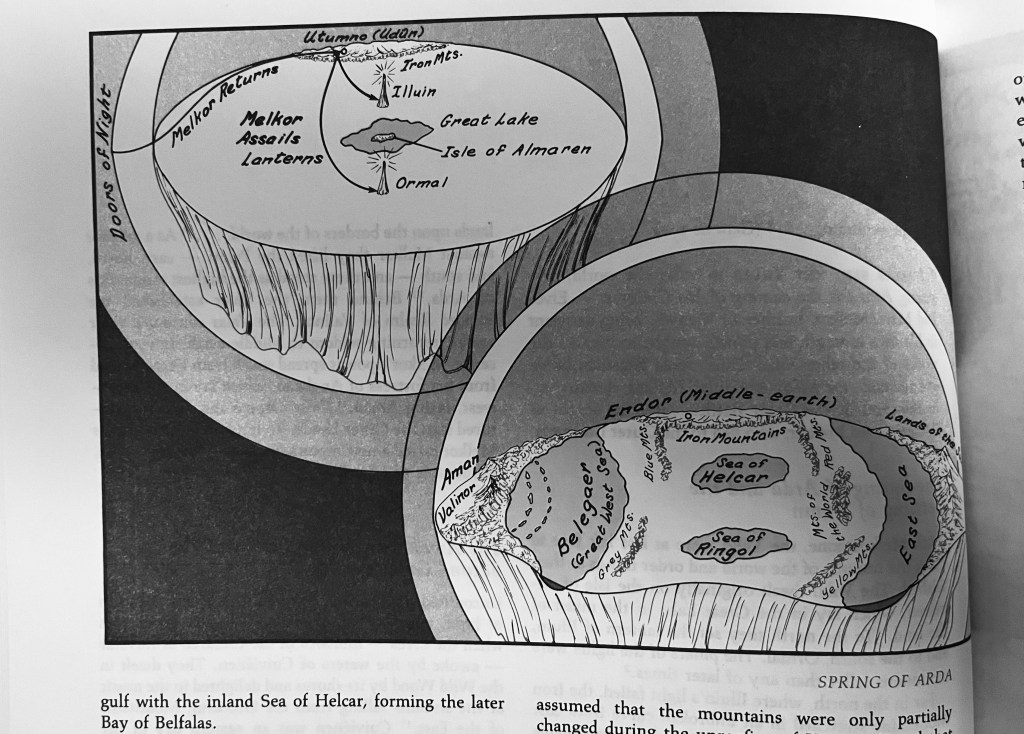
    It’s the beginning of the world, and the world is flat! The creative song of the Valar that we heard about in the Ainulindalë comes to fruition; Yavanna is the star here, planting trees and making the new world beautiful and lush. One of the things that sets the good guys apart in Tolkien’s world is their ability to work together (in a fellowship, if I may), and it is through the combined craft of Aulë, Yavanna, Varda, and Manwë that the two great lamps of Middle-earth give first light to the land, though this is technically set before Middle-earth looks anything like we’re used to. Karen Wynn Fonstad’s The Atlas of Middle-earth is a really fun resource for uber-nerds, and she’s drawn what this version of the world looked like in the top left image.

    To celebrate winning the First War against Melkor (about which little is said other than Tulkas having some Rohirrim-like battle joy) and the greenness of the land, the Valar party! In their distracted rest, Melkor sneaks back into the north of Middle-earth and builds his stronghold Utumno. No one realizes he’s there, but the lush land that Yavanna created begins to rot and grow poisonous. When he deems that he’s strong enough, he launches an attack on the two lamps, destroying them, casting the world into darkness, and literally throwing the earth into tumult.

    Valinor

    The Valar retreat far across the sea to the west, where they build a new home and name it Valinor – yes, the Valinor that the Elves in Lord of the Rings always talk about!

    “Valinor became more beautiful even than Middle-earth in the Spring of Area; and it was blessed, for the Deathless dwelt there, and there naught faded nor withered, neither was there any stain upon flower or leaf in that land, nor any corruption or sickness in anything that lived; for the very stones and waters were hallowed.”

    The Silmarillion, page 30.

    Valinor is very much a physical place, and a lot of action is going to happen here in future chapters, but as you can see from the quote above, it’s also got a lot of Heaven Vibes that are strongly leaned on in later books, like this gorgeous conversation between Pippin and Gandalf:

    PIPPIN: I didn’t think it would end this way.

    GANDALF: End? No, the journey doesn’t end here. Death is just another path, one that we all must take. The grey rain-curtain of this world rolls back, and all turns to silver glass, and then you see it.

    PIPPIN: What? Gandalf? See what?

    GANDALF: White shores, and beyond, a far green country under a swift sunrise.

    The Valar settle in, building a mountain range along the edge of the sea to keep Melkor out, and generally creating and singing together like the world’s original commune.

    All of this was done in darkness, since you’ll remember that Melkor destroyed the two lamps. Yavanna takes the lamp idea and makes them her own by singing into existence two trees to light the land: Telperion with silvery dark green leaves and Laurelin with golden light green leaves. Their light waxes and wanes and overlaps in 12-hour cycles, and time now exists in Valinor!

    The rest of the Valar keep on about their business, and we get some little hints about the relationships they will have with the Elves in the future, including the first name drop of the gems referenced in this book’s title: “Aulë it is who is named the Friend of the Noldor, for of him they learned much in the after days, and they are the most skilled of the Elves…The Noldor also it was who first achieved the making of gems; and the fairest of all gems were the Silmarils, and they are lost” (pg. 33). Spoilers!

    Middle-earth

    While the Valar are having a great time in Valinor, Melkor skulks around Middle-earth in cold and fire. He’s a Valar of extremes, which is a Tolkienian sign of unhealthiness! Although the focus in on Valinor, a few of the Valar keep a bit of attention on the lands where they once lived. Manwë gets regular information from his eagle and hawk friends; Ulmo never went to Valinor at all but continued to chill in the oceans; Yavanna returns to Middle-earth occasionally to heal the land’s hurts; and Oromë rides out to push Melkor’s dark forces back to Utumno. But those forces are never fully defeated, and one can’t help but think the Valar should focus their efforts and take care of him before anything gets out of hand! But then we wouldn’t have much of a story… and that seems to be something of Ilúvatar’s plan.

    Elves and Men

    The first chapter ends with a broad introduction to the Children of Ilúvatar, aka Elves and Men (Men here means humankind, though to be honest, Tolkien also mostly focuses on men!). If you watched The Rings of Power and thought the border elves were kind of harsh on the Southlanders (or heck, remember the disgust on Elrond’s face when he spits, “Men? Men are weak”), well, this is a very common thought amongst the early denizens of Middle-earth. Ilúvatar loves Men, but everyone else is a little skeptical. From the beginning, it’s said that they would “stray often, and would not use their gifts in harmony.” In fact, “the Elves believe that Men are often a grief to Manwë…for it seems to the Elves that Men resemble Melkor most of all” (pg. 36). Harsh.

    In contrast, listen to the Elves’ introduction:

    “The Quendi [Elves] shall be the fairest of all early creatures, and they shall have and shall conceive and bring forth more beauty than all my Children; and they shall have the greater bliss in this world.”

    The Silmarillion, page 35.

    What I find especially interesting about this is Tolkien’s reason for the great difference between the two. Men are given the gift of death, “which as Time wears even the Powers shall envy.” It seems that because of the short amount of time given to Men, it brings out the best and the worst in them, especially because Melkor “confounded it with darkness, and brought forth evil out of good, and fear out of hope.”

    Death as a gift is a theme that is revisited throughout Tolkien’s works, though it is never fully explained, because how could it be? I wrestle with this idea a lot, but in a society that glorifies youth and spends a lot of time and money resisting the inevitable, I find it helpful to sometimes think about death not as something to be feared, but as a reminder to live fully while I can. Memento mori.


    We end this chapter with Elves and Men, and in the next chapter we get one of my favorite stories: the creation of Dwarves! See you then.

  • All the (Silmarillion) Feels | Valaquenta: The Gods and Goddesses of Middle-earth

    All the (Silmarillion) Feels | Valaquenta: The Gods and Goddesses of Middle-earth

    All the (Silmarillion) Feels is an emotion- and story-focused summary of The Silmarillion. You’ll get facts, but that’s not the point here. Let’s talk themes, meaningful quotes, and moments that made us go “WHOA.” I started this project after falling in love with The Rings of Power television show, so expect me to focus on things to do with Galadriel and Sauron.


    Where are my Greek mythology girlies at? This is the chapter for you! Tolkien’s cisheteronormative pantheon includes seven gods and seven goddesses (aka Valar, six of which are paired off, and this section of The Silmarillion introduces us to each one (plus some lesser gods with VERY familiar names).

    Valaquenta: aka the Gods and Goddesses of Middle-earth

    Manwë, Lord of Arda

    Manwë rules the skies, which gives me serious Zeus vibes. However, he has none of the Greek gods’ licentiousness, because one of Tolkien’s favorite things is monogamy. He’s also less about lightning and more about birds, and yes, the Eagles are Coming was Manwë’s doing.

    Varda, Lady of the Stars

    Varda is the Valier who is most feared by Melkor because the light of Ilúvatar is in her face. The elves love her best of all the Valar, and she’s basically the personification of hope, so in the world of Tolkien, that makes her the best.

    RELATIONSHIP ALERT: Varda + Manwë

    The first couple in list and in power, I adore the fact that Tolkien mentions that their powers are greater when they are together. Varda helps Manwë see further, and Manwë helps Varda hear more clearly. I’m a big believer that couples should support and enhance each others’ strengths, so this note is right up my alley.

    Ulmo, Lord of Waters

    A solitary Valar with the heavy influence of Poseidon, Ulmo symbolizes freedom. He doesn’t go to meetings, he doesn’t rest, he doesn’t like to appear to elves or men, though he will help out if necessary. He just wants to hang out in the deeps of the sea, making him the patron saint of introverts.

    Aulë, Master of All Crafts

    Aulë is the good Morgoth, and maps onto Hephaestus pretty well. They both love making original content, but while Morgoth does it for his own glory, Aulë shared what he made and was open to direction by Ilúvatar. The Dwarves love Aulë because he’s all about gems and gold, and SPOILER, but Aulë is actually their daddy.

    Yavanna, Giver of Fruits

    As the lover of all things that grow, Yavanna is the Demeter of Middle-earth. There’s a great image of her as a giant woman robed in green, with roots stretching to Ulmo’s waters and branches high in Manwë’s sky…kind of like if the Norse tree of life, Yggdrasil, was a lady, which I am very into.

    RELATIONSHIP ALERT: Yavanna and Aulë

    Relationships in mythology are used to show the interrelationship of natural things. In this case, the two Valar are a celebration of the earth, above and below, as well as the creative capacity of natural substances. Yavanna gives me serious elvish vibes while Aulë is strongly connected to the dwarves; the fact that these two races are so often at odds is extra tragic when we’re told here that the two are best when working together.

    Námo/Mandos, Keeper of the Houses of the Dead

    It’s Hades! Mandos is the place which essentially becomes Námo’s name, and he’s the keeper of knowledge and souls, the pronouncer of Doom upon the world. But like, in a heavy but not evil way?

    Vairë, the Weaver

    Vairë is the three Fates as one being, and she weaves the webs of Time in ever-widening halls. Pretty badass, if you ask me, though she does sound a bit like a spider.

    RELATIONSHIP ALERT: Mandos and Vairë

    These two are the gothic couple that everyone respects but doesn’t invite round for tea.

    Irmo/Lórien, Master of Visions and Dreams

    Can’t read Lórien without thinking Lothlórien, am I right? Galadriel will rule over Lothlórien someday, and her Mirror gives visions…COINCIDENCE?

    Estë, Healer of Hurts and Weariness

    What a useful, lovely goddess! The equivalent deity that springs to mind is Becky Chambers’ Allalae, the god of small comforts. Estë seems to sleep all the time, and she gifts rest to those who need it. Love a sleepy girl.

    RELATIONSHIP ALERT: Lórien and Estë

    Do you have friends who, when you go to their place, you know you’ll feel cozy and cared for? Honestly, I aspire to be that friend, and now I know who to emulate. Tolkien says that the Valar head to Lórien and Estë’s house when they need to ease their burdens; sounds nice.

    Nienna, Lamenter of Grief

    Nienna is a downer at first glance since she is melancholy personified, and I LOVE that Tolkien made this emotion a deity. She is “acquainted with grief” and her mourning was woven into the song of creation. But she isn’t morbid. Her grief enables others to “learn pity, and endurance in hope.” She’s a single lady, and like a wise guru, people come to her to so that their sorrow can be turned to wisdom.

    NOTE: One of the Maiar (lesser gods) who spent a lot of time with Nienna is Olórin. The name he’s better known by? GANDALF.

    Tulkas the Valiant

    Tulkas is Thor, the broiest of the Valar. He loves fighting and proving his physical prowess. You can just imagine him bouncing around asking people to dare him to jump over a mountain or wrestle a bear.

    Nessa the Fleetfooted

    Nessa is Artemis if Artemis also loved dancing. She likes deer? This is pretty much all we know about her.

    RELATIONSHIP ALERT: Tulkas and Nessa

    What does their relationship reveal? They both have an air of wildness about them, though in possibly the most heteronormative way possible. Tulkas is all manly brawls, while Nessa is nimble and quick. A classic barbarian/rogue team up?

    Oromë, Lord of Forests

    This guy loves Middle-earth the most (as opposed to Valinor, the heavenly land where the Valar live and the elves sail to), and Oromë is the original horse boy, in whose footsteps Aragorn and his ancestors will someday tread.

    Vána, Ever-young

    The younger sister of Yavanna (see tree goddess above), this Valier is all about flowers and birdsong. She’s basically the template for a 20th century Disney princess.

    RELATIONSHIP ALERT: Oromë and Vána

    The feeling I get with these two is a May-December romance that feels kinda skeezy from the outside, but they’re genuinely happy on their ranch, where they garden and hunt to their hearts content.

    Melkor aka Morgoth

    This guy is counted among “The Enemies,” though he was once the mightiest of the Valar. He’s a classic case of hubris, desiring things he couldn’t have and ruining (and being ruined) in the process of pursuing them.

    “Melkor spent his spirit in envy and hate, until at last he could make nothing save in mockery of the thought of others, and all their works he destroyed if he could.”

    Page 18

    He is especially tied to darkness, which is likely why he’s so afraid of Varda and her light. He’s power drew a lot of people to his side among the Maiar (lesser gods), including Ossë, who rules the coasts, the Balrogs, and SAURON. Tellingly, Tolkien points out that Sauron was not as evil as Morgoth because he served another rather than himself. It’s when Morgoth is gone and he claims total power to rule for himself alone that he’s truly beyond redemption.

    (If you’ve got feels about how this relates to his offer to share power with Galadriel in episode 8 of Rings of Power, then WOW, let’s please talk in the comments.)


    With the Ainulindalë and Valaquenta done, we move into The Silmarillion proper! It’s time to focus on the original piece of jewelry that threw all of Middle-earth into a tizzy.

  • All the (Silmarillion) Feels | Ainulindalë

    All the (Silmarillion) Feels | Ainulindalë

    Watching season one of The Rings of Power brought my deep and abiding love of J.R.R. Tolkien’s stories of Middle-earth back to forefront of my interests, and when it ended I knew I wanted to reread The Silmarillion to continue living in pre-Lord of the Rings history. This is a startlingly beautiful book that is, nevertheless, very dense and intimidating. There are a plethora of deep dives and fact battles out there for the reader who wants to focus on timelines and details. But if you’re like me, you would much prefer a guided walk through the stories prioritizing emotions and relationships. Hence, All the (Silmarillion) Feels.


    Some people consider The Silmarillion to be the bible of The Lord of the Rings, so it’s fitting that we begin in the same place: with the god(s), before the world was made, in a story that is more poem than prose.

    Ainulindalë: aka The Creation Myth of Middle-earth

    In just nine pages, Tolkien rolls out an awe-inspiring creation story based in music, conflict, and hope. I’ll be honest, it’s hard for me to read this bit without going deep into my religious feels, but I already wrote that essay in my personal blog in 2015: “Theodicy and The Silmarillion.” For our purposes here, I’ll stick to themes and values that go beyond any particular religion.

    Main Characters

    • Ilúvatar: God, basically
    • Melkor (soon to be known as Morgoth): Satan, basically
    • Ainur/Valar: gods in the vein of Zeus, Poseidon, etc.

    Middle-Earth’s HR Policies

    Middle-earth is created by music sung by the gods, which such a great emotional image. I can just imagine that a river is a song given physical form, you know? Ilúvatar is the manager of our dreams, laying out a clear picture of what he expects to see and then rewarding the tentative attempts of his workers until they are confident in their ability to sing beauty into existence. When one worker (Melkor) gets ideas of grandeur into his head and begins to sing his own song, Ilúvatar weaves the songs together into something greater than before. There’s even a bit that reads like a progressive discipline manual, with Ilúvatar reacting to Melkor’s initial shenanigans with a smile, then with sternness, and finally with a face “terrible to behold.” It’s a poetic glimpse of the story we’re going to read in The Silmarillion, The Hobbit, and The Lord of the Rings: beautiful, patient, melancholy, tragic, and ultimately: cathartic. The good and the bad feel worth it, and maybe even necessary.

    Where Are the Ladies?

    It’s worth noting here that Tolkien’s Catholicism shows in his fantasy religious hierarchy of male-defaulted deities. The three Valar that are named (plus Melkor) are all male, though the equivalent of goddesses will exist in future chapters. There’s also some old-fashioned gender essentialism in Tolkien’s description of the Valar taking on physical form. He does a lot of things really well, my favorite cis white fantasy author, but nuanced depictions of gender and sexuality are not among his talents.

    Don’t Play D&D with Melkor

    Easily the most emotional part of this introduction is the fact that over and over again, good is made out of evil. Exactly how that evil is portrayed (pride, impatience, envy) can be accepted or not, but the key thing here is that every time Melkor tries to wrest control of creation through violence, the end result is something beautiful. Creation is meant to be a group project, one in which personal flourishes are applauded but expected to work alongside everyone else’s flourishes. It’s like in D&D when you tell the players not to hog the spotlight but instead draw out those who are quieter or more timid. Melkor would be a disaster to play D&D with.

    Luckily, Ilúvatar is a great GM. When the Valar complain about Melkor ruining their campaign, he basically says, “Yeah, I know it sucks that he made bitter frost and fire without restraint, and it’s ruining the setting you’re trying to create. But hey, I took his ideas of extreme temperature, and they’re actually going to cause mist, clouds, and rain. And those are really great.”

    Beauty isn’t the only thing made out of discord; connection is too. The god of the air (Manwë) and the god of the sea (Ulmo) are the ones complaining about Melkor’s shitty behaviour, and his actions allow the two of them to work together more closely.

    “Then Ulmo answered: ‘Truly, Water is become now fairer than my heart imagined, neither had my secret thought conceived the snowflake, nor in all my music was contained the falling of the rain. I will seek Manwë, that he and I may make melodies for ever to thy delight!’ And Manwë and Ulmo have from the beginning been allied, and in all things have served most faithfully the purpose of Ilúvatar.”

    Page 9

    Today’s Emotion is: Trust

    There’s a lot of lore and a lot of values packed into the Ainulindalë; we’re going to see them play out over and over again in the remaining 354 pages. As a truly talented storyteller, Tolkien is confident enough in his story that he gives away the ending right at the beginning: It’s going to be alright.

    I love reading Tolkien’s work because it is religion, therapy, and entertainment wrapped up in one. “Things are going to be terrible,” I see him saying, “but that isn’t all there is. Find the beauty in the pain, and trust that in the end, it will all be okay.”

    And you know what? I trust him.