Tag: ttrpg review

  • Curse of Strahd Review

    Curse of Strahd Review

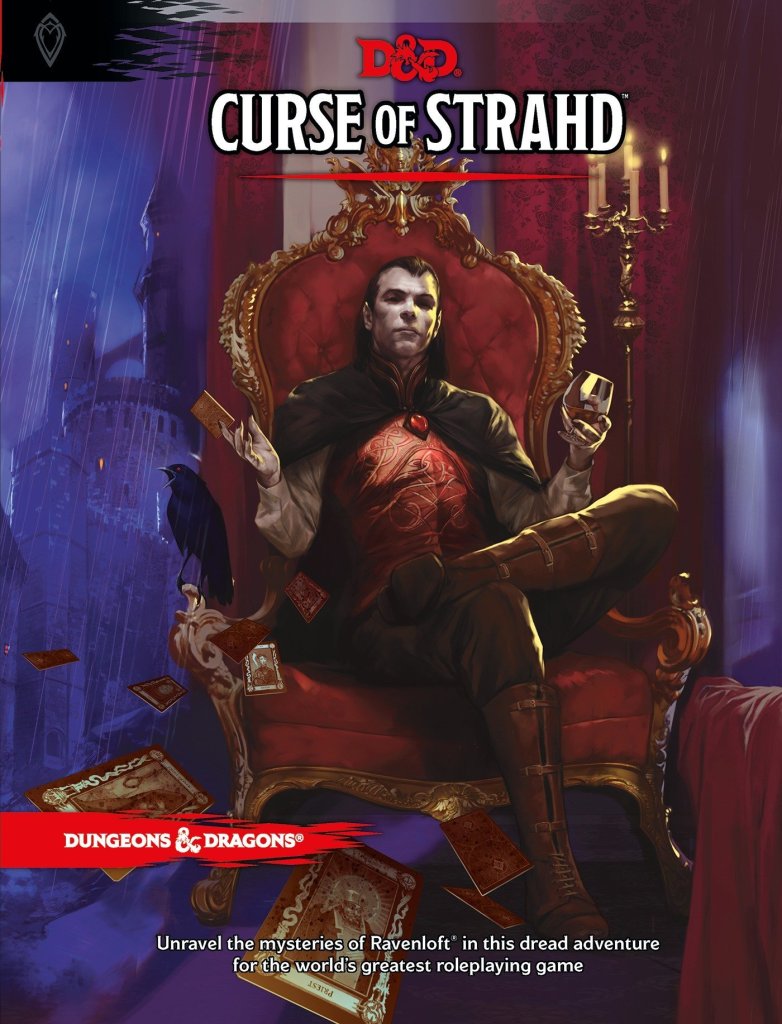
    Under raging storm clouds, the vampire Count Strahd von Zarovich stands silhouetted against the ancient walls of Castle Ravenloft. Rumbling thunder pounds the castle spires. The wind’s howling increases as he turns his gaze down toward the village of Barovia. Far below, yet not beyond his keen eyesight, a party of adventurers has just entered his domain. Strahd’s face forms the barest hint of a smile as his dark plan unfolds. The master of Castle Ravenloft is having guests for dinner. And you are invited.

    Curse of Strand is a D&D 5e horror adventure released in March 2016. This popular adventure is a fun journey with a lot of amazing bonus content and progressive updates to the original material available online.

    Rating: 5 out of 5.

    Our Curse of Strahd Campaign

    I DMed Curse of Strahd from September 19, 2020 – October 30, 2022 (yes, we angled to finish on Halloween weekend). This campaign was one of the primary social activities I had during COVID, and during our two years playing together, our group met in person, outside in the park, or online depending upon what was safest at any given point. It was my first time running a campaign, but I had such a fun time combining the original material with bonus content I found online (listed at the end of this blog post).

    We started with four players and ended with three, which I think is pretty good for a two-year campaign! Meet the players and their characters:

    • Tricia (DM). Although I had experience running one-shots, this was my first campaign to manage. I especially loved roleplaying the following NPCs: Strahd, Szoldar (who took on an outsized role in our campaign), and Arabella.
    • Rachel (Ireena, human). Normally an NPC, Rachel infused Ireena’s character with trickster cleric energy, a passion for small business, and an intense hatred of Strahd.
    • Frank (Seraphina, half elf). As a Paladin to Athena, Seraphina was a righteous voice for good in a morally complex world.
    • Nick (Beldhur, elf). Strahd’s not the only one wrestling with a Dark Power, and Beldhur’s inner evil was a game changer in our final session.

    Curse of Strahd is an adventure designed to take players through traditional horror tropes like vampires, werewolves, and witches. We took a more “dark fantasy” approach full of quests and high emotions with a side of Buffy the Vampire Slayer-esque humor. The characters found themselves in the locked land of Barovia, ruled over by the vampire lord Strahd von Zarovich. He is obsessed with the local woman Ireena, and the players are tasked with keeping her safe from him and, along the way, saving the world from his evil rule! The playable world is a predefined valley with three main towns and a few dungeons, it has a lot of depth that allows locations to feel different when explored with new information. The small world also allows players to feel the impact of their actions, as decisions made in Vallaki have a spill over effect for other NPCs in other locations.

    Although the book is designed to take characters from level 1-10, my players got to level 12 because I included the Fanes additional content (described below), and each time the group reconsecrated a Fane location, they leveled up. Actually, Nick ended up level 14, because I offered him additional power if he pledged himself to his Dark Power. During the final battle when all seemed helpless, he accepted the deal!

    What Did I Do Differently?

    • Ireena was a PC. Making Ireena a playable character rather than an NPC allowed the initial adventure hook to feel impactful throughout the entire adventure. It also raised the emotional impact of revelations regarding Ireena’s surfacing memories as Tatyana, since it was directly related to one of my players rather than an NPC. I highly recommend this change; because Ireena has led a sheltered life in only one town, she doesn’t need to have much pre-knowledge of the world.

      If you would like to flesh out Ireena’s backstory and give your player something to base her performance on, Rachel and I created the Tome of Ireena to describe her childhood and pre-story interactions with Strahd.
    • The Three Fanes. Using Mandy Mod’s bonus content (related below), I added the Three Fanes into Barovian mythology. This gave the history of the world more weight, further vilified Strahd, and gave the players a concrete way to start changing the world by reconsecrating their shrines.
    • Making the Vistani less problematic. Curse of Strahd is famous for its thoughtless portrayal of the Vistani as thinly veiled Romani, and they’re coded as fairly evil, no less! There are a lot of resources online to guide you in changing this dynamic. I kept the group as ostracized for their historical support of Strahd, but took out the cursing and Gypsy descriptions. I also made their support of Strahd much more understandable and sympathetic, to the point that the group made it their mission to reconcile the Vistani with the other Barovians.
    • Szoldar became a main character. Szoldar is a wolf hunter in Vallaki with a throwaway description in the original adventure. There is always one NPC in caampaigns like these that capture the players’ attention, and Szoldar was that NPC! Rachel’s Ireena fell in love with him, and they even got engaged in an epic one-shot that Rachel DMed to elaborately propose.
    • No Argynvostholt or Dinner at Ravenloft. My players were suspicious of Strahd from the beginning, so they never accepted his multiple invitations to dinner (this may be a consequence of having Ireena as a PC). This meant that when they stormed Ravenloft in the finale, they had never been there before; luckily, they found the castle blueprints in the Amber Temple and could therefore make a plan of attack.

      They also never got around to visiting Argynvostholt, which is too bad! I kept reminding them of its existence, but they chose other adventures that wound up leading to Strahd’s increasing wrath, and eventually it became clear that they needed to kill him or risk all of Barovia being wiped out. I think the Argynvostholt dungeon could still work as a post-finale mini adventure if the group wants to get back together to finish clearing out the valley’s last dark spots.

    Additional Resources

    • Mandy Mod’s Fleshing Out Curse of Strahd (free). This is the material I used as religiously as the actual adventure book. Mandy Mod has created an immense “Fleshing Out Curse of Strand” chapters on Reddit that adds NPC personalities and motivations as well as large scale changes such as the addition of the Fanes into the world of Barovia. 100% recommend this should be treated as essential.
    • The Interactive Tome of Strand ($14.99). The Tome of Strand is an item in the original book that offers one page of information; this bonus content revolutionizes the item into a book that PCs can enter and live through 14 of Strahd’s memories that really opens up his character and the world.
    • Countess von Zarovich ($9.99). This 62-page PDF reimagines Strahd as a woman. This isn’t a surface gender swap; the creators explain in depth how Strahd’s female gender would have shaped her upbringing and motivations. I found this too late for my campaign but will definitely use it if I run it again!
    • Landmarks on the Svalich Road (free). DragnaCarta’s CoS expansions on Reddit are often used in place of, or alongside, Mandy Mod’s content. I didn’t find his style as much to my taste, but I did love this Google Doc that adds a lot more flavor to traveling the main road throughout Barovia.
    • Visions of the Vestiges ($8.95). One of my favorite parts of CoS is tempting my PCs with Dark Power deals so that they will hopefully unleash one at the Amber Temple and set themselves up as the next Dark Lord of Barovia. This PDF expands on this idea by fleshing out the Vestiges and including artifacts throughout Barovia to bind PCs to their will.

    Have you played Curse of Strahd? Leave a comment and tell me about your character and favorite memory!

  • Yazeba’s Bed & Breakfast Review:  A Legacy RPG by Possum Creek Games Coming Soon!

    Yazeba’s Bed & Breakfast Review: A Legacy RPG by Possum Creek Games Coming Soon!

    Yazeba’s Bed & Breakfast

    A slice-of-life legacy tabletop role-playing game about a found family and their magical home.

    Created by Mercedes Acosta, Jay Dragon, M Veselak, and Lillie Harris with Possum Creek Games, Yazeba’s Bed & Breakfast was funded on Indiegogo with over $420,000 pledged. You can download a free Playkit here while you wait for the book to be published!

    Mercedes Acosta
    Jay Dragon
    M Veselak
    Lillie Harris

    Rating: 5 out of 5.

    The Set Up

    Yazeba’s Bed & Breakfast is a legacy RPG with 48 chapters that reveal new worlds, new secrets, and new character depth that can be played in any order with any friends at any time! This is the flexible and fun game that is perfect for the busy nerd who has a hard time coordinating schedules with everyone on a regular basis (*raises hand*).

    When the final edition is released, the book will serve as your personal version of the magical B&B, to be written in, covered in stickers, and opened slowly. As the owner of the book, you are the Concierge (think DM, but with way less responsibility). You need to be familiar with the cast as well as the flow of play, but all players can basically start with zero knowledge and jump into the game easily.

    Let’s see what works and what doesn’t in Yazeba’s Bed & Breakfast!

    Highlights

    • The chapters. Each chapter of the book serves as a traditional RPG session and generally lasts around 1-2 hours. The chapters each focus on specific characters while leaving room for others to join as desired, and there are bespoke mechanics for each chapter that are rules-lite and easy to catch on to.
    • The characters. There is a cast of 7 core residents and up to 50 guests that can participate in a session, and they range from robots to witches to sentient bunny warren. Players choose a character for one session, but are encouraged to switch often, with the lovely note that in this way, different players can reveal different aspects of a character’s personality. Each character balances uniqueness with archetypes, and it is easy to find yourself in everyone.
    • The character sheets. When you begin the game, some chapters and characters are inaccessible; you unlock them by completing characters’ growth journeys, each of which is specific to the character. I especially love Amelie’s sheet; as a robot, you can rewrite her code as she progresses, and when every line has changed, you unlock “Glitch in the System.”
    • The inclusion. As with Wanderhome, my favorite game from Possum Creek Games, queer themes abound in Yazeba’s Bed & Breakfast. Aside from creating trans characters to play with and focusing on stories about hurting people finding loving community, I think this is also expressed in the soft, inviting language throughout the book and its emphasis on player health and enjoyment over gameplay. For instance, players are explicitly encouraged to use take-backsies if you have a better idea later or don’t like what someone says.
    • The easy access. The book is designed to open up slowly, which means you don’t have to read the whole thing and memorize loads of rules before starting the game. You could very easily sit down with your friends, open it for the first time, and get through the intro and one session in a comfortable evening.

    Challenges

    • Mark up the book. I’m torn on this one, and I won’t fully know until I use the actual book. I love the idea of marking up character sheets and filling in bookcases with stickers to mark achievements, but also…what if I make a mistake and it is immortalized forever!? I will be strongly tempted to try to print off pages so that the book remains pristine, which absolutely defeats its purpose. Time will tell what path I choose…
    • Less character creativity. This is an RPG with established characters rather than one in which you can create your own. There is a lot of good to this (see above), but some people are going to miss the freedom to play their own creation.

    My friends Jessy, Rachel, and Allonté played “Chapter 5: Another Rainy Day” and “Chapter 10: Wash Cycle” with me to help with this review. Find out what they thought about Yazeba’s Bed & Breakfast below!

    Jessy (he/him) says…

    “I had a great time playing Yazeba’s. It was a constant delight! The unique rules that each chapter introduces help to underpin the mood and feel for those chapters, both that we played mostly included elements of slapstick chaos as we attempted to keep Hey Kid entertained so they wouldn’t explode or attempted to rush through a mountain of laundry so Sal could get to his show on time. The chapters we played also tied multiple characters into the game, making sure that every chapter has characters that are invested in events. And what characters they are! On top of the central 7 characters who live or work at the B&B, there are 50 additional guests who you can also play. These characters include a group of rabbits who wear outfits, a sentient glob of grim, or, my personal favourite, the evil skeleton who wants to end the world but is rather ineffectual. All the characters have traits called Bingos and Whoopsies that are used for differing effect in each chapter but always reinforce a characters personality and reward the player for embracing those traits. It’s an elegant way to keep aspects of each character consistent even between different players while also giving players room to make each character their own while they play them. I love that the game encourages players to switch between characters for different chapters, giving everyone a chance to play their favourites.

    Due to the nature of the test play kit there are some aspects of the game I’m still a bit muddy on, mostly pertaining to its legacy nature. Each character has a track that gets filled up at the end of chapters but we didn’t have much opportunity to see what effects that can have due to the limited nature of our play test. There are also some aspects like collectables that I’m a bit unclear on. My hope is that these mechanics will be a lot of fun, but currently I find them a bit unclear. However, I expect once I have the opportunity to play more chapters and experience more of the legacy mechanics I will enjoy them.

    Overall, the game is really great! I had a load of fun playing with my friends and look forward to the full released.”

    Rachel (she/her) says…

    I had a really great time playing Yazeba’s Bed & Breakfast. Being given a character with just enough guidance in the form of Bingos and Whoopsies was a new experience but very easy to get into.

    For the first game, I played Gertrude trying in vain to keep Hey Kid occupied on a rainy day with the help of a weird skeleton and a bored desk clerk. Gertrude is not the kind of character I gravitate towards normally, so I relied on the guidance of the character sheet and soon got the hang of it. I came out feeling like I knew Gertrude a little better by the end.

    The second session I played The Bunnies in the Garden Who Wear Little Outfits; yes, that is their full name. They were super fun to play, making a new warren in the over-flowing laundry room that the other players were trying to tidy up. They are the vessel for any voice/accent you have wanted to try out as they have so many voices, and for me at least one or two of the bunnies stood out as favorites. The sheet for these guys has a little less on it but that lends to so much room for creativity, I love them.

    Allonté (he/they) says…

    Yazeba’s Bed & Breakfast (YBB) is another great creation from Possum Creek Games. Not only does it have a great cast of diverse characters, it also offers plenty of (re)playability in its almost choose-your-own-adventure style of scenes. YBB is super easy to begin and requires very little prep. It feels like the perfect game to play when everyone wants to relax, has limited time, wants to play something that is DMless, or wants to see the character’s story blossom like a novel but through play. In Wanderhome, the creation I know Possum Creek Games from, the creativity is front-loaded in the place you make at the table, but here in YBB that is more focused to one’s interpretation of the character’s Bingos, Whoopsies, and goal track.

    I had the pleasure of playing Sal and Monday. I think I had the most fun with the goal tracks – it is the thing that can carry over from game-to-game and is easily affected by the choice made at the table. Another unique thing this game offers is seeing how other folk interpret characters that have already been played. It was very cool to see how my Sal and Tricia’s Sal felt different and the same; that there is a degree of headcanon that keeps the story of the scenes feel so unique. While Sal feels like some odd multiverse version of my soul, Monday was a lot of fun to play. If you want to play something that is some amalgam of fairy-god-person and/or crossroads demon, give Monday a try!

    You may enjoy this game if you are the type of player who:

    • Needs more structure
    • Likes to embody a character outline
    • Likes minimal mechanics
    • Is an (aspiring) actor
    • Is secretly a demon child who will literally explode if the inn goes less than 40 mph…or something to that effect.

    You may NOT enjoy this if you are the type of player who:

    • Needs loose structure of goals
    • Does not enjoy being a character that is somewhat pre-made
    • Needs conflict that is outside the group/party
    • Is an (aspiring) director
    • Is a slime princess turned into a tall humanoid by a pact made with a glittering entity all in the name of the quest to do the umpteenth load of laundry so that they won’t get cursed, kicked out, be forced to walk the long winding road to some weird under-colony of Too Many Rabbits where they must make a new life as a side-show alien…or something to that effect.

    If you want to try Yazeba’s Bed & Breakfast,
    you can download the Ashcan PDF here.

    Their Indigogo campaign raised over $420,000 in March 2022.

    Follow Possum Creek Games to stay up to date on the game’s official release!


    Want more creative TTRPGs?
    Check out Common Sense and Sensibility,
    a game designed by
    Rachel and Tricia of Roar Cat Reads!

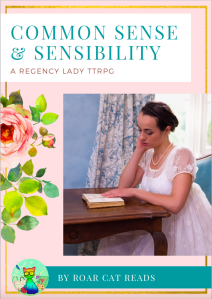
    Common Sense and Sensibility: A Regency Lady TTRPG

    “It is exceedingly well known that the life of a lady is far from easy. Death raises its grisly visage at every turn: whether from shawl insufficiency or too many novels, a Regency-era lady can never be too cautious.”

    In Roar Cat Reads’ original TTRPG character funnel, Regency ladies will test their delicate mettle and try to stay alive. This handbook lays out the game’s core rules, character creation instructions, and a list of the surprisingly mundane events that can test a lady’s constitution.

    Download your FREE copy at our Ko-Fi shop.


  • Reviewing Wanderhome, a cozy TTRPG by Jay Dragon

    Reviewing Wanderhome, a cozy TTRPG by Jay Dragon

    History

    Wanderhome is a pastoral fantasy role-playing game about traveling animal-folk, the world they inhabit, and the way the seasons change. It is a game filled with grassy fields, mossy shrines, herds of chubby bumblebees, opossums in sundresses, salamanders with suspenders, starry night skies, and the most beautiful sunsets you can imagine. (Possum Creek Games)

    Created by Jay Dragon, Wanderhome was a hugely successful Kickstarter campaign, raising over $300,000. It has since won Polygon’s Best Indie Tabletop Games of 2021 and is available for digital or physical purchase here.

    Rating: 5 out of 5.

    The Set Up

    Wanderhome is the TTRPG for anyone who wishes D&D had less combat and more animal handling checks. In our Roar Cat Reads’ Discord, those people were easy to find! We each prepared by reading through the book, which is full of gorgeous artwork, and then six of us met online to try the game for the first time.

    It was, dare I say, magical. I have never played a game that included so many people saying, “Awww!” on repeat, and meaning it sincerely every time. For two and half hours, we created characters, settings, and storylines as a group. As an overworked DM, I found this collaborative element hugely enjoyable. The system provides just enough structure to guide creation and keep things moving while allowing an enormous amount of creativity. We spent nearly an hour creating our characters, choosing from 15 different playbooks that are full of delightful flavor that creates a much more nuanced character than traditional systems like D&D. When we had finished, we unanimously agreed that we could happily sit around creating characters for hours, and that this would be entirely satisfying.

    We did move on, however, to creating our first destination. Wanderhome‘s conceit is that your group of travelers arrives at a new destination every session. When played as a GM-less game, this means you can use roll tables and prompts to create the next location as a group. We wound up creating a monastery that overlooked a lake of spirit koi where big cats wove tapestries from whiskers. I never would have created a setting that fun on my own!

    I was most nervous about actually playing the game. After all, how does anything happen if there is no established plot? What do we do if there isn’t someone pulling the strings? I was delightfully surprised to find that we created a fun little scene together that had actual emotional impact. Granted, there were a couple little-too-long moments when we described how we entered the monastery and didn’t quite know what was happening. But those small, purposeless moments feel different in Wanderhome. This is a game that comes to life in the pauses, when you can develop your character by putting your bumblebees to bed or build relationships by asking the squirrel to haul the aged owl onto the roof. It was on that roof that we noticed a spirit ship approaching, and after fifteen minutes of creative role play that culminated with a beach party, we took a contented sigh and realized we had reached the end of our day’s journey.

    Highlights

    • My absolute favorite part was the end of character creation when you ask a pre-written relational question of the characters on your right and left. They were surprisingly deep and truly effective at establishing quick bonds among the party.
    • When everyone is the GM, everyone gets to play the NPCs (“kith” in Wanderhome), which allows for even more diversity and creativity.
    • The vibes! This is a game feels slow, purposeful, and cozy. You could probably include drama and intense action, but I think you would lose some of the magic. Wanderhome is a celebration of the mundane in the absolute best possible way.

    Challenges

    • You need the right group for this with at least a couple very creative people, as the story will only be as good as you make it.
    • Conversely, you also need to make sure your group’s more vocal participants don’t take up the spotlight and prevent the quieter, slower creatives from contributing.
    • Most importantly, make sure your group enters this game with a yes/and mentality! Anything is possible, so say yes to the idea you don’t particularly like, see where it goes, and build on it!

    Other Players’ Reviews!

    Chad (he/him)

    Wanderhome harkens back to the days of my childhood when roleplaying was just some friends sitting in a circle or going over MSN Messenger and making stuff up, but with just enough of a world and guidelines to keep anyone from being put on the spot or having to spend hours planning. It’s almost more of a collaborative story-building event than it is a roleplaying game, though I mean that as the highest of compliments and not to diminish it’s place as a roleplaying game.

    We played roles. We played multiple roles. I was the Owl Teacher I came with, the Hillock we came to along the way, and the misunderstood Warthog Captain of a lake-faring vessel that formed the ‘conflict’ of the session. I say conflict in that the stakes were never much higher than ‘how fun and interesting can we make this’ as opposed to life or death. Wanderhome is painting pictures with words, creating personalities for everything, and being inventive with friends – both old and new. A welcome departure from the typical and a leap into the fantastical.

    Jessy (he/him)

    Playing Wanderhome for the first time was a thoroughly enjoyable experience. It’s very fun! And that fun doesn’t come just from going on adventures as woodland creatures, though that certainly is a lot of fun. For me a big part of the fun was making our characters and location together. This was the only time I’ve played a game where I would have been excited to just keep making characters with everyone.

    The mechanics elegantly facilitate bouncing ideas off of your fellow players while still moving at a brisk pace for those who may want to rush into adventure. Cooperatively creating a location like it is a character of its own was exciting and getting to use the locations’ actions to form a narrative works smoothly once you get the hang of it. After all that creation, playing the characters and locations we built was an absolute blast. I would recommend it to anyone.


    Have you played Wanderhome? Tell us what you thought!

    Common Sense and Sensibility: A Regency Lady TTRPG

    “It is exceedingly well known that the life of a lady is far from easy. Death raises its grisly visage at every turn: whether from shawl insufficiency or too many novels, a Regency-era lady can never be too cautious.”

    In Roar Cat Reads’ original TTRPG character funnel, Regency ladies will test their delicate mettle and try to stay alive. This handbook lays out the game’s core rules, character creation instructions, and a list of the surprisingly mundane events that can test a lady’s constitution.

    Download your FREE copy at our Ko-Fi shop.

  • Reviewing Feudal Attraction, a D&D 5e Dungeon

    Reviewing Feudal Attraction, a D&D 5e Dungeon

    History

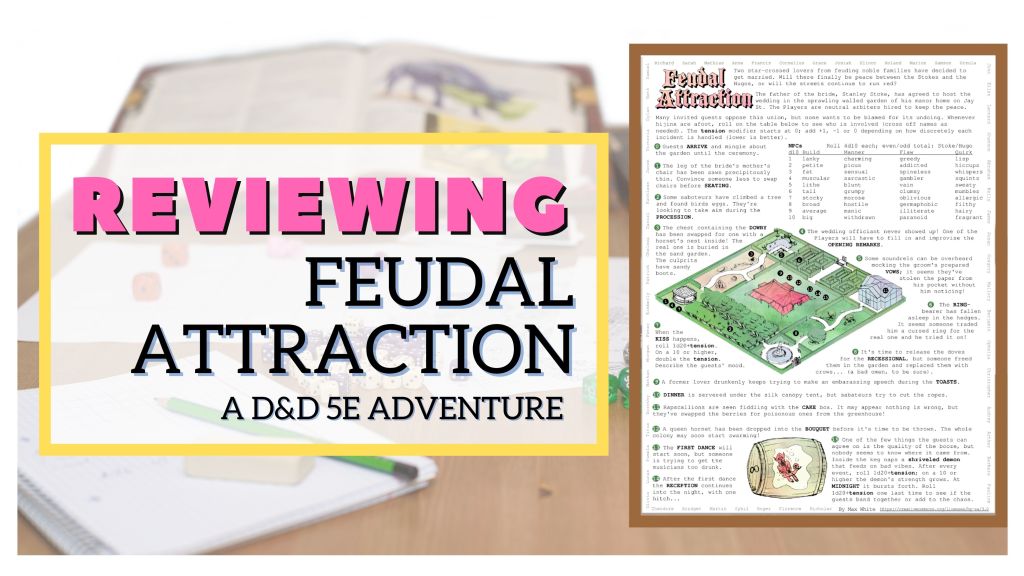
    Feudal Attraction was a winning entry in 2019’s One Page Dungeon Contest by Max White. You can find the single page adventure on RPG Geek.

    “Two star-crossed lovers from feuding noble families have decided to get married. It won’t go smoothly.”

    Rating: 5 out of 5.

    A DM’s Perspective

    Highlight

    This is one of my favorite one-shots to run; it is silly and romantic, which is me in a nutshell. In fact, I have run this adventure four times now! It’s a mark of how good the adventure is that with one page of information, I have had four very different experiences with different groups of people.

    The story is simple: A group of characters has been hired to run interference for a wedding between two feuding families. The wedding takes place in the enclosed grounds of a fancy estate and has a schedule that is recognizable to anyone who has been to a wedding before. As the day (and the adventure) progresses, the players must try and thwart various attempts to keep the happy couple apart.

    My favorite thing about this adventure is that it allows room for a lot of creativity and social interaction. I find this to be a perfect adventure to run for people new to D&D, since weddings are a familiar setting and they only have to worry about creating a character and some basic skill rolls. It’s also a lot of fun with experienced players. I just played through Feudal Attraction with a group (some of whom wrote their thoughts below) who brought a lot of roleplaying and creative character skills to the event. It was an absolute blast as they prevented kids from throwing eggs, found the lost ring and vows, and exchanged a rigged dowry with the correct chest of gems.

    Changes Made

    Other than the first time I ran this campaign, I never include the combat at the end (there is a demon in the wine barrels that can break out and cause a fight). All of the other mishaps are more petty than dangerous, so it feels out of sync with the rest of the experience. More than that, I just really like running an adventure that challenges the assumption that all D&D adventures must have a fight to be fun.

    The other significant change is in how the wedded couple is decided. Sometimes I let the players decide the race/gender/names of the couple (most recently, a female tabaxi named Bella married a nonbinary dwarf named Chives). If I know the group needs something familiar to latch on to, I will run it as the wedding of Legolas and Gimli. This leads to some excellent comedy (Frodo the cursed ring bearer, Gandalf the “a wizard is never late, nor is he early” missing officiant, and Aragorn as the grieving ex) that works if your players are big LotR nerds.

    What I Would Do Differently

    One thing I always forget to mention at the beginning of the session is a warning along the lines of “I don’t know what you might find, so it’s best not to wander alone!” The wedding estate is pretty spacious, and players tend to spread out in 1s and 2s at the beginning. They do inevitably start to work together a bit more as the session goes on, and I’ve gotten better at shifting scenes more smoothly, but setting that expectation early might allow for more player interaction from the beginning.

    Let’s Hear from the Players!

    Izzy AKA Cassian Pwyll (Human Hexblood Shadow Sorcerer and Event Decorator)

    Dungeons and Dragons is not normally a game that is built to reward completely non-combat related conflict. With the level system designed to dole out largely combat related abilities the natural progression is an almost natural shounen anime-like curve… But even in shounen anime sometimes you just need an episode where your characters go to the beach to relax.

    Having a number of challenges social and mental this one shot gave a chance for cantrips, racial abilities and skills to shine. Keeping the players at level one was an incredibly savvy move as most of the flavour of a character is intact at the beginning of their arc and there is no backlog of non-combat skills that never see the light of day. It is also my belief that this particular one shot keeps the DM engaged with a lot of topical variability as at the outset we were given the choice to pick the families of the two persons getting married (We chose a Dwarf and Tabaxi) and their officiant was a party member who chose a cult of the apocalypse which stained upwards to colour the entire tale with the vibrant hues of a calico heat death of the universe which still managed to be endearing and romantic somehow.

    Every character got a chance to shine and teamwork and colorful NPCs tugged at heartstrings and kept us laughing. After a solid three hours of lighthearted comedy, weird facts about doves/bees and bardic inspiration that seemed to affect the players more than the characters themselves I experienced a roleplaying high of the sort that refreshed me like a long rest. Solid 10/10.

    Listen to two players relieve their experiences in character!

    Allonté AKA Maester Diehart (Nihilist Cultist Cleric of Peace, Extoller of the Saint Mediggo’s teaching)

    This the kind of adventure for those who either thirst for roleplay or perhaps may not know how. From the onset, our wonderful DM/GM asked us, the players, to decide whom shall be wed. I am glad our group was on board for the most unlikely of pairings as well as having the ability to remind each other that in a fantasy world, why cling to convention or norms? In that, it is easier to find the heartbeat of this adventure, giving two who love one another the best day possible.

    Now this is an adventure of course, so there will be many obstacles in the way. If you are a completionist like me, you might miss a few things in the pursuit of a mini-quest and that’s….. Great! This is a hallmark of an adventure that you may want to experience again and again to see all the things you missed or to have differing experiences with different characters.

    Be forewarned, this is an adventure made without combat. With that knowledge, if you have some murder hobo tendencies, think of the social interactions or obstacles as a form of combat and choose your spells and abilities somewhat wisely. Or just have fun justifying why or how something should work. If you are a GM/DM looking for something to get your experienced roleplayers on a high or getting those without much experience engaged, I would run this adventure! Moreover, this will test your DM/GM skills in switching between scenes. For once, this is a great time to split the party! 12/10 would play again!

    Chad AKA Albert Corrian (Half-Elf Bard)

    As an experienced and long time player, it was an excellent change of pace to play something that was pure roleplay. There’s more than enough hack and slash to go around so a session with zero combat and all skills and talking was engaging. It’s important to note this was a known element coming in. Had we not been told there would be zero combat, our character choices would likely have been considerably different. I could see a meat-and-potatoes Fighter not having a lot of fun.

    Everyone got to do something, and everyone was involved. Playing a Bard, I focused more on my performing than my bevy of Charisma skills as our Warlock officiant had those in spades. I was ready to back him up but he handled everything well and rolled like a champ (once with a bit of help from Bardic Inspiration). I didn’t even have to sling any of the non-combat spells I selected, like Charm Person or Sleep, as ‘oh hell’ buttons. The atmosphere was calm and enjoyable, and we were able to inject some excellent comedy. Everyone left feeling energized and accomplished.

    10/10 would recommend running this session as a nice break, especially to try and crack some non-roleplayers out of their shells.


  • Reviewing White Plume Mountain, a D&D 5e Dungeon

    Reviewing White Plume Mountain, a D&D 5e Dungeon

    History

    White Plume Mountain is a 13-page dungeon crawl adventure for a group of level 8 characters. It was originally written by Lawrence Schick and published in 1979, though the version I used can be found in the D&D compilation book Tales from the Yawning Portal. Ranked the 9th greatest Dungeons and Dragons adventure of all time by 2004’s Dungeon magazine, it is a game that requires brute force and creative solutions in order to find three very cool sentient weapons.

    Rating: 5 out of 5.

    A DM’s Perspective

    Highlights

    As a DM, I strongly prefer working from pre-existing material, and I was excited to run a tried-and-true dungeon from Tales of the Yawning Portal. This adventure is not a one-shot (it took my group 4 sessions at 3 hours per session), but it is contained enough to be a nice breather in between campaigns or as a single adventure if you don’t want to commit to more, which I didn’t!

    I loved how creative the dungeon is; it is full of riddles, puzzles, and traps to navigate. It really brought out the creativity in my players, and they used their skills and spells in unique ways to survive. Sometimes TOO unique! They refused to enter the Room of Glass Globes (#4) and instead blasted all of the orbs from outside, releasing three shadows, an air elemental, and a gray ooze all at once! Since they had already found Wave, one character created a Cube of Force around the group the size of the corridor, which they used to body slam the monsters into submission. It was not how I expected the encounter to run at all, but it was amazingly creative and fun!

    Changes Made

    The one significant piece that is missing is a final fight with the wizard Keraptis. My players made it clear early on that they were interested in defeating him, so I made some alterations to the campaign to make that happen. I gave Sir Bluto a key that could be used to unlock the way to his santcum from the Pool and Drain (#9). I threw together a random dungeon chamber in which they could fight a lich (though I didn’t use its level 7-9 spells so that they had a hope of defeating him).

    My players were very invested in socializing with any characters they met along the way, so I made all humanoids in the dungeon former treasure seekers who had been forced to guard the weapons they once sought. Some were tricked out of their treasures (they gave the vampire Ctenmiir a footrub so good that he didn’t realize they stole Whelm from him), others were fought, and others were invited to join the cause. In particular, they really latched onto the flesh golem in the Numbered Golems room (#5). They named him Dusty, and a really sweet romance developed between his strong silent arms and one of the players! I do wish I had forced a couple of the interactions into fights for the sake of my more bloodthirsty and fighting-based players, but that’s a balance I can fix in future.

    What I Would Do Differently

    I wish I had done more preparation for the three sentient weapons that characters are meant to find throughout the dungeon. I could have given them much more depth, almost to the point of NPCs, if I had invested more time in preparing them. Because this was a one-shot separate from an overarching campaign, I would have made them more useful for this dungeon in particular so that the party could enjoy the weapons once they had them. One character (Adelin) got Blackrazor just in time to fight the lich…which is undead and therefore doesn’t work! On the fly, I had Blackrazor tell Adelin that it would attack the lich and deal appropriate damage only if he agreed to sacrifice half of his hit points. The player got very into this, stabbing himself with the sword to gain further advantages. It was a fun character moment, and I very much wish I had thought of similar things for Wave and Whelm!

    Let’s Hear from the Players!

    Rachel AKA Kreeth the Aarakocra Fighter

    This was the first time I had played a higher level, purely martial character. I chose this class partially out of curiosity and partly to round out the party; it was possibly not the best choice since I didn’t have a lot of ways to really help out the party. I went with a dex-based fighter, so I wasn’t able to heft things out of the way or force sticky levers, and because we socialed our way out of most combat encounters, I think I only used my +9 attack once or twice. 

    I was able to utilize the features from my race much more effectively than my class. I went with an aarakocra, so being able to fly was great (if a little limited) and getting into the bird mannerisms made it fun to roleplay. I found myself in a support role – when someone would trigger a trap or fail a dex check, I was able to swoop in and save them which was nice.

    I got the magical weapon Wave, but unfortunately, this did not gel well with my dex build (it did not return to your hand if thrown, unlike Whelm). However, its cube of force feature did allow me a brief glimpse into the magic user’s view of the dungeon, but I quickly burned through all the charges and was back to more passive play. 

    Overall I think this is a good dungeon. It was certainly challenging for our group and felt deadly! The only thing I would change is my character choice.

    Anne AKA Cinder the Fire Genasi Artificer (armorer specialty)

    This dungeon has a mix of combat and puzzles. I’d recommend it for people who are less interested in kicking down the door and murder hoboing as much as collaborative, varied paced campaigns. It’s not a hex crawl and there isn’t the frustration of just not being able to figure out which way to go to progress the session. There are enough potentially deadly encounters to keep it interesting.

    The one big flaw with having the goal being to recover magic weapons is that you might have a group that can’t make use of them. I think the DM either needs to communicate this during character creation or be willing to hand wave this aspect of the mechanics. Or enjoy giving your players a bunch of fun loot that they can’t use!

    Allonté AKA The Professor the Human Bard

    I loved my delve into the be-trapped abyss called White Plume Mountain! The beautiful thing about any adventure is that it is not just the setting, mechanics, or build, but it’s the table that makes it wondrous. I feel as if I hit the jackpot in this one-shot!

    DM Tricia, word of the mountain, was everything I wanted in a DM and didn’t know it. There was so much freedom to play in ways that were offbeat, fun, guilt-free, and rewarded us for ingenuity! Going in to this, we were warned this would be a no-holds-barred slog, and the impetus was to explore traps as a DM. I have fun into too many folk who would trigger the trap regardless of the creative ways one could maneuver. Initially I was mildly apprehensive, but that feeling quickly dissolved. This challenge, much to the credit of our DM, became a great experience. My favorite trap-dodging was Mold Earthing monkey bars across the roof while being caressed ‘n’ carried by a flesh golem! Just as importantly, there was also safety to purposefully fail for fun! Adalin, in this same session, explored this trap we were dodging. This resulted in having the entire team enjoy and work together saving them from a very, shall we say, tetanus-y fate. Moreover, I was impressed by how often resolving something in a non-combat way through role-play (not just dice numbers) was encouraged throughout. Let this be a lesson from the Professor to you, foot rubs are the Holy Grail and may one day save your life!

    Hear from Professor Mythalwulf about the adventure:

    I also cannot forget my other delver-in-arms friends, Cinder and Kreeth! All the players at this table made a this a beautiful experience. From the beginning, Cinder brought the realism with the reactions to the environment, really selling me this mini-world, which made me want to role-play more and get more reactions out of them, even if they were love-jabs. I also nominate them for the best Mold-Earth-Bridge Inspector of the Year. Kreeth also gave really great development throughout, whether it be inter party, inner-self, or against opposition; this enthusiastic incorporation made me, as a player, wait on bated breath for what they would do or how I could enhance them or bring more out of them. Kreeth, you will always be the best bird-voicebox-using-in-a-bear-body-sea-worshiping-being in my book. For my last award, I also need to commend Adalin, from one play to another, on playing chaotic in all the right ways: respecting everyone’s autonomy, never inflicting unjust harm in the name of random, and always playing the balance of trying to bring control to the chaos.

    I think the moniker of a good adventure, group, or in this case one-shot, is how it leaves you feeling. This left me wanting more in all the best ways! White Plume Mountain (via our group) left me wanting to explore all the stories that brought us here and all the stories that will take place after! As a fledgling DM, I think this is the perfect adventure both if you are not sure how to make a whole campaign-world OR if you want to add some dungeon-spice to your existing worlds.


    Common Sense and Sensibility: A Regency Lady TTRPG

    “It is exceedingly well known that the life of a lady is far from easy. Death raises its grisly visage at every turn: whether from shawl insufficiency or too many novels, a Regency-era lady can never be too cautious.”

    In Roar Cat Reads’ original TTRPG character funnel, Regency ladies will test their delicate mettle and try to stay alive. This handbook lays out the game’s core rules, character creation instructions, and a list of the surprisingly mundane events that can test a lady’s constitution.

    Download your FREE copy at our Ko-Fi shop.