Tag: Adventure Queers

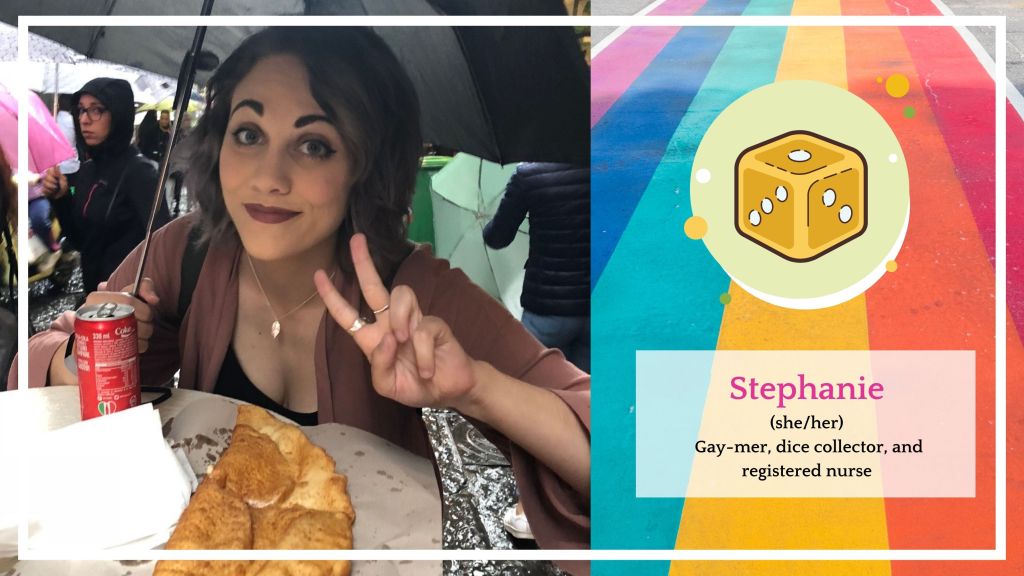
  • Adventure Queers: Meet Stephanie!

    Adventure Queers: Meet Stephanie!

    Stephanie, you’re going to GM the 1:00 p.m. PST session for our Rainbow Refugee Charity Event on October 16th. Can you tell us a little about your session?

    My session takes place in a Sound of Music-esque quaint little Swiss Alps town. The characters are going to try to break into a pair of socialites’ home during a ball to steal a fabled ticket to a hidden VIP brunch location. Gay hilarity will ensue!

    I’m so excited to see this play out. How would you describe your GM style in general?

    My ideas always go through several stages of chaos before I know what I want to do. When I was thinking about this session, I knew I wanted to do a heist. A while ago, I ran a one shot that dug into my character’s backstory – he was a drug smuggler, and his friend got caught and ratted him out. He was led on a heist through a bunch of tunnels, and when he finally opened a hatch, it was into a police station. I thought I would reuse it, but with everything going on, I don’t want minorities like myself to feel the threat of policing. So took the heist idea and twisted it, always asking, “How can I make it more queer?” Eventually I realized that the thing we love more than anything is: Brunch.

    I have always run one shots when I GM, but I like them to be deeper than just a dungeon crawl. I like there to be a story that players can discover if they so choose, otherwise they can fly by it. I made a dungeon once that had artifacts hidden around hinting at the fact that someone had once hidden their lover in the dungeon to protect them from evil forces; the players got really invested and wanting to figure out what was going on. They wound up fighting the ghost of the person hidden there, and afterwards everyone was asking, “What was this?” and “Who was that?”

    When you’re making a one shot, I think they do need to be a little railroad-y with a set goal and a set end. Otherwise they grow into multiple sessions and, eventually, a campaign. But like I said, it’s railroad-y but with added flavour and depth so that it’s not just going into new rooms and killing new bad guys.

    What kind of characters do you tend to play?

    Character creating is my favorite thing! Every character I’ve created is my child.

    The first character I created was a joke – he was meant to be the most annoying bard ever. He was a 16-year-old prince who went to a bougie music school, had a ridiculously long name, and played an otamatone. Over the two year campaign, he wrote himself. He ended up becoming a young hero of the party who was brave and heroic, when at first he was stuck up and didn’t want to help others in case he hurt himself. In general, I love creating dynamic characters that are more than just one note.

    How long have you been playing D&D? What has your experience been like?

    The week after New Year’s 2017, a good friend of mine and their “friend” (now wife) started playing D&D. They gathered a couple other friends (all queer), invited me, and we all gave it a try. Something that was just a fun whatever turned into a campaign that lasted two years, and then another two year campaign after that!

    Like you, I’ve always played D&D with queer people, and I hear horror stories about the worst kinds of straight TTRPGS. What do you think makes a queer D&D experience so special?

    There is unspoken solidarity between everyone at the table. We know where to draw the line so that we don’t touch on our collective trauma; there’s no racism, homophobia, transphobia, or sexual assault. We know what it’s like to be queer in real life – it’s cathartic to be queer in a fantasy world, to be who you want to be with freedom.

    In general, I think queer people are often creative, artistic people. We’re good at coming up with stories and characters. If you put two characters in front of me, I would know which was the gay one. I don’t know why this is. It’s probably multi-factoral, but I think part of it comes from turning into yourself because of fear, and finding ways to express what you find in there.

    I will say that straight people can be good players too. There’s a girl in our current campaign that I call our “token straight.” And I’ve played D&D with some good boys before; one had a friend who came out as non-binary, so he played a non-binary character to practice using they/them pronouns.

    I understand that you volunteer with Rainbow Refugee. Can you tell us a little about what that looks like?

    I grew up seeing and helping my mom, who was really into animal rescue. She created her own non-profit (Best Friends for Life) to collect pet food and supplies for people living in the Downtown Eastside. So fundraising and fundraising events are something I’m very familiar with.

    About a year ago, I saw a post on Instagram from local trans activist Lauren Sundstrom asking if anyone could help bring an Iranian trans man and his wife fleeing persecution to Canada from Turkey. I said yes!

    Our fundraising circle has ten people. We have a Canada Helps page where we raise money by doing events like silent auctions. Rainbow Refugee requires a foundation of at least $20,000 to get someone set up, and we’ve raised almost $30,000! We’re also working on the paperwork necessary to actually get them to Canada, hopefully by the new year. Once they arrive, we will be their social and emotional support. We will help them find and furnish an apartment, and support them for at least their first year here.

    The most interesting part of this process has been navigating this during COVID. The easiest go-to fundraiser is a pub night, but you can’t do that now. I will say, Rainbow Refugee has been so supportive of our fundraising initiatives. They provided an immigration lawyer who briefly worked with our team to help navigate the legalities of fundraising.

    If someone is interested in volunteering, can you tell us the best way to connect with Rainbow Refugee?

    Go to their website and shoot them an email. They might have circles that need more volunteers, or there may be fundraisers that you can participate in.

    Is there anything you would like our readers to know about?

    Support our next fundraiser. The wife that we’re helping coming to Canada is sending us her art – water colours, brooches, and pins. They’re so beautiful! We’re going to sell them in a silent auction to keep raising money for her and her husband.

    Also, please don’t protest in front of hospitals! I work in chemotherapy, and all of our patients were late to their appointments; some of them are disabled, and they had to walk three blocks to get to their appointments because of protesters!

    Get vaccinated!

    Do you have any queer nerdy recommendations for readers?

    • My friend has started a D&D podcast called Fey Finders (@feyfinders on Instagram and Twitter) that everyone should check out.
    • I also want to shout out GM Tim! He was working at Strategies and sold me my first set of dice. He’s awesome. (GM Tim is also a GM for our Rainbow Refugee Charity Event).
    • The last thing I want to plug is Lykopis Archery on Commercial Drive. That’s where I practice, and it’s run by a queer POC lady master archer and is super inclusive!

    Thank you Stephanie! I’m so excited to watch your D&D session on October 16th.

  • Adventure Queers: Meet Haley Boros!

    Adventure Queers: Meet Haley Boros!

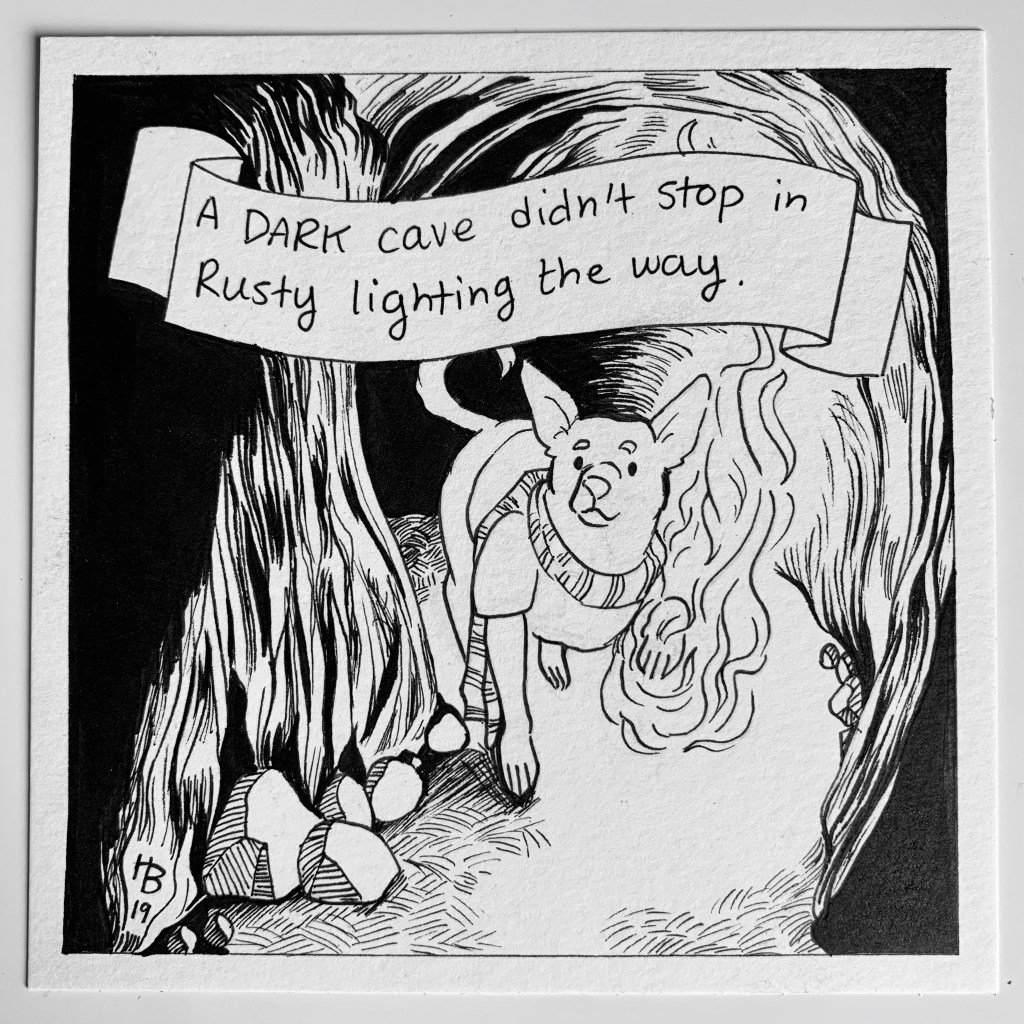
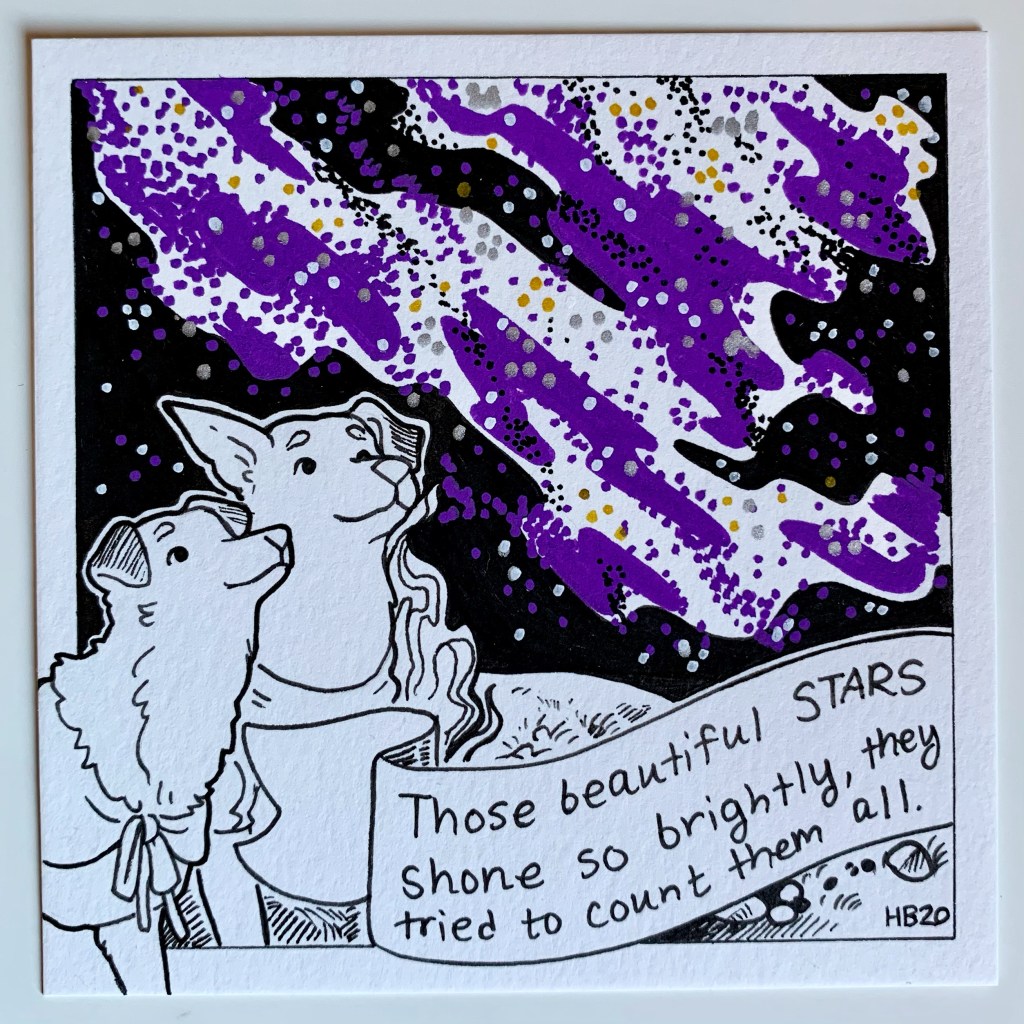
    Hello! I’m Haley Boros, my pronouns are she/her, and I’m an award winning graphic designer, illustrator, and published cartoonist. Outside of my career in the label printing and flexible packaging industry, my creative practice focuses on whimsy and fantastical creatures – think dogs doing fantasy jobs! I’ve contributed to several comic and art anthologies since 2017, most of which can be found on my website at haleyboros.com. You can also become a patron of mine at patreon.com/hihaleyboros, or follow along at @hihaleyboros on twitter and instagram!

    How did you begin playing/DMing D&D?  What is your favorite aspect of the game?

    My first experience playing in a roleplaying game like D&D was when I was in high school and hanging out at the local game shop (Bastion Games). Chad Charest and I grew up together and we would go there on Wednesdays to hang out. We were invited to play in the attic of the store and, while that campaign didn’t last for me, I went on to play in many different groups over the years.

    During my time playing tabletop games, I’ve been a player more than a DM. I have had the opportunity to run three one shot campaigns, two of which were modules and one was written by myself! That one was particularly wonderful: picture a cozy comic convention on the east coast of the US, in Bethesda, Maryland – and in a hotel room, 4 cartoonists got together to storm a library as their respective characters. Dust mephits! Lots of flying books! It was quite the adventure I planned (with help from my husband Jessy, of course!).

    I’d have to say the best part about playing is getting to know my characters and their backstories. I feel like I’ve always created fun characters, most with interesting parts about themselves (I’m partial to skin and eye pigment distinguishing features like heterochromia and vitiligo)!

    As a bisexual woman, have roleplaying games helped you explore or express your queer identity?

    Unfortunately, I can’t say that playing roleplay games has! I’m a late queero, coming out after I married my husband in 2016, but knowing who I’ve been my whole life and kind of affirming it, I haven’t seen a shift in exploration of who I am through roleplaying games…yet! I’ve played with a few of my friends that have introduced a whole spectrum of sex and gender identities, but I’m itching for more! 

    You have contributed as a cartoonist and illustrator to several projects, including Faerie Fire, a 5e supplemental Anthology and Welcome to Mina’s: A Diner Comic Anthology.  You are currently promoting Fantastic Frights, a comic anthology coming to Kickstarter in October 2021.  How do you decide what projects you would like to participate in?  

    Great question! With so many things in my creative career, I’m drawn to projects that I could really see my skills lending well to. With those specific projects – I reached out to Shan Campbell, the editor of Astrolago Press and publisher of Faerie Fire, to see if they needed more artists since their stretch goals kept climbing and climbing on the kickstarter.

    With Cloudscape comics, I’ve always wanted to be involved with this local society! I met a few of the collective back in 2012 at the very first VanCAF and have been following their projects ever since. Welcome to Mina’s is the first comic I’ve contributed to Cloudscape, creating the art to Dino Caruso’s lovely story about two women that fall in love over the years, connected by the warmth and atmosphere that is Mina’s diner. I’m drawn to stories with heart at their core. With Mina’s, it’s the shared love between two strangers turned friends turned partners throughout the decades. Ultimately, I leave a lot of my projects up to the decisions of editors, as many anthology projects are submission based, and their decisions are what fills my plate with projects. I just love creating stories with other people and I don’t think I’ll ever stop.

    Can you tell us a little about Fantastic Frights as a whole as well as what you contributed to the anthology?

    For sure! Fantastic Frights is an all-ages fantasy/horror comics anthology that will feature stories in order by least to most spooky. I’ve been told it’s a modern day love letter to those pulp horror stories of the 90s and early 2000s – but with a fantasy twist! When it comes to fantasy and horror comics, those two genres blended together have become one of my favourites.

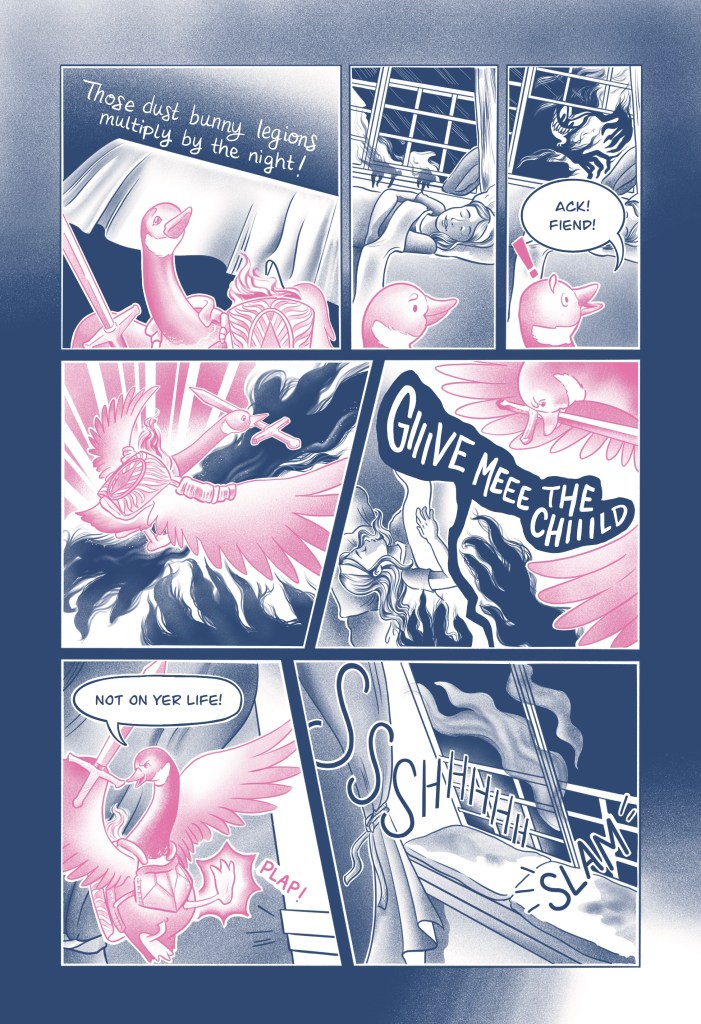
    My story is with Amy Chase, whom I’ve worked with on a couple other past comics projects (see: They Have Issues: Tales from comic book stores), and it’s about a little girl that has a plush canada goose that watches over her as she sleeps. Only, at night, our good knight goose comes to life to fend off unsightly dust bunnies and other bumps in the night. I imagine this story to be at the very beginning of the anthology, although the editors haven’t said where it will be – but given the subject matter, if it’s right at the beginning, I bet it will give this anthology a really great opener.

    I have seen you selling pet portraits on Twitter – they are so cute!  How did this start, and how do you capture the spirit of someone’s pet?

    Thank you! I’ve been doing commissions for quite some time, but my pet portraits started at the first VanCAF I exhibited at, in 2017. It was also my first year on the board for VanCAF too, and I was excited to show off my work. It really just took off from there. Often when I’m in artist alley’s at comic conventions, I’ll offer pet portraits for a base price and scale up from there based on size, colour, that sort of thing. When I’m drawing a pet, I like to focus on areas that draw me in and I also ask the client what is one word to describe their pet. Like a little bit of tuft fur that always seems to stick up in that specific way, an ear that flops back, or even a sassy pose!

    What makes my portraits stand out is that I like to mix them up with D&D classes too. You might get a roguish lizard or a lovebird that’s a wizard! Once I show the client the finished portrait and I get to see the look on their face seeing their loved one – especially if the portrait is for a pet that’s passed on…just pure happiness on their faces. I love it.

    What art prompt challenges can we expect to see you participate in in the coming months?

    Well, this month I’ve combined Doggust (August) and Swordtember (September) prompts! I don’t have a completed title for the series yet, I’ve been calling it Dogs with Swords (very original), but if anyone comes up with a better one, I’ll give you a copy of the completed, printed collection, on me! I may do a third volume of Three-Legged Tales in October? I have yet to decide and in typical me fashion, I leave my decisions down to the last few days before the month’s challenge starts.

    Other than D&D or comics, what nerdy interests are you most excited about right now?

    Two come to mind immediately: Astronomy and Video games! I’ve always said that if I wasn’t an artist, I would probably be a scientist studying astrophysics. There is always some amazing news coming out of the field of Astronomy and I just love doing science research. In regards to video games, I have my own Nintendo Switch that I pour hours of play into. Games like Animal Crossing, Cozy Grove, Spiritfarer, Zelda: Breath of the Wild, Pokemon – all of the great chill or open world RPGs. And yes, I do have the limited edition Animal Crossing switch, ha!

    Do you have any recommendations of queer nerdy content that you would like people to know about?

    Oh you bet I do! I’m currently reading Tillie Walden’s On A Sunbeam, a queer space graphic novel set in a world with mystical space creatures and there are even some fun little LARPing happening in panels too. It’s been on my to-read list for awhile and I’m just adoring it. Also set in space is Becky Chamber’s A Long Way To A Small Angry Planet, another sci fi story that has queer characters and just lovely character building. I wish I could say I’ve been watching more TV and movies than I am, but Jessy and I LOVE watching The Circle (a new season just dropped) and that show is one great human experiment, mixing different identities, politics, gender, all sorts of human interactions – without ever seeing the person on the other side of the screen. It’s just so fun.

    Thank you again for having me as part of Roar Cat Reads!

  • Adventure Queers:  Meet Milo Applejohn!

    Adventure Queers: Meet Milo Applejohn!

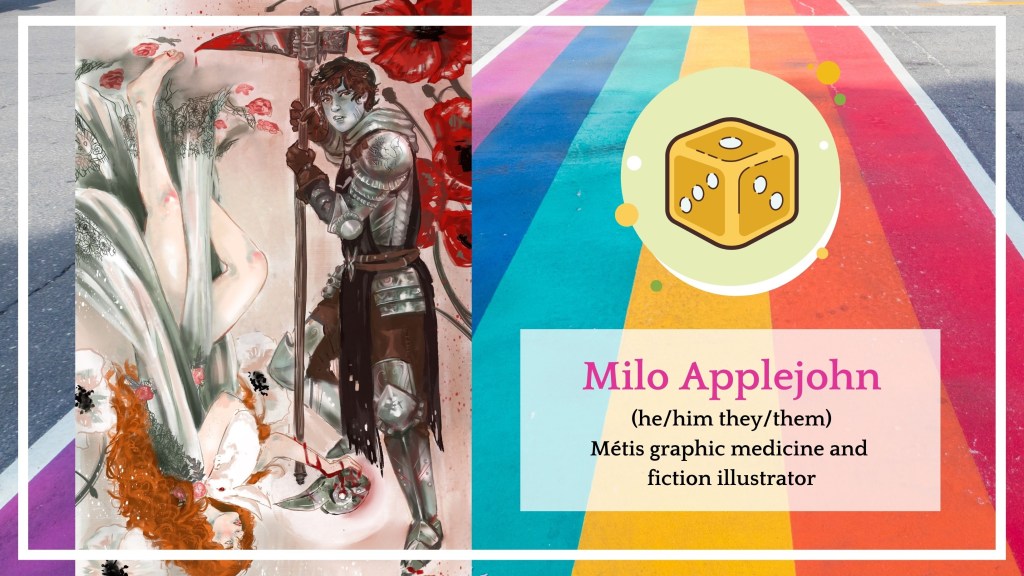
    Milo Applejohn (he/him, they/them) is a Métis graphic medicine and fiction illustrator. He is the author of graphic novel Fox on the Table: Broken Sun and novella Fox on the Table: The Princess and the Plague King, and he was most recently a story contributor to the North American Indigenous storytelling novel Cautionary Fables, now on Kickstarter. You can follow him on Twitter @bonmotmilo.


    Milo, how did you get into playing D&D and when did it hook your interest?

    I started playing in 2007 when I was invited to join a party. I thought it would be an actual party, but when I arrived, I realized it was a D&D party. I stayed anyway and played; I actually met my husband there! I had always been a nerd, but initially I wasn’t very interested in the game. That first group was very rules based, and I was pretty checked out. When the group fell apart, I didn’t play for a long time.

    After I had my first baby, I really needed human interaction. My husband and I were friends with another pair of couples who had kids. We were this great mom/dad/nonbinary parenting group, and we all started playing D&D together at parent-convenient times. Unfortunately, that group dissolved when one of the couples divorced, but I joined other groups because by then, I was much more into the game. Most recently, I’ve been playing for a couple years with Jessy and Haley Boros and others.

    It wasn’t until I tried DMing that I was really hooked. That’s when I could see D&D from a narrative experience rather than a mechanical experience. I introduced romance into the games, which was really fun and gave us opportunities to learn consent and boundaries.

    I have had such great friends in my D&D groups, and what I love most about it all is giving my DMing to my friends. I’m a creative, academic person, and I can create a story and experience as a gift to the people I really care about.

    Have roleplaying games helped you explore or express your queer identity?

    I wish they had!  Honestly, I’ve been struggling to play characters since coming out.  I usually play masculine female characters, and I spent so long building my identity around female characters that I don’t know how to move forward. I will often play elves because they’re androgynous. There’s this idea in D&D that you should be playing an idealized version of yourself, like, “This is the man I ought to be.” But I don’t know who that is, and I always feel like I have to fight to present as masculine. I do want to play a trans character someday, but I feel like they would become a Mary Sue.

    Getting deeply involved in a character feels too weird and personal right now, so I prefer to DM. That way I can play a lot of different characters, which feels more comfortable. It also lets me feel like I’m creating for others rather than for myself.

    The most important thing D&D has helped me with was giving me a supportive community. When I came out two years ago, I lost the people who raised me to transphobia, which I wasn’t expecting. But my D&D community was right there, so happy for me, celebrating me. A little while before that, I was diagnosed with autism, and again, my group accepted me. That’s why I love creating things for them, whether that’s campaigns, graphic novels, or character drawings.

    What kind of stories do you like to tell when you’re DMing?

    I like to create stories that are in the grey space. There is so much there to be explored. I think D&D and tarot have a lot in common: I think of tarot as a psychological tool that shows you what you’re looking for. D&D can do the same thing.

    I’ve always been a fan of complicating D&D stereotypes – give me a Drow charity worker! My villains aren’t evil, and my good guys aren’t perfect. In my stories, I always want my players to get past the automatic knee-jerk reaction of killing the character who betrays them. I’ve tried to lead them in that direction by dropping backstory about someone that they killed that leaves them thinking, “Oh, they were cool as heck!” Hopefully that makes them stop and think before killing the next NPC.

    It’s not always easy telling stories in the grey space. We played a year long campaign where it began with your traditional behind the scenes quest giver, but because of the way this character was read in a setting where we were asking these questions about intent, the party ultimately changed sides! I hadn’t planned it this way, and it was fascinating to see the traditional ‘mysterious quest giver’ archetype processed through this lens where in the end, they found him manipulative.

    What makes a D&D table feel safe to you?  How do you create safe spaces for people playing with you?

    I always do veils and lines with my players to establish boundaries: Something is a “veil” if it’s okay to happen in the story but not to my character, and a “line” is something they don’t want in the story at all.  I also make sure they know that these are changeable at any time, and that we can have open communication.  A horror campaign is challenging because it should be uncomfortable, but it shouldn’t negatively influence a person’s mental health.  

    Other than those boundaries, I think the most important thing is having safe players.  I don’t want any gay jokes, no way.  No racist comments.  In the world we create, I never want someone’s identity to be a problem (“Everyone in this town hates elves”) unless they specifically write it into their character’s backstory. 

    However, I don’t think that “safe” means “not dangerous.” Danger can be a part of safety. I am definitely willing to explore messy themes with my players; if they have a dark, twisted backstory and we’re both comfortable working with it, we will. I’m not The Great DM Therapist, but there should be space for the uncomfortable, yucky things in D&D. We need that. A lot of female and queer authors write a lot of really messed up stuff because they’ve been denied expressing it for so long. So many people have traumatic histories that they feel they can’t present to the world. If we bring some of that into D&D, maybe people can see that the trauma can be ugly, but that doesn’t mean that you’re ugly.

    You have written a graphic novel called Fox on the Table: Broken Sun that became quite a hit. What did you learn from that experience?

    I wanted to make something for the first group that I DMed for.  I was in a really low place, and this was something I could latch on and escape to.  Drawing it for them… their joy gave me joy.  I made it for fun, but it was received voraciously; I went to shows and toured the US with it.

    At those shows, I got to meet the community. There was a lot of queer trauma there, and people who were drawing that.  The indie community is a really safe space for disability and queer people. It’s becoming weaponized, though. These safe spaces started as an escape, but now we’re being confined to those spaces, like we’re not allowed to ask for more. When you leave indie spaces, you’re shocked by how little safety is out there.

    I don’t think the answer is to stay in safe spaces, though. They can be addictive and dangerous in their own right. A lot of the time, expectations in queer spaces are unreasonable. People want things to be unproblematic, but that isn’t possible. It’s like rules lawyering real life. Like we talked about before, we have to be more comfortable in the grey space.

    Do you have any recommendations of queer nerdy content that you would like people to know about?

    Thank you Milo! If anyone would like to check out his biomedical portfolio, look here.

  • Adventure Queers: Meet Nate!

    Adventure Queers: Meet Nate!

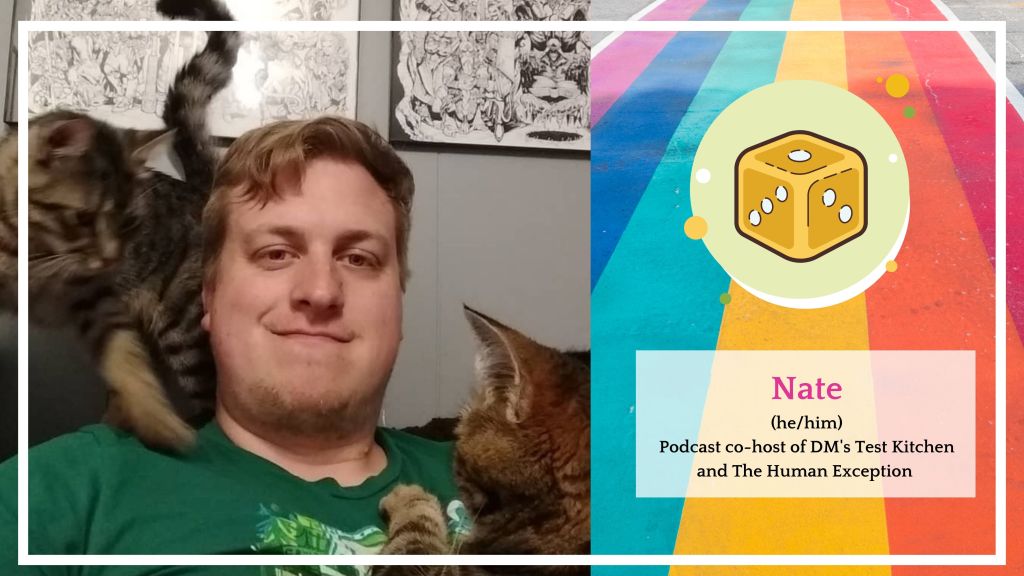
    Nate (he/him) is a co-host of the podcasts The Human Exception and DM’s Test Kitchen. You can find him on Twitter @legionofmoose.

    Nate, how long have you been playing D&D?  What has your experience in the TTRPG world been like?

    It wasn’t that long ago; I got into my first D&D game at the end of August 2017. A close friend of ours (Nate’s partner is Cayla) started a game online. It was a learning curve figure out both Roll20 and the rules of D&D at the same time. In fact, we spent the first two sessions just figuring out our characters and Roll20. I really enjoyed the social aspect of it, but I didn’t really connect with the characters until the DM stepped down. I don’t want the game to go away, so I stepped in to DM – that was Christmas of 2017.

    When I started DMing, I spent a month going through the DM’s Guide to learn about the barbarian, rogue, and ranger classes so I could flesh out the game to make my players feel like they were using their characters in a way that was meaningful to them. I think the hardest thing when I started was that at that point, we were running with three players and I was DMPCing. I can separate what my character does from me telling the story, but I’ve found that it’s hard as a DM to play a really fleshed out PC and DM at same time.

    My favorite part of DMing is the ridiculous shenanigans that people throw at you. You have an idea of where you think the story might go, but it never happens. The plan never survives the first encounter. Now I am about 95% No Plan when it comes to DMing; I just have story beats that I want to hit to give them lore and get them involved in the world. I lay those out a bit in advance, but how they get there is up to them. Sometimes I will make up encounters for different scenarios, but most of the time I’ll make up encounters on the fly. If players show special interest in a particular aspect of the world, then I’ll plan ahead to give them the lore dump and a scenario for a certain area.

    I understand that you have recently come out as bisexual. Have roleplaying games helped you explore or express your queer identity?

    I don’t know. Honestly, probably not a whole lot. For a long time, I wasn’t verbally out, but I was never shy about my actions or how I treated my friends or what I said. A lot of people were like, “Yeah, that tracks” when I came out. A lot of the characters that I play are more fluid in what they’re open to. My first character was a bard, but there was no idea that they could have a romantic interest in the world. The character was ostracized from his family and trying to figure out where they fit into the world in general rather than pursuing a romance.

    I tend to play females more often in games that give me the opportunity. In video games like Dragon Age, where the option to romance men and women is there, I’ll figure out which character is most interesting to me and I’ll romance them.

    Who did you romance in Dragon Age?

    I’ve only played Dragon Age: Inquisition, and I romanced Sera. At first, I couldn’t stand her character, but the more characters you add to your party, the more interesting her interactions become. Her character is similar to my D&D characters – pretty chaotic. When I realized that, I thought I’d give it a try to romance her! A lot of it is “What can we do to prank these people all of the time.” She’s not what you stereotypically expect an elf to be, which I like, and she had a fun story. She hides things because she feels like she doesn’t fit in anywhere; her attitude is “If I’m having fun, I don’t have to think about anything else!” Being able to draw that out of her was really satisfying.

    You have told me a little about some creative and detailed worlds that you are building for D&D.  What interests you most about the worldbuilding process?  What part is the hardest?

    When I build a world, it’s usually built around an event of some kind. The game that we’re playing now for DMTK, I built in 2018. It all started around a plague… Before that, everything in the Overworld was prosperous. There was peace, technology, and all sorts of things. Then a plague ravaged everything and everyone went underground. In the campaign, all of the players start in the Underdark, where there are huge mountains in a massively cavernous space, including an ocean with multiple coasts. The whole idea was that it’s been 200 years since everyone went Under. I want the characters to figure out what has happened to the Overworld, and will it be safe to go up and check it out?

    I have a really hard time with continuity and figuring out what’s going on in the world when the players are doing one thing but there’s stuff happening elsewhere. I always have things going on in the back of my head about what’s going on on the other side of the continent, but I struggle with figuring out how do those move forward when players aren’t interacting with them.

    I’ve recently tried to finish campaign 2 of Critical Role – I’m on episode 120. One of the really interesting things I’ve been trying to glean from Matt’s DMing (spoilers) happened when they all ended up back where Sam’s character lived with her husband and kid. The town was ravaged, and they were like “Oh, what happened?” and Matt responded, “If you decided to come back two weeks earlier, you might have been able to stop it.” Whoa!

    Once, I had a group that talked their way out of a whole dungeon. The idea was that there was a sleeping dragon under the mountain that had been sleeping long enough that it was covered in rock. The kobolds who worshipped it built a temple around the dragon. My group went to the temple, got some lore, and said, “No, we don’t want to deal with this.” They handed over a bunch of really expensive spell components and magic items to the kobolds in return for the thing they were looking for in the temple. Instead of waking the dragon by taking the stone like I planned, the kobold shaman finished his ritual, absorbed the dragon, and turned into a giant kaiju. But the group just took off in their airship and said “Nope! Goodbye!”

    What advice do you have for GMs who want to get better at worldbuilding?

    The biggest thing is focus on a city or a place that is important to your world first, then figure out how that place interacts with other things. Think about how cities interact with each other. What does each city look like? Are there specific regions that people live within? Is it all just one area with self-governing cities? Then figure out the land around the cities and how the cities impact the land around them. How does trade work between cities that are more advanced with smaller communities that are less advanced?

    What nerdy interests are you most excited about right now?

    Up until a month ago, I was playing a lot of FF14, and I feel like I need to get back in, especially because a new expansion in November. I’m part of a ridiculous guild with a bunch of anime nerds that are on all of the time. They do a lot of events, like playing hide and seek every night.

    I also really like anime; it’s my weekend guilty pleasure. I’m watching My Hero Academia right now, and one of my favorite shows is Restaurant to Another World. It’s about a Japanese café where every Saturday, a door shows up in the fantasy world side and wizards and dragon folk show up to this regular guy’s restaurant to eat.

    Do you have any recommendations of queer nerdy content that you would like people to know about?

    • Ice Cream Dice – Marc is an absolute gem. He does great work, and has a lot of fun with his unique dice brand. Bonus points: he is Canadian and from Edmonton. 
    • Bee and Crow, authors of World of Wyldrvir – Bee also DMs the Frost Walkers Podcast.
    • If people are interested in the weird shit people do – Cayla, Halli and I are going hard on The Human Exception podcast. This project has been a lot of fun, and we get into some really weird stuff. In one episode, we talk about Mount Rushmore and how behind Lincoln’s head there is a time capsule with a tunnel and everything. We also cover the weird conspiracy theories that people have about the place. Our second episode might be more interesting to Roar Cat Reads readers – we talk about the origins of the word “homosexual” in the Bible. Eventually, there will be episodes coming about how I was raised, so stay tuned!

    Thank you, Nate!

    Are you an Adventure Queer? Do you love to play D&D? Email us at roarcatreads@gmail.com to let us know you would like to be interviewed!

  • Adventure Queers: Meet Cayla!

    Adventure Queers: Meet Cayla!

    Cayla (she/her) is a nerd of every flavor, including western comics, manga, video games and table top with a passion for cosplay, writing, world building and drawing.

    Today she is a host, player and producer of multiple TTRPG podcasts and in involved in more games than she can count. You can find her on Twitter @veranox, read her webcomic Blackburn, and listen to The Human Exception podcast, where Nathan, Halli, and Cayla go on wild trips down the rabbit hole that is human history and the Internet.

    Cayla, how long have you been playing D&D?  What has your experience in the TTRPG world been like? 

    I started in my early teens, but it wasn’t something that really took over my life until the last five years when we began DM’s Test Kitchen. With the goal to try and play as many different TTRPGs as possible, it has really opened up the TTRPG world! We have met some truly amazing people (like Jessy!) because of this and for the most part my personal interactions have been very positive. 

    As a pansexual woman, have roleplaying games helped you explore or express your queer identity?: 

    I have always felt pretty comfortable being myself while gaming, but I think the thing that has made a difference for me is the community. There is a really large and compassionate community of queer folk that made me feel a lot more comfortable finding my place there. Being pan in a “hetero” relationship, it’s easy to not really feel like you’re part of the LGBT world or like an “imposter”. But the community is incredibly positive and encouraging of bi and pan individuals, and it really gave me more confidence as a queer.

    From our conversations, it seems like you are intense in your love for nerdy hobbies.  What does it take for a project to hook (and keep) your attention? 

    Well, I think a big part of my intense and multi-faceted nerdom can be traced back to my ADHD. I don’t know how to dip my toe in, I just go headfirst into pretty much anything that catches my passion. I think the thing at the core of all my projects/hobbies comes back to stories and storytelling. 

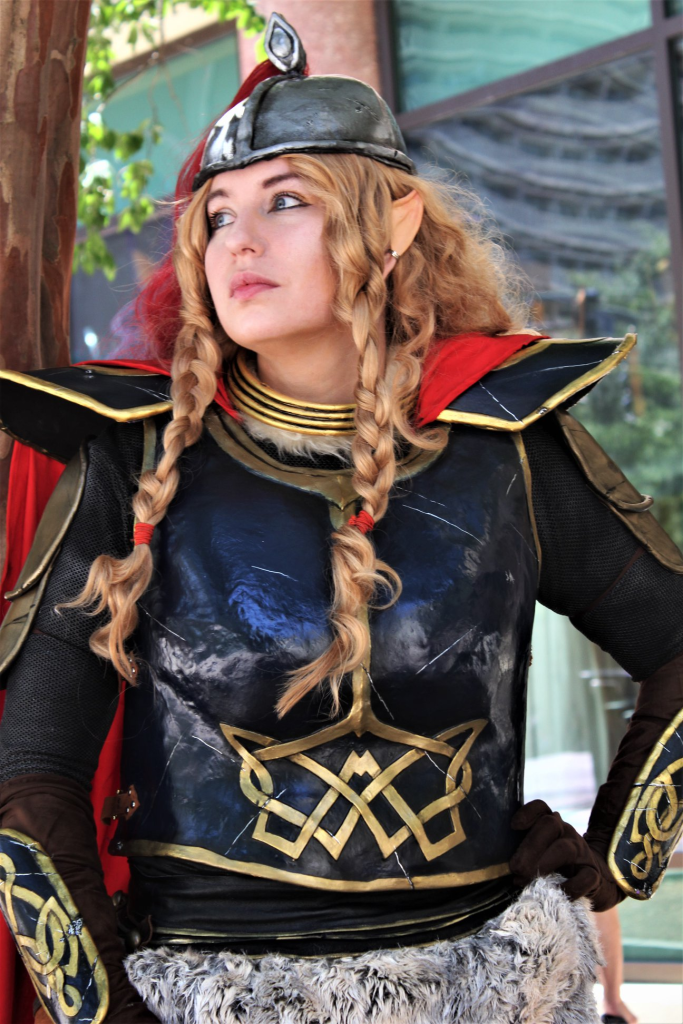
    When it comes to cosplay, I pick characters that I identify with or really love the stories of. “Recently” (aka the last costume I worked on pre-Covid) I made a costume that I have wanted to do for decades: Laurana from the novels and TTRPG setting Dragonlance. I grew up on those books and the story meant a lot to me. So yeah, my love for Dragonlance led me to do a 100+ hr cosplay build. 

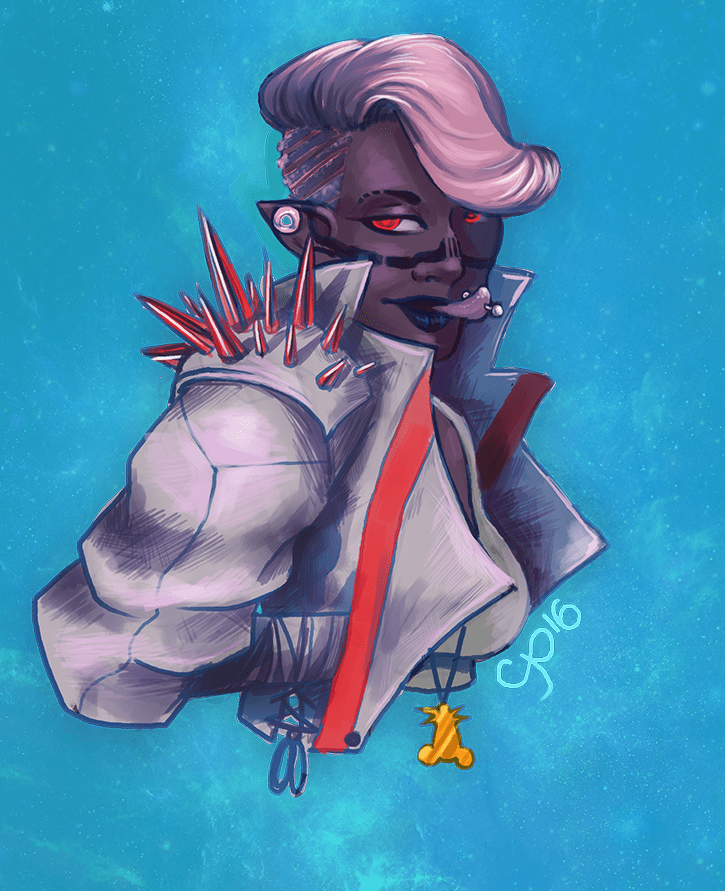
    Even my comic Blackburn which I have been working on for 3 years now started with a single drawing. Whenever I draw I am telling a story to myself the entire time, and I decided to draw this punk drow character. As I was drawing, I asked myself why she was the way she was, what led her to be that way and what kind of world she lived in. In the end I wanted to find these answers out and that’s ultimately what led to Blackburn. 

    The main game I am running now, that I started like 2 years ago? Is a completely custom setting built from the ground up that all spawned from the phrase “feast or famine”. I was actually planning a one-shot for something else, when the phrase popped into my head and I couldn’t let it go and immediately wrote up an outline where I explored the idea of what a world controlled by this concept of feast or famine would look like. I came back with this idea of a world with only two seasons. Feast: Where everything was lush and grew wild, threatening to consume villages and Famine: where nothing grows and disease and monsters become a major threat. How do people live in a world like that? What does that look like? Why is it that way?

    That’s pretty much a summary of how all my passions start, with a single idea that gets lodged in my ADHD-riddled brain that I can’t let go of. Just a spark for a story that I want to share or tell.

    What nerdy interests are you most excited about right now? 

    My biggest focuses right now are my giant Pokémon cross-stitch that I showed you. The final canvas is probably going to be like 4’x7′ and will consist of all the sprites from Pokémon gen 1-5. I love Pokémon, have ever since I was a child. And ever since I learned to cross stitch as a child I entertained this idea of making a giant Pokémon tapestry, but never knew how I would do it. The idea showed up again a month or so ago when I saw an ad on Facebook where you could submit an image to a website and they would make you a custom cross stitch kit. I looked at all the options and wasn’t really satisfied with the services that were out there. I stumbled across a free online pattern generator that allows you to upload an image and it will make a pattern for you and provide you with a list of all the colors you would need. Well obviously I needed to do that, and pretty much ordered everything the same day. 

    I also kickstarted a Horizon Zero Dawn board a while back, and the last of the assets finally arrived, meaning I have dozens of minis to paint and I am so excited!

    My other big project right now (that I guess isn’t really that nerdy?) has to do with our podcast HEX. Last year, Halli, one of our hosts did a story on Teal Swan, the online self-help guru and cult leader (and overall horrible person. This story and many of the attributes of Teal reminded me of a story I had read on reddit, known as the Final Fantasy 7 house. A harrowing tale of Icarus, a young trans man in college, who was struggling to figure out his identity and ended up meeting some people online that seemed to accept and love him for who he was and they bonded over a shared love of Final Fantasy 7. He would go to live with them over the summer only for him to realize he had joined a cult and he was forced to live in horrid conditions and serve their every whim. 

    So I put together my story and shared it on the podcast, but it drew me back in, and I began to dig deeper. Not only did I find out that this internet legend was actually a fairly accurate account of real events, I found that Icarus was far from the only survivor. I’ve talked to nearly a dozen survivors now, having tracked them down on the internet even having many come on the show (we have another interview coming out this week) giving them a chance to tell their story of survival and be more than just a victim of the woman that has been running this abusive scam since 2001 and may even be still active today.

    It’s become a whole thing and a huge passion project for me, to find these survivors and give them a platform to speak out about what happened and a safe environment to do so, all with the hope that their story could maybe help someone else. All of the survivors I have spoken to are queer and the grand majority of them fall into the trans spectrum. They were targeted specifically because they were questioning and feeling alienated and unsure of themselves. It’s been absolutely inspiring to hear their stories and how they escaped and have grown into such amazing people (not that they weren’t to begin with). Being someone that is also an abuse survivor, it has been very healing for me. 

    Other than that, I continue to work on my Feast or Famine campaign and world building. We hope to make the campaign available as an actual play podcast in the future, and I look forward to sharing that world with the rest of the world.

    What advice do you have for GMs who want to get better at worldbuilding? 

    It all comes back to stories. Everything you make should tell some sort of story: Do all your elves live under the ocean? Why? Have they always lived there? How do they live there? What do they eat? Sometimes the most seemingly boring questions can lead to some of the most delightful “discoveries.” One thing we had to consider for Feast or Famine is, how do you live 6 months when you can’t grow new food or breed livestock? Pickling and canning seemed like the obvious solution, but what if you wanted fresh meat? That’s how rock chickens were born. 

    I had this idea for chickens that came from the fireplane, whose eggs were like rocks, and wouldn’t hatch until they were put in fire, after which they would grow to maturity in a very short period. Meaning that you could have a store of rock chicken eggs that you can hatch at any time. When we were doing our session zero, I kind of threw the idea of rock chickens out there, and my players loved it, and now we’ve developed a whole thing around rock chickens. Like they taste like Louisiana hot chicken and different varieties have different flavors (even a cool ranch variety). 

    Which, on that note, don’t forget to bring your players in on some of the world building! It helps get them excited about the world, and bouncing ideas off each other helps develop them or come up with something you never would’ve thought of on your own! World building isn’t just about the DM. It’s easy to think of it as a solitary activity done in isolation, but a DM is only a narrator. The players are the characters, the ones that actually do things and shape the world. 

    There are also a ton of world building games that you can play as a group to help further develop your world. One thing we did was play a game of the Quiet Year (made by queer creator Avery Alder) to develop the town the players would start in. This led to the discovery of an underground city, a salt plague, a murder mystery and shadowy monsters that live on the edge of town. This also created a whole host of NPCs and a functional town, as the game asks you questions about how the town survives, what the dynamics are and challenges you to make decisions about the world functions. 

    Do you have any recommendations of queer nerdy content that you would like people to know about? 

    Oh man, do I! Halli (from HEX and a player in DMTK) just released her first book: Wilderwood. It follows three characters as they try to protect the small town of Wilderwood from mysterious forces. They are Octavia, the vampire baroness, who has watched over the town for centuries, Bellemy, the non-binary hunter and lover of Octavia that disappeared into the faelands 2 years ago and has suddenly returned mysteriously and Roderick, another hunter that has been drawn to town on a hunt avenge his fallen partner. 

    And I can’t mention Halli without mentioning her TTRPG stream Terrible Party where she and her queer cast play games, host charity streams and much more! 

    Thank you, Cayla!

    Are you an Adventure Queer? Do you love to play D&D? Email us at roarcatreads@gmail.com to let us know you would like to be interviewed!

  • Adventure Queers: Meet Chad Charest!

    Adventure Queers: Meet Chad Charest!

    Please welcome Chad Charest (he/him)! He is a geek of all types, master of none, and he is in the running to become World’s Coolest Uncle. You can hear more from him in his podcast interview with DMs of Vancouver, and stay tuned! He is writing an urban fantasy series; it will hopefully be on your bookshelf in the future.

    Chad, when did you first play Dungeons and Dragons?  What was the experience like?

    My experience with roleplaying games actually started with MSN role play chat with friends. We made stuff up with no material or oversight, just one person acting as gamemaster and the rest of us reacting. When I was 12-13 years old, I would go to a local Chilliwack game store (now Bastion Games) to play Yu-Gi-Oh!. Another teenager invited me to play D&D, and actually, we still play together! For years, I was mostly playing with people older that me, usually with straight cis men. I would love to play with a more diverse group, but queer female nerds tend to live outside of Chilliwack.

    Nowadays, I usually split my time between DMing and playing 50/50. DMing is more work, but I like trying to force people to role play. A normal group is very hack and slash based, so I will give them prompts during character creation to expand a little. The one I usually use is the prompt “You are lost, either physically, mentally, or emotionally. Why?” Then in a twelve-session campaign, each character gets three sessions of focus to find the thing that is lost.

    As a player, my characters have changed a lot over time. I used to like paladins a lot, then I went through a charisma character phase. Right now I’m obsessed with intelligence based characters like wizards and artificers. I recently played gnome wizard inspector, and it was really fun.

    I hear that you’ve introduced your nephews to D&D. How did that go?

    Yeah, I recently taught my two nephews (aged 11) how to play D&D! The system allows for people to play at any age. Some handholding is necessary at first, and having an experienced player other than the DM at the table is helpful. But let them do what they want, and don’t guide them or be too helpful. Make suggestions and remind them what they’re capable of, but let them make decisions on their own.

    When I was starting with my nephews, I gave them a walkthrough of every class and where they typically end up focusing, but I also gave them flexibility if they changed their minds. I think it’s also important to base the game on things they’re already interested in, like Minecraft. And sometimes it’s important to change how to play to fit their style. I usually play D&D with theater of the mind, but I bought them miniatures because I knew they’d love it. Now they’re playing by themselves, and they give me regular updates. I’m usually like, “That’s definitely not following the rules, but you’re having fun!” It feels so good to have passed this on to them.

    How do you bring your asexual identity into D&D and roleplaying games?  Has D&D played a part in exploring or understanding your sexuality?

    Honestly, not really. I only figured out that I am asexual when I was 27 – about seven years ago. My D&D characters have just never been sexual, and usually I was playing with cis dudes who weren’t going to role play flirting with each other, and if they did romance an NPC, the scene would fade to back.

    I love playing bards, but contrary to popular stereotypes, they don’t flirt. Instead, they’re cocky and fun, and they make great friendships with other characters.

    What makes a D&D table a queer-friendly atmosphere to you?

    I haven’t had much trouble with that. When I came out as asexual, my friends were accepting and it was fine – not a big deal. I do like to play with queer people; when I have it’s awesome. You get a lot less of the hack and slash role play, and you get diverse characters who care about more things and have more in-depth identities (though of course cis people sometimes do too). Izzy introduced non-binary characters into their campaign, and that was awesome. I want more of that! For now I seek out that representation and community in literature or TV shows.

    What would you like to see done differently in D&D (either the culture surrounding the game or the mechanics of the game itself)?

    Wizards of the Coast have made some good steps recently; Tasha’s Cauldron of Everything no longer forces stats based on race. We need more things like that! We should also moving away from stories based in imperialism and be more creative by telling different kinds of stories. I try to bring that into my campaigns when I can.

    Are there TTRPG systems that you enjoy other other D&D?  What are they, and what do you like about them?

    I love Warhammer RPGs. It’s a well-established world. Even though it is very imperialistic, they’re fun! There is a wealth of history and lore that gives you a lot to work with, so you can lean away from imperialism and play from other alien species perspectives to get into more interesting content. Orcs grow from mushrooms, so let’s have asexual orcs!

    I also like Clockwork and Chivalry. In fact, my queerest experience happened in that game…with non-queer people. There is a table you can roll to determine how you know the other characters. The one woman in the group was in love with my character, and everyone else was in love with another character. It led to this great scene where everyone spent the night sneaking to someone else’s tent, only to find it empty because the other person was sneaking off to someone else’s empty tent!

    Of all the TTRPGs I’ve played, though, I think Rolemaster is my favorite. It is a little bit like D&D but it’s complex; there are 270 skills. In D&D, your characters are badasses too easily. In Rolemaster, you have to be really careful in combat situations. A group of goblins can take out a level 10 character if you aren’t strategic about your location or defenses.

    Do you have any recommendations of asexual representation done well in a nerdy property (TV show, podcast, book)?

    I actually got to sit on a panel at Emerald City Comic Con about asexual representation in media. We talked about Todd Chavez in Bojack Horseman and Jughead from Archie comics. Often in media, male representation of asexuality leads to characters that are infantilized and treated like children. On the other hand, there is a lot of amazing female representation. There is a drama podcast called ARS Paradoxica with a lead who is asexual, and it’s the best time travel anything that I’ve ever experienced. Elizabeth Moon’s fantasy novel The Deed of Paksenarrion has a main character who doesn’t use the word “asexual” to describe herself, but she does talk about not being interested in sex or romance.

    Thank you for coming on Roar Cat Reads to share your experience with us, Chad!

    Are you an Adventure Queer? Do you love to play D&D? Email us at roarcatreads@gmail.com to let us know you would like to be interviewed!

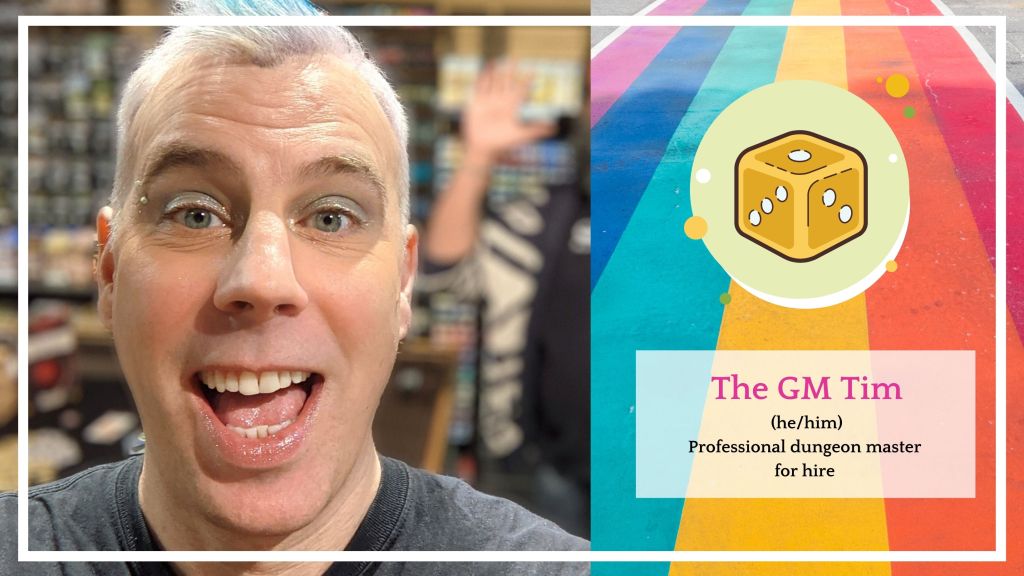
  • Adventure Queers: Meet The GM Tim

    Adventure Queers: Meet The GM Tim

    DC 10 Wisdom (Perception): From Vancouver, Canada, The GM Tim is a busy gaymer: He dungeon masters private games for multiple roleplaying groups. In the before-time he hosted the Quests + Queers board game nights, and DMed Fierce Adventures – a monthly live D&D Drag show which is on hiatus until COVID19 restrictions end. The GM Tim currently streams Star Trek Online and Star Trek: Lost Voyages.

    DC 15 Intelligence (History): Through years of gaining experience and levelling up with the D&D Adventurers League, this Theatre of the Mind Game Master has multi-classed. Now an adventure writer, The GM Tim continues to run games at conventions, like Winter Fantasy, for Baldman Games, playtests for the League and Dungeons & Dragons, and is a featured DM at D&D in a Castle.

    GM Tim, how did you become the GM that you are today?

    I was lucky to have a DMing Yoda who taught me to play at the table. We played TTRPG Star Wars, Star Trek, Star Gate…all the Stars! Star Trek was my favorite – that’s my nerd jam.  I ran my own Star Wars game with him, and he coached me through it, showing me how to listen to players and roleplay.  

    I started DMing two groups in Vancouver many years ago; they were weekly games that grew bigger and bigger. The players trusted me enough to – well, not screw around, but to dive into their characters’ backgrounds.  One had a whole story created that his mom was evil, and his dad had trained him. I later built up a huge Darth Vader reveal that his dad was the one who was evil and had killed his mom. There were tears at the table! But you can’t do something like that without trust. I have a table rule that I call The Golden Box. Anything players put on their character sheet is untouchable, but if they share anything about their characters in game, like memories, I’m allowed to twist that into a story if I want.

    The other group was all women, a mix of cis and trans women. I was super lucky and really honored to run this group for them. It was one of the big wake up calls for me. It was enlightening in how different the sessions were. The dynamics at the table, the way they interacted with NPCs and monsters – it was so different from typical grognard BS. The experience allowed me to be more narrative and creative as a DM.

    What do you love about D&D?

    When I first started playing, it was total escapism. It was a way to not be me. Today it’s a little bit of that, but I just love it. I don’t know that there is One Thing. The power for storytelling is incredible. Maybe the thing I like most is that you realize you’re more creative than you think you are. You can play with tropes and twists of tropes, and people love when you do that. It’s like someone who thinks they don’t have a mind for math, but soon they’re pulling off complex equations! It showed me that I can write and conceptualize things, and it’s opened a lot of avenues for me.

    Have you experienced any differences playing D&D with queer people vs predominantly straight groups?

    Oh yeah!  In 2017, right as I became “The GM Tim,” I had a group of all queer guys.  It’s the most diverse group I’ve ever had, and we all met through Grindr of all places. It was a lot of fun with a lot of jokes and great interplay. The best thing about it was that it was unapologetically gay. There was a complete normalization of queerness with zero worries or concern. We didn’t have to think or second guess ourselves. We didn’t have to worry that the straight guy across from us thought we were hitting on them. There was no body shaming or ageism.  In fact, we had a recurring NPC called Mondo the bugbearian (a bugbear barbarian) who wound up dating a player’s rock gnome character. There were a lot of top/bottom jokes. They got so attached to him that when they thought he was dead they went on a quest to find a wish spell to bring him back to life!

    I have another group that’s been playing with me for 4 years that is a group of straight cis guys. With all of my groups, I am unapologetically gay, and I make that known on the first night. If you’re not okay with that, the game is not going to go beyond that night. I will make just as many jokes about hot guys as they make about hot girls. Honestly, one of the things I’ve noticed is that straight cis players are less likely to get into relationships in the game if they’re dating someone in real life. Their monogamy extends into fiction. But gay or straight, any group can be just as good at story, and the trust factor between GM and players should exist no matter what. The vibe is just different.

    Tell me about the D&D Drag Show you ran before the pandemic. It sounds amazing!

    Matt Baume, a colleague in Seattle, started the concept with Queens of Adventure, first in bars and now a podcast. I asked him if I could do something similar in Vancouver.  Fierce Adventures is mix of drag show with D&D starring four queens. A couple weeks before the event, we sit down to go over plot outline.  We’ve only got two hours to perform, so as a group we agree that we need this and that to happen by this time, and by the end, we have to be there. Then we decide what numbers they want to do.  We theme the numbers to what is happening in the game, so they can use the number as a way to defeat a monster, play into a joke, solve a trap, or reveal what the character is thinking.  

    There is heavy audience interaction. We charge cover, but queens are largely dependent upon tips, so we let the audience purchase bonuses throughout the game.  We have someone walk through the audience to sell +2 and -2 cards. Throughout the game, a queen will yell out “I need a two!” and someone can boost their roll. But early on, it changed to applying any time I say a number. “There are five trolls, no three trolls. Okay, there is one troll; nope, negative one trolls…the trolls have joined your group.” The audience can also decide on voices. Once when I asked what draconic sounds like, someone said, “Bad Swedish,” so that’s what happened.

    We hope to restart soon, but we’re waiting for venues to open up. Hopefully by the end of the year we’ll be performing again.

    How do you create safe nerdy spaces for queer players?

    I learned a lot when I did Quests & Queers at Stormcrow Alehouse and Tavern. It was a queer board game night, and everyone working there understood that for the night, the bar was a gay bar. It was hands down a safe space. All the servers wore pronoun tags and we introduced ourselves with our pronouns to normalize it.

    What does “safe space” mean, though? It’s very individual. I think it just means making a space comfortable, welcoming, and supportive. I do that for all of my games, even with a bunch of straight guys. If you help someone feel safe, you can teach someone or encourage them to grow as an individual because they’re not on the defensive. When someone is on the defensive, their guard is up and they won’t have an open mind.

    Representation can also create safe spaces. When I normalize nonbinary NPCs in my adventures, it makes it easier for players to normalize nonbinary people away from the table. I created a polyamorous relationship between two nonbinary characters with they/them pronouns and a third whose pronouns were he/him for the Adventurer’s League, and one of the nonbinary characters was so popular that they’re in other adventures now! I hope that anyone who is questioning their gender identity feels welcomed and safe because that character exists.

    What advice would you give to someone who wants to try playing or DMing D&D?

    If you want to start playing D&D, there are a lot of DMs for hire [like The GM Tim himself]. You can also look for D&D podcasts with discord channels for “looking for games.”

    If you want to DM, try to remember that it is not some mystical role. DMs are players in the game too. Like with all games, you play and get better as you go. If you think you need to be ready for anything, there’s no way that’s going to happen. Just grab an adventure in Adventurer’s League – they’ve got everything you need to get started.

    If you want to create your own adventure, grab a piece of paper and write down a couple of encounters. The easiest hook is to just “collect the thing from the forest.” What are they going to fight? Maybe it’s the ghost of the last person who tried to get the treasure. Throw in some traps – quicksand is a good one – and maybe some monkeys who cause havoc and try to steal your stuff as you go by. The process doesn’t have to be complex.

    Tips and Tricks from The GM Tim!

    • If a character gets knocked out during a battle, give them something to do. Usually I give them the monster’s stat sheet and a note with a plot point that needs to happen and let them go! This accomplishes two things: it keeps them invested in the game, and it gives them a small taste of being a DM. Of course, if they don’t want to, they can just roll death saves and wait.
    • Subtly take notes of what your players think is going to happen in the campaign and adjust accordingly. If you’ve planned for the Big Bad to be an Umber Hulk but they’re convinced a Black Dragon is behind everything, they’ve just given you a storyline that they are invested in. Give someone the opportunity to say, “I KNEW IT!”
    • A good test to see whether you like creating adventures is to use the charts on pages 99-101 of the Dungeon Master’s Guide to create a dungeon. As you roll for Dungeon Location, Creator, Purpose, and History, a story will probably start to take form. [Note: The GM Tim walked me through this exercise, and we created a dungeon stronghold beneath a mesa, ruled by elves who had moved there to escape an ancient green dragon who had corrupted the nearby forest. It was a surprisingly easy way to create the foundation of an entire adventure or even campaign.]

    You run a book club for gamers: How does it work? What queer nerdy books do you recommend?

    I wanted to have more ideas for my adventures, so I went to books for inspiration.  I started re-reading the Dragonlance Chronicles.  While it has a special place as my first foray into fantasy and the catalyst for all this, they are a product of their time, and it’s an inherently white story. For so long, white men (J.R.R. Tolkien, C.S. Lewis, A.A. Milne) told us what fantasy is.  I wanted to change that, so I made a list of books called Appendix Lit and formed a book club around them.  Our first book was The Candle and the Flame by Nafiza Azad, a Canadian author. Ten months in, we are reading our first white male author with Agency by William Gibson.  I made the list 50% female identifying, 50% BIPOC, and at least ⅓ Canadian. The next list I make will be even more diverse.

    We read speculative fiction, historical fiction, and science fiction. My hope is that the stories we read inspire you as a DM or player to come up with different ways to see the world. One of my favorites that we’ve read so far is Stealing Thunder by Alina Boyden. The author is a trans woman with an anthropology doctorate in Indian/Pakistani studies, and the book has a trans main character.

    If you want to join us, you can check out the dates for our book club conversations here and join the discord to chat here.


    Thank you so much for a fun conversation, The GM Tim!
    I’m reading Agency and looking forward to the book club on August 14th. I hope some Roar Cat Reads readers will join in too!

  • Adventure Queers: Meet Izzy Braumberger!

    Adventure Queers: Meet Izzy Braumberger!

    Izzy Braumberger (they/them) is an armchair historian and philosopher as well as an avid player of TTRPG games and a developing system designer.

    Izzy, you’ve been playing D&D for over 15 years, and during that time you’ve seen some of its limitations, like the way its mechanics and history create a colonialist focus on combat and looting.  What keeps you playing the game despite this, and what kind of changes would you like to see to the system?

    D&D is a very popular system with wide-spread appeal. I think that’s mostly because it has the crunchy mechanical stuff that people enjoy while also being loose enough to leave room for people to make it their own.

    I find D&D to be very transactional and video game-like. The default is a system model that rewards the story “go out, find a problem, kill the problem, loot the room.” This model makes it easy to track people’s success and determine when and how they level up, but it’s also limiting and celebrates a particular kind of playing. Even in parties that try to value equality, the distribution of wealth and power still tends to be dependent upon who killed the most enemies.

    I would like to see the system emphasize rewards based on nonviolent participation. I have seen other systems like Exalted create mechanics to track political and social relationships; it would be as if the bonds and relationships in D&D were put to mechanical use. Instead of always rewarding players with treasure, parties can be rewarded with allies and stronger relationships. This would create room for more kinds of stories and characters.

    In a previous conversation, you mentioned that you’re a history nerd.  Roleplaying games often take place in a liminal space between history and fantasy that is often defaults Eurocentric.  What historical facts would you like to see acknowledged in D&D campaigns?  What is your dream setting for a campaign?

    When I GM, I like to throw in historical facts that have no societal baggage. I don’t want to bring up real world struggles, consciously or unconsciously, but adding little known details to the adventure can make the world feel richer. For instance, let’s say your party is traveling by wagon pulled by a team of oxen. I would include the fact that the one on the right has a two syllable name and the one on the left has a one syllable name – that way the oxen know which one is being talked to.

    My dream campaign would be one that is so grounded in actual history that it seems alien to players. I would like to see a game set in pre-Enclosure England, when the structure of land use was centered on families, and there was no concept of “going to work” because you worked where you lived.

    D&D isn’t very accurate, really. The typical tavern/inn that parties go to would have looked very different historically! There weren’t rooms or subdivided spaces, because there was no way to heat everything. There also weren’t roaring fires, because fireplaces didn’t exist until much later than most people think. Privacy was not a thing until very recently. Even royal houses were just a line of rooms that people had to walk through; hallways weren’t common for most of history. Industrialization changed everything worldwide, so setting an adventure before then would be my preference.

    Roleplaying in D&D provides the opportunity to explore your identity in myriad ways.  For queer people, this can be a really liberating experience.  How have you been able to explore your identity through D&D?

    I have found that role playing games are a wonderful mirror to hold up so that you can figure out what sort of person you would be if you could be anyone. You get to be any kind of person you want and experience how it feels when people react to you in this different way. Self-exploration is expected in these spaces. You can be the manliest man who plays a 4’2″ elf with a high-pitched voice who flirts with guys. No one automatically assumes that’s what you’re into in real life – it’s play. And play is a valuable teaching space.

    For the longest time, I thought it was just play, and I didn’t really take to heart what I was experiencing. I knew I felt free, happy, and more myself, but I didn’t quite get what was going on. It took me time to piece together disparate behaviors and thoughts to figure out what made me feel happy and comfortable. Really, embracing my trans identity was about finding comfort. There were both disphoric and euphoric elements to finding out what I do and don’t like – all together it paints a picture to your route toward happiness. I asked myself a lot of questions: Can I live with this? What do I need to change or give up? What is the fluctuating baseline that I want to rest at?

    The valuable thing about role playing games is that you don’t have to wrestle with all of these variable judgments all the time. I don’t actually play non-binary characters very often. I lean into masculine characters because I don’t get to be that in real life. It’s an interplay of wish fulfillment and that mirror to see who you could be. I’ll be honest, I’ve used some DMs as therapists over the years – it’s always a bad idea, but we do it anyway!

    Self-exploration is a vulnerable process.  In your experience, what makes a D&D group safe to explore or live out your queerness?  

    When you play a roleplaying game with people, you enter a social contract to be cool with whoever your party members are. A good DM will stop people from imposing their will or view of your character on you. If someone says, “Why are you flirting with that girl? You said your character was gay,” a DM should guard and support nuance. Don’t let people police people’s expressions of sexuality or gender identity.

    I think it’s most important to show enthusiasm for people who are exploring new things. Show active positivity, ask questions with the desire to know more rather than judge. Focus on understanding people, not being disappointed or uninterested in what they’re doing.

    When DMing a game, it can sometimes be hard to fight the cisheteronormative culture in which we were raised and populate the world with diverse NPCs.  How do you prioritize representation of trans people in D&D?  What tips do you have to convey the complications of gender identity in role playing games?

    Exploring gender identity is an in depth, nuanced process, and this doesn’t translate to D&D very well if NPCs aren’t given the space or time to explore that nuance (and most of the time NPCs are one and done). When introducing characters, it’s easy to rely on shorthand descriptions to indicate trans people, and that usually means perpetuating potentially harmful stereotypes. The easiest thing to do is to make these NPCs central characters that are returned to throughout the campaign. You can have more meaningful representation when players are emotionally invested in characters and want to learn more about them. That’s when you can have those more nuanced conversations and experiences over multiple interactions.

    Introducing MtF or FtM characters into your campaign can be tricky. How do you alert characters to the NPC’s trans identity without some kind of gross skill check that amounts to “You can tell this character is trans”? In a campaign that I’m playing in, the DM took us into an NPC’s memories, where we saw her experiencing abuse as a child for being trans. It was such a smart way to reveal this fact about an NPC we all really cared about!

    I personally have no problem with straight cis GMs role playing trans characters, so long as they aren’t fetishizing anyone or perpetuating harmful stereotypes. At the stage we’re in culturally, visibility is really important, and it’s a great opportunity to practice they/them pronouns and get in the headspace of people who have had different experiences from you. Having diverse characters can also help communities surrounding property more inclusive.

    Are there any resources you recommend for players or GMs who want to work to create a safer, more inclusive gaming table?

    In general, I recommend you look into TTRPG horror games. Horror has a unique contract regarding the creation of a safe space at the table. You have to lay everything on the table beforehand – your fears, your expectations, your limits – so that you can create a safety system, and you’re expected to check in after the session to make sure people are okay. There is an overlap with the BDSM community, actually. Playing horror games helped me learn how to engage with other people more sensitively, which I think transfers to all kinds of games.

    Specifically, I want to recommend the podcast DMs of Vancouver. They intentionally interview diverse guests and value showcasing a variety of perspectives. [Note: Izzy was a guest on DMs of Vancouver. Check out their episode here!]

    Roar Cat Reads is a blog for queer nerdy content.  What is something queer and nerdy that you would like readers to know about?

    • League of Ultimate Questing – an amazing podcast with a pretty diverse cast of characters. They do a great job of normalizing inclusivity.
    • Chilling Adventures of Sabrina – the mechanics of the world support the gender identity of the character Theo in some really cool ways.
    • Philosophy Tube – the trans host of this YouTube channel has one of the best coming out videos I’ve seen.
    • Inn Between – another podcast with great representation AND one of the most interesting handlings of a body swap episode I’ve ever encountered! 

    Thank you for spending some time with us at Roar Cat Reads, Izzy! If anyone would like engage in more of their content, you can check out their episode on DMs of Vancouver. And stay posted! They’re in the early stages of an actual play project that we can’t wait to learn more about.

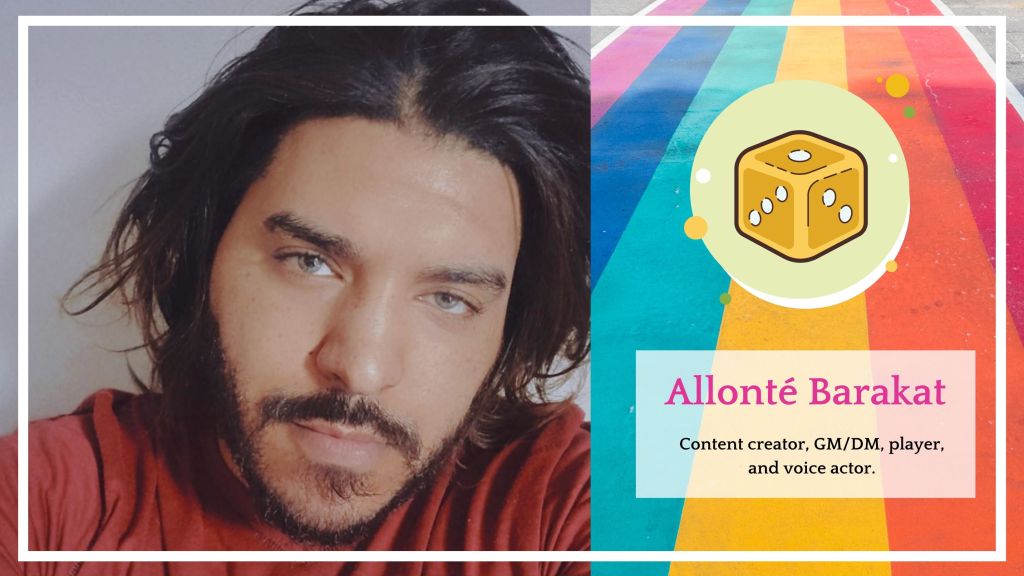
  • Adventure Queers: Meet Allonté Barakat!

    Adventure Queers: Meet Allonté Barakat!

    Allonté Barakat (he/they) is a burgeoning content creator, GM/DM, player, and voice actor. When they grow up they hope to meld the power of gaming with the healing of therapy. Best known as Kryst Z’Grande, he evolved his talents in pursuits of elevating more voices. Be sure to look out at their social media for a new upcoming podcast and audio drama!

    @ThatBearKat across all social media platforms.

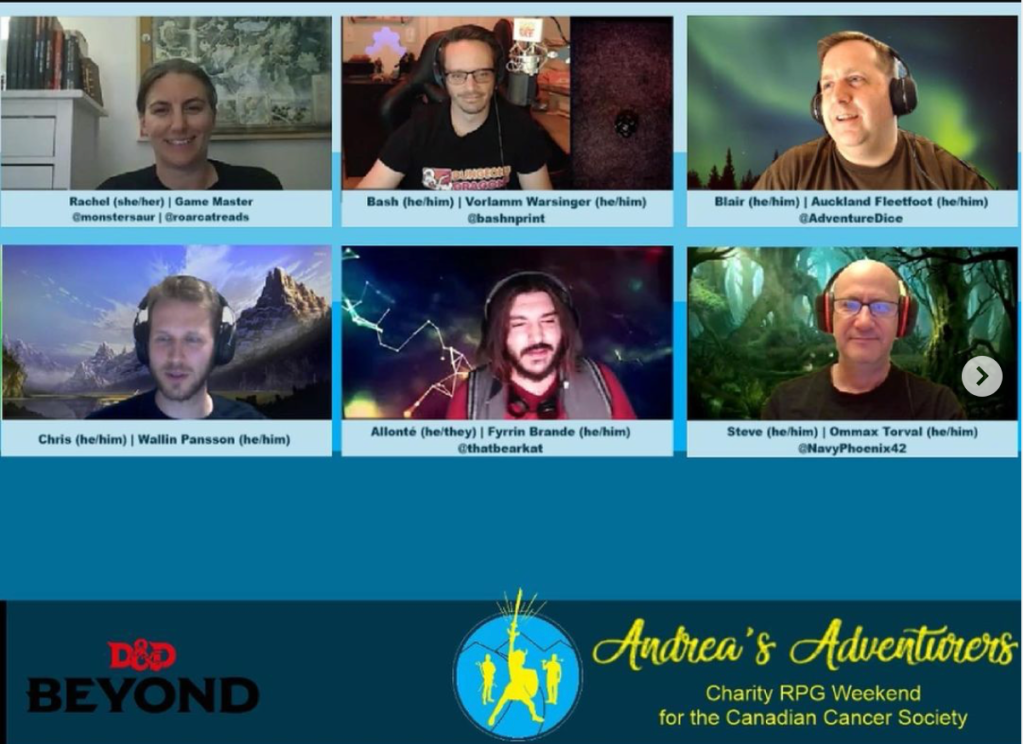
    Allonté, we first got to know you when you played in Rachel’s D&D session for Andrea’s Adventurers Charity RPG Livestream.  You were enthusiastic, smart, and your character had a mechanical cat – obviously we liked you! 

    I liked you too! Also, I had fun with the party! I feel like I lucked out with your DM/GM style. Early on I remember you saying, “The collaborative aspect is my favorite part, if as the GM I haven’t spoken in 20 mins because my players are planning a talent show to boost the morale of their pirate crew, I am happy!” This is such a beautiful and refreshing sentiment, you gave us the freedom to be weird. If one is not weird, they might be boring, at least that’s my personal philosophy. So much platinum coins to you and/or maybe some churu for the kitten!

    https://clips.twitch.tv/SwissManlyLionArsonNoSexy-ggHtGkhelAEc572o?fbclid=IwAR37BocBkIkv1-V0zLiJY5vRfookwE_stJWhjE-7SRxOQgtBP5waj5ij23Y

    When did you first play Dungeons and Dragons?  What was the experience like?

    I played Dungeons and Dragons in the late 3.5 era… for a class! I dreamed of being a game designer and in the pursuit of an Interactive Media and Game Design degree, I found myself in a fun storytelling class. Until then, I didn’t know what it was or what it could be. The experience as a whole was interesting. I honestly can’t say I enjoyed it until a story moment just seemed to align like a constellation of badassary! Through an obscuring fog, facing imminent death from a plague rat in the musty murky sewers, a single, last-ditch spinning keen-edge of a dagger seemed to part this occlusion sea. This desperate edge pierced the skull of the mammoth plague beast and one-hit-K.O.’d it, saving our party (and our session). I walked away from that experience changed, knowing that a TTRPG has the power to evoke emotions in an ever-lasting way.

    I went on to try to reclaim and recreate this experience but I have often gone up against huge gate-keeping walls. So many people like to tell others the “correct way to play” or hold on too strong to strict ideals that somehow a world where literally and figuratively anything could happen has to be a carbon copy of the real one with all its woes. No thanks. So I took a long break until about 2-3 years ago where I performed, or live-played, a character in 5e for an audience!

    What is your favorite part of playing D&D?

    I don’t know if I can just pick one thing! There is something so attractive about embodying, exploring, and experiencing a world that is (hopefully) so much better than our real one. I am gay. I am a person of color. This world is not, shall we say, often kind. Being in these worlds gives me hope. In that hope, I have seen the loving power to change people, to slay demons within and without, and have some fun! From all these experiences I want to see us bring these ideals back to the real world.

    In a slightly less existential way, I would have to say I love pushing the boundaries of what things could happen, using my character and abilities in ways that are unexpected. As some would put more succinctly, the rule of cool. Say we were on a boat. The night is a heavy backdrop of deep night, with a single pale light source in the sky. Fog rolls in from all sides making it neigh impossible to decipher East from North from South-West. Why can’t I, as a Sorcerer, use Absorb Elements in a ritualistic dance to bring that fog into me as my compatriots light the way forward and steer? Or perhaps we should do a one-on-one duel, against a mighty wizard. My back against the wall, the arena engulf in flames, and I am inches away from death. I steal their prized tome, with a lifetime of lifeworks inside, and threaten to burn it unless they surrender. Are these ways of existing and playing bad D&D? I for sure don’t think so! (P.S. I’ve done all those things in previous games!)

    Have you experienced any differences playing D&D with queer folx vs. predominantly straight groups? 

    I. Need. To. Play. With. More. Queer. Beings! It is a massive difference. So many straight groups come with this baggage-notion that there is one path, one right way to play, and/or one way to be. There may also be the dreaded, I’m going to play as [insert marginalized group or proxy] without understanding the depths or doing the work. Don’t even get me started on the dangerous implicit biases we have all seen or experienced firsthand. This is not why we play!

    There may be that living and fighting for a life that is different from the majority of others gives us marginalized individuals an emotional superpower. I have had more fun, connected with, been accepted by, and every other positive and loving attribute possible by other queer gaymers! Queer people bring the love and space for you to be you at whatever stage of being you are at and willing to pull you towards the light. We are guardians of the ideal world. I love that prejudice has no place in our spaces, or at least not without proper talking beforehand and aftercare.

    What makes a nerdy space feel safe to you as a queer person?  Are there any (positive or negative) signals that you look for?

    A quick visual cue for me is, how homogenous does space looks from the outside? Are there wonderfully out loud queer folk? Are there people of color? Are there women? If none of these exist, you should probably run away screaming. Well, use your best judgment. I have, a countless many times, had to be a pioneer of various spaces so that others can feel comfortable.  I also say for joining a new group, or even looking at various content, look at the legacy. If women, people of color, or queer people are being cycled through or do not wish to come back to the game, while other more “palatable” people remain, there are core issues there that do not deserve your awesomeness.  

    So this is the part where I have to confess to you, that when I joined the charity stream, you were my absolute first choice in being my GM/DM! I distinctly remember making an audible sigh of relief when I got in your game, I naively knew, well hoped, that the wall of “this is what this is” didn’t exist. That let me be free to be the Fyrrin Brande possible in our game. By the way, my question to you is one unanswered in game, what does transmutation magic taste like? 

    It’s like eating a handful of every flavor beans – you don’t know what you’re going to get, and it changes as you eat them!

    That being said, the positive signals are always openness, understanding, and making good decisions that keep our human need for connection strong. If people are making non-selfish choices, are being inclusive, and can recognize your human needs, then set some gaming roots!

    You were a part of a live-play podcast. How did you become involved in that project?  What were the highlights and lowlights?

    I was, indeed. Truth be told, it was a bit out of the left field. A friend of mine I played card games with suggested I try out for this project that started from nothing. I never thought of myself as charismatic or anything but I figured why not try. I didn’t think I’d end up being first-choice casting. In my tenure as the Crystalline Sorcerer + Creation Bard, Kryst Z’Grande, I set out to tell a story that means something, so that even if the project failed, I did something that maybe someone out there could connect to and not feel alone. From the onset, I wanted to tell a story about trauma, that you, the listener, can know in the back of your mind that no matter what was done to you, you can and will overcome. It was also important to play a queer person of color because our stories don’t get told. We do not get to be heroes, just sacrifices. I also confess I played an idealized self. I think in some way everyone does that, they bring a lot of themselves into whatever they play.

    My highlight is experiencing the power this story had. There were so many beautiful messages from many beautiful souls about being inspired, heard, seen, that I got to help people through tough times being someone they could reach out to. In that, I think there exists my lowlight, that even throughout all the good, through what was a great character performance (I hope), in my opinion, reality became just another sad tale-reflection of issues marginalized people face to this day.

    Do you have any tips or advice for people who want to try playing D&D? Any tools that you recommend?

    Dive. Right. In! There is no true right or wrong way to play! If you are new, grab your friends and do a one-shot amongst yourselves. You can also hire an understanding GM to run a game for you if that seems daunting. Be willing to have conversations before and after the game, not just about expectation but about actions that happen in game. Give kiddos the rule of cool or have a conversation about why a choice was harmful to others. A party of adventurers in a TTRPG is most often a reflection of the real-life relationship connections at the table, so if you want a strong party, build strong friendships.

    For the more experienced folk, go out and play more games, more TTRPG, more everything! D&D is great but by no means perfect. Remember this is a world where literally anything can happen, so make it happen. Dust off those mechanics where you can, for example, fail a roll but with some advantage!  There are some great tools out there like DnDBeyond to make characters, monsters, NPCs, and see other homebrews. Foundry or Roll20 for playing the game with, quite literally, all the bells and whistles. Check out r/dndmaps, Inkarnate, Watabou, to find or make maps. MyNoise.net to play around with ambient music/noise to get the room feeling like your scene or setting. 2MinuteTabletop is also great for tokens. 

    So to all you wonderful, beautiful, creative souls, get out there and get gaming!


    Thank you, Allonté! And thank you for leaving us a picture of you with your oldest kitten, Sir Winston. If you want more of Allonté, check out their linktree.

    A

    If you are a queer person who plays or DMs/GMs Dungeons and Dragons and you would like to be interviewed, please send me a message at roarcatreads@gmail.com.

  • Adventure Queers: Meet Diana Gaeta aka Superdillin!

    Adventure Queers: Meet Diana Gaeta aka Superdillin!

    There has never been a better time to be a queer Dungeons and Dragons fan, but let’s be honest: not all groups are safe or inclusive. In this blog series, I ask queer D&D fans about their experiences playing TTRPGs and what they think could be done to make the gaming experience better for all.


    I first discovered Diana (she/they/he) in the Adventuring Academy podcast episode “Give People More Room (with Diana Gaeta).” I loved their unapologetic preference for story and character over gaming rules, and when I learned that they had a podcast of their own, I immediately binged the entire catalogue of Femsplained (my particular favorites are the episodes on Dragon Age, Indie TTRPGs, and of course, Black Sails!). I’m so honoured that Diana agreed to be interviewed for Roar Cat Reads, so without any further ado:

    Welcome, Diana!

    I’m Diana Gaeta aka Superdillin, a tabletop RPG creator, entertainer, and event organizer. I published a 5e compatible setting based on Neverland from Peter Pan and stream LOTS of tabletop games.

    Diana, when did you first play Dungeons and Dragons?  

    I first saw a game being played when I was in middle school, but was told it was boys only, so I angrily avoided the game for years after that. I think the first time I played D&D specifically was when I was just out of college.

    Do you currently play D&D? What is a recent memorable moment that you would like to share?

    I do still play D&D with my home game group that’s been going for about 3-4 years now. Every moment with them is special, but one in particular is the first time I ever saw this group get deeply invested in their characters. They were all new to TTRPGs in general, and in the beginning everything was very silly and loosey-goosey. Then I reintroduced a character from someone’s backstory, and for the first time saw them start pacing around my living room, trying to figure out what to do, and what to say. It was like a light switch flipping on.

    Have you experienced any differences playing D&D with queer folx vs. straight groups?

    In general, yes. I don’t love being fully openly queer or playing characters that are in groups where I’m the only queer person. It feels too vulnerable and uncomfortable, even when I love and trust the folks I’m playing with. 

    When you DM, how do you create a queer-friendly atmosphere in your group? 

    Step one is being loud and upfront about my own identity, that tends to drive away people that won’t contribute to a safe table. Next is including pronoun introductions as a normal part of the character creation process for everyone. Safety tools and checklists also help.

    What is your favorite aspect of playing D&D?

    Getting to explore new parts of myself and to create stories with people.

    What is your favorite aspect of DMing?

    Seeing the excitement on people’s faces when you surprise them with something cool, or when you say yes to the cool-as-hell thing they just thought up, or when they figure out the mystery you put together.

    Do you have any tips or advice for people who want to try playing or DMing D&D? Any tools that you recommend?

    Random generators got me through my first year of DMing. Donjon.bin.sh is the greatest thing on earth. 

    And finally, if you could change one thing about Dungeons and Dragons culture, what would it be?

    Wizards of the Coasts entire upper management team needs an overhaul, and they need to actually vocalize dissent against the “old guard” who harass people in the hobby (and in the MtG hobby as well).

    Thank you, Diana!


    If you are a queer person who plays or DMs/GMs Dungeons and Dragons and you would like to be interviewed, please send me a message at roarcatreads@gmail.com.