Alex (he/him) is a bisexual bilingual Britalian currently living on xʷməθkʷəy̓əm, Sḵwx̱wú7mesh, and səlilwətaɬ land. He is a literary translator from Italian into English, though he also dabbles with French and RPGs, and is co-editor of The Norwich Radical. His work has been published in NYT Magazine, The Massachusetts Review, The Short Story Project, and PEN Transmissions. You can find him around the internet at alexv.fyi or alexvalente.fyi.
What queer book have you chosen to share with our readers today?
Seth Dickinson’s The Traitor Baru Cormorant was the first book featuring queer women by a male writer that did not make me want to scratch my eyes out in frustration. It is also an intricate, detailed, historically accurate while being ahistorical, fantasy dissection of the powers of empire, colonialism, oppression and, most of all, assimilation. Baru is a young savant from the latest colony of the Masquerade, who decides to rise through the ranks and destroy the empire from within. Of course, at every step of her silent revolution, there are temptations (the women who work with, for, or against her tend to be most of them, especially Tain Hu, her field general) and limitations to what her imperial power can do, and Dickinson makes sure to wring every ounce of gut-churning tears and screams of frustration up to the very last page. It’s brutal, it’s visceral, it’s like nothing I had ever read before, and I will never forgive him for the ending.
Why is this book one of your favorites?
I am very, very wary of books written by men about women, especially queer women. Dickinson came with some very good recommendations, and it still took me over a year to try the first book – in fact, it was his blog post about the world of Baru Cormorant that finally gave me the last push (and a good friend of mine reading ahead of me to vet it). I have been disappointed too many times, but this one managed to get so many things just right, while also not holding back on several punches and horrible twists, in a way that built a world instead of placidly and tacitly becoming complicit with the homophobia, transphobia, xenophobia and layers of oppression that the Masquerade enforces upon its subjects and colonies. It sits in the same general area as The Poppy Wars, She Who Became the Sun, The Unbroken as part of a new canon of queer explorations and subversion of colonial fantasy. It’s the one book I would recommend to anyone trying to write fantasy or any form of world-building. It’s just that good.
How would you describe yourself as a reader?
I am a very focused reader, both by professional deformation (translation: not even once) and by choice. I have very specific criteria on what books to choose to read because I have to dabble in so many I might not usually want to read for work. So I rarely choose litfic for pleasure, and tend to not read a lot of recent YA, for example, and try to steer clear of anything with law enforcement as main characters. But as I said above, I also avoid male writers unless they come from a marginalised background or identity, unless they come incredibly highly recommended, or their work is online as short stories or poems or novelettes. And even then, I have so much catching up to do with so many good really imaginative fiction (horror, fantasy, scifi, all of the above) writers I never even knew existed from my first decades of reading mostly male authors. I’m sure The Men won’t be missing me as a reader!
As a queer person, have books helped you explore or express your queer identity?
This might not be the answer you’re looking for but: I’m not sure it has. Or at least, not exactly. I do remember being shaken to the core when I first read Jeanette Winterson’s Written on the Body, but it was a similar reaction to Patrick Ness’ A Monster Calls or watching A Single Man – I’m not sure if queer stories are what I needed, but now that I look at it, there is a pattern of queer authors and creators that have had a recognisable impact on my own development and discovery, yes.
Other than reading, are there any queer nerdy recommendations that you would like to leave with our readers?
There are many many many TTRPGs that are off the beaten track (i.e. D&D and its siblings) which deal with issues of identity, sexuality, marginalisation, class awareness, and subversion of violence as conflict resolution. Narrative games like Wanderhome and A Quiet Year, social games like Monsterhearts 2 or Big Gay Orcs, solo games like A Thousand Year Old Vampire or The Magus or Plot Armor, and even a few two people games, like Enticement, or Things, Eldritch and Terrifying. Go take a look at itch.io, try a few, and let them change how you look at stories, at games, and yourself.
Thank you, Alex!
Check out our Queer Lil Library for more book recommendations and reviews!
Hi there! I’m Haley Boros, my pronouns are she/her, and I’m an award winning graphic designer, illustrator, and published cartoonist. Outside of my career in the label printing and flexible packaging industry, my creative practice focuses on whimsy and fantastical creatures – think dogs doing fantasy jobs! I’ve contributed to several comic and art anthologies since 2017, most of which can be found on my website at haleyboros.com. You can also become a supporter of mine at ko-fi.com/hihaleyboros, or follow along at @hihaleyboros on twitter and instagram!
What queer book have you chosen to share with our readers today?
Today I’ve chosen Beyond: The Queer Sci-Fi & Fantasy Comic Anthology. Featuring 18 stories by 26 contributors, Beyond is a 250+ page, black and white, queer comic anthology, full of swashbuckling space pirates, dragon slayers, death-defying astronauts, and monster royalty. Each story celebrates and showcases unquestionably queer characters as they explore the galaxy, mix magic, have renegade adventures, and save the day!
Why is this book one of your favorites?
I’m a BIG fan of comics that are sci-fi and fantasy all rolled into one. It’s the best of both genres!
How would you describe yourself as a reader?
That’s a terrific question. I would have to say that I enjoy books that match the mood I’m in, for the most part. As an example, I picked up the newest Chris Hadfield book from the library (where I’ve been doing a lot of my current reading from!!) because I felt it would be a good mix of things I love – Space and Mystery. Even though I have borrowed it from the Library twice now, I really don’t think I could get into it again. It just didn’t feel like something I could see myself spending my time doing. If I’m not connecting with something within 50-100 pages, I abandon it and find something else that sparks my interest.
As a queer person, have books helped you explore or express your queer identity?
Yes, ABSOLUTELY! I’ve found I really relate so much to my queer comics peers when I read their works. I’ve found little pieces of myself in them, and it brings me so much joy. Getting to read about different character’s experiences in their own queer journeys has really made me consider that mine is unique and should be cherished.
Other than reading, are there any queer nerdy recommendations that you would like to leave with our readers?
Queer and Nerdy recommendations that aren’t reading…hmmm.. OH! There are quite a few television shows and movies up on Netflix that are very good and very queer. Some that stand out to me are Feel Good, Everything Sucks!, Schitt’s Creek, Sex Education, SheRa and the Princesses of Power, and One Day at a Time.
Thank you, Haley!
Check out our Queer Lil Library for more book recommendations and reviews!
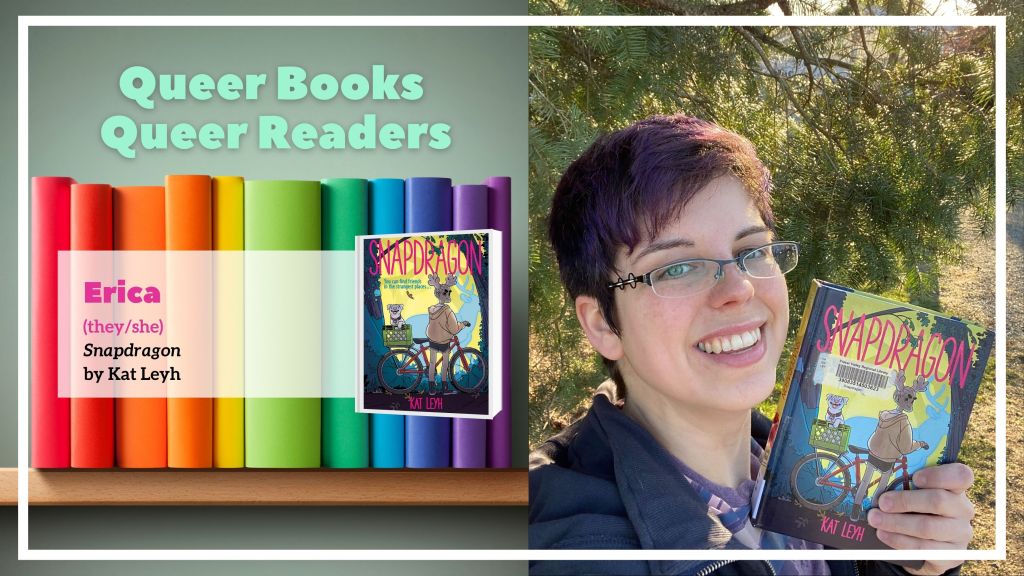
Hi, I’m Erica (they/she)! I’m a ceramics artist, library worker, theatre-goer, and – of course – a reader. I sometimes share my art and my cat on Instagram: @airekker.
What queer book have you chosen to share with our readers today?
I’m glad to have the opportunity to gush about Snapdragon by Kat Leyh, a young adult graphic novel about a creepy old witch who lives in the woods selling roadkill online, a teen girl who needs her help, and a web of connections that brings everything together. I was so charmed by the expressive art, the flow of the story, the transitions – gah! It’s all just so beautiful! It’s a very wholesome read. When I finished this comic my heart felt full.
Why is this book one of your favorites?
When I was a teen I read a lot of old-dead-white-guy sci fi that was very heteronormative. I thought a lot about the future in the abstract sense, but while embroiled in these very patriarchal visions I don’t think I could realize my own identity or picture what my own future could look like. I think that’s why Snapdragon spoke to me; there’s this teen girl who doesn’t quite fit the mold or understand herself, and she finds comfort in an elder queer, and that’s just pure hope to me. That teens now will see older queer people living and thriving and imagine themselves doing the same. My great dream is for children and teens to be able to envision their queer futures and for that vision to be hopeful.
How would you describe yourself as a reader?
Flighty! I have a long, long list of books I want to read but I don’t move through it methodically at all. Some books have been on that list for a decade, but I can’t resist a pretty cover that passes under my nose. And working at the library, that happens a lot!
As a queer person, have books helped you explore or express your queer identity?
For sure. Often when I read information about identity language I think, “hmm, so that’s what some people experience and how they describe it.” But when I read queer fiction or memoir, I see that experience firsthand and I realize – wait – that’s how I feel, too. Am I also that thing? Sometimes it helps me to connect the dots on how aspects of my identity relate to each other. It opens new doors for understanding myself and articulating my own realizations.
Other than reading, are there any queer nerdy recommendations that you would like to leave with our readers?
I’ve sunken a lot of time into Fire Emblem: Three Houses. I wish it had more gay romance options, but there are some great ships to be had wrapped up in a great strategy game.
Thank you, Erica!
Check out our Queer Lil Library for more book recommendations and reviews!
Hello! My name is Nico (they/them pronouns), and I am a queer Torontonian who loves (and loves learning about) art and ASL. I identify as a genderqueer bi+ peep who is slowly getting into DnD and RPGs but has always loved literature and stories more than anything else. You can find me sneakily liking all your animal photos.
What queer book have you chosen to share with our readers today?
It was a tough choice because I have a hard time picking favourites, but the queer book I chose to share today is Little Blue Encyclopedia(for Vivian) by Hazel Jane Plante. The book is a trans femme sapphic text. The premise is that this text is an encyclopedia for an imaginary show called “Little Blue,” a show which the narrator’s best friend / love interest is obsessed with. It is likely one of the queerest unrequited sapphic love letters I have ever read. Using encyclopedia entries as the framing device, the reader learns about the narrator, their best friend / love interest, “Little Blue” and how one’s relationship to fandom can be integral to your existence.
Why is this book one of your favorites?
This is one of my favourite representations of queer longing, which is so complicated and beautiful and could be carried for eons. The book asks you: What do you do with those emotions? Do you feel guilt and anger or anguish for carrying that longing for so long, knowing it will never be requited? This book proves that you can live with these questions and maybe never figure out any answers. I appreciate its messiness and how the emotions portrayed in the book bleed into one another. I find comfort in the loose ends and lack of resolution and resistance to completion.
How would you describe yourself as a reader?
I am a dedicated reader when I have enough time to be alone with a book. Right now, it’s a bit difficult to get that time, but I try to always carry something with me. That’s part of why I love travelling; books make the best travel companions, and that time is already there. I especially gravitate towards books with different structures or formats, which is why I love books like Little Blue and graphic novels like Are You Listening. I appreciate the meta approach taken in books that play with how they present themselves, and love writers and artists take risks that make their work different but meaningful.
As a queer person, have books helped you explore or express your queer identity?
Honestly, I think I am who I am because of queer literature. Queer books, queer bookstores, and the queer sections of every library and bookstore have been my havens and my mirrors when I needed them most, when I needed to know I was still real and still existed. My identity is oftentimes in this cycle of realization and affirmation thanks to books, and I discover things about myself, rediscover things I’ve forgotten, and reignite what I lost or gave away. I’m my own little forest of reading, and some of these stories bloom or decay along my path, but they are all always present and part of the cycle, nourishing me as I grow into the person I hope to be.
Other than reading, are there any queer nerdy recommendations that you would like to leave with our readers?
I recommend Shing Yin Khor and their games. I am currently playing Remember August, about a time-travelling friend who needs you to remember them, and I’ve responded to it so sincerely it kind of hurts sometimes. They are usually solo games, but I believe they can be adapted as needed.
I also recommend the Tea Dragon Society series. Super queer, they are adorable graphic novels, but their creators also made the CUTEST dragon plushes ever.
Also also, I recommend StoryGraph if you’re looking for a replacement for Good Reads; the site is run by a Black web designer who wanted a recommendation site that did not actively work with Amazon. I really liked the recommendations it gave me, and hope you do too
Thank you, Nico!
Check out our Queer Lil Library for more book recommendations and reviews!
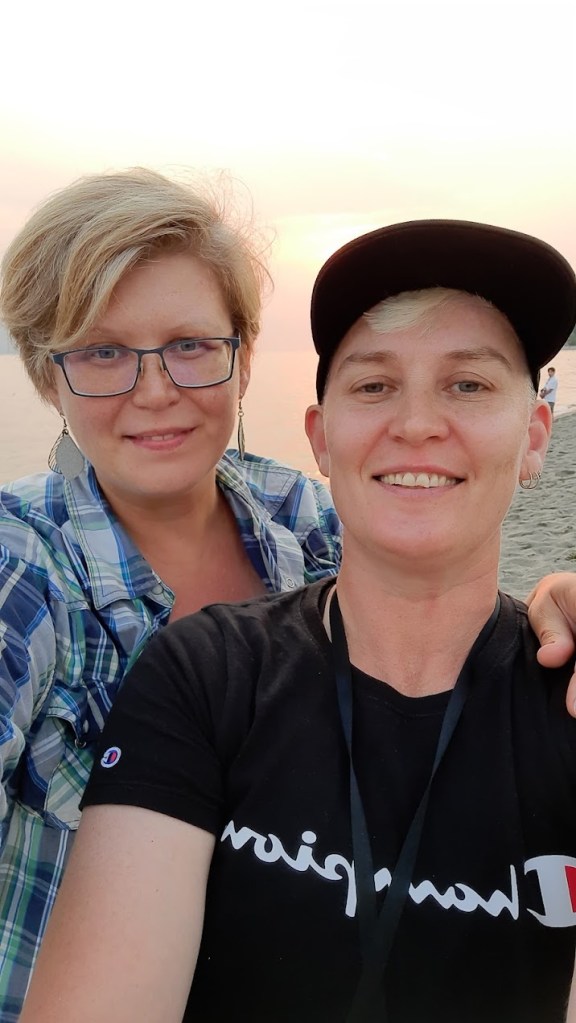
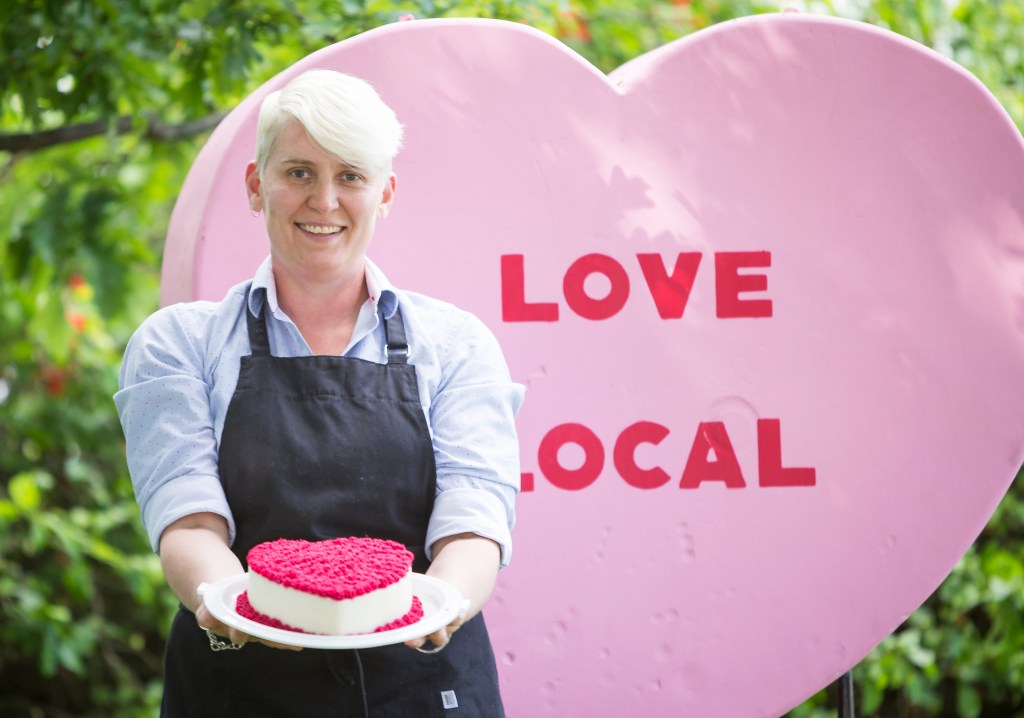
Olga and Natasha Vernev are local business owners in Vancouver. Together, they own The Great Canadian Dog Cakes where they make healthy dog food as well as beautiful dog cakes and cookies. Their path here has not been easy. As a lesbian couple in Russia, they fled persecution to Thailand and Cambodia before eventually immigrating to Canada with the help of Rainbow Refugee. Olga and Natasha have partnered with Roar Cat Reads to raise awareness of the awesome work Rainbow Refugee is doing and encourage all readers to participate in our upcoming fundraising event. You can donate HERE now!
How did the two of you meet? When did you know that you were in love?
This is a funny story about how I have known Natasha for twenty years, and she has only known me for ten years.
I met Natasha in 2001 when I was a university student. I left the library and saw her standing in the street and talking to her friends. And she was amazing. Like a character from some comic about lesbian superheroines (does such a comic exist at all? It’s a pity if not).
I immediately fell in love with her at first sight, and she didn’t even notice me.
Ten years after that, we met on social networks.
At this point, we were both already pretty disappointed in relationships, both after difficult breakups. For my part, I would not have agreed to try to meet if it was anyone but Natasha.
We got pretty tough about the boundaries of our future relationship, and both agreed that we would have a date and one night stand. Nothing but this! And…there must be a joke about lesbians who move in together after the first meeting.
We’ve been together for almost ten years since that date, because she also fell in love at first sight, only with a slight lag.
I don’t want you to discuss anything that makes you uncomfortable, but why did you know that you weren’t safe staying in Russia?
Oh, we’ve talked about this so many times that it has become my new comfort zone, something like sitting on nails. You know, there is a method of self-help therapy to tell a story so many times until all the emotional content evaporates from the narrative. I can’t say that we finally succeeded, but we both have therapists, and our PTSD is under the supervision of a very good Canadian doctor.
My wife and I had very different backgrounds. Natasha is a little older than me and managed to capture some rather dangerous times in the 90s in Russia, and she was subjected to the most brutal attacks several times. She was literally beaten to a pulp. So she was closed and wary.
I came out to a more or less prosperous beginning of the 2000s, and did not see any danger at all. I lived openly. I even had a rather dangerous hobby – trolling homophobes on the streets. If someone came up to say something disgusting to me, I literally took the person by the hand and gave him an educational lecture in the most serious tone until he ran away screaming and cursing. I didn’t believe at all that someone could do me any harm other than verbal.
Because of these different experiences, Natasha and I had some disagreements about how we would behave on the outside while with each other.
When the Russian government began to develop a draft law banning the promotion of homosexuality, the speed of events shocked us. Previously, we all hoped that Russia would move closer to the Western path of development, but Putin’s government suddenly took a sharp conservative turn, and then real troubles began, especially in provincial cities like ours.
As I said, I lived quite openly. My friend and I had a shop of hand-made queer stuff, we drew and sold t-shirts, posters, and calendars online. At first, our store received threats and we were forced to close it. Then some of our friends were attacked and the police refused to help them. And then Natasha and I also began to receive threats. Some people wrote terrible phrases and threats to kill us in our car and on the front door of the apartment.
With this law, the state seemed to make it clear to the aggressively-minded part of the population that they can freely express their aggression and there will be no consequences for them. I’m seriously telling you, there was a criminal case shortly before our departure about a man who killed a gay man with an ax and received a two-year suspended sentence.
And then there was a Nazi organization that practiced hunting gay people for money, it was called “safari.” People were lured into fake dates on social networks, locked up in an apartment, beaten, and monstrously humiliated. These acts were filmed and published on the Internet to destroy the lives of these people permanently. This organization built something like a franchises – those who wished could open a safari club in any city and invite participants to hunt for a fee. Very inexpensive, by the way.
In addition, some absolutely terrible false information about gay people poured from TV screens in prime time. For example, talk shows had disgusting discussions in which participants freely expressed their most vile opinions and desires. Intolerance in society began to grow under the influence of this information.
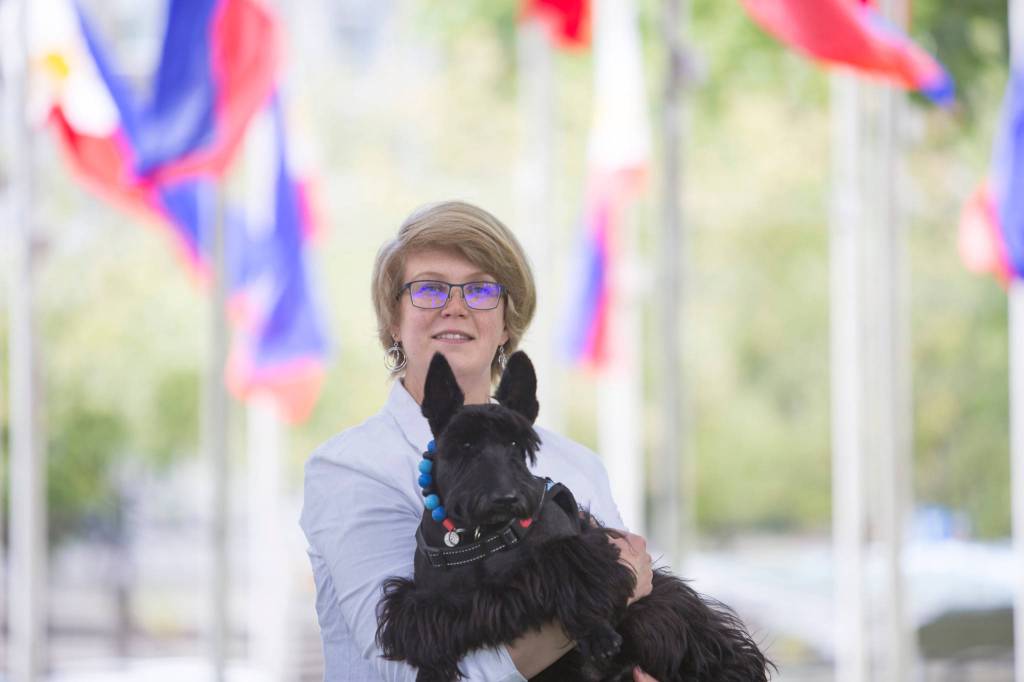
Natasha gifted me a Scottish Terrier puppy for my 30th birthday. He and I once went to a local grocery shop and came across a group of young men who, with the words “Well, lesbian, finally you got a man?” kicked Spielberg and ran after me. I grabbed the dog and ran, and just managed to close the doorway.
Natasha, who had much more negative experience than me, immediately realized that it wouldn’t end well for us. Soon, we sold everything we had and left the country with one suitcase and a puppy. We went to Thailand, then to Cambodia. From Thailand, we turned to Canada for help.
How did you end up connecting to Rainbow Refugee?
We googled a well-known lawyer, Robert Hughes, and he helped us get in touch with Chris Morrissey directly. Here it should be said that everything was complicated by the fact that we didn’t speak English, so I used a lot of Google translator, which in those days was far from perfect. Ultimately, Chris became a member of our support circle.
We have been asked many times something like, “But how did you get in touch with Hughes?!” and we reply “We googled.” Can you imagine the level of responsiveness of the people involved in LGBT issues in Canada? You just accidentally write to a celebrity lawyer who simply answers, “Ok, let’s see what we can do about it,” and the superstar of the Canadian LGBTQ+ movement, Chris Morrissey, starts to deal with your case!
How did Rainbow Refugee support you, both as you immigrated to Canada and after you arrived in Vancouver?
We have received tremendous support from Rainbow Refugee. In our opinion, it is great luck that this organization exists and helps people. We were supported psychologically (in the last year in Cambodia I was in almost daily correspondence with members of the circle of support) and we were very strongly supported financially.
When you are a refugee of a sponsor group, the first year after arriving is completely focused on adaptation. There is a big difference between coming here as a tourist to see beautiful British Columbia, and arriving to start your life here from scratch.
The whole system here does not work the way you are used to. You need to learn something new every day – how to use public transport, how to get an appointment with a doctor, how to pay bills, where to get an insurance number, where to go to learn English, how to sort the garbage correctly, how to fill out the tax return correctly – an endless to-do list.
Often, by the time of arrival, refugees are morally exhausted, traumatized by all that they have experienced, disoriented, or in a depressive period or anxiety. Having help with simple bureaucratic actions and exploring a new world in these situations is priceless. Every day, someone from the support group helped us deal with all of this. We made friends with many of them and still maintain relations.
You came here with your pet dog, Spielberg. Did RainbowRefugee help with bringing a pet to Canada?
Yes, Rainbow Refugee completely orchestrated Spielberg’s arrival. For a long time we didn’t dare to tell Chris or anyone else that we had a dog. We were worried that this might affect the decision to take our case at all. Then it turned out that this is the most common thing – to flee from a dangerous country, taking a pet. Our case is not exceptional.
Why do you think it’s important for people to support Rainbow Refugee?
I have a story about this. A few weeks ago I was sketching on Jericho Beach and a nice family sat next to me. We started a conversation and they asked me where I was from and how I came to Canada. I said I was a refugee because, you know, I have this idea that every time I don’t hide it, I kind of destroy a tiny bit of stigma around that word.
Some media tries very hard to portray refugees as a frightening, faceless crowd of freeloaders, and sometimes this affects people. But every refugee has a long, individual story behind them. It seems to me this is such a challenge – here I called myself, here I am, here is my wife, it is difficult to depersonalize us at this moment.
This nice family turned out to be very radical in their views on refugees and LGBTQ+ in particular, so I just sat there and destroyed their every assumption.
When they said that refugees come and spend money from Canadian people, I replied that we have been working since the third day of our stay in Canada and pay taxes. When they started talking about sin, I said – look, here is my wife, we have been together for many years, just like you. And when in the end they said that refugees, with their low-paying jobs, increased the financial burden on the state system during the pandemic, I shrugged my shoulders and said that it was at this time that we launched our business.
Do you know why I’m so bold? Why I can afford to stand in front of skeptical people and lay out all these crushing arguments in front of them?
Because how quickly we found a job, integrated into the local community, spoke English and created our company is the result of Rainbow Refugee and our support team’s work in the first year.
Every minute of the work of volunteers who helped us overcome frustration in the bureaucratic part of our process and in adapting to life in Canada, every donated dollar – all this was spent so that we could take language courses, plan and build our new life without paralyzing fear that tomorrow we will be thrown out on the street in an unfamiliar country.
Being a sponsored refugee is a privilege that gives you the greatest head start on integrating into Canadian society. The first year with a support group for a refugee is as important as the first year of a baby in the mother’s arms.
We had a rare chance to find out what it is like to be taken care of so that you can become a conscientious and resourceful member of society. It’s priceless.
As we grow, we will try to help others in the same way that all these people have helped us.
Is there anything else you would like readers to know about the organization or your experience?
You know, the hardest part about the refugee process is suspense. You drop everything and go on a journey without a return ticket, with no guarantees of a happy ending. Often this means that all family and friendship ties are cut off, you have to reconsider everything that you knew, and you yourself have to go through a serious test.
I used this metaphor in an open letter to fundraising participants a couple of years ago, and I will repeat it now, because I still don’t know how to describe the refugee process any better. Imagine that you’re a trapeze acrobat under a circus dome performing a trick for the first time in complete darkness. You swing, unclench your hands and fly into the unknown. You don’t know if there is another trapeze at the end of your route or if you can grab it. There is an abyss below you.
Rainbow Refugee are the people who pick you up in the middle of the flight in this complete darkness and literally carry you to your final destination in their arms. Someone turns on the flashlight and someone grabs your wrists for you to complete the trick.
Natasha and I wish no one ever has to experience such a flight. But for this we need some other world, probably.
Finally, we would like to end on a fun note. This is a queer, nerdy blog! If you could choose to have one super power, what would it be?
Natasha says that she would like to fly like a superhero, and I would like to have an Incinerate Look. In some life situations, this could be a very useful skill! Although in Canada it would be of little use to me. This country is inhabited by some absolutely amazing people.
Well, and we both would like the main superpower – that our English becomes as good as our Russian, so guys, many of you have one important superpower, you just don’t realize!
Patrick Myers (he/him) is a freelance writer and playwright. His practice encompasses a variety of disciplines, including but not limited to writing, producing, criticism, and teaching. His work has appeared in American Theatre, HowlRound Theatre Commons, and ARTSATL, and he can be found tweeting irreverently @patrickrmyers on Twitter.
What queer book have you chosen to share with our readers today?
I’ve picked Alec by William di Canzio. It’s inspired by the novel Maurice by E.M. Forster, where two men fall in love in Edwardian England and run away together – destined to be happy for the rest of their days. Where Maurice explores the world through the gentleman Maurice’s perspective, di Canzio explores the world through the eyes of his working class lover, Alec, and expands the plot to what happens after they run away together.
Why is this book one of your favorites?
I love Maurice, and Alec is the perfect companion piece to that novel – where Maurice was written in 1913, the 21st century perspective on the events of the novel allows for an understanding of what comes next for Maurice and Alex: World War 1. With that as the catalyst, the novel becomes a sweeping romance not just for how they come together, but how they stay together. What is more romantic than unyielding and undying commitment? Also, it has some of the best sex scenes between two men ever written, both realistic and hot. There is nothing left on the table. I could want nothing more from a book.
How would you describe yourself as a reader?
I’m a terrible reader. I either devour book after book or read infrequently, if at all. I use random bills or printouts or credit cards as bookmarks. I stop halfway through a book and don’t continue reading until months or years later, picking it back up where I left off as if no time had elapsed. I live and die by a book and recommend it to friends and when they ask for the plot, I seem to be unable to conjure any of the narrative for them. I start and stop multiple books before I pick one to finish, as if I was at a wine tasting, sampling for the bottle I’d bring home. I love books. But I’m a tedious, unrepentant, awful lover to have.
As a queer person, have books helped you explore or express your queer identity?
I didn’t have access to queer books as a child or teenager, but I did have an internet connection, so I spent much of my youth online reading and writing fanfiction for some of my favorite books. I would write about characters I identified with and used them as proxies for my burgeoning queer identity. In that way, I was able to use accessible books to explore queerness when I had none available to me. And it was reading that opened up that door for me.
Other than reading, are there any queer nerdy recommendations that you would like to leave with our readers?
For anyone who loves to game, I’d definitely recommend Hades published by Supergiant Games. It’s a roguelike dungeon crawler, which is normally not my type of game. HOWEVER! You play as the son of Hades and Persephone, Zagreus, and throughout your many attempts to escape the depths of hell, you are given the opportunity to reunite some of Greek mythology’s most iconic couples, including the warriors Achilles and Patroclus. On top of that, Zagreus has multiple characters he can romance, including the dashing and mysterious God of Death, Thanatos (or Than for short). It’s brutal and romantic and filled with unearthly wonder – perfect for a rainy day on the couch.
Thank you, Patrick!
Check out our Queer Lil Library for more book recommendations and reviews!
I’m Chelsea (she/her), an asexual and aromantic librarian, who blogs about books over at Spotlight on Stories. You can also find me on Instagram (@crdinsmore) or twitter (@doh_rae_me).
What queer book have you chosen to share with our readers today?
Loveless by Alice Oseman was one of my favourite reads of 2020. It has a special place in my heart because it’s one of the first times I felt seen by a book. A Young Adult aromantic asexual coming-out story, Loveless is set at Durham University and follows fanfic-loving protagonist Georgia. As a romantic, she believes that she will find her happily ever after eventually, but soon begins to question why the romance that comes so easily to her friends is so hard for her. Although Loveless isn’t autobiographical, author Alice Oseman writes from experience and Georgia’s exploration of her identity as an aro-ace person hit home for me. A charming tale of acceptance that celebrates love in all its forms.
Why is this book one of your favorites?
As a reader in my thirties I’m moving away from Young Adult as a genre these days, but Alice Oseman’s books are the exception! Like the characters in her webcomic series Heartstopper and those in her previous novel Radio Silence, Georgia and her friends grapple with questions of identity, and specifically queer identity, in realistic ways. The characters are so endearing and believably teenage. I absolutely love how platonic relationships are prioritized in this book and how well Oseman develops each of Georgia’s friendships. Loveless is the first book I’ve read with such prominent aro-ace representation and it really is uncanny that I wound up reading this book about an aro-ace nerd who starts a Shakespeare Society with her friends at a time when I, an aro-ace nerd, was performing in weekly Shakespeare plays over zoom!
How would you describe yourself as a reader?
I’d describe myself as a voracious reader of diverse books, with a special fondness for science-fiction and fantasy. I love the creativity and escape that SFF offers as a genre and I feel like we’re living in a golden age of diverse SFF right now, which makes it an exciting genre to follow! Some of my best bookish friends read literary fiction and champion translated works though, and I’ve been picking up more of their recommendations, even when they’re outside of my comfort zone.
As a queer person, have books helped you explore or express your queer identity?
The biggest way in which books have helped me explore my queerness is through connecting me to other LGBTQIA+ readers and the broader queer community.
I was in my mid-twenties before I learned that there was a word for people like me who don’t experience sexual or romantic attraction. Even after I identified as asexual, it took me awhile to feel comfortable calling myself queer because I wasn’t sure if I would be accepted as part of the community or if I was “queer enough”. Strengthening friendships with other queer readers who share an interest in books and working with wonderful queer library workers on a regular basis have helped me to feel like I have a place within the queer community.
I didn’t see myself represented on screen or on the page when I was growing up. Too often it looked like a happy ending could only be achieved through a romantic relationship, a path that I knew wasn’t for me. It’s only in the last five years that I’ve started to see books with asexual and/or aromantic characters being released by mainstream publishers. I think shifts in the publishing industry will make it easier for teens and young adults exploring their asexuality these days, but I do wish there were more books targeted at adults with asexual and aromantic characters.
Other than reading, are there any queer nerdy recommendations that you would like to leave with our readers?
My go-to rec is Black Sails, but I think Roar Cat Reads has that covered, so I’m recommending In the Flesh, a 9-episode British show that is the most original take on a zombie apocalypse I’ve ever seen. The show is set a few years after “The Rising”, a period in which thousands of people around the world reanimated as zombies, wreaking havoc. Now a medication has been developed to restore consciousness to those who suffer from “Partially Deceased Syndrome” (PDS), but prejudice abounds. Pansexual protagonist Kieran is a sufferer of PDS who returns to his hometown and his family but feels guilty over what he did in his rabid state.
As far as other pursuits go, since April 2020 I’ve been part of Project Shakespeare, a group of friends who gather on zoom to perform Shakespeare plays, complete with props, costumes, and schtick. I’m naturally an introverted, shy person and it took a few months to come out of my shell, but if you have a safe and supportive group of friends I highly recommend acting out some Shakespeare as a queer and nerdy pastime!
Check out our Queer Lil Library for more book recommendations and reviews!
Hi there, my name is Kelly Slaven and my pronouns are she/her/hers.
What queer book have you chosen to share with our readers today?
OK, I know that I am beginning the interview by breaking the rules. I LOVE John Irving. I love him so very much that I will always read anything he writes and I love the detail and mundane that he provides in his writing. So, here’s the deal, I suggest ALL of his books. In In One Person, Billy is the bisexual narrator and the heroines of the novel are two transgender women, in The Cider House Rules, Dr. Larch is reported to only have had sex one time, and Johnny Wheelwright, who is the “nonpracticing homosexual” narrator of A Prayer for Owen Meany, never has sex. There are transgender characters in The World According to Garp and A Son of the Circus, and gay characters in The Hotel New Hampshire and Son of the Circus.
Why is this book one of your favorites?
I trust John Irving to show me every detail of the story, especially the day to day ones, so that I believe him. Life is not always exciting so his mundane details are what make his writing real to me.
How would you describe yourself as a reader?
The opposite of who I am in life. In life, I don’t want all of the details, just the big picture and tell me in one sentence, not 20. But, in a book, when I slow down, I want to know it all! The more words the better.
As a queer person, have books helped you explore or express your queer identity?
I think that any representation helps me in this way. The author, Glennon Doyle, has helped me realize myself and all of my details (being queer, being female, etc) more than anyone else because she says what everyone is thinking and allows space to explore it without shame.
Other than reading, are there any queer nerdy recommendations that you would like to leave with our readers?
Hi, I’m Lauren! Or Lo. I use she/her or they/them pronouns. I’m queer and neurodivergent and a little witchy and book obsessed. You can find me occasionally posting about books at @readingwithfeelings on Instagram.
What queer book have you chosen to share with our readers today?
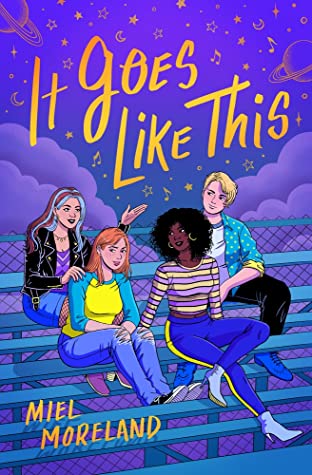
Okay, after many false starts and much deliberation, I have chosen to tell you about IT GOES LIKE THIS. An absolutely beautiful debut from Miel Moreland, it is a YA book about a queer pop group who have broken up but come back together for a benefit concert after a storm ravaged their hometown.
Why is this book one of your favorites?
It made me feel so many feelings. If a book makes me both laugh and cry, I am basically forever obsessed with it. Steph’s exploration of gender identity and their feelings around Moonlight Overflow constantly being referred to as a girl group. Their love of family and trying to balance that with living their own life. Celeste and Eva and their relationship and the ways we can hurt those we love, and hopefully the ways we heal from that hurt. The song lyrics! The fact that everyone was allowed to be young and make mistakes and figure out what they wanted! Ugh, so, so good and I wish it got more hype
How would you describe yourself as a reader?
Voracious? I read a lot. Definitely every single day. It is a form of escapism and learning both. I definitely read more fiction than nonfiction but I try to get in a few nonfiction books per month. I also read more queer than not, and I love the over abundance of queer books now! I have so many I want to read!
As a queer person, have books helped you explore or express your queer identity?
I feel like I read a lot of YA that teenage Lo would have benefitted from greatly. I feel like my main responsibility as a queer person is to constantly question my own beliefs and make sure I am interrogating my own internalized homophobia, racism, sexism, ableism, xenophobia, etc. Reading keeps me intersectional. I am loving Andy’s intentional reading challenge for this year! (You can check it out at Andy’s Insta @foreverinastory)
Other than reading, are there any queer nerdy recommendations that you would like to leave with our readers?
This is also book related, but: I love the Bookstagays podcast! Alex and Sam are amazing.
Thank you, Lauren!
Check out our Queer Lil Library for more book recommendations and reviews!
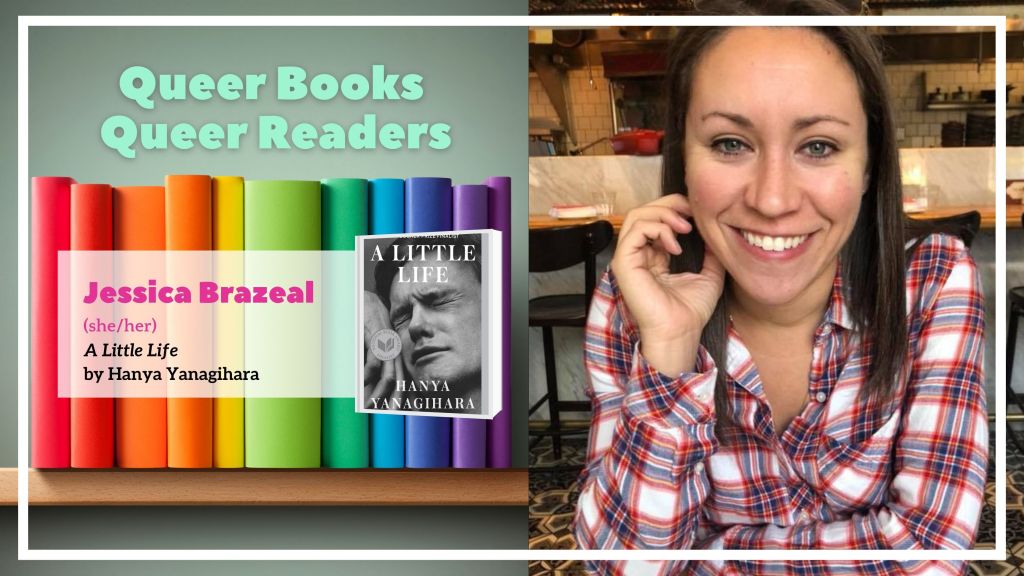
Hello! My name is Jessica Brazeal (she/her) and I am a therapist by day, reader by night hailing from Dallas, Texas. I work with sex trafficking survivors at an organization called New Friends New Life where I oversee all of our program services. I have been married to my wife, the love of my life, Kelly, for almost 4 years. I love to read, always have, and also love so many bookish things as a part of the hobby of reading: reading challenge spreadsheets, my Goodreads account, organizing and reorganizing my library shelves, I could go on. You can find me on Goodreads for sure as well as on Instagram.
What queer book have you chosen to share with our readers today?
This is actually my very favorite book of all time. Jude breaks my heart into a million tiny little pieces. I love him so much that one of our dogs is named after him. I attached a picture of our pup too. For me, this book spoke to me at the very correct time and place. I was falling in love with my best friend at the time that I read this in much the same way that happens for two of the characters and it gave me an externalized example of just how beautiful our love was and also how deeply my love for her went. There were areas of my life where I was not experiencing a great deal of support for our relationship, so this book was a healing and validating experience for me. It is 750 pages and I read it in 5 days. Just couldn’t put it down.
Jude, named after one of the main characters of A Little Life.
How would you describe yourself as a reader?
I would describe myself as a voracious and varied reader. I read a LOT and I read lots of different kinds of things. I usually always have a novel, non-fiction audiobook and a book for work going all at the same time. I am also a reader that is highly driven by reading challenges, so this keeps the momentum moving forward. I am currently doing the 52 Books in 52 Weeks Challenge and the PopSugar Reading Challenge.
As a queer person, have books helped you explore or express your queer identity?
Absolutely. I think as a queer person living in a largely conservative place and having a background in a conservative faith, reading and books have been such sources of comfort, support, validation, escape and celebration. I really love seeing more and more queer characters gracing the page, especially in YA literature. Let’s just create visibility and validation right from the start!
Other than reading, are there any queer nerdy recommendations that you would like to leave with our readers?
Well, if you haven’t watched the new season of Queer Eye, they came to Austin and it is fantastic.
Thank you, Jessica!
Check out our Queer Lil Library for more book recommendations and reviews!
What queer book have you chosen to share with our readers today?
Sunstone by Stjepan Sejic. Mature slice of life, graphic novel. Sunstone is a powerful and realistic depiction of queer and kink life seen through the lens of the two fem main characters. The story explores the discovery process and gritty real failures that many of us experienced as we explored our identities and communities. We follow the characters through their meeting and relationship, queer, and kinky journey.
Why is this book one of your favorites?
This book is one of my favorites because it feels very real. Too often queer media or kink media is hyper sexualized or romanticized in many unrealistic and unhealthy ways. Sunstone addressed many of the common pitfalls and struggles that folks face as they explore, fail, learn, and grow. These characters struggle to communicate and overcome in modern healthy depictions. This combination of exciting and realistic depictions of the mundane and sexy make it one of my favs.
How would you describe yourself as a reader?
I consider myself a chaotic reader. I am usually reading two or three books at one time. Switching between a high fantasy novel, an academic style journal or book, and stylized graphic novels. I love satire and works that poke holes in our society or draw humor out of the absurd. Terry Pratchet’s Discworld series is a prime example.
As a queer person, have books helped you explore or express your queer identity?
I struggled a lot to find books that spoke to my queer identity. I come with many hyper masc aspects to my life (military service, tradesman, Gold medal athlete) which often came into conflict with my love of romantic poetry, and deep love of expressive painting and photography. I always felt split, as though I couldn’t be both of these things (of course I could but try explaining 24 year old me that). I remember reading the Malus Darkblade series from the black library (very edgelordy I know) and there were multiple characters who were the mercenary and fantasy fighter types. But in the side chapters of the books were artists, and poets, and expressed their love for other characters of various gender expressions as well as their devotion to the main character Malus. Looking back I don’t think these expressions of love were romantic, but to young me they were. It made me think of how a person is not limited by the expectations of others and is free to craft their own forms of self. I have always appreciated strong soft characters. Not the gentle giants, but the big strong characters who choose love and peace in life.
Other than reading, are there any queer nerdy recommendations that you would like to leave with our readers?
D&D is one of the single best ways to explore self expression and test out aspects of the self. If you can find a safe queer friendly community you will soar through the act of communal improve.
Check out our Queer Lil Library for more book recommendations and reviews!
Mallory Woodard (she/her) is an ACPE Chaplain Resident in Memphis, TN, USA, where she now lives with her spouse and daughter. In her chaplaincy work she is interested in spirituality and how it can help LGBTQ persons and/or people of no faith create meaning and build resilience. While she has minimal presence on social media, you may catch the occasional like or retweet at @HubyDoobyDoo.
What queer book have you chosen to share with our readers today?
A book that has followed me since I read it this summer is The Thirty Names of Night by Zeyn Joukhadar. This novel follows a closeted Syrian American trans boy as he comes to terms with who he is in his family traditions and customs. The artful expressions of himself have been stifled by the ghost of his mother as he wrestles with what it means for his life. The story of this boy also parallels Laila Z, another Syrian American artist, in interesting ways. As these stories progress, he learns about the ways that Syrian queer communities exist and existed. It is this truth that allows him to find himself and to gain meaning of how he can live his life and use his art.
Why is this book one of your favorites?
Thirty Names of Night hooked me in from the first chapter to the last. Not only is the story worthwhile, but the writing is moving and pulls the reader into transcendent spaces. There are interesting spiritual concepts interwoven throughout the novel, like what it means to be an LGBTQ+ body in a world that works to erase us. This is the story of a trans boy finding and making meaning of his world and his body. There is loss and grief and community and hope and love. I mean I’m a Spiritual Care Provider – this is right up my alley.
“If an object can become sacred by placing it on a table and calling it an altar, then who is to say we cannot sanctify our own bodies? When I touched those eggs in the nest, I understood that to love something, even oneself, is its own terrifying act of faith.”
This book is an exploration of the ways that queer people, especially those whose skin color or ethnicity sets them even further apart from the normative culture, can live and love – themselves and the world – in embodied ways.
How would you describe yourself as a reader?
Because I just completed my Masters degree and am now in a residency program, most of my reading time is dedicated to learning. But when there is an education break, I want a new world and culture to get lost in! A good fantasy book full of magic and mayhem that I can binge read is the absolute best. When an author can build characters and cultures with precision and harmony, there really isn’t anything better. I also adore reading books that others have personally recommended to me. If someone I know loved it, then I already have a trust built with that author and story. When I’m looking for a new book to read, I will first choose anything not written by a white, able-bodied, heterosexual, cis male. Partly because I spent the majority of my life choosing those books and partly because I feel a depth that is lacking. Of course, there’s always the exception (LOTR?).
As a queer person, have books helped you explore or express your queer identity?
I grew up in a religious culture that attempted to deny me my existence. When I met my now spouse and began the larger coming out process, there were very few spaces where I could move in ways that felt safe. As a child and youth, books were also not valued in my communities. It wasn’t until I became an adult that my spouse gave me the freedom to enjoy the life that I wanted for myself. Books, specifically novels with stories that I can get lost in, have been a large part of this enjoyment. The first book that helped me explore who I am was The Song of Achilles by Madeline Miller. I remember sitting in the backyard on a swing on a Memphis Autumn day. As the sun dappled my skin, I sat there and wept as I turned the last pages of the book. I was moved in immeasurable ways by this story of queer love that existed in the world! It was just there for anyone to read! Unbelievable! Since then, I have been able to see the ways that queerness exists in the world through so many storytelling avenues. I am still deeply moved by the ability to access them, when I was taught growing up to question and devalue their (and my!) existence. Books can be safe in that they give me a place to wrestle and ruminate and explore by myself and in my own spirit. Books are also dangerous because they push the boundaries of my knowledge and experience. What joy and possibility!
Other than reading, are there any queer nerdy recommendations that you would like to leave with our readers?
I do not consider myself a gamer, mostly because I am not good at the gameplay aspect. I set it to easy and explore. And unfortunately, queer representation in gaming is few and far between! But I do love a good story, and open world RPG games can provide beautiful stories. Horizon Zero Dawn has been my absolute favorite. There is a ton of diversity throughout the game, and it’s an enjoyable play. It was my first love on my PS4, and I hope Horizon Forbidden West will be my next love on my PS5.
Check out our Queer Lil Library for more book recommendations and reviews!
I’m Halli, or Halli Starling (she/they). @hallistarling on Twitter, Instagram, and Tumblr, and my website is hallistarling.com.
What queer book have you chosen to share with our readers today?
I’m sharing just the most amazing queer romance, An Unsuitable Heir by K.J. Charles. It’s a historical queer romance about Pen, who is a trapeze artist with his sister Greta in Victoria England. They’re “The Flying Starlings” and semi-famous. When Mark, a private detective, is tasked with tracking down a missing heir to an earldom, the trail leads him to Pen. But there’s a string of mysterious murders on that trail as well, and as Pen and Mark fall for each other, they grapple with their attraction as well as the danger before them.
Why is this book one of your favorites?
I….this book. This book made me WEEP with how tender it was. Let’s talk about the rep first: Mark, the private detective, was born with one arm (the other ends before his elbow), and Pen is neither he or she (there wouldn’t have been a “they” consideration during that time). He’s just Pen, and unlike anyone else. Everything about Mark and Pen’s relationship is understanding and sweet, and even when the danger upends their lives and they get dumped into the middle of a murder mystery, Mark has Pen’s back no matter what. I have never, ever seen disability and identity tied together in this way, especially not in a historical romance. I’m forever grateful to the author for creating these two incredible characters and the cast around them (the whole trilogy is brilliant, but this book broke me). And the end? THE END?? With the gold-yellow robe and Mark and Pen being loving and soft? My heart SOARED.
How would you describe yourself as a reader?
I’m a picky but voracious reader! I’ve always been like that, since the time I was a little kid and books were an escape from an abusive home life. I let fantasy worlds take me far away from the reality I lived in and I’m eternally grateful to every author who let me peek inside their imaginations.
As a queer person, have books helped you explore or express your queer identity?
Whew, what a question! I think the key word for me is “safely”. I struggled with my understanding of bi or pansexuality when I was around 14/15, because I grew up in a really rural area that was mostly white and seemingly straight. Reading books about other people, other identities, other ethnicities and experiences? It was a gateway for me, an open door invitation to understand more about the world. I was terrified of my own attractions and accused of being a “lesbian” by my mother when I spent a lot of time with a platonic female friend (her house was safer than mine, so it’s not difficult arithmetic!). And that accusation hurt in a way I couldn’t put words to. But I could read and explore safely on my own through books.
Other than reading, are there any queer nerdy recommendations that you would like to leave with our readers?
Don’t forget your librarians! Even if you need to reach out to a library not in your area, they’re so helpful (and if they’re judgey, kick them to the curb!). There are so many queer librarians ready to help – including me!
Check out our Queer Lil Library for more book recommendations and reviews!
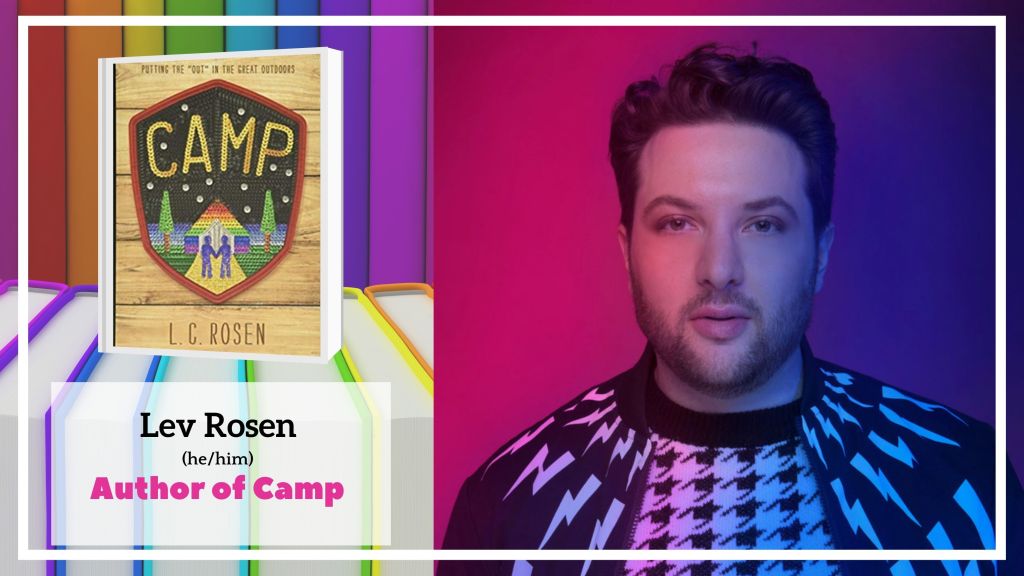
Lev Rosen writes books for people of all ages, most recentlyCamp, which was a best book of the year from Forbes, Elle, and The Today Show, amongst others and is a Lambda finalist and ALA Rainbow List Top Ten. His next book, Lavender House, will be released fall of 2022. He lives in NYC with his husband and a very small cat. You can find him online at LevACRosen.com and @LevACRosen
Your novel Camp takes place at a utopian summer camp for queer teens, Camp Outland. Was it inspired by any real life camps or experiences?
There are in fact several queer camps around the country, but Camp Outland wasn’t inspired by any of them in particular. Physically, though, it’s based on the Jewish summer camp I went to as a kid and worked as a teen for several years – though that was a very different experience. But I used that camp as a good blueprint for where to put activities, cabins, and secret spots.
One of the central themes of the book is learning how to balance your own personality with allowing growth based on the preferences of others. Why do you think this is an important idea for readers, especially teen readers, to consider?
I’m not sure I’d phrase it that way – “allowing growth based on the preferences of others” – I think that implies we can grow trying to be someone else for someone else, and while that might be what happens at first, I think Randy’s growth comes from himself in the end, from discovering that this persona he’s created actually has a lot of him in it already, parts of himself he didn’t know about or get to try on, not that he’s growing into someone else for Hudson. What’s important about trying on new identities, though – whether inspired by an ill-conceived romantic plot or just a desire to change – is that a lot of queer kids don’t get that chance. The moment you come out, you’re often labeled the queer kid, and no matter what you do, your actions, attitude and choices are thought of as being an extension of that. The only way to get out of that is to not be thought of as “just” the queer kid – one way to do that is by surrounding yourself with other queer people, who won’t view your sexuality as the central part of your personality. But the only other way to fix that is by reminding straight people that queer kids are entitled to just as much identity experimentation as straight ones, and to let them go through that without making it about their queerness.
In Camp, just about every character is a queer person. This is quite a change from the days in which we were lucky to get one gay side character in a story. Why do you think it’s important to write books that are entirely centered on queer teens and adults?
Well, I think there are actually a lot of queer YA books coming out these days that have more than just a few queer characters, but the real reason I wrote a mostly queer cast is because I just don’t care about straight people. Their opinions on my sexuality, on queer teens, on what books are appropriate for queer teens – I do not care. We’ve had centuries of books with entirely straight casts. Time for some with queer casts. I mean, it’s only fair we have just as many books with all queer characters as we do book with all straight characters. And if people disagree with that, it’s good to ask why.
Camp Outland is a safe space for queer people, but it’s removed from daily life by nature of being a summer camp. What are some practical ways we can create safe spaces for ourselves and for other queer people in our daily lives?
I mean if you’re straight, the best thing you can do to ensure a safe space for queer people is to stay out of it. That’s my biggest piece of advice. The other thing I think we as queer people should do is find each other and remember that we’re a family. We might hate other queer people, or love them, or find them annoying, but in the end, these folks are part of your community, and you have to welcome them in at least somewhat. That’s not to say you should remove yourself from the straight world entirely (I mean, if you can, more power to you). That’s nigh impossible, sadly. But take space for yourself where you don’t have to perform for straight people. Where there’s no concern about being too gay about being not the stereotype people expect from you. And straight people, like I said, stay out.
You have a new book coming out in fall 2022. What can you tell us about Lavender House?
Lavender House is an adult book, but it also features an almost entirely queer cast – in the 1950s. It’s a detective story, very Knives Out, in which a San Francisco police detective, having been caught on a raid on a queer club, is fired from the force. He thinks his life is over, but is approached by a woman who asks him to investigate the murder of his wife. She takes him to a manor outside the city where there’s a wealthy family united around a lavender marriage (a marriage between a gay man and a lesbian which is just for appearances). There’s been a murder, there’s plenty of queer suspects, and plenty of fun. It’s a bit Chandler, a bit Christie, and very gay. The only thing I will say, and I hope this is obvious anyway, is it’s not a big happy lovefest like Camp. This is about a queer guy in the 50s, it’s not a pretty story, and the family is bickering and infighting. But I wanted to show the ways queer people existed before Stonewall and had their communities and families. The best part is it’s the first in a series; the second is scheduled for fall 2023, and will follow the same detective investigating more queer mysteries. When your identity is a crime, you can’t go to the police when a crime is committed. Queer fiction and crime fiction go hand in hand, and I’m so excited to get these books out there.
Are there any other queer books (or other media) that you would like to recommend to our readers?
SO MANY. One book that’s coming out soon and is getting a lot of Camp comparisons is Robby Couch’s Blaine For the Win, which is like a gay YA legally blonde where a queer kid runs for class president to prove to his ex he’s not a ditz, essentially. I’m also so excited for Dahlia Adler’s Home Field Advantage – a cheerleader and the first female football player at high school fall for each other. I’ve read this one and it’s not just an amazing sweet romance, it’s also a real exploration of the ways queer people find each other in homophobic environments and support each other. I’m also excited for Adib Khorram’s Kiss and Tell, about a queer boybander, and how his role as a queer celebrity involves navigating who he really is vs. the fetishized and sanitized version of queerness his label wants him to be. So I’d recommend pre-ordering all of those. There are many many amazing looking queer books forthcoming, though. Those are just off the top of my head.
For more information on Lev Rosen and his work, please visit his website.
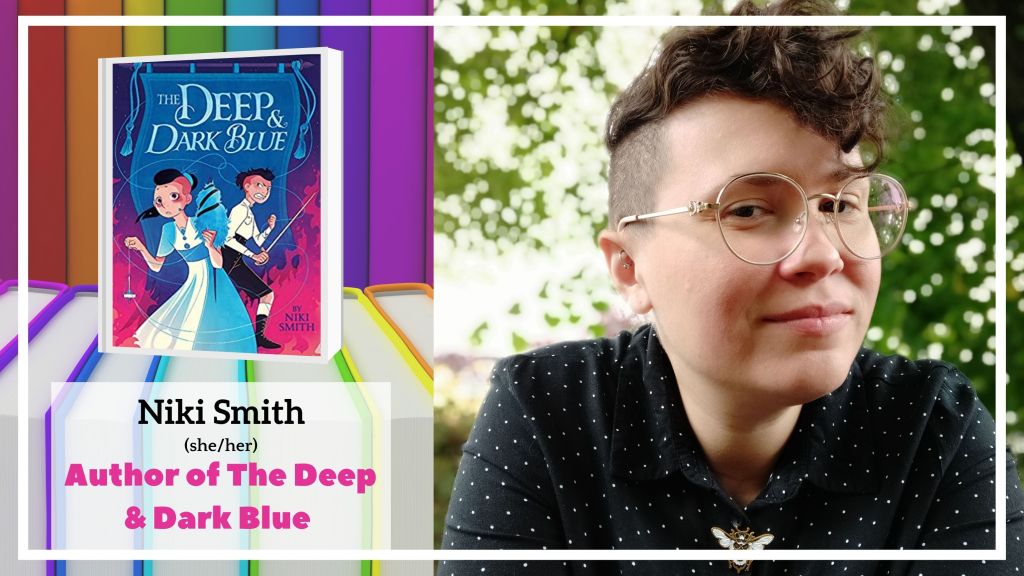
Niki Smith (she/her) is the author of The Deep and Dark Blue, a beautiful middle grade graphic novel with a trans girl protagonist. Please enjoy this interview with Niki Smith:
As the author of graphic novels, which comes first? Do your stories originate with a picture, words, or some combination of both?
My books always start with a story hook I want to explore, but visuals play a big role in my research! I don’t start sketching characters or designs until much further down the line, but I make folders full of imagery I want to include. For The Deep & Dark Blue, those folders were full of natural dye pools, medieval tapestries of family trees, and depictions of spindles in mythology and fairy tales.
The Deep & Dark Blue is set in a fantastically creative fantasy world; I particularly loved the women who can cast magic by spinning. Where did your inspiration for the world and the story come from?
I grew up reading and loving so many fantasy stories that played with gender– girls who disguised themselves to live out their dreams of being knights or pirates or soldiers. I loved them, but I never encountered anything that was the inverse; being a girl was always boring and full of tedious needlework. I wanted to celebrate that instead, to write a world Grayce would long to be a part of! Spindles have been a part of so many myths throughout history, from Sleeping Beauty to the Three Fates and their thread of life. The women of the Communion of Blue spin magic thread with wool dyed a deep, mysterious blue, and can control the strings of the world around them.
It was incredibly satisfying to see Grayce’s gender validated not only by her family, but magically by the family tree. Why do you think that was important to include?
Over the course of the book, Grayce finds a place she belongs, but I didn’t want the home she’d left behind to be a source of painful memories of her dead name. The family tree is a tapestry woven from the same magic threads that Grayce learns to spin in the Communion of Blue– it’s a living tapestry, documenting births, deaths and the line of inheritance. It only made sense to have it reflect her new name once she was ready to share it!
What do you hope your readers will take away from your books?
That queer kids can have adventures too! That a little trans girl can learn to weave magic and save the day. 🙂
You have a new book coming out November 23rd. What can you tell us about The Golden Hour?
I do! The Golden Hour is very different book– it’s about a boy struggling with PTSD and anxiety after witnessing gun violence. Manuel keeps his struggles to himself, using his phone and photography to find anchors and keep himself grounded during panic attacks, but life is lonely and hard until he’s teamed up with his classmates, Sebastian and Caysha, for a group project. Sebastian lives on a grass-fed cattle farm outside town, and Manuel finds solace in the open fields and the antics of the newborn calf Sebastian is hand-raising. Manuel helps his new friends get ready for the local county fair, and he learns to open up and find the support he needs from the boy who’s always there for him.
I didn’t want to tell a story about violence. The Golden Hour is about what comes after: the trauma, the panic attacks and the nightmares. But it’s also about slowly healing, Kansas wheat fields, and a sweet first crush on a gentle boy!
In addition to all of your amazing work, do you have any queer books or media that you would like to recommend to our readers?
Absolutely! If you love graphic novels as much as I do, you should check out Snapdragon by Kat Leyh, Laura Dean Keeps Breaking up with Me by Rosemary Valero-O’Connell and Mariko Tamaki, and The Tea Dragon Society series by Kay O’Neill!
For more information on Niki Smith and her work, please visit her website.















 Roar Cat Reads