Tag: Meet the Author

  • Meet the Author: Lev Rosen

    Meet the Author: Lev Rosen

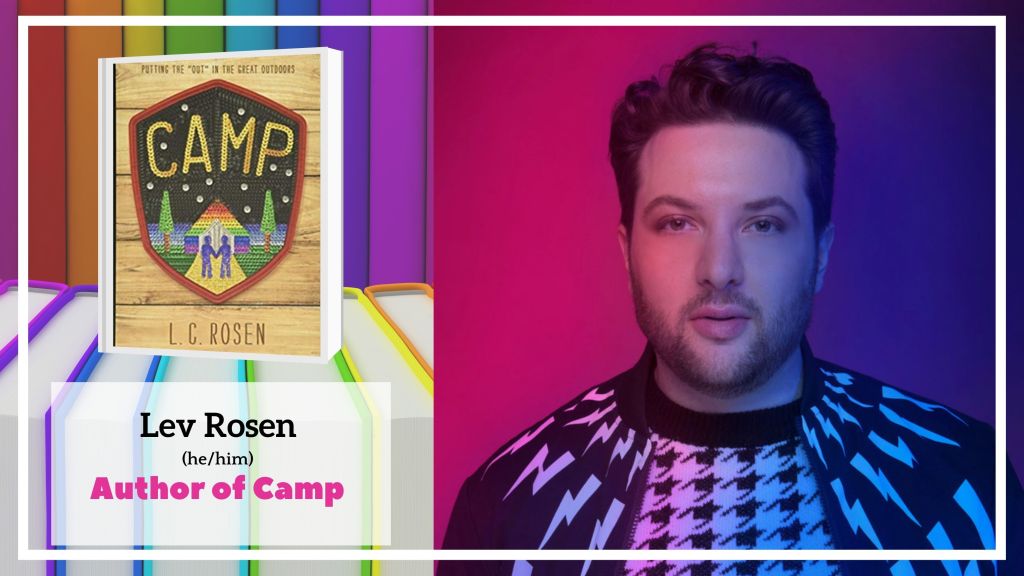
    Lev Rosen writes books for people of all ages, most recently Camp, which was a best book of the year from Forbes, Elle, and The Today Show, amongst others and is a Lambda finalist and ALA Rainbow List Top Ten. His next book, Lavender House, will be released fall of 2022. He lives in NYC with his husband and a very small cat.  You can find him online at LevACRosen.com and @LevACRosen

    Your novel Camp takes place at a utopian summer camp for queer teens, Camp Outland.  Was it inspired by any real life camps or experiences?

    There are in fact several queer camps around the country, but Camp Outland wasn’t inspired by any of them in particular. Physically, though, it’s based on the Jewish summer camp I went to as a kid and worked as a teen for several years – though that was a very different experience. But I used that camp as a good blueprint for where to put activities, cabins, and secret spots.

    One of the central themes of the book is learning how to balance your own personality with allowing growth based on the preferences of others.  Why do you think this is an important idea for readers, especially teen readers, to consider?

    I’m not sure I’d phrase it that way – “allowing growth based on the preferences of others” – I think that implies we can grow trying to be someone else for someone else, and while that might be what happens at first, I think Randy’s growth comes from himself in the end, from discovering that this persona he’s created actually has a lot of him in it already, parts of himself he didn’t know about or get to try on, not that he’s growing into someone else for Hudson. What’s important about trying on new identities, though – whether inspired by an ill-conceived romantic plot or just a desire to change – is that a lot of queer kids don’t get that chance. The moment you come out, you’re often labeled the queer kid, and no matter what you do, your actions, attitude and choices are thought of as being an extension of that. The only way to get out of that is to not be thought of as “just” the queer kid – one way to do that is by surrounding yourself with other queer people, who won’t view your sexuality as the central part of your personality. But the only other way to fix that is by reminding straight people that queer kids are entitled to just as much identity experimentation as straight ones, and to let them go through that without making it about their queerness. 

    In Camp, just about every character is a queer person.  This is quite a change from the days in which we were lucky to get one gay side character in a story.  Why do you think it’s important to write books that are entirely centered on queer teens and adults?

    Well, I think there are actually a lot of queer YA books coming out these days that have more than just a few queer characters, but the real reason I wrote a mostly queer cast is because I just don’t care about straight people. Their opinions on my sexuality, on queer teens, on what books are appropriate for queer teens – I do not care. We’ve had centuries of books with entirely straight casts. Time for some with queer casts. I mean, it’s only fair we have just as many books with all queer characters as we do book with all straight characters. And if people disagree with that, it’s good to ask why. 

    Camp Outland is a safe space for queer people, but it’s removed from daily life by nature of being a summer camp.  What are some practical ways we can create safe spaces for ourselves and for other queer people in our daily lives?

    I mean if you’re straight, the best thing you can do to ensure a safe space for queer people is to stay out of it. That’s my biggest piece of advice. The other thing I think we as queer people should do is find each other and remember that we’re a family. We might hate other queer people, or love them, or find them annoying, but in the end, these folks are part of your community, and you have to welcome them in at least somewhat. That’s not to say you should remove yourself from the straight world entirely (I mean, if you can, more power to you). That’s nigh impossible, sadly. But take space for yourself where you don’t have to perform for straight people. Where there’s no concern about being too gay about being not the stereotype people expect from you. And straight people, like I said, stay out. 

    You have a new book coming out in fall 2022.  What can you tell us about Lavender House?

    Lavender House is an adult book, but it also features an almost entirely queer cast – in the 1950s. It’s a detective story, very Knives Out, in which a San Francisco police detective, having been caught on a raid on a queer club, is fired from the force. He thinks his life is over, but is approached by a woman who asks him to investigate the murder of his wife. She takes him to a manor outside the city where there’s a wealthy family united around a lavender marriage (a marriage between a gay man and a lesbian which is just for appearances). There’s been a murder, there’s plenty of queer suspects, and plenty of fun. It’s a bit Chandler, a bit Christie, and very gay. The only thing I will say, and I hope this is obvious anyway, is it’s not a big happy lovefest like Camp. This is about a queer guy in the 50s, it’s not a pretty story, and the family is bickering and infighting. But I wanted to show the ways queer people existed before Stonewall and had their communities and families. The best part is it’s the first in a series; the second is scheduled for fall 2023, and will follow the same detective investigating more queer mysteries. When your identity is a crime, you can’t go to the police when a crime is committed. Queer fiction and crime fiction go hand in hand, and I’m so excited to get these books out there. 

    Are there any other queer books (or other media) that you would like to recommend to our readers?

    SO MANY. One book that’s coming out soon and is getting a lot of Camp comparisons is Robby Couch’s Blaine For the Win, which is like a gay YA legally blonde where a queer kid runs for class president to prove to his ex he’s not a ditz, essentially. I’m also so excited for Dahlia Adler’s Home Field Advantage – a cheerleader and the first female football player at high school fall for each other. I’ve read this one and it’s not just an amazing sweet romance, it’s also a real exploration of the ways queer people find each other in homophobic environments and support each other. I’m also excited for Adib Khorram’s Kiss and Tell, about a queer boybander, and how his role as a queer celebrity involves navigating who he really is vs. the fetishized and sanitized version of queerness his label wants him to be. So I’d recommend pre-ordering all of those. There are many many amazing looking queer books forthcoming, though. Those are just off the top of my head. 
    For more information on Lev Rosen and his work, please visit his website.


  • Meet the Author: Niki Smith

    Meet the Author: Niki Smith

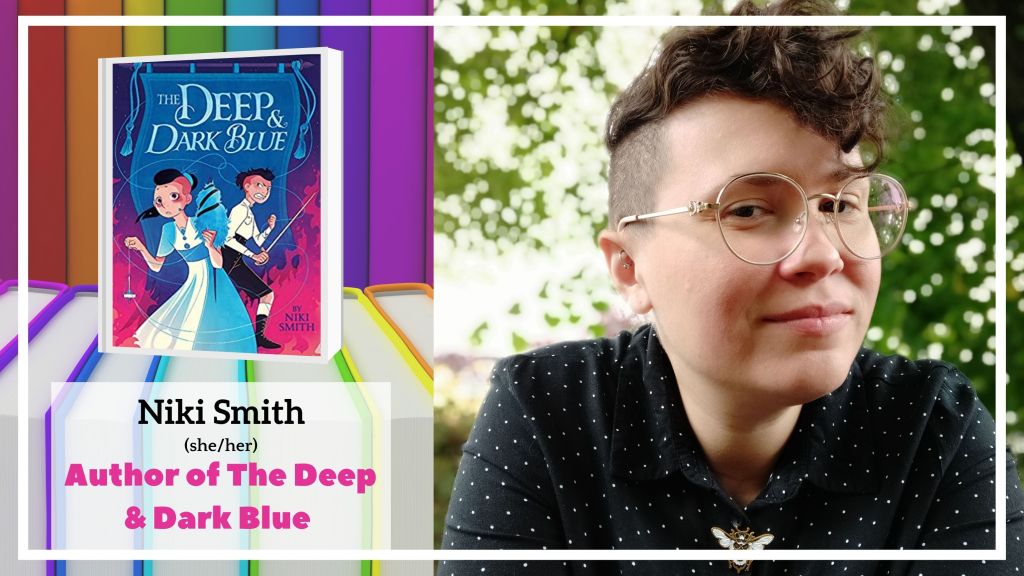
    Niki Smith (she/her) is the author of The Deep and Dark Blue, a beautiful middle grade graphic novel with a trans girl protagonist. Please enjoy this interview with Niki Smith:

    [Twitter | Instagram]

    As the author of graphic novels, which comes first?  Do your stories originate with a picture, words, or some combination of both?

    My books always start with a story hook I want to explore, but visuals play a big role in my research! I don’t start sketching characters or designs until much further down the line, but I make folders full of imagery I want to include. For The Deep & Dark Blue, those folders were full of natural dye pools, medieval tapestries of family trees, and depictions of spindles in mythology and fairy tales.

    The Deep & Dark Blue is set in a fantastically creative fantasy world; I particularly loved the women who can cast magic by spinning.  Where did your inspiration for the world and the story come from?

    I grew up reading and loving so many fantasy stories that played with gender– girls who disguised themselves to live out their dreams of being knights or pirates or soldiers. I loved them, but I never encountered anything that was the inverse; being a girl was always boring and full of tedious needlework. I wanted to celebrate that instead, to write a world Grayce would long to be a part of! Spindles have been a part of so many myths throughout history, from Sleeping Beauty to the Three Fates and their thread of life. The women of the Communion of Blue spin magic thread with wool dyed a deep, mysterious blue, and can control the strings of the world around them.

    It was incredibly satisfying to see Grayce’s gender validated not only by her family, but magically by the family tree.  Why do you think that was important to include?

    Over the course of the book, Grayce finds a place she belongs, but I didn’t want the home she’d left behind to be a source of painful memories of her dead name. The family tree is a tapestry woven from the same magic threads that Grayce learns to spin in the Communion of Blue– it’s a living tapestry, documenting births, deaths and the line of inheritance. It only made sense to have it reflect her new name once she was ready to share it!

    What do you hope your readers will take away from your books?

    That queer kids can have adventures too! That a little trans girl can learn to weave magic and save the day. 🙂

    You have a new book coming out November 23rd.  What can you tell us about The Golden Hour?

    I do! The Golden Hour is very different book– it’s about a boy struggling with PTSD and anxiety after witnessing gun violence. Manuel keeps his struggles to himself, using his phone and photography to find anchors and keep himself grounded during panic attacks, but life is lonely and hard until he’s teamed up with his classmates, Sebastian and Caysha, for a group project. Sebastian lives on a grass-fed cattle farm outside town, and Manuel finds solace in the open fields and the antics of the newborn calf Sebastian is hand-raising. Manuel helps his new friends get ready for the local county fair, and he learns to open up and find the support he needs from the boy who’s always there for him.

    I didn’t want to tell a story about violence. The Golden Hour is about what comes after: the trauma, the panic attacks and the nightmares. But it’s also about slowly healing, Kansas wheat fields, and a sweet first crush on a gentle boy! 

    In addition to all of your amazing work, do you have any queer books or media that you would like to recommend to our readers?

    Absolutely! If you love graphic novels as much as I do, you should check out Snapdragon by Kat Leyh, Laura Dean Keeps Breaking up with Me by Rosemary Valero-O’Connell and Mariko Tamaki, and The Tea Dragon Society series by Kay O’Neill!


    For more information on Niki Smith and her work, please visit her website.

  • Meet the Author: Mira Ong Chua

    Meet the Author: Mira Ong Chua

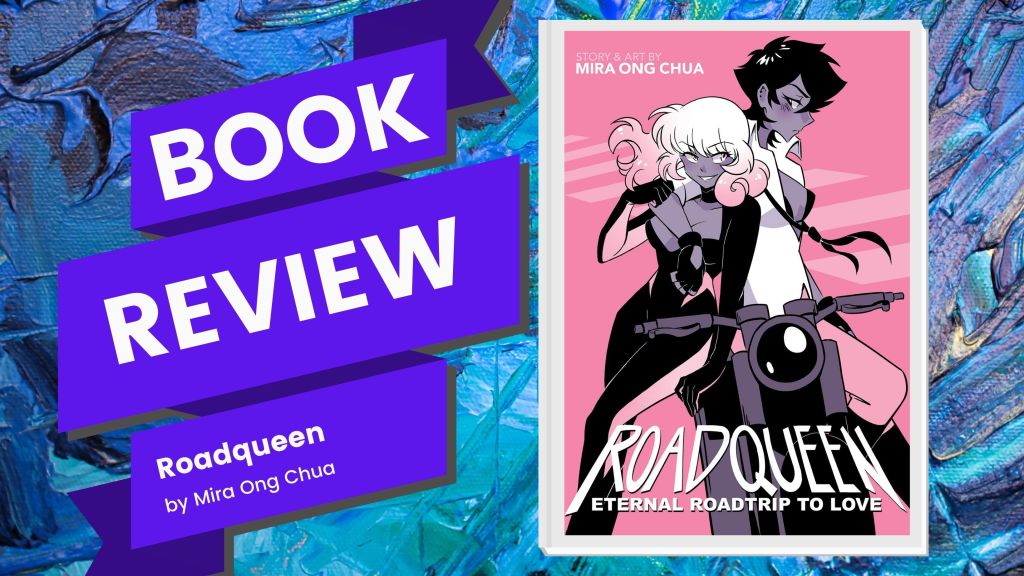
    I was thrilled to ask Mira Ong Chua (they/them) some questions about ROADQUEEN: Eternal Roadtrip to Love, a lesbian fake dating graphic novel that had me laughing out loud. Please enjoy this interview with Mira Ong Chua (Twitter Instagram):

    Roadqueen: Eternal Roadtrip to Love takes place in a world in which queer ladies go to school on a mountain via motorbike; this amazing creation is indicative of the story as a whole.  It’s every lesbian fever dream I didn’t know I had put to page!  How did you make this absolutely perfect thing? 

    When I embark on a new personal project I try to set a challenge for myself in some way, like working within a new format or genre. For ROADQUEEN, it was writing a story where I’d be forced to draw motorcycles. Everything else was based on that premise.

    The story is centered around the fake dating trope – one of my favorites!  Vega says that she wants to see if Leo can be a decent lesbian.  What, in your opinion, makes a lesbian decent?

    I don’t want anyone to worry about that.

    Leo’s long-suffering friends were very relatable, as was Leo’s desperate (and often failed) attempts to do right by Vega.  You balance a super fun light-hearted romp with very realistic character work. How did you develop this skill?

    Practice, probably. I was fortunate to have a day job at the time where one of my responsibilities was writing comedy scripts under tight deadlines. I’d often look back and think “Okay, well, I didn’t like how this part came out, so next time I’ll try this instead…” Once you begin building a body of work, you start understanding the things you’re drawn to. 

    I can’t imagine this story as a heteronormative romance.  What do you think are some hallmarks of queer/lesbian love stories?

    Rather than looking for hallmarks, I’d like to see queer love stories expand upon every single style and genre and niche imaginable.

    What do you hope your readers take away from the story?

    I hope readers have fun. And if they’re inspired to go make something of their own, too, that would be great.

    Will we ever get more Leo and Vega, or another story set in this world? 

    Those characters started it all for me, so in a way I feel like they’re in every story I write. As for more stories set in their world…who knows!

    I see that you have a new book out (I’m going to be ordering that immediately!) called Goodbye, Battle Princess Peony.  Can you tell us a little about it and where people can buy it?

    Goodbye, Battle Princess Peony is a gothic fairytale romance about an otherworldly princess falling into the hands of the villain who has always tormented her. It was funded through Kickstarter earlier this year, and is now available exclusively through my online store. And on October 1 I am launching my next book project: a queer 18+ romcom called Vampire Blood Drive, based on a short comic I did of the same name.


    To buy Mira Ong Chua’s fabulous books, please visit her online store.

  • Meet the Author: Nicholas Eames

    Meet the Author: Nicholas Eames

    Nicholas Eames (he/him) is the author of Kings of the Wyld and Bloody Rose, the first two books in the hilarious and heartfelt trilogy The Band. I’m grateful that he took the time to speak with me about the musical influences on his work, how he decided to write a book with a queer female protagonist, and what we can expect from the final book in his trilogy. Please enjoy this interview with Nicholas Eames:

    [Twitter | Instagram]

    The world of Kings of the Wyld and Bloody Rose feel very inspired by D&D and RPGs.  What is it about those systems and stories that inspired to you write these books?

    The main premise of the series is inspired by rock bands, but there are a lot of similarities between bands and RPG groups, namely, getting together with friends to have a good time.  I hope the books capture the spirit of roleplaying with the camaraderie and friendship that can form while playing RPGs with a lot of laughter and drinks.  

    I’ve played D&D since my first year of high school. I skipped school for the very first time to play D&D and had this epic odyssey getting home, jumping ditches and dodging cops.  It was pretty memorable.  Right off the bat, I immediately knew I wanted to tell the stories myself.  I’ve been DMing ever since.  

    What motivated you to write the second book in your series with a queer woman as the protagonist?

    It wasn’t something I set out to do when I originally wrote it.  The main character was a boy named Tom, but halfway into it, I wasn’t liking the way his relationship with the band and Rose in particular was playing out. It was all too cliché.  I talked to my editor, and even though it was pretty late in the writing process, I made the main character a girl instead.  It wasn’t as easy as changing “he”s to “she”s; every conversation became different.  I had to go back to the beginning and start over.  It made a night and day difference to the story; Tam’s relationship with Rose felt right, and her relationship with Cura developed.  The character just fit better.

    When my editor and I were talking about making this change, we knew there would be some pushback.  Kings of the Wyld was a book about older white cis dudes, and that appeals to a certain kind of reader who is going to expect more of the same.  We knew assholes would gripe about it, and we checked in with each other:  Do you care?  No – okay, let’s do it.  Luckily, people responded pretty well.  And ultimately, if you get one teenage girl who writes and says she sees herself in the character, it’s worth it.

    I didn’t find it difficult to write from the perspective of a queer woman, but you obviously want to be as careful as you can and not to fall into any stereotypes.  With all of my characters, their sexuality doesn’t define them.  It’s something that affects them, but it’s not everything.  A lot of fantasy will make a big deal out of a gay character; I wanted to make it a fact of life.

    I really enjoyed seeing the story through Tam’s perspective, and I would love to know why you chose to make her the protagonist rather than the titular Rose?

    I was using famous rock and roll tropes, and Bloody Rose is Almost Famous with a rock journalist on the road with the band.  When a band is full of self-destructive assholes, you can’t see that as much when you’re in their shoes.  You have to see that from someone else’s perspective.  Axl Rose telling his story would just be, “I’m amazing.”  And yes, Axl Rose is the inspiration for Rose’s name.

    Your female characters are all very diverse and complex, and Cura became one of my favorite characters.  The reveal that she has been weaponizing and reliving her trauma through her tattooed summons was really powerful, as was the way she eventually started healing.  What inspired you to tell this particular story?

    Kings of the Wyld was about the music of the 70s, and Bloody Rose is about 80s music.  The characters in the second book had to be larger than life, with the equivalent of the facepaint and big hair in the 80s.  The tattoos were originally not about trauma.  She had butterfly wings tattooed that would come out, and fireballs tattooed on her arm.  I hadn’t gotten through the first scene with her before realizing it sucked.  I knew it had to be something more, and with the theme of the self-destructiveness and self-harm that happened with 80s rock, I wanted her story to be about gaining mastery over something that haunts you. 

    One of my favorite themes is “hurt people hurt people” and the cycle of violence.  We see this on both a personal and systemic level in your books.  Why did you choose to focus your story on this theme?

    I wrote Kings of the Wyld as a standalone, but my publisher asked if it could be a series and obviously I said yes.  I knew I was not going to keep the same main characters, which turned into the idea that the series would move through eras of music and involve different generations.  You can read them in any order, but the events in one affect what happens in the next.  Within each book, the characters carry something forward from the past – like resentment of or love from parents – and consequences are always cascading into the future.  That cycle is the point of the whole series. 

    What can you tell readers about the third book in the series?

    It’s called Outlaw Empire, and it’s inspired by 90s music.  If I’m picky, it’s about early 90s anti-establishment music: grunge, hip hop, Rage Against the Machine.  They were all angry about things.  I’m going to keep the book funny and light, relatively, but it will definitely be defined by its music.  

    There will be some carry over characters.  It’s the final book of the series, so anyone who’s alive might be in there at some point.  If anyone had kids, you can almost guarantee they’re in there.  In fact, you’ve already met three of the four band members.  One of the characters is a kobold named Shortknife; he’s mentioned briefly in a Kings of the Wyld scene.  By the time I was writing the third book, I knew the group would be made up of both men and monsters, and he was a perfect character to put in.  He’s got a really cool power, and he’s that one character who gets to say the fun and ludicrous things (in the first book, that was Moog, then Roderick in Bloody Rose).

    It must be a very different experience to write a book on your own in contrast to writing the third book of a series with an already established audience.  How has that experience been for you?

    Before I wrote Kings of the Wyld, I spent ten years writing a giant grimdark fantasy book.  I was racking up rejection letters, and I decided I wanted to write something that was the exact opposite.  I didn’t want to get lost in worldbuilding, and I let the story be funny and goofy.  Kings of the Wyld was a one in a million idea, and I’m so lucky that I thought of it, and that no one else had thought of it first.  Bloody Rose is good, but it was more challenging to write.

    I was hellbent on finishing Bloody Rose quickly while Kings of the Wyld came out.  I had a rough time dealing with expectations, especially in my own head.  Honestly, I had a relatively miserable time writing most of it.  There came a point at the end of it when I had also started writing the third book that I just snapped.  I knew I couldn’t keep stressing out about it.  I would lay in bed and get out a calculator to work out how far behind on my word count I was, and how many days were left until the deadline.  But I came to the realization that nothing is worth your mental health, so I took a big step back.  Now I’m working toward finding a balance.

    Is there anything else readers should know about your books?

    I have curated playlists on Spotify (Kings of the Wyld | Bloody Rose), with songs that are a chapter by chapter breakdown for Kings of the Wyld on my website.  They’re not imperative, but they add a lot to the books.  Certain songs were so important that they unravelled scenes I was stuck on, and you can listen to them and read the chapter beat by beat. 

    Queen’s song “Too Much Love Will Kill You” is Freecloud’s song, and Meatloaf’s “For Crying Out Loud” is the final battle scene in Bloody Rose.  I listened to it 4 or 5 times on the way to work to plot out that scene, right down to a pause for the moment Tam releases her arrow.  

    What queer and/or nerdy things are you enjoying at the moment?

    • Gideon the Ninth and Harrow the Ninth.  Harrow in particular is bewildering as hell, but worth the read for the writing itself – it’s phenomenal.  Both books remind you that you can tell a fantasy story with a contemporary voice.  
    • The Unspoken Name.  My god, I love it.  It’s great, and the last sentence is absolutely beautiful.

    For more information on Nicholas Eames and his work, please visit his website.

  • Meet the Author: Sarah Blake

    Meet the Author: Sarah Blake

    It was my absolute pleasure to interview Sarah Blake (she/her) about Naamah. This retelling of the story of Noah from his bisexual wife’s perspective became a fast favorite of mine, and I can’t seem to stop including it in my “Best OfLists. Please enjoy this interview with Sarah Blake:

    What motivated you to retell the story of Noah? 

    In my poetry, I was rewriting the stories of women I’d been introduced to in my childhood. In these new stories about them, I wanted them to be women that I would have been drawn to. So many stories of women ended in heartache, sacrifice, punishment, and death. And the happy endings took place at marriage, which seemed a little early to me.

    What themes were you keen to explore and make your own?

    I wanted to explore hopelessness. That’s what drew me to Naamah. I felt hopeless in my life (in the face of gun violence and rising antisemitism), but her situation was hopeless to the extreme. She was stuck on the water with no end in sight, with every task at hand a difficult one, and with everyone she knew dead. I wanted to offer her things–gifts, respite, love, escape. 

    And I was drawn to the time period. We have so little evidence about that time, I could imagine it however I wanted. I could explore sexuality, gender, and marriage without any of the social constraints of today. In a book about God trying to get the world right, I could make something closer to the world I wanted.  

    Naamah is a bisexual woman whose sexuality is complicated but never apologized for.  Why was it important for you to create her this way?

    I thought this was important, yes, but I also thought it would be the truth! I didn’t feel like I was creating Naamah that way. Instead I felt like I was interrogating what a woman would be like in this time, given these circumstances. That she would be bisexual (or pansexual) seemed beyond question to me. If you strip back all of the terrible things we’re taught about what’s normal and what’s not, about what to have shame about, what to have guilt about, I think what’s left is people experiencing attraction all over the spectrum of sexuality. 

    You chose to represent Naamah’s experience, in part, through her loss of vision.  To me, that evokes so much of the hopelessness you described as a theme – the literal representation of not being able to see anything, let alone something better. What does Naamah’s inability to see the animals on the ark say about her way of coping with immense tragedy?

    I’ve always been fascinated with the ways our minds try to protect us–what we forget and what we remember–and how often our mind gets it wrong. Holding onto some terrible memory isn’t actually protecting us from future harm! When I thought about Naamah on the ark, after months had passed, with no end to the flood in sight, I imagined that her mind might try to protect her. And the first thing I thought it might do is strip her of her ability to see them, which, of course, puts her in more danger. 

    For Naamah, the unseen world (of angels, visions, and memories) becomes more real than the family and animals that are stuck on the boat with her.  Why did you focus so much of Naamah’s journey on her interactions with Sarai, with the Metatron, etc.?

    The children, still alive under the water, were a gift to Naamah, and to myself. It was hard to face all of the tragedy that the flood posed. Sarai, too, was a gift–a glimpse into the future, some small hope that all of Naamah’s work is not for nothing.

    From the start of the book, I knew Naamah would have to talk to God the way that Noah had talked to Him. And I knew that, according to ancient Jewish texts, this would be through the Metatron. (I also love Kevin Smith’s Dogma, and Alan Rickman’s portrayal of the Metatron, so I had to include him!) Building up her encounters with the Metatron allowed me and her to have that final conversation with God.

    I am also struck by how much Naamah lives in her body, in her physicality.  This is especially evident in her vibrant sex life.  These sorts of representations are few and far between, never mind the fact that this is a reimagining of a biblical story.  Did you have any pushback when you were creating or selling the book?

    This is so important to me, across all of my work. I love bodies, and my body, and I want everyone to love their body. And I especially want people to have the language and the comfort level that they need to talk about their body, be it to their partner(s) or to medical professionals. 

    Luckily, I didn’t have any pushback. There were many agents who only wanted to represent the book if I removed the sex or the cursing or the whathaveyou. So I waited until I found the right agent! And she knew instantly which editor would love this book and would stand behind every part of it that mattered to me. I was very lucky.

    What do you hope readers take away from Naamah?

    I hope at the end of the book there’s a sense of power and joy. That’s what I wanted for Naamah and for myself. 

    Your new book, Clean Air, comes out February 8, 2022.  What can you tell Roar Cat Reads readers about it? 

    I’m so excited about Clean Air. It’s about Izabel, her husband, Kaito, and their daughter, Cami. They live in a future where unfiltered air is unbreathable due to pollen levels. Their lives take place in dozens of airtight domes. At the very start of the book, someone begins slashing those domes, killing the families inside by exposing them to the air. Soon Izabel and her family get tangled up with the killer in a few unpredictable ways, and it’s a pretty wild ride!


    For more information on Sarah Blake and her work, please visit her website.