Tag: D&D

  • Adventure Queers: Meet Izzy Braumberger!

    Adventure Queers: Meet Izzy Braumberger!

    Izzy Braumberger (they/them) is an armchair historian and philosopher as well as an avid player of TTRPG games and a developing system designer.

    Izzy, you’ve been playing D&D for over 15 years, and during that time you’ve seen some of its limitations, like the way its mechanics and history create a colonialist focus on combat and looting.  What keeps you playing the game despite this, and what kind of changes would you like to see to the system?

    D&D is a very popular system with wide-spread appeal. I think that’s mostly because it has the crunchy mechanical stuff that people enjoy while also being loose enough to leave room for people to make it their own.

    I find D&D to be very transactional and video game-like. The default is a system model that rewards the story “go out, find a problem, kill the problem, loot the room.” This model makes it easy to track people’s success and determine when and how they level up, but it’s also limiting and celebrates a particular kind of playing. Even in parties that try to value equality, the distribution of wealth and power still tends to be dependent upon who killed the most enemies.

    I would like to see the system emphasize rewards based on nonviolent participation. I have seen other systems like Exalted create mechanics to track political and social relationships; it would be as if the bonds and relationships in D&D were put to mechanical use. Instead of always rewarding players with treasure, parties can be rewarded with allies and stronger relationships. This would create room for more kinds of stories and characters.

    In a previous conversation, you mentioned that you’re a history nerd.  Roleplaying games often take place in a liminal space between history and fantasy that is often defaults Eurocentric.  What historical facts would you like to see acknowledged in D&D campaigns?  What is your dream setting for a campaign?

    When I GM, I like to throw in historical facts that have no societal baggage. I don’t want to bring up real world struggles, consciously or unconsciously, but adding little known details to the adventure can make the world feel richer. For instance, let’s say your party is traveling by wagon pulled by a team of oxen. I would include the fact that the one on the right has a two syllable name and the one on the left has a one syllable name – that way the oxen know which one is being talked to.

    My dream campaign would be one that is so grounded in actual history that it seems alien to players. I would like to see a game set in pre-Enclosure England, when the structure of land use was centered on families, and there was no concept of “going to work” because you worked where you lived.

    D&D isn’t very accurate, really. The typical tavern/inn that parties go to would have looked very different historically! There weren’t rooms or subdivided spaces, because there was no way to heat everything. There also weren’t roaring fires, because fireplaces didn’t exist until much later than most people think. Privacy was not a thing until very recently. Even royal houses were just a line of rooms that people had to walk through; hallways weren’t common for most of history. Industrialization changed everything worldwide, so setting an adventure before then would be my preference.

    Roleplaying in D&D provides the opportunity to explore your identity in myriad ways.  For queer people, this can be a really liberating experience.  How have you been able to explore your identity through D&D?

    I have found that role playing games are a wonderful mirror to hold up so that you can figure out what sort of person you would be if you could be anyone. You get to be any kind of person you want and experience how it feels when people react to you in this different way. Self-exploration is expected in these spaces. You can be the manliest man who plays a 4’2″ elf with a high-pitched voice who flirts with guys. No one automatically assumes that’s what you’re into in real life – it’s play. And play is a valuable teaching space.

    For the longest time, I thought it was just play, and I didn’t really take to heart what I was experiencing. I knew I felt free, happy, and more myself, but I didn’t quite get what was going on. It took me time to piece together disparate behaviors and thoughts to figure out what made me feel happy and comfortable. Really, embracing my trans identity was about finding comfort. There were both disphoric and euphoric elements to finding out what I do and don’t like – all together it paints a picture to your route toward happiness. I asked myself a lot of questions: Can I live with this? What do I need to change or give up? What is the fluctuating baseline that I want to rest at?

    The valuable thing about role playing games is that you don’t have to wrestle with all of these variable judgments all the time. I don’t actually play non-binary characters very often. I lean into masculine characters because I don’t get to be that in real life. It’s an interplay of wish fulfillment and that mirror to see who you could be. I’ll be honest, I’ve used some DMs as therapists over the years – it’s always a bad idea, but we do it anyway!

    Self-exploration is a vulnerable process.  In your experience, what makes a D&D group safe to explore or live out your queerness?  

    When you play a roleplaying game with people, you enter a social contract to be cool with whoever your party members are. A good DM will stop people from imposing their will or view of your character on you. If someone says, “Why are you flirting with that girl? You said your character was gay,” a DM should guard and support nuance. Don’t let people police people’s expressions of sexuality or gender identity.

    I think it’s most important to show enthusiasm for people who are exploring new things. Show active positivity, ask questions with the desire to know more rather than judge. Focus on understanding people, not being disappointed or uninterested in what they’re doing.

    When DMing a game, it can sometimes be hard to fight the cisheteronormative culture in which we were raised and populate the world with diverse NPCs.  How do you prioritize representation of trans people in D&D?  What tips do you have to convey the complications of gender identity in role playing games?

    Exploring gender identity is an in depth, nuanced process, and this doesn’t translate to D&D very well if NPCs aren’t given the space or time to explore that nuance (and most of the time NPCs are one and done). When introducing characters, it’s easy to rely on shorthand descriptions to indicate trans people, and that usually means perpetuating potentially harmful stereotypes. The easiest thing to do is to make these NPCs central characters that are returned to throughout the campaign. You can have more meaningful representation when players are emotionally invested in characters and want to learn more about them. That’s when you can have those more nuanced conversations and experiences over multiple interactions.

    Introducing MtF or FtM characters into your campaign can be tricky. How do you alert characters to the NPC’s trans identity without some kind of gross skill check that amounts to “You can tell this character is trans”? In a campaign that I’m playing in, the DM took us into an NPC’s memories, where we saw her experiencing abuse as a child for being trans. It was such a smart way to reveal this fact about an NPC we all really cared about!

    I personally have no problem with straight cis GMs role playing trans characters, so long as they aren’t fetishizing anyone or perpetuating harmful stereotypes. At the stage we’re in culturally, visibility is really important, and it’s a great opportunity to practice they/them pronouns and get in the headspace of people who have had different experiences from you. Having diverse characters can also help communities surrounding property more inclusive.

    Are there any resources you recommend for players or GMs who want to work to create a safer, more inclusive gaming table?

    In general, I recommend you look into TTRPG horror games. Horror has a unique contract regarding the creation of a safe space at the table. You have to lay everything on the table beforehand – your fears, your expectations, your limits – so that you can create a safety system, and you’re expected to check in after the session to make sure people are okay. There is an overlap with the BDSM community, actually. Playing horror games helped me learn how to engage with other people more sensitively, which I think transfers to all kinds of games.

    Specifically, I want to recommend the podcast DMs of Vancouver. They intentionally interview diverse guests and value showcasing a variety of perspectives. [Note: Izzy was a guest on DMs of Vancouver. Check out their episode here!]

    Roar Cat Reads is a blog for queer nerdy content.  What is something queer and nerdy that you would like readers to know about?

    • League of Ultimate Questing – an amazing podcast with a pretty diverse cast of characters. They do a great job of normalizing inclusivity.
    • Chilling Adventures of Sabrina – the mechanics of the world support the gender identity of the character Theo in some really cool ways.
    • Philosophy Tube – the trans host of this YouTube channel has one of the best coming out videos I’ve seen.
    • Inn Between – another podcast with great representation AND one of the most interesting handlings of a body swap episode I’ve ever encountered! 
    Thank you for spending some time with us at Roar Cat Reads, Izzy! If anyone would like engage in more of their content, you can check out their episode on DMs of Vancouver. And stay posted! They’re in the early stages of an actual play project that we can’t wait to learn more about.

  • How to Find Source Material for D&D Adventures

    How to Find Source Material for D&D Adventures

    by Rachel

    If you want to DM a D&D adventure but don’t know where to start, I’m here to help! It can feel daunting, but the first step is to decide on the source of your material. In my experience, there are three common ways people get started: Published Materials, Creations from the Internet, and Homebrew Content. Keep reading to find out which ones have worked for me and why!

    Published Materials

    Examples: Lost Mine of Phandelver, Curse of Strahd, Tales from the Yawning Portal

    This is how I started DMing, and it gave me the foundation to run games of my own soon after. Published materials hand you fully formed adventures with all the resources you will need to run them. (Note: With the exception of the D&D Starter Set, published materials might assume that you have other books or resources available like the Player’s Handbook or the Monster Manual. However, this material is available online if you search for it, so you don’t need to buy them until you’ve DMed a few times and decided the books are worth the purchase.)

    The quality of published materials is reliably good, and because it is widely distributed, there is often a lot of supplementary material available online that can give you examples of how it plays. Before running Lost Mine of Phandelver, I listened to The Adventure Zone podcast that loosely covers the same material. It was very helpful to see how the game ran and how easy it was to add my own twist to the existing material.

    One of the biggest drawbacks to published material is that it requires you to read and absorb the adventure as is. While there is room for your own creativity, the plot is already laid out for you. When your players veer off to a location that you haven’t read about yet or don’t remember fully, there is often a moment of panic where you hope you don’t mess anything up that you can’t retcon later – published materials make it possible for the DM to feel like they have ‘made a mistake’.

    The most important thing you can do is find the right material that you want to run, like finding a good book. Yes, you could read (or run) anything, but finding the right book that draws you in and makes you excited to share with others will make running it more enjoyable for both you and your players. It’s also worth considering the fact that published materials can be expensive, so it’s worth doing a little research to choose the one that is right is for you.

    Speaking of expense – the price of published materials is a big drawback. When there is so much out there for free, why would you want to pay for it?

    Creations from the Internet

    Examples: Feudal Attraction, Into Wonderland

    People love making D&D adventures and many people make them available to others for a modest price or even free. DriveThruRPG offers a huge selection of adventures ranging from one or two-page dungeons to full on campaigns (and a bunch of supplementary material). Need a quick adventure last minute? Searching for ‘one page dungeon’ will bring up a ton of short, easily digestible adventures for your session that starts in an hour. There is so much content out there!

    The sheer volume of content is both the great and terrible thing about other people’s creations. There is so much to wade through, it’s hard to know what is going to work for you. Is it in a genre you like? Is it written in a way that is easy to understand? It can be difficult to search for what you want. Occasionally you will find a great adventure, and you can look for more by that author or more on that website, but there is no guarantee. You might end up reading through 3 or 4 or more different adventures before finding one that suits you.

    These adventures are usually not as polished as published materials. They might include made up monsters that are unbalanced, have plot holes your players will inevitably find or just don’t make sense to you. On the other hand, they might be great! I’m currently running Into Wonderland, a 240-page adventure set in the Feywild, and it is amazing. I found it on ‘pay what you want’ on DriveThruRPG after seeing it recommended in a blog post. If you’re willing to wade through a lot of subpar adventures, you will occasionally find a gem.

    Homebrew Content

    Do you want to avoid all that research and reading? Do you want the perfect adventure that’s exactly your style? Make it yourself! But be prepared to spend just as much time-if not more-in the process. 

    Lots of DMs make homebrew adventures (that’s where all those internet creations came from), and if they can do it, so can you. You don’t need to know every rule or think of every possible outcome to make your own adventure, but it will take time to mold your ideas into something comprehensible. Luckily, there is a lot of advice out there about how to make adventures yourself. Perhaps I will even get around to writing on the topic! The bottom line is you need to find it fun and enjoyable to write an adventure. You’ll be spending a lot of time on this project, so if you are not having fun making it, go ahead and try one of your first two options above.

    Conclusion

    I think there is a time and place for all of these methods to finding your D&D source material. In fact, you could mix and match. Perhaps you take an adventure you found on DriveThruRPG and add it as a side quest to your published campaign, or maybe you take that same found adventure and use it as a basis for your own creation. Drawing from different sources improves your DM skills as you expose yourself to new ideas and spark creative inspiration. Have fun!

  • 5 LGBTQ+ Book Characters I Want in My D&D Party

    5 LGBTQ+ Book Characters I Want in My D&D Party

    You’re walking down a forest road when you’re beset upon by goblins! Quick, grab your queer books – it’s time to choose your party!

    The first person I knew I wanted in my Queer D&D Party is Harrowhark Nonagesimus from The Locked Tomb series (Gideon the Ninth and Harrow the Ninth) by Tamsyn Muir. What can I say? I’m attracted to raw power, high intelligence, and low charisma. I would sort Harrow as a Chaotic Neutral Warlock – she doesn’t care about following the rules, and I cannot in good conscious claim her to be either good or evil. Instead, she is concerned about doing right by those she cares about (barely), and hang the rest. As for the Warlock bit, she’s clearly a magic user. I think the pact her parents made to kill 200 children to give her power aligns nicely with a warlock’s pack with an otherworldly being. And are you kidding me with her necromantic powers – who needs Turn Undead with Harrow around?

    Every necromancer needs a cavalier, and I wanted a physical fighter to balance her magic. The easy answer would be Gideon herself, but that felt like cheating! Instead, I went with Murderbot from The Murderbot Diaries by Martha Wells. Murderbot skews far more science fiction than most D&D campaigns, but I don’t care! I want them on my team, and I trust them to be able to adjust to a new setting with aplomb (and complaints). I think Murderbot would be a Neutral Good Fighter. They’re clearly not lawful because they hacked their governor module and lied about being a free agent. But they’re not really chaotic either; Murderbot just wants to keep its humans safe and watch its shows. And I think they would be a fighter because they’re not really anything else – I can’t see Murderbot as a Barbarian or a Ranger. MAYBE a Monk with its super speed Flurry of Blows, but still. I think fighter best sums up Murderbot’s skills.

    One giant problem with my first two choices is the fact that they are extremely anti-social. We need some charisma in this party! And who is more charismatic than a Bard? Enter Tam Hashford from Bloody Rose by Nicholas Eames. She’s new to adventuring, but eager to fit in and earn her keep. She’s used to being around hardened mercenaries, so I don’t think she would be too bothered by Harrow and Murderbot. She could do the talking (and raise a bit of money for the group with a song) when the stumble into a town and need a place to stay.

    There’s a lot of chaos in this group, so I think we need someone with a strong moral compass to guide our group. Since Murderbot is constantly getting a little bit exploded, I want to add Jane Hodgson from Alice Payne Arrives and Alice Payne Rides by Kate Heartfield to the group. Her 1789 scientific and mechanical skills seem like a good fit for a D&D setting, so I would cast her as a Lawful Good Artificer. Usually left behind by Alice, I think it’s time for Jane to have some of her own adventures. And we someone in this party to see the wounded

    To round everything off, I can’t resist adding Jam from Pet by Akwaeke Emezi. She’s got the heart of a Lawfully Good Paladin, determined to find and destroy monsters, be they literal or metaphorical. It doesn’t hurt that she has Pet, a creature who fills the role of something like the result of a “Find Steed” spell (Pet is an unusually intelligent and strong celestial being!) or the deity who inspires Jam in her monster hunting. Together they’re pretty unstoppable, and that’s exactly what I want in my D&D party.

    So that’s it! A pretty ridiculous group of queer characters, which is the recipe for a fun campaign.

    Who would you include in your D&D party of queer characters? Leave a comment with your characters!

  • We Fell in Love Through D&D

    We Fell in Love Through D&D

    When I (Tricia) first moved to Vancouver, I was 30 and interested in making friends through something that had always intrigued me: Dungeons & Dragons. I grew up in a conservative Christian circle that never really went hard on the Satanic Panic movement of the 80s and 90s, but why risk it, you know? Even when I was older and no longer scared of imagination games with friends summoning actual demons, I didn’t find myself with friends who wanted to play. But then I moved to a new city, and I was determined to create the social group that I had always dreamed of.

    I joined a Meetup group for nerdy ladies in Vancouver and wrote a post saying that I wanted to join a D&D group – was anyone else interested? Rachel was one of the first people to reply. We set up a time to meet in person (also with Anne, who still plays D&D with us – hi, Anne!) at the Stormcrow Tavern on Commercial, RIP. I won’t say that it was love at first sight, but looking back on this origin story, I’m struck by how we were already working together to get things done.

    In September 2019, our group of four nerdy ladies got together to play our first D&D session. Rachel DMed, despite having only played D&D one time before, and together we made our way through our first one-shot. I was in love – both with D&D and increasingly, with Rachel. I was in the story for chaos and pet monsters, so I stole an egg from the giant snake we killed and dropped it into a magic potion we later found. Rachel went along with every twist I threw her way, and the adventure ended with my halfling rogue holding a cracking egg….Zink the Mood Ring Snake was born!

    For a few months, we played our way through the beginner’s Phandalin plot, but our creativity soon demanded more. I suggested that we work on creating our own dungeon, and okay, yes. It was also a shameless attempt to hang out with her one to one. It worked.

    We made Glowtopia, a dungeon that quickly became too convoluted. The underground dwarven adventure park soon turned into multiple levels with escaped dragon hatchlings, a hidden gnome society (with an overt Twilight Edward/Bella/Jacob subplot, oh my god), and a minecart ride gone wild. We only ran it once, but what was a D&D failsure was a relationship success. We could work together, navigating conflict and opposing creative ideas. We discovered that Rachel was better at the worldbuilding and I was better at character depth and relationships. We found the places where we complemented each other.

    It took an entire year for us to start dating, but I believe that time of friendship, nerdiness, and creative partnership set us up for success. We had already had our first fights, since we are both stubborn and competitive and cling to our ideas. But we had learned to value each other’s skills, and to prioritize communication with the goal of compromising. And most importantly, our relationship was built on FUN.

    Through D&D, we got to be ridiculous with each other. Stupid voices and monster screeches meant we didn’t have to pretend to be cool in front of each other. We ate snacks and drank wine and got incredibly silly, both in our times alone and with friends around the D&D map. We learned about each others’ interests, and Rachel in particular is the absolute BEST at giving D&D gifts (get you a girlfriend who writes an entire pirate campaign for you!).

    Once we finally started dating, we found ourselves in the best position in the world: Both DMs, both players, we could create and play in each other’s worlds every week. Rachel is still running the aforementioned pirate campaign (in which I play a nonbinary hadozee), and I run a Curse of Strahd campaign (in which she plays Ireena Kolyana). We help each other work through sticky DM situations and we share fun D&D merch or ideas we find online. It is a blast.

    I cannot recommend this highly enough. Date your DM. It’s a really good time.

  • How do I make sure everyone is having fun at my D&D table?

    How do I make sure everyone is having fun at my D&D table?

    Dear Roar Cat,

    I am a new DM, and I find it difficult to manage my players’ different social styles. Some are eager to jump in, but others rarely speak up unless I ask them something specifically. How to I make sure both my quiet and my performative players are happy?

    Sincerely,

    I Just Want Everyone to Have a Good Time


    Dear I Just Want Everyone to Have a Good Time ,

    Group dynamics is one of the most difficult things to navigate in D&D, both as a player and especially as a DM. Ideally, you want all of your players to be equally engaged and contributing to the story. However, we all know that in reality, this is hard to achieve!

    The fact that you are already asking questions about this is a good sign. You are aware of your players and you care about making sure they are having fun. When you notice that some players are contributing more than others, ask yourself why there is a disparity. In general, it will be one of two reasons:

    Personality: People are different! A quieter player might be happy to sit back and let others drive the story, or they might wish they had more room to contribute. Those who are more gregarious love to take center stage to fill the necessary role of building story momentum, and they may or may not be happy to cede time to others when necessary.

    Conflict. In any group of people, conflict is inevitable. Learn to look for its early warning signs (passive aggressive behavior or comments, one person always getting their way, multiple players ganging up on another) and address the conflict as soon as possible. This can be as simple as a light-hearted “Wow, things are getting pretty heated here!” or addressing a specific player with, “How did your character feel when everyone did x?” Unaddressed conflict can build, leading players to become less and less involved in the game.

    Once you have identified the source of the disparity, you have a few options.

    • Keep checking in with your players, both in-game and out. During the adventure, ask your quieter players, “What is your character doing while Loud Player is acting?” This gives them the opportunity to contribute as much or as little as they like. Similarly, it never hurts to send a message to your players after the session, asking if everyone was happy with the amount of play time that they had.
    • Encourage quieter players. Intentionally make space for them by designing part of the session especially for them (a puzzle only a wizard can solve, an NPC from their character’s backstory who distrusts strangers, etc). Think about where that player has shown interest and enthusiasm in the past, then try to build adventures with similar hooks in the future.
    • If your showboater keeps talking over others or playing for them, this is a boundary issue. Start with a gentle reminder that the louder character is not involved in the scene or that they need to make space for others. If this doesn’t work, you might need to flex your communication skills outside of the session. These conversations tend to go more smoothly if you bring them into a positive plan rather than shutting them down. Try something like: “Help me bring ___’s character out (not as your sidekick); I think you would be really good at it!”

    As the DM, it is your role to manage social dynamics as well as the story. If you ask your players how they’re doing on a regular basis, and speak up for those who are quieter when necessary, you should find that everyone has the chance to contribute and have fun!

    Wishing you high charisma rolls,

    Roar Cat Reads


    Send your D&D questions to Dear Roar Cat Reads at roarcatreads@gmail.com.

  • How Can I Find a Safe and Comfortable D&D Group if I’m a Queer Lady?

    How Can I Find a Safe and Comfortable D&D Group if I’m a Queer Lady?

    Dear Roar Cat is an advice column for questions about D&D. Send in your questions to roarcatreads@gmail.com.


    How Can I Find a Safe and Comfortable D&D Group if I’m a Queer Lady?

    Dear Roar Cat,

    I want to get into Dungeons and Dragons, but as a queer woman, I don’t always feel comfortable in what I call “nerd bro” spaces. How can I find people to play with if I don’t want to just walk into a gaming store?

    -I Just Want to Kick the Door Down

    Dear I Just Want to Kick the Door Down,

    As a queer lady myself, I want to start by saying I get it. Although a lot of nerdy spaces are female-friendly and gay-positive, it only takes one weird look or some unwanted attention to put you off even trying.

    Unfortunately, you ARE going to have to try. Joining a new group is always a little awkward, so the first step will be to embrace the awkward and put yourself out there regardless. It will be worth it, I promise!

    The good news is, there are lot of friendly queer spaces online and IRL. Start with some of the groups that you are already a part of: Are you in a book club? Do you have a nerdy group chat? It doesn’t hurt to ask them if anyone wants to try a one-off game of D&D. You might be surprised at who has a secret history with role playing games.

    Personally, I have found friends in two unusual online spaces: I met my current D&D group on Meetup. I joined a group called “Vancouver Nerdy Ladies Club” and started a conversation saying that I was interested in starting an all-ladies D&D group. A couple people responded, friends were added, and it’s now we’ve been playing together for two years.

    I also met a friend through a Patreon forum. I joined a group that was focused on queer nerdy content and started a conversation, saying I was new to Vancouver and asking if anyone wanted to hang out. I met a girl who is still my friend two years later – we even started a podcast together!

    My point is, make your intentions known and get creative with online platforms.

    Alternatively, you have found Roar Cat Reads! Both Rachel and Tricia are professional DMs and run sessions for just $12.50/person for a 2-3 hour session. Send us an email at roarcatreads@gmail.com if you’re interested in hiring us!

    Level up,

    Roar Cat


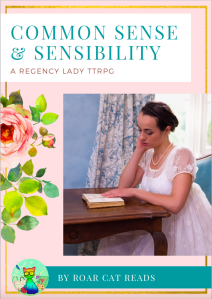
    Common Sense and Sensibility: A Regency Lady TTRPG

    “It is exceedingly well known that the life of a lady is far from easy. Death raises its grisly visage at every turn: whether from shawl insufficiency or too many novels, a Regency-era lady can never be too cautious.”

    In Roar Cat Reads’ original TTRPG character funnel, Regency ladies will test their delicate mettle and try to stay alive. This handbook lays out the game’s core rules, character creation instructions, and a list of the surprisingly mundane events that can test a lady’s constitution.

    Download your FREE copy at our Ko-Fi shop.

  • D&D Monster Fight: CAMBION vs. VAMPIRE SPAWN

    D&D Monster Fight: CAMBION vs. VAMPIRE SPAWN

    Rachel and I both DM separate Dungeons and Dragons campaigns. In an effort to improve our knowledge of D&D monsters and fight more creatively, we decided to challenge each other to a duel.

    ROUND ONE
    Cambion vs. Vampire Spawn

    Challenge Rating (CR) 5

    The Setting

    A cavern 80 ft long narrows in the middle with a natural pillar in the center.

    The Story

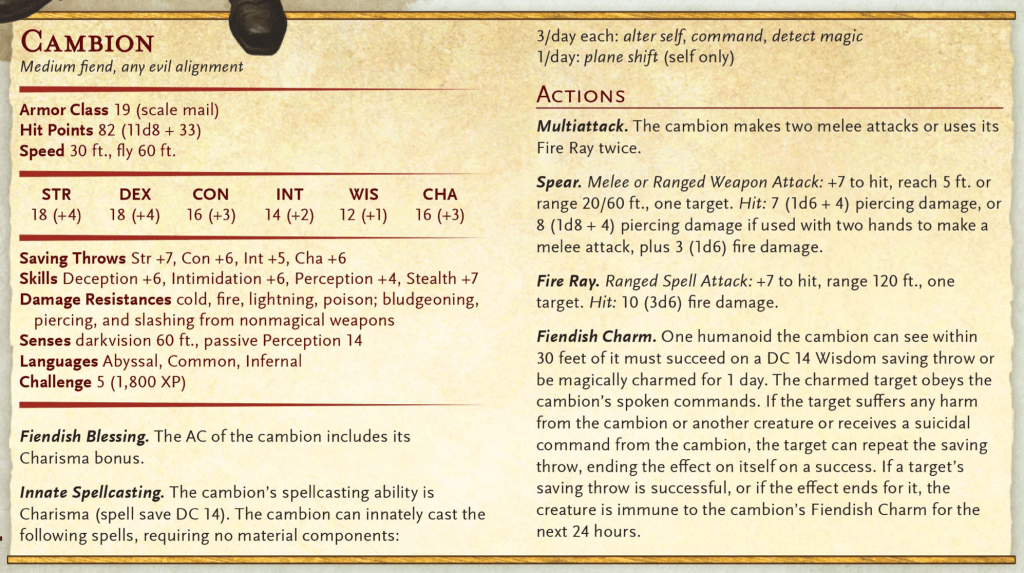
    The cambion, let’s call her Raja, flies forward until she is within range to cast Command on Lucy the vampire spawn. It is successful, and Lucy Halts. Raja swoops forward and finishes her turn. Lucy, held by the Command spell for one round, can take no action. 

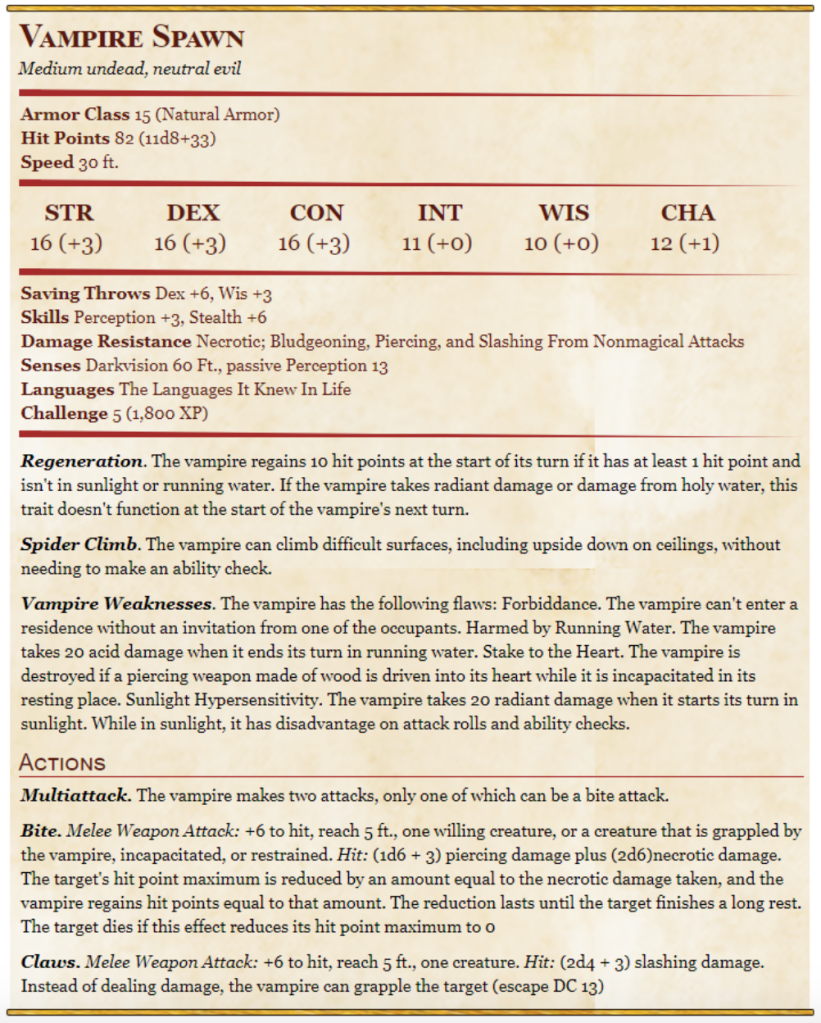
    On the next turn, Raja uses the ranged spell attack Fire Ray twice and deals damage before flying out of range of the vampire spawn. At the start of Lucy’s turn she regenerates 10 HP (something she will do at the start of each of her turns) and scuttles out of sight behind the pillar.

    Raja flies past the pillar to bring the vampire spawn back into view, but she isn’t there. Lucy held her action and used Spider Climb to scale the pillar until she was 20ft above the ground. When the cambion comes into range, she leaps forward and grapples the creature out of the air after succeeding on contesting strength rolls. Raja sustains fall damage and fails to break free of the grapple on her turn. The vampire spawn has now regained full HP thanks to the Regeneration ability and Bites Raja, dealing 19 points of damage. If she hadn’t already been at full HP, the necrotic damage done via Bite would have healed the vampire spawn. Lucy holds on to the Cambion and maintains her grapple.

    On her next turn, Raja breaks free and blasts Lucy with two Fire Rays before retreating to a safe distance. The vampire spawn once again scuttles behind the pillar.

    At this point, we paused to discuss how to resolve the hiding aspect of the vampire spawn's tactics. Because the cambion has 60ft of movement through the air compared to the vampire spawn's 30ft, there is no way for Lucy to close the gap. Hiding and leaping out as the cambion flies past is her best option. We decide to contest Stealth and Perception rolls when Raja and Lucy potentially have line of sight on each other.

    When Raja swoops past, she spots Lucy immediately and blasts her with 2 more Fire Rays. Lucy scuttles away and regenerates.

    On the next pass, Lucy surprises the cambion by falling from the ceiling. Their contested strength rolls match, so Lucy does not grapple Raja and the cambion is free to move. We imagine Lucy is hanging on to Raja’s foot. Raja flies up as high as she can and kicks the vampire spawn off with a contested roll, Lucy takes 40ft of falling damage (4d6).

    The game of cat and mouse around the pillar continues. The vampire spawn’s best tactic is to try and drag the fight out as long as possible. The cambion is below half HP; Raja is doing a lot of damage but has no way to heal, Lucy has taken a total of 140 points of damage, but Regeneration is keeping her in the game. If she can land another couple of surprise attacks, she could win this. 

    On Raja’s next pass Lucy drops on her from above and drives her to the ground dealing 20ft of falling damage, Raja grips Lucy’s wrist and casts Plane Shift. After a successful spell attack and a failed Charisma saving throw from Lucy, the vampire spawn is transported to a plane of Raja’s choosing. “Celestial,” the cambion says with an evil grin. Lucy lasts 12 seconds in the celestial realm, taking 20 points of radiant damage each turn before bursting into flames.

    The Takeaway

    Tricia aka Lucy the Vampire Spawn

    I tend to hack and slash my way through fights, whether as a player or the DM. This fight took that option away from me, since my speed was half that of my opponent, who could also fly! I had to get creative, which meant using Spider Climb to hide and surprise attack the cambion. Having Regeneration was a (literal) lifesaver, and if it weren't for that stupid Plane Shift spell, I maintain that I would have won!

    Rachel aka Raja the Cambion

    Utilizing my movement advantage was key to this fight, so I was constantly flying close and retreating out of reach. It became apparent that I wasn't doing enough damage to the vampire spawn, and I was starting to take significant damage myself without a way to heal. It was nice to have Plane Shift in my back pocket, but because there were two checks, it was not a guaranteed win. This time, it worked in my favor. 

    WINNER: CAMBION