Genre | Middle grade graphic novel Page #s | 256 Publishing Date | November 2021
From the author of The Deep & Dark Blue comes a tender graphic novel, perfect for our time, that gently explores themes of self-discovery, friendship, healing from tragedy, and hope for a better tomorrow.
Struggling with anxiety after witnessing a harrowing instance of gun violence, Manuel Soto copes through photography, using his cell-phone camera to find anchors that keep him grounded. His days are a lonely, latchkey monotony until he’s teamed with his classmates, Sebastian and Caysha, for a group project.
Sebastian lives on a grass-fed cattle farm outside of town, and Manuel finds solace in the open fields and in the antics of the newborn calf Sebastian is hand-raising. As Manuel aides his new friends in their preparations for the local county fair, he learns to open up, confronts his deepest fears, and even finds first love.
Goodreads
The Golden Hour is a gorgeously drawn graphic novel that visually captures the feeling of PTSD and anxiety perfectly. Manuel is a sweet boy who is struggling to readjust after witnessing a school shooting and the injury of his art teacher. The violence is implied and occasionally depicted in a roundabout way, but the instance itself is not this book’s focus; Manuel’s healing process is.
Central to this healing process are his two friends. They are endlessly supportive, understanding, and simply the best. They draw Manuel into their world of farming and the Ag-Club. Their companionship combined with peaceful country living provides him with a safe space to re-enter the world. Additionally, his therapist suggests he use photography as a coping strategy. It is a way for him to see the world one step removed, which feels safer. It’s also a way for him to focus on one small thing (his screen) when his anxiety starts to take over. All of this is drawn effortlessly; it’s truly impressive how Smith manages to convey psychological and emotional experiences artistically.
There is no explicit queer representation, unlike Smith’s earlier middle grade graphic novel The Deep & Dark Blue. However, there are soft boys exploring friendship with meaningful looks between them; they’re totally going to date.
Who Do I Recommend This Book To?
The Golden Hour has broad appeal; if you’re into sweet stories about young people growing up after tragedy with the help of nice people, you will enjoy this graphic novel!
Check out our Queer Lil Library for more book recommendations and reviews!
Hi, my name is Nicole (She/Her). I am a multipotentialite, world-traveler, podcaster, aspiring comedian, and nerd just trying to make the best of life in this mortal realm. One of my favorite pastimes is getting together with friends and playing board games or D&D, it’s a great way to connect with others and disconnect from everything else. You can find me on social media as @itswafflebitz.
Nicole, you have said that you enjoy playing D&D “with the right crowd.” I can definitely relate! What does that mean to you?
Those rare times I play D&D, I love for the energy in the room to just be sort of… chaotic. I really enjoy being able to just be silly and do absurd things in-game and enjoy it even more when the people playing with me can match that energy. Feeling this “vibe” in the group creates a judgment-free, safe space to just let go and have fun for a few hours.
As a queer person, have roleplaying games helped you explore or express your queer identity?
When I first started playing games like D&D, I experimented with my different character’s gender expression & identity. I was still trying to figure myself out in real life, so playing those characters and seeing how supportive the people around me were of that helped me become more comfortable in real life.
We love a gamer at Roar Cat Reads, and you are into both board games and video games! What are some of your favorites, and why?
I have played 100’s of board games so it’s hard to name just a few, but some of the games I keep coming back to are: Parks, Betrayal at House on the Hill, and Codenames. These have a lot of replayability and are easy to teach. As for video games, I enjoy a game with a well-written story. One of my favorite games is the Walking Dead series from Telltale Games and a great co-op game I played recently is “It Takes Two”.
I hear you’ve got a podcast in the works. What can you tell us about it? When can we expect it to be released?
My friend Allonté and I are in the process of creating our podcast, The Imperfect Matters. In our podcast, we talk about societal issues that are far from perfect but really matter. The tone is a healthy balance of informative, comedy, and satire. There is no release date yet, but we have a few episodes already recorded and aiming to release this year (2022).
In addition to your nerdy interests, you’re a frequent solo traveler. What are some of your favorite travel destinations? Do you find that you travel differently when you’re on your own?
On my first solo trip, I spent 2 months traveling around parts of SE Asia. It was so nerve-wracking leaving the comfort of my country and having to figure things out in a completely new environment. That trip holds a special place in my heart because I literally consider it life-changing. I now love and prefer traveling solo because not only is it easier to meet wonderful people along the way, but also it feels so empowering, especially as a female. Traveling with others can be fun, but there’s always the issue of managing multiple itineraries and schedules, and it’s more difficult to be spontaneous and take as long as you want to do certain activities. Meeting new people can also be difficult when traveling with others because you’re more likely to stick together. I have solo traveled to Mexico, Germany, and Sweden since that trip and have many more to come.
Do you have any recommendations of queer nerdy content that you would like people to know about?
YES. I’m a huge fan of the Avatar the Last Airbender & Legend of Korra universe. There is a TTRPG from Magpie Games coming out very soon that I backed on Kickstarter set in this universe. I’m really looking forward to playing it.
Sign up for Roar Cat Reads’ Monthly Newsletter
Every month one subscriber wins a prize!
Processing…
Success! You're on the list.
Whoops! There was an error and we couldn't process your subscription. Please reload the page and try again.
By clicking submit, you agree to share your email address with the site owner and Mailchimp to receive marketing, updates, and other emails from the site owner. Use the unsubscribe link in those emails to opt out at any time.
Welcome to DM’s Pocket Guide, where we discuss the rules, spells, and monsters of Dungeons and Dragons, 5th edition.
Rachel: Okay, so today we are going to be talking about the Schools of Magic. This is a bit of a follow up to Detect Magic, we had to learn the schools because of that particular spell. So let’s get into it. A nice summary of this appears in a box on page 203 of the Player’s Handbook, and it goes through the Schools of Magic. “Academies of magic group spells into eight categories, called Schools of Magic. Scholars, particularly wizards, apply these categories to all spells, believing that all magic functions in essentially the same way, whether it derives from rigorous study or is bestowed by a deity.”
Tricia: So this calls into, if you play a wizard, at the second level, you can like choose your particular school of magic, which there are these eight. And then as you’re playing through your wizard character, you like develop skills and stuff based on that. I have never actually played a wizard, so this also contributes to why I’m not very familiar with these different Schools of Magic. But the – I think the idea is that probably in the past, when wizards were like the big D&D thing, they created these, and then they were like, “Oh, also, just like all magic fits into these schools.”
R: Yeah, I recognize a lot of these categories from like playing Skyrim, or any kind of like, strategy game like that. It goes on to say the Schools of Magic help describe the spells but have no rules of their own, even though there are some rules that refer to the schools of magic.
T: Yeah, so these are just categorizations. They’re not actually doing anything. It’s just kind of helping you to be like, “Ah, this goes under that category.”
R: Exactly. Okay. So the first one is Abjuration. “Abjuration spells are protective in nature, though some of them have aggressive uses. They create magical barriers, negate harmful effects, contrast passes, or banish creatures to other planes of existence.”
T: So some examples of that would be like Remove Curse. Yeah, also Aid, so that’s kind of like a positive way. Aid, you’re doing a protective barrier thing. Remove Curse, you’re removing something harmful. A favorite, Counterspell, is an abjuration spell. So just like, nope! Abjuration are the Nope spells.
R: Changing something. Okay.
T: Nope, not changing things, just blocking things.
R: Blocking things. Okay. Conjuration comes next. “Conjuration spells involve the transportation of objects and creatures from one location to another. So the spells summon creatures or objects to the caster’s side, whereas others allow the caster to teleport to another location. Some conjurations create objects or effects out of nothing.”
T: So this would be like your Find Familiar.
R: Okay, yeah.
T: Bloop! Your familiar pops up into existence. Also, like Conjure Animals, Conjure Celestial. There’s a whole bunch of ‘Conjure.” Surprisingly, it’s a conjuration spell. But this would also include like Mage Hand. Yep, it’s coming out of nothing, conjuring it, and also Entangle. So you’re conjuring the plants out of the ground. This is one that I could actually see it maybe fitting in some others, but it is technically a conjuration spell.
R: Okay, yeah, it sounds like there might be a few that had a bit of a crossover. Next one is Divination. “Divination spells reveal information, whether in the form of secrets long forgotten, glimpses into the future, the locations of hidden things, and the truth behind illusions or visions of distant people or places.”
T: So this is Clairvoyance. This is Scrying. Those are kind of classic divination staring into a teacup things.
R: Detect Magic is a divination spell.
T: Uggggh.
R: Man, the snake eats its tail, I tell you.
T: Yeah. But it’s also Comprehend Languages, which is sure. And Speak with Animals.
R: Okay. Yeah, revealing information, being able to understand. Yeah, okay, that’s cool. “Enchantment spells affect the minds of others influencing or controlling their behavior. Such spells can make enemies see the caster as a friend, force creatures to take a course of action, or even control another creature like a puppet.”
T: Yeah. So some of those would be Calm Emotions, Command – you can just make somebody do something – also Sleep and Animal Friendship.
R: My cleric from Curse of Strahd is feeling very attacked right now.
T: Enchantments! Sorry, that was a Dragon Age joke.
R: Yes, I haven’t played that series, unfortunately. “Evocation spells manipulate magical energy to produce a desired effect. Some call up blasts of fire or lightning and other channel positive energy to heal wounds.”
T: So yeah, so this is like super most basic magic: Fireball, Burning Hands, Cure Wounds, Eldritch Blast. Anything that’s like Kapow!
R: Okay, so all of this stuff you would, yeah, use – I see all of these things being used regularly. These are all evocations. Okay, cool. I don’t think I would have known that. “Illusion spells, deceive the senses or the minds of others that cause people to see things that are not there, to miss things that are there, to hear faint noises or to remember things that never happened. Some illusions create phantom images that any creature can see. But the most insidious illusions plant an image directly into the mind of a creature.”
T: Your Curse of Strahd character might be feeling called out now too. This would be like Disguise Self, Invisibility. But also fun ones like Color Spray.
R: Huh, fun times.
T: So anything illusory. That one feels pretty self-explanatory.
R: Okay, the next one we’ve got is Necromancy. “Necromancy spells manipulate the energies of life and death. Such spells grant an extra reserve of life force, drain the life energy from another creature and create undead, or even bring the dead back to life. Creating the undead through the use of necromancy spells such as Animate Dead is not used by good casters and only evil casters use such those frequently.” This is a bit of a moral…
T: Yeah, it’s interesting that that’s the only one that has that caveat when you could probably say, if you’re evoking Fireball on innocents, that’s also bad? You know, I don’t know, it’s an interesting thing. But necromancy is divided into these two categories, basically, where it’s either interacting with the dead in a negative way – Animate Dead, Raise Dead – but also, like, Chill Touch does necromantic damage. But it’s also – Resurrection is a necromancy spell because you’re just raising your own party from the dead and it’s therefore okay, versus raising the undead for dealing damage? That’s what your party is gonna do. It’s, uh, it’s kind of weird.
R: Yeah, that’s interesting that these spells also fall under necromancy.
T: Yeah. Also Clone. Clone is a necromancy spell.
R: Oh, yeah. Okay, I mean, I guess under the context, that makes sense. Okay, but the last one we have is Transmutation spells. I believe this used to be called Alteration. I was once corrected on this, that I was quoting 3rd edition even though I’ve never played it. It’s now called Transmutation. And these “change the properties of a creature, object, or environment. They might turn an enemy into a harmless creature, bolster the strength of an ally, or make an object move at the caster’s command, or even enhance the creatures innate healing abilities rapidly recover from an injury.”
T: Yeah, so that is Barkskin. You’re transmuting your own skin to be protective. This is Control Water. It’s also like Telekinesis.
R: Okay, yeah, that makes sense.
T: So those are the Schools of Magic.
R: Page 203 in the Player’s Handbook.
Thanks for listening! If you have something you’d like us to cover, email it to roarcatreads@gmail.com or find us on Twitter and Instagram @roarcatreads.
Genre | Science fiction and fantasy Page #s | 372 Publishing Date | September 2021
Good Omens meets The Long Way to a Small, Angry Planet in this defiantly joyful adventure set in California’s San Gabriel Valley, with cursed violins, Faustian bargains, and queer alien courtship over fresh-made donuts.
Shizuka Satomi made a deal with the devil: to escape damnation, she must entice seven other violin prodigies to trade their souls for success. She has already delivered six.
When Katrina Nguyen, a young transgender runaway, catches Shizuka’s ear with her wild talent, Shizuka can almost feel the curse lifting. She’s found her final candidate.
But in a donut shop off a bustling highway in the San Gabriel Valley, Shizuka meets Lan Tran, retired starship captain, interstellar refugee, and mother of four. Shizuka doesn’t have time for crushes or coffee dates, what with her very soul on the line, but Lan’s kind smile and eyes like stars might just redefine a soul’s worth. And maybe something as small as a warm donut is powerful enough to break a curse as vast as the California coastline.
As the lives of these three women become entangled by chance and fate, a story of magic, identity, curses, and hope begins, and a family worth crossing the universe for is found.
Goodreads
Light from Uncommon Stars should have been my jam, but unfortunately, I just never connected with the book. I mean, with a summary like “Ageless bisexual alien from space who now runs a donut shop falls in love with a middle-aged Japanese lesbian who sells souls to a demon in exchange for her own back, and if that weren’t enough, there’s also a runaway trans girl who becomes a violin prodigy,” I was all in! I am so mad that this perfect idea didn’t land better for me.
The good stuff is on the tin – it’s a wild mashup of genres that work together because why not? The diversity is all-encompassing, and no one blinks when the alien lady reveals that her true form is purple with two elbows.
Where it falters is a little harder to parse out. Personally, I was not a fan of the way it was written. There are a lot of short scenes from a lot of perspectives. I prefer a story that digs deeper into one, maybe two, points of view. More than that, I found the internal logic of the book lacking in some ways. I’m down for a wild ride with unexpected standards of behaviour, but they need to be consistent. For instance, Lan bloops her son Marcus out of (temporary) existence for murdering two people (this is seriously downplayed, by the way), and no one cares. But Lan’s subsequent desire to duplicate her AI daughter to take him to space leads to a freak out from multiple people that ends with her atoning for this egregious decision. I love that the book pushes back on the personhood of AI, but then…shouldn’t Marcus also be valued similarly?
I also couldn’t fully track with the book’s handling of trans trauma. On the one hand, I admire Aoki’s unflinching depiction of a trans girl’s abusive family, abusive friends, and the ways in which she resorts to sex work to get by. It was not my favorite, because this is a vaguely feel-good book in most other areas, and then BAM, rape. But the book ends with a throwaway line that Katrina is living with a rich guy who we saw greet her by sexually assaulting her? That’s not a satisfying ending from my perspective.
In the end, I wasn’t a fan of this book, but everyone else seems to adore it, so perhaps I am missing something!
Who Do I Recommend This Book To?
Honestly, I don’t know! Popular Books of 2021 lists are saying to give it to everyone, but I truly didn’t like it. Try it if you’re intrigued, I guess!
Check out our Queer Lil Library for more book recommendations and reviews!
Olga and Natasha Vernev are local business owners in Vancouver. Together, they own The Great Canadian Dog Cakes where they make healthy dog food as well as beautiful dog cakes and cookies. Their path here has not been easy. As a lesbian couple in Russia, they fled persecution to Thailand and Cambodia before eventually immigrating to Canada with the help of Rainbow Refugee. Olga and Natasha have partnered with Roar Cat Reads to raise awareness of the awesome work Rainbow Refugee is doing and encourage all readers to participate in our upcoming fundraising event. You can donate HERE now!
How did the two of you meet? When did you know that you were in love?
This is a funny story about how I have known Natasha for twenty years, and she has only known me for ten years.
I met Natasha in 2001 when I was a university student. I left the library and saw her standing in the street and talking to her friends. And she was amazing. Like a character from some comic about lesbian superheroines (does such a comic exist at all? It’s a pity if not).
I immediately fell in love with her at first sight, and she didn’t even notice me.
Ten years after that, we met on social networks.
At this point, we were both already pretty disappointed in relationships, both after difficult breakups. For my part, I would not have agreed to try to meet if it was anyone but Natasha.
We got pretty tough about the boundaries of our future relationship, and both agreed that we would have a date and one night stand. Nothing but this! And…there must be a joke about lesbians who move in together after the first meeting.
We’ve been together for almost ten years since that date, because she also fell in love at first sight, only with a slight lag.
I don’t want you to discuss anything that makes you uncomfortable, but why did you know that you weren’t safe staying in Russia?
Oh, we’ve talked about this so many times that it has become my new comfort zone, something like sitting on nails. You know, there is a method of self-help therapy to tell a story so many times until all the emotional content evaporates from the narrative. I can’t say that we finally succeeded, but we both have therapists, and our PTSD is under the supervision of a very good Canadian doctor.
My wife and I had very different backgrounds. Natasha is a little older than me and managed to capture some rather dangerous times in the 90s in Russia, and she was subjected to the most brutal attacks several times. She was literally beaten to a pulp. So she was closed and wary.
I came out to a more or less prosperous beginning of the 2000s, and did not see any danger at all. I lived openly. I even had a rather dangerous hobby – trolling homophobes on the streets. If someone came up to say something disgusting to me, I literally took the person by the hand and gave him an educational lecture in the most serious tone until he ran away screaming and cursing. I didn’t believe at all that someone could do me any harm other than verbal.
Because of these different experiences, Natasha and I had some disagreements about how we would behave on the outside while with each other.
When the Russian government began to develop a draft law banning the promotion of homosexuality, the speed of events shocked us. Previously, we all hoped that Russia would move closer to the Western path of development, but Putin’s government suddenly took a sharp conservative turn, and then real troubles began, especially in provincial cities like ours.
As I said, I lived quite openly. My friend and I had a shop of hand-made queer stuff, we drew and sold t-shirts, posters, and calendars online. At first, our store received threats and we were forced to close it. Then some of our friends were attacked and the police refused to help them. And then Natasha and I also began to receive threats. Some people wrote terrible phrases and threats to kill us in our car and on the front door of the apartment.
With this law, the state seemed to make it clear to the aggressively-minded part of the population that they can freely express their aggression and there will be no consequences for them. I’m seriously telling you, there was a criminal case shortly before our departure about a man who killed a gay man with an ax and received a two-year suspended sentence.
And then there was a Nazi organization that practiced hunting gay people for money, it was called “safari.” People were lured into fake dates on social networks, locked up in an apartment, beaten, and monstrously humiliated. These acts were filmed and published on the Internet to destroy the lives of these people permanently. This organization built something like a franchises – those who wished could open a safari club in any city and invite participants to hunt for a fee. Very inexpensive, by the way.
In addition, some absolutely terrible false information about gay people poured from TV screens in prime time. For example, talk shows had disgusting discussions in which participants freely expressed their most vile opinions and desires. Intolerance in society began to grow under the influence of this information.
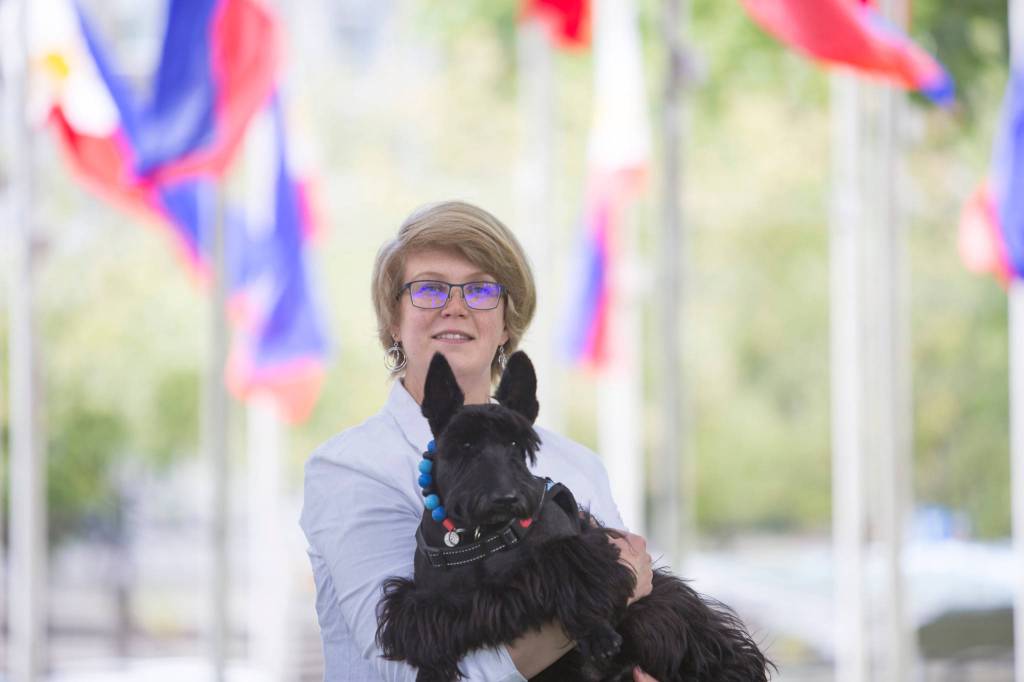
Natasha gifted me a Scottish Terrier puppy for my 30th birthday. He and I once went to a local grocery shop and came across a group of young men who, with the words “Well, lesbian, finally you got a man?” kicked Spielberg and ran after me. I grabbed the dog and ran, and just managed to close the doorway.
Natasha, who had much more negative experience than me, immediately realized that it wouldn’t end well for us. Soon, we sold everything we had and left the country with one suitcase and a puppy. We went to Thailand, then to Cambodia. From Thailand, we turned to Canada for help.
How did you end up connecting to Rainbow Refugee?
We googled a well-known lawyer, Robert Hughes, and he helped us get in touch with Chris Morrissey directly. Here it should be said that everything was complicated by the fact that we didn’t speak English, so I used a lot of Google translator, which in those days was far from perfect. Ultimately, Chris became a member of our support circle.
We have been asked many times something like, “But how did you get in touch with Hughes?!” and we reply “We googled.” Can you imagine the level of responsiveness of the people involved in LGBT issues in Canada? You just accidentally write to a celebrity lawyer who simply answers, “Ok, let’s see what we can do about it,” and the superstar of the Canadian LGBTQ+ movement, Chris Morrissey, starts to deal with your case!
How did Rainbow Refugee support you, both as you immigrated to Canada and after you arrived in Vancouver?
We have received tremendous support from Rainbow Refugee. In our opinion, it is great luck that this organization exists and helps people. We were supported psychologically (in the last year in Cambodia I was in almost daily correspondence with members of the circle of support) and we were very strongly supported financially.
When you are a refugee of a sponsor group, the first year after arriving is completely focused on adaptation. There is a big difference between coming here as a tourist to see beautiful British Columbia, and arriving to start your life here from scratch.
The whole system here does not work the way you are used to. You need to learn something new every day – how to use public transport, how to get an appointment with a doctor, how to pay bills, where to get an insurance number, where to go to learn English, how to sort the garbage correctly, how to fill out the tax return correctly – an endless to-do list.
Often, by the time of arrival, refugees are morally exhausted, traumatized by all that they have experienced, disoriented, or in a depressive period or anxiety. Having help with simple bureaucratic actions and exploring a new world in these situations is priceless. Every day, someone from the support group helped us deal with all of this. We made friends with many of them and still maintain relations.
You came here with your pet dog, Spielberg. Did RainbowRefugee help with bringing a pet to Canada?
Yes, Rainbow Refugee completely orchestrated Spielberg’s arrival. For a long time we didn’t dare to tell Chris or anyone else that we had a dog. We were worried that this might affect the decision to take our case at all. Then it turned out that this is the most common thing – to flee from a dangerous country, taking a pet. Our case is not exceptional.
Why do you think it’s important for people to support Rainbow Refugee?
I have a story about this. A few weeks ago I was sketching on Jericho Beach and a nice family sat next to me. We started a conversation and they asked me where I was from and how I came to Canada. I said I was a refugee because, you know, I have this idea that every time I don’t hide it, I kind of destroy a tiny bit of stigma around that word.
Some media tries very hard to portray refugees as a frightening, faceless crowd of freeloaders, and sometimes this affects people. But every refugee has a long, individual story behind them. It seems to me this is such a challenge – here I called myself, here I am, here is my wife, it is difficult to depersonalize us at this moment.
This nice family turned out to be very radical in their views on refugees and LGBTQ+ in particular, so I just sat there and destroyed their every assumption.
When they said that refugees come and spend money from Canadian people, I replied that we have been working since the third day of our stay in Canada and pay taxes. When they started talking about sin, I said – look, here is my wife, we have been together for many years, just like you. And when in the end they said that refugees, with their low-paying jobs, increased the financial burden on the state system during the pandemic, I shrugged my shoulders and said that it was at this time that we launched our business.
Do you know why I’m so bold? Why I can afford to stand in front of skeptical people and lay out all these crushing arguments in front of them?
Because how quickly we found a job, integrated into the local community, spoke English and created our company is the result of Rainbow Refugee and our support team’s work in the first year.
Every minute of the work of volunteers who helped us overcome frustration in the bureaucratic part of our process and in adapting to life in Canada, every donated dollar – all this was spent so that we could take language courses, plan and build our new life without paralyzing fear that tomorrow we will be thrown out on the street in an unfamiliar country.
Being a sponsored refugee is a privilege that gives you the greatest head start on integrating into Canadian society. The first year with a support group for a refugee is as important as the first year of a baby in the mother’s arms.
We had a rare chance to find out what it is like to be taken care of so that you can become a conscientious and resourceful member of society. It’s priceless.
As we grow, we will try to help others in the same way that all these people have helped us.
Is there anything else you would like readers to know about the organization or your experience?
You know, the hardest part about the refugee process is suspense. You drop everything and go on a journey without a return ticket, with no guarantees of a happy ending. Often this means that all family and friendship ties are cut off, you have to reconsider everything that you knew, and you yourself have to go through a serious test.
I used this metaphor in an open letter to fundraising participants a couple of years ago, and I will repeat it now, because I still don’t know how to describe the refugee process any better. Imagine that you’re a trapeze acrobat under a circus dome performing a trick for the first time in complete darkness. You swing, unclench your hands and fly into the unknown. You don’t know if there is another trapeze at the end of your route or if you can grab it. There is an abyss below you.
Rainbow Refugee are the people who pick you up in the middle of the flight in this complete darkness and literally carry you to your final destination in their arms. Someone turns on the flashlight and someone grabs your wrists for you to complete the trick.
Natasha and I wish no one ever has to experience such a flight. But for this we need some other world, probably.
Finally, we would like to end on a fun note. This is a queer, nerdy blog! If you could choose to have one super power, what would it be?
Natasha says that she would like to fly like a superhero, and I would like to have an Incinerate Look. In some life situations, this could be a very useful skill! Although in Canada it would be of little use to me. This country is inhabited by some absolutely amazing people.
Well, and we both would like the main superpower – that our English becomes as good as our Russian, so guys, many of you have one important superpower, you just don’t realize!
Yesterday I shared the 10 posts that are most viewed by readers. Many of my favorites are also on that list, but I wanted to give a shoutout to some of my favorite posts that I’ve written that haven’t gotten quite the same attention:
What would you like to see more of in Roar Cat Reads’ second year? Leave a comment and let us know!
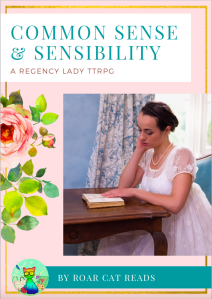
Much like hobbits, in honour of our 1 year anniversary, we are gifting you with a FREE copy of our original RPG, Common Sense and Sensibility: A Regency Lady TTRPG.
Common Sense and Sensibility: A Regency Lady TTRPG
“It is exceedingly well known that the life of a lady is far from easy. Death raises its grisly visage at every turn: whether from shawl insufficiency or too many novels, a Regency-era lady can never be too cautious.”
In this TTRPG character funnel, Regency ladies will test their delicate mettle and try to stay alive. This handbook lays out the game’s core rules, character creation instructions, and a list of the surprisingly mundane events that can test a lady’s constitution.
Roar Cat Reads will turn 1 year old on March 4th! To celebrate, we are looking back at all of the things that got us here. Today, let’s see which 10 posts you the reader liked best of all!
Much like hobbits, in honour of our 1 year anniversary, we are gifting you with a FREE copy of our original RPG, Common Sense and Sensibility: A Regency Lady TTRPG.
Common Sense and Sensibility: A Regency Lady TTRPG
“It is exceedingly well known that the life of a lady is far from easy. Death raises its grisly visage at every turn: whether from shawl insufficiency or too many novels, a Regency-era lady can never be too cautious.”
In this TTRPG character funnel, Regency ladies will test their delicate mettle and try to stay alive. This handbook lays out the game’s core rules, character creation instructions, and a list of the surprisingly mundane events that can test a lady’s constitution.
Welcome to DM’s Pocket Guide, where we discuss the rules, spells, and monsters of Dungeons and Dragons, 5th edition.
Rachel: Okay, so today we’re going to be talking about Detect Magic, which is a spell that can be found on page 231 of the Player’s Handbook.
Tricia: This is my least favorite spell.
R: Yeah, one of mine too. It’s definitely one that, as a DM, suddenly comes with a lot of things that you have to know.
T: Let’s hear what some of those things are.
R: Okay, so read the spell first of all. This is a first-level divination ritual. So it’s first level. So your players might have this very, very early on and sometimes want to spam it.
T: Yeah. Yeah, I mean, because they can.
R: Because they can. Absolutely. So the casting time is one action. The range is something that you cast on yourself to try and detect the magic around you. It has a verbal and-
T: So what is the range?
R: The self.
T: Oh. Is it of what you can see?
R: You cast it on yourself to be able to detect the magic around you. And has a verbal and a somatic component, so you have to be able to speak in order to cast this, and you have to be able to make whatever movement it is that allows you to spell it, so if you are restrained in some way, you might not be able to cast Detect Magic. The duration is concentration up to 10 minutes, so this is a spell that can last a bit of time too.
T: They could like literally walk through an entire building, looking at everything and detecting any magic.
R: Yeah, an experience that I might have had once was a player that did cast Detect Magic, and then just runs around as much as they can. That really kind of can mess with your plan as a DM, you know, things that you need to reveal. And suddenly, the only thing you can focus on is trying to reveal all of the magical things to this player as they are, you know, running around like a crazy – or like, remember those 90s point-and-click games where you couldn’t find the trigger.
T: Yes.
R: And you just clicked literally everywhere on your screen. Yeah, that’s how I think players behave sometimes with this spell.
T: Yes. Click, click, click, click, click.
R: Okay. But let’s get into the description. For the duration, you sense the presence of magic within 30 feet of you. If you sense magic-
T: Oh within 30 feet. I knew there was something.
R: Yeah, yeah, it’d be nice to have that somewhere a little bit early on but do you have to get into the description to work out how far they can see the magic. If you sense magic in this way, you can use your action to see a faint aura around any visible creature or object in the area that bears magic. And you can learn its School of Magic if any – so two things there. Faint aura. DMs, get ready to describe what kind of aura it looks like. And you might want it to be thematic for the School of Magic.
T: It can go really deep, really fast. But I think some of the important things there are it is visible things. So if you want to hide something, like in a drawer, or like in a secret compartment, you wouldn’t be able to see it with Detect Magic.
R: Ah!
T: Ohhh.
R: The spell could penetrate most barriers but is blocked by one foot of stone, one inch of common metal, a thin sheet of lead, or three feet of wood or dirt.
T: Okay. So it’s literally you’d have to be buried underground, but you could see in like desk drawers and things because it’s not enough wood.
R: Yeah, unless you had an inch of like a lead-lined drawer or something.
T: So yeah, so I guess that’s in like world-building as a DM. If you really want to hide something from your players with Detect Magic, you have to prepare for it. I just find this spell so tedious. I hate it so much. Literally, I’ve read it many times, and I’ve already asked questions that are answered in the spell because my brain just refuses to learn it. I hate it.
R: Yeah, it is – I’m not gonna say it’s a game-breaking spell, because it’s definitely useful for the players. But I guess the thing I’m thinking about it is: if you have it, it makes any kind of searching the room for the hidden secret magical thing, super easy. But if you don’t have it, then your players might not find it. It’s one of these things that just like, it’s like switching the difficulty mode down when you’re stuck in a part of a video game or something.
T: Yeah, yeah. And maybe that’s thing. Before I played with people who knew about this spell and used it often, I think we kind of addressed these situations by using perception checks or arcane checks of like, “Oh, I’m looking for magical things. Do I see an arcane energy?” and just as a DM it was like, “Yeah, I’ll help you out. You notice this or that.” But what I hate about this spell too is – the players that I’ve played with who, who knows things, they’re like, “Oh, well, don’t forget that my magical amulet would show up and that person’s magical weapon, and their, like, familiar that, like, all of literally every magical thing!” And it’s just like, ahh!!!
R: Yeah, it’s so much information to hold in your brain as a DM when that is cast, because yeah, probably the biggest thing that’s gonna show up on Detect Magic are the other members in the party and you know, all of their different things. And if there’s some sort of magical item that somebody is trying to keep secret from the rest of the party, that’s going to show up.
T: Right!
R: So yeah, so let’s add this to the DM’s mental juggling list. You’ve got all of the rooms and the things that are in the dungeon that you’re trying to run, all of your players and their various items and different things and oh, they want to keep this hidden – is this thing going to be a surprise? So congratulations, your player has cast Detect Magic, time to do some mental gymnastics. Or have to retcon like a whole bunch of things.
T: Yes. So some ways to get around this would be to turn it back on the players. “Okay, you detect magic? Who’s got magical items on them?” Make them do the work for you.
R: Describe how you show up; what kind of auras your character gives off under Detect Magic. That’s a good way to do it.
T: Another way to save time and energy is because the aura is just one part. The other is you can determine the School of Magic of each thing.
R: *Sigh*
T: We’re gonna do a separate episode on Schools of Magic because that’s a whole thing. But something you can do if you, like us, are not super confident in knowing the Schools of Magic for every magical item in existence – turn it on the players as well. The one who casts Detect Magic say, okay, “So which Schools of Magic are you familiar with?” Because it’s not like it’s going to appear with a sign saying “Boop bo doo! School of Abjuration!”
R: Here’s something you know nothing about.
T: Right.
R: So for wizards, this makes sense, because in the wizard section of the Player’s Handbook, it sort of describes that you are a knowledgeable scholar with, you know, knowledge of all of these different Schools of Magic. They are going to be familiar with the different Schools of Magic, but if I’m playing a cleric or a bard-
T: Or a fighter!
R: Yeah, the fighter class that could get a bit of magic, like, what are they going to know about Schools of Magic? Like, would they care? Or is it just going to show up as magic of some kind?
T: Yeah. So, this spell sucks. I mean, I think to be fair, there’s probably some cool ways to do it. Like magically revealing something that a character’s wanting to keep secret is kind of cool. You could do some fun stuff with that. But it basically just does require so much mental work for DMs to remember, basically everything. It’s very difficult, and I don’t like it.
R: Me either, but that’s Detect Magic on page 231 of the Player’s Handbook. May it never appear in your games.
Thanks for listening! If you have something you’d like us to cover, email it to roarcatreads@gmail.com or find us on Twitter and Instagram @roarcatreads.
Genre | YA Contemporary fiction Page #s | 374 Publishing Date | May 2019
Perpetually awkward Nima Kumara-Clark is bored with her insular community of Bridgeton, in love with her straight girlfriend, and trying to move past her mother’s unexpected departure. After a bewildering encounter at a local festival, Nima finds herself suddenly immersed in the drag scene on the other side of town.
Macho drag kings, magical queens, new love interests, and surprising allies propel Nima both painfully and hilariously closer to a self she never knew she could be—one that can confidently express and accept love. But she’ll have to learn to accept lost love to get there.
Goodreads
Kings, Queens and In-Betweens is a sweet coming-of-age story about a queer girl in a small town who discovers the drag scene and community. Nima is a painfully awkward person, and I laughed out loud at her panicked reactions multiple times (as well as almost needing to throw the book across the room in sympathy embarrassment at one particularly cringeworthy scene). She is totally endearing, and it is a joy to watch her gain confidence in her relationships and performances.
I so appreciate books that don’t make coming out a huge deal, but at the same time, I know it’s important to acknowledge the real consequences some people face when sharing their identity with others. This book covers both experiences, with Nima’s friends and family being accepting and inclusive (in fact, she has parent drama that is NOT about coming out – a marvel!) and side character Gordon experiencing intense homophobia from his father. I think this approach is incredibly important, as it shows that negative expereinces do not have to be the norm by also modeling healthy familial love.
I also loved that, although Nima’s friends and family accept her and her attraction to women, she still finds a special kind of relationship with the queer community that she becomes a part of. There is something about the power of being with people who share your identity to make you feel safe, seen, and powerful in a very unique way. These different kinds of relationships don’t have to be in competition, and I appreciated that Boteju purposefully merged the two worlds.
While this book does capture the magic of queer community, I did find the character of Deidre leaned a little too far into the “drag queen fairy godmother” territory. She is constantly available to help Nima out of one scrape or another, and we don’t get a real sense of her personal friendship group or community. She’s over ten years older than Nima and co! I want her to have a vibrant social life with peers!
Aside from that minor quibble, this book is just so enjoyable. Pick it up and give it a read!
Who Do I Recommend This Book To?
Gift Kings, Queens, and In-Betweens to your cousin from Rural Town for them to read on the way to the drag performance you take them to.
Check out our Queer Lil Library for more book recommendations and reviews!
Patrick Myers (he/him) is a freelance writer and playwright. His practice encompasses a variety of disciplines, including but not limited to writing, producing, criticism, and teaching. His work has appeared in American Theatre, HowlRound Theatre Commons, and ARTSATL, and he can be found tweeting irreverently @patrickrmyers on Twitter.
What queer book have you chosen to share with our readers today?
I’ve picked Alec by William di Canzio. It’s inspired by the novel Maurice by E.M. Forster, where two men fall in love in Edwardian England and run away together – destined to be happy for the rest of their days. Where Maurice explores the world through the gentleman Maurice’s perspective, di Canzio explores the world through the eyes of his working class lover, Alec, and expands the plot to what happens after they run away together.
Why is this book one of your favorites?
I love Maurice, and Alec is the perfect companion piece to that novel – where Maurice was written in 1913, the 21st century perspective on the events of the novel allows for an understanding of what comes next for Maurice and Alex: World War 1. With that as the catalyst, the novel becomes a sweeping romance not just for how they come together, but how they stay together. What is more romantic than unyielding and undying commitment? Also, it has some of the best sex scenes between two men ever written, both realistic and hot. There is nothing left on the table. I could want nothing more from a book.
How would you describe yourself as a reader?
I’m a terrible reader. I either devour book after book or read infrequently, if at all. I use random bills or printouts or credit cards as bookmarks. I stop halfway through a book and don’t continue reading until months or years later, picking it back up where I left off as if no time had elapsed. I live and die by a book and recommend it to friends and when they ask for the plot, I seem to be unable to conjure any of the narrative for them. I start and stop multiple books before I pick one to finish, as if I was at a wine tasting, sampling for the bottle I’d bring home. I love books. But I’m a tedious, unrepentant, awful lover to have.
As a queer person, have books helped you explore or express your queer identity?
I didn’t have access to queer books as a child or teenager, but I did have an internet connection, so I spent much of my youth online reading and writing fanfiction for some of my favorite books. I would write about characters I identified with and used them as proxies for my burgeoning queer identity. In that way, I was able to use accessible books to explore queerness when I had none available to me. And it was reading that opened up that door for me.
Other than reading, are there any queer nerdy recommendations that you would like to leave with our readers?
For anyone who loves to game, I’d definitely recommend Hades published by Supergiant Games. It’s a roguelike dungeon crawler, which is normally not my type of game. HOWEVER! You play as the son of Hades and Persephone, Zagreus, and throughout your many attempts to escape the depths of hell, you are given the opportunity to reunite some of Greek mythology’s most iconic couples, including the warriors Achilles and Patroclus. On top of that, Zagreus has multiple characters he can romance, including the dashing and mysterious God of Death, Thanatos (or Than for short). It’s brutal and romantic and filled with unearthly wonder – perfect for a rainy day on the couch.
Thank you, Patrick!
Check out our Queer Lil Library for more book recommendations and reviews!
Welcome to DM’s Pocket Guide, where we discuss the rules, spells, and monsters of Dungeons and Dragons, 5th edition.
Rachel: Okay, so today we’re talking about determining character ability scores as part of character creation.
Tricia: Yes, this was something that I didn’t actually realize there multiple ways of doing it, because I just used D&D Beyond stuff where it’s like, “Here’s your standard array, put them accordingly.” I think that’s what you taught me, because that’s what you knew. So I didn’t know there were other options until we started playing with different people and they were like, “Do you want to do standard array or this or this?” and I was like, “Wha-ha-ha-ut?”
R: Yeah, so there’s three different ways to go about doing this. The first way that’s in the book is the chaos way. It says you generate your character’s six ability scores randomly by rolling four 6-sided dice and recording the total of the highest three. So roll four, discard the lowest one.
T: That prevents you from getting truly abysmal characters?
R: Uhhhh, yeah, well, no, actually. This is the most chaotic method of doing it, because there is the possibility of you rolling four 1s and having a character with an ability score of 3.
T: That’s true. But by having the fourth dice, it is trying to prevent that as much as possible.
R: Yeah. The law of averages should even you out to something nice and rounded. It’s true the other way as well, that you could end up with – the highest score possible with this is 18, which is way way up there. So yeah, if you enjoy chaos, I know this is a good method for, maybe if you don’t know what kind of character you want to make, you can roll the dice and have them decide. So if you ended up with a really high strength score and a really high charisma score, well that’s leaning toward a paladin. So yeah, that’s one way to do it.
T: I like this. I haven’t done this way yet, and I now want to, cuz it appeals to me in that – biological determination, that this way is, well you’re just given these sets of skills. What do you make with them? Versus what we will talk about next.
R: Okay, well maybe there’s a game in our future with that. The next one is the standard array. There is a set of six figures that you will apply to your ability scores – 15, 14, 13, 12, 10 and 8. So that way you’re guaranteed to get a couple of good scores, a couple of bad scores, and a couple of mediocre kinds of things. It’s the most even way of distributing your ability score points.
T: Yeah.
R: Yeah.
T: I’m trying to think if there’s much to say about it other than that is very even and controlled. It’s the easiest way to make sure you have a balanced party.
R: Or a balanced character, at least.
T: Well, but party too! Cuz then you’re guaranteed that there isn’t going to be that one character that’s so powerful or so tragic.
R: That’s true, but I mean, this is before we apply any sort of racial bonuses to it, so you could still end up with a character that piles everything into a single –
T: Yes, but then they’re still only guaranteed a single really good thing. The foundation is the most even.
R: No, I agree with that, for sure. And then the last one is a variant way of addressing ability scores. This is the point-buy system. I think this is the one that D&D Beyond steers you towards straight away, is the point-buy. The way it’s described in the book is a little counterintuitive in the age of technology when you can literally just click up and down on a thing. You have 27 points to distribute. Everything starts with, I believe an 8, and then you buy up with the different scores.
T: You’re looking at me like I should know, but I literally always just choose standard array when I make a character on D&D Beyond.
R: Oh, interesting. I’ve always been funneled into point-buy.
T: Well, keep telling me about it.
R: So with point-buy, in the book it’s limited to the highest score you can get is 15, so similar to standard array. It puts that limitation on there. You can’t get above that, above that number. It allows for a bit more customization, so if you wanted to be really good in two skills, you could buy them both up to a 15, and then have like, two really bad ones. So yeah, if you want to create a character that is all about something and has nothing to do with something else, then this is the way to do it.
T: So it’s still even in that you can’t just be like, “I’m perfect at everything!” But you can be much better at more skills, so long as you’re willing to compromise by being much worse at more skills.
R: Yeah, exactly that, yeah.
T: Okay, and where is all of this information?
R: This is all very early on the Player’s Handbook. Page 13 in the Player’s Handbook.
T: Page 13. So with this one in particular, I do want to just end by summarizing: On page 13, there’s three different ways to determine your ability scores when you’re character creating. There’s the chaos method where you use four d6s and use the highest of three, and that’s the most chaotic. There’s the standard array, which those numbers are in the book. You have to choose those and allot them to different abilities. And then there’s the point-buy system where you have 27 points and you can determine how you want to allot those points to different skills.
R: Yeah.
T: Alright! Well, let’s make some characters!
R: Okay! Thanks for listening! If you have something you’d like us to cover, email it to roarcatreads@gmail.com or find us on Twitter and Instagram @roarcatreads.
Genre | Contemporary Fiction Page #s | 288 Publishing Date | June 2017
The Clothesline Swing is a journey through the troublesome aftermath of the Arab Spring. A former Syrian refugee himself, Ramadan unveils an enthralling tale of courage that weaves through the mountains of Syria, the valleys of Lebanon, the encircling seas of Turkey, the heat of Egypt and finally, the hope of a new home in Canada.
Inspired by Arabian Tales of One Thousand and One Nights, The Clothesline Swing tells the epic story of two lovers anchored to the memory of a dying Syria. One is a Hakawati, a storyteller, keeping life in forward motion by relaying remembered fables to his dying partner. Each night he weaves stories of his childhood in Damascus, of the cruelty he has endured for his sexuality, of leaving home, of war, of his fated meeting with his lover. Meanwhile Death himself, in his dark cloak, shares the house with the two men, eavesdropping on their secrets as he awaits their final undoing.
Goodreads
The Clothesline Swing is a gorgeously written novel about love, death, and the stories we tell to stay alive. Written in overlapping and intersecting stories told by a gay man to his dying lover in their Vancouver home, we slowly learn more about their lives in perfectly timed revelations.
This is a book about trauma, from being raised with abuse and neglect, to being a gay man in an oppressive culture, to surviving uprisings and war; most importantly, it is about the intersection of all of these things. It is a book about loss, but it is also a book about endurance, about finding pleasure in the midst of pain, and about accepting the things we have suffered.
Although I found this book difficult to read sometimes because of its heavy subject matter, I was always drawn forward by the beauty and honesty with which Ramadan writes. The relationship at the center of the book is loving, tumultuous, and mundane (and I could equally be referring to Hakawati and his lover or Hakawati and Death here). There is no perfection here, only complex people trying to make sense of a world that has offered mostly pain and suffering.
One of the most poignant relationships tracked throughout the book is Hakawati’s relationship to his mentally ill mother. We see her through stories, through flashbacks, and finally through her own perspective. She is a beautifully complicated woman, and her transition from villain to victim is stunning and heartbreaking. Without taking away from the very real consequences of being raised by an impulsive and violent woman, we are also invited to empathize with her as woman struggling with mental illness, misogyny, and isolation.
I also greatly appreciated the complicated depictions of home from a refugee’s point of view. Syria is beautiful, Syria is terrifying, Syria is not what it was…and yet both men at the center of the book return again and again, either physically or mentally. Society often wants to flatten refugees’ experiences into a narrative of rescue, but the truth is far more complicated than that.
That’s the theme of this book, apparently. Complicated and complex. I so appreciate Ramadan’s ability to guide readers into a world without easy answers, and to leave us there, equipped with a sense of peace and of meaning, if not certainty.
Who Do I Recommend This Book To?
If you appreciate an incredibly well-crafted book that deftly handles deep and dark themes, The Clothesline Swing is for you!
Check out our Queer Lil Library for more book recommendations and reviews!
I’m Chelsea (she/her), an asexual and aromantic librarian, who blogs about books over at Spotlight on Stories. You can also find me on Instagram (@crdinsmore) or twitter (@doh_rae_me).
What queer book have you chosen to share with our readers today?
Loveless by Alice Oseman was one of my favourite reads of 2020. It has a special place in my heart because it’s one of the first times I felt seen by a book. A Young Adult aromantic asexual coming-out story, Loveless is set at Durham University and follows fanfic-loving protagonist Georgia. As a romantic, she believes that she will find her happily ever after eventually, but soon begins to question why the romance that comes so easily to her friends is so hard for her. Although Loveless isn’t autobiographical, author Alice Oseman writes from experience and Georgia’s exploration of her identity as an aro-ace person hit home for me. A charming tale of acceptance that celebrates love in all its forms.
Why is this book one of your favorites?
As a reader in my thirties I’m moving away from Young Adult as a genre these days, but Alice Oseman’s books are the exception! Like the characters in her webcomic series Heartstopper and those in her previous novel Radio Silence, Georgia and her friends grapple with questions of identity, and specifically queer identity, in realistic ways. The characters are so endearing and believably teenage. I absolutely love how platonic relationships are prioritized in this book and how well Oseman develops each of Georgia’s friendships. Loveless is the first book I’ve read with such prominent aro-ace representation and it really is uncanny that I wound up reading this book about an aro-ace nerd who starts a Shakespeare Society with her friends at a time when I, an aro-ace nerd, was performing in weekly Shakespeare plays over zoom!
How would you describe yourself as a reader?
I’d describe myself as a voracious reader of diverse books, with a special fondness for science-fiction and fantasy. I love the creativity and escape that SFF offers as a genre and I feel like we’re living in a golden age of diverse SFF right now, which makes it an exciting genre to follow! Some of my best bookish friends read literary fiction and champion translated works though, and I’ve been picking up more of their recommendations, even when they’re outside of my comfort zone.
As a queer person, have books helped you explore or express your queer identity?
The biggest way in which books have helped me explore my queerness is through connecting me to other LGBTQIA+ readers and the broader queer community.
I was in my mid-twenties before I learned that there was a word for people like me who don’t experience sexual or romantic attraction. Even after I identified as asexual, it took me awhile to feel comfortable calling myself queer because I wasn’t sure if I would be accepted as part of the community or if I was “queer enough”. Strengthening friendships with other queer readers who share an interest in books and working with wonderful queer library workers on a regular basis have helped me to feel like I have a place within the queer community.
I didn’t see myself represented on screen or on the page when I was growing up. Too often it looked like a happy ending could only be achieved through a romantic relationship, a path that I knew wasn’t for me. It’s only in the last five years that I’ve started to see books with asexual and/or aromantic characters being released by mainstream publishers. I think shifts in the publishing industry will make it easier for teens and young adults exploring their asexuality these days, but I do wish there were more books targeted at adults with asexual and aromantic characters.
Other than reading, are there any queer nerdy recommendations that you would like to leave with our readers?
My go-to rec is Black Sails, but I think Roar Cat Reads has that covered, so I’m recommending In the Flesh, a 9-episode British show that is the most original take on a zombie apocalypse I’ve ever seen. The show is set a few years after “The Rising”, a period in which thousands of people around the world reanimated as zombies, wreaking havoc. Now a medication has been developed to restore consciousness to those who suffer from “Partially Deceased Syndrome” (PDS), but prejudice abounds. Pansexual protagonist Kieran is a sufferer of PDS who returns to his hometown and his family but feels guilty over what he did in his rabid state.
As far as other pursuits go, since April 2020 I’ve been part of Project Shakespeare, a group of friends who gather on zoom to perform Shakespeare plays, complete with props, costumes, and schtick. I’m naturally an introverted, shy person and it took a few months to come out of my shell, but if you have a safe and supportive group of friends I highly recommend acting out some Shakespeare as a queer and nerdy pastime!
Check out our Queer Lil Library for more book recommendations and reviews!
Welcome to DM’s Pocket Guide, where we discuss the rules, spells, and monsters of Dungeons and Dragons, 5th edition.
Rachel: Okay, so now we’re gonna talk about Owlbears on page 249 of the Monster Manual.
Tricia: I love owlbears.
R: Yeah, they are pretty good. Fun fact about owlbears is they are a large monstrosity.
T: Oh, a monstrosity.
R: Not a beast.
T: Interesting. Yeah I definitely would have assumed that they were a beast.
R: Yeah. So this is important for druids who wish to Wild Shape into creatures. They can only Wild Shape into beasts, not into monstrosities.
T: Okay, so no druid is turning into an owlbear.
R: Yeah. And they are unaligned. They aren’t neutral, they aren’t even anything. They’re not evil, not good; they’re not chaotic. They are just unaligned. Owlbears have an armor class of 13, so pretty low. And they have 59 hit points. So kind of up there – pretty tough. You take a lot of damage. And they can move 40 feet –
T: So faster than the average character.
R: Yeah, definitely faster than level one characters, they can be outrun by an owlbear. For their individual characteristics, strength is up there with a nice +5. These things are immense hulky things. I’ll probably point out at this point that it is an owl head on a bear body, not a bear head on an owl body.
T: Yeah, they got those powerful bear limbs – so strong!
R: Yeah, and a big fierce beak. So yeah, big strength makes sense. Big body of a bear. They aren’t very smart; they’ve got a -4 for their intelligence. Not charismatic either, unsurprisingly. And just like reasonably dextrous. They get a +3 to Perception. You can imagine, like keen eyesight, keen senses.
T: They’re probably gonna see you coming.
R: Yeah, they’re gonna know you’re there.
T: Okay.
R: They’ve dark vision up to 60 feet. So, even if it’s dark and you’re in their lair, they’re gonna know you’re there with a Passive Perception 13, which is pretty reasonable. They don’t speak any languages.
T: Sure.
R: And they have a challenge rating of 3.
T: Okay, pretty good for early days
R: Reasonable challenge, yeah. Yeah. And the feature that they’ve got on this sheet is keen sight and smell. They owlbear has advantage on Wisdom Perception checks. They rely on sight or smell, so when they are trying to find prey – find characters – yeah, they’re gonna have an advantage on those rolls. This thing is ready to hunt things.
T: Yeah, it’s a hunter.
R: It gets a multi attack when it’s in combat. They can make two attacks, one with its beak and one with its claws.
T: Oh man, I remember this, the first time fighting an owlbear was the first time that I think a multi-attack ever happened, and it, like, blew my terrified little D&D mind, like, “It can hit twice!?”
R: Yep, it’s just weapons all over this thing. So the beak is going to do 1d10 +5 piercing damage. So this is the big chomper. They get a +7 to hit as well. So these things are pretty, pretty brutal in battle. And then its claws do 2d8, so higher average damage but probably more. Yeah, claws are what you want to be using to deal out your damage. Again +5 for the damage and then +7 to hit as well. So it does only have a melee attacks, it’s got nothing ranged.
T: Right. It’s got to get up close.
R: Totally.
T: To bite your face off.
R: Indeed, yeah. So that’s what the stat block has to say. You’ve got kind of a picture of what this thing is like. The flavor text in the Monster Manual sort of goes on to describe these creatures as rushing into attack whatever has come into their territory. They don’t care if it’s bigger than them. If you are in its space, it is going to attack you and you will know it’s coming.
T: Yeah. They’re the barbarians of villains, of monsters. They’ll just rush right in.
R: Mmhm. Yeah. So they like hooting and screeching as they’re charging in. They’re probably thick and bulky, and they… it says they prefer, like, denser forests so that their prey doesn’t have room to escape. So you can imagine them, like, crashing through the undergrowth, like you’re gonna know when an owlbear is coming at you.
T: Yeah, I think that is important. This is not the stealthy monster. This is the, “Oh, my goodness. What is coming at us?”
R: Equally with an owlbear den, you’re also gonna know that by the smell. Apparently, these creatures drag their prey back to their den so there’s a lot of rotting carcasses around and other creatures that – the scavengers, they come in and pick through these things. So if you’re gonna have your players come across an owlbear den, there’s definitely some great flavor text in the –
T: Yeah, this is definitely the, like, intimidation creature.
R: Yeah, for sure. They typically are solitary creatures, but they do mention hunting in mated pairs.
T: Oh!
R: But they typically only stay together as long as it takes their young to be able to hunt for themselves essentially. And we should probably talk about what happens when your party encounters and owlbear –
T: And they want to adopt them!
R: Yes. So their intelligence is pretty low. It’s a 3, which is required for any kind of, like, training or use as a mount. It is possible to do it, but it takes a lot of good rolls and probably a bunch of time to, to train your owlbear.
T: Okay. Yeah. This is not just one good Animal Handling.
R: Oh, no, no, many, many good animal handlings. And probably even after that, like, there’s always a chance that your owlbear will become unruly, and –
T: Yes, it could bite the hand that feeds it.
R: Yeah, for sure. So that goes on to sort of describe some different ways that owlbears have been used in different cultures, which is kind of cool. Like a good way to get an idea about how these creatures interact with the world, have been interacted with by the world, and then their origins are very mysterious.
T: Ooo!
R: Yeah, scholars have long debated the origins of the owlbear, and some people say that it was like a demented wizard that made this first hybrid.
T: Of course.
R: Yeah. And then some, there’s some things about a fey ancestry, or like they’ve been around for a lot longer than –
T: So you can kind of make up whatever background you want for these creatures because canonically, it is ambiguous.
R: In fact, there is a really good book that has this as a feature: Kings of the Wyld by Nicholas Eames has a whole like hunt for owlbears, and that’s definitely – I’ve heard that wizard thing from that book. Yeah, excellent. Well, that’s owlbears on page 249 of the Monster Manual.
Thanks for listening! If you have something you’d like us to cover, email it to roarcatreads@gmail.com or find us on Twitter and Instagram @roarcatreads.
Genre | Fantasy Romance Page #s | 182 Publishing Date | April 2016
In the rare moments when Deanna Scott isn’t working as the moderator for Wolf’s Run, an online werewolf role-playing game, she wanders the local forest trails with her golden retriever, Arthur, and daydreams about Jaime, the attractive, enigmatic woman who lives upstairs. As Wolf Run’s ‘den mother,’ Deanna is accustomed to petty online drama. But when threats from an antagonistic player escalate, Deanna wonders if her awesome online job could be riskier than she d ever imagined and if her new girlfriend knows more about this community than she had realized.
Goodreads
The Better to Kiss You With is a fun lesbian romance with great characters and exactly the right amount of “Yes, there are werewolves, but it isn’t melodramatic.” Let’s be honest, it’s hard to begin anywhere other than werewolves, once you know they’re going to be in a romance novel. For starters, and this would have been very important information to me before reading – there is no sex between human and werewolf!
Instead, we get a really cute story of two lesbians meeting in their building’s hallway, going on sweet dates and having hot sex. There are semi-dramatic, semi-tongue in cheek hints that one of them may be a werewolf, but the actual reveal leans much more into a protective metaphor than a sexy metaphor. And I cannot stress this enough – the characters are all a little embarrassed to find themselves in a werewolf story. Like, they realize it’s weird, and they’re going to talk about all of the repercussions that would naturally come up, but it’s going to be with humor and teasing.
The other aspect of the werewolf thing is that Deanna runs a role-playing game server based on werewolves in Vancouver (sign me up!), and she winds up dealing with an internet troll – er, werewolf – who is an online predator AND actual predator. This metaphor worked for me so well! I also loved Osgood’s takedown of this guy, as she refuses to give him the dignity of being hot or skillful. He’s just a violent a$$hole that needs to be taken care of.
I would be remiss if I didn’t mention how much I loved Deanna’s relationships outside of girlfriend Jaime, by which I mean with her dog and her best friend. They are fully realized characters who are equally meaningful to her safety and well-being. While I love a good all-encompassing romance, I worry about characters whose sense of self wholly depends on a significant other.
Who Do I Recommend This Book To?
The Better to Kiss You With is the book to give to your sapphic friend who wants a fun, quick, sexy read!
Check out our Queer Lil Library for more book recommendations and reviews!










 Roar Cat Reads